Part of our complete guide to Hospital Asset Management: The Complete Guide.
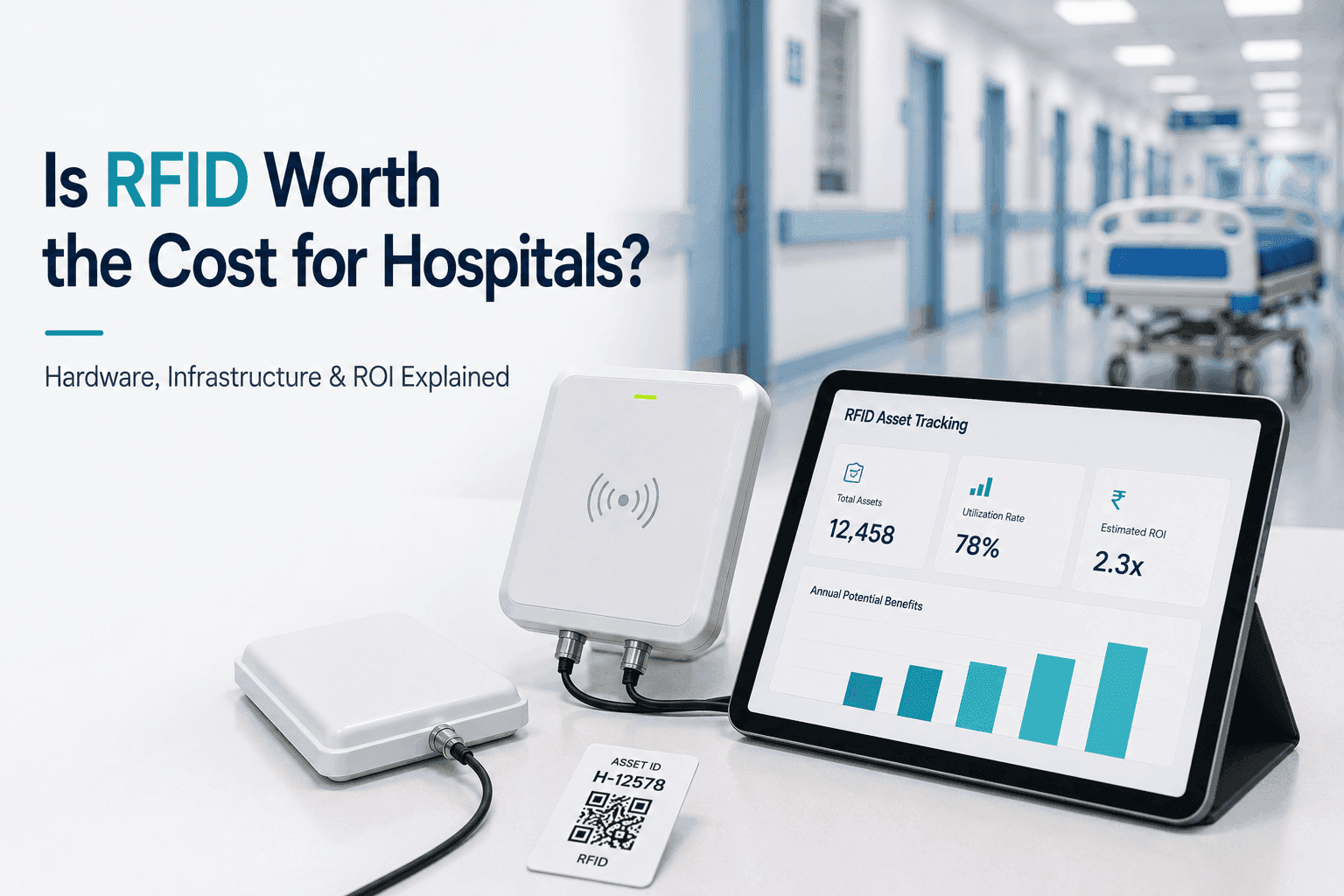
Quick answer: RFID is worth the cost for a hospital above roughly 2,000 tracked assets or a monthly audit cadence; below 1,000 assets with an annual audit, barcode is the right answer. Year-1 hybrid barcode + UHF RFID hardware runs ₹21-22 lakh ($26,000) for a 500-bed hospital with 3,000 assets and about ₹40-45 lakh ($48,000-54,000) for 1,000 beds and 5,000 assets. Over five years the programme is usually net cash positive, because the largest recovery is deferred procurement, not audit time. Payback at 2,000-plus assets is typically 18-24 months.
The honest answer to "is RFID worth it" depends on three numbers: how many assets you track, how often you audit, and whether you have a credible procurement-deferral story. This guide walks through the five-year total cost of ownership model hospital CFOs use, with sample numbers for a 1,000-bed hospital and the sensitivity at smaller sizes. It is written for CFOs, CIOs, and biomedical heads preparing a board case in India.
Reviewed by the Assetly product team at Nirmitee.io. Last updated August 2026.
What RFID Costs A Hospital
RFID cost has four hardware lines and one software line. Indicative 2026 ranges, from the OEMs and their Indian distributors:
| Line | Unit Price | 500 Beds, 3,000 Assets | 1,000 Beds, 5,000 Assets |
|---|---|---|---|
| RFID-capable printer-encoder | ₹1.2-3 lakh ($1,500-3,800) | 1-2 units, ₹1.8-2.5 lakh | 2 units, ₹3-4 lakh |
| UHF RFID tags and labels | ₹20-50 ($0.25-0.60) each; on-metal ₹60-150 | ≈ ₹1.5-2 lakh | ≈ ₹2.5-3.5 lakh |
| Fixed portal and ceiling readers with antennas | ₹1.5-3 lakh ($1,800-3,600) per installed portal | 4-6 portals, ₹8-10 lakh | 10-14 portals, ₹18-24 lakh |
| Handheld readers | ₹80,000-2 lakh ($1,000-2,500) | 2 units, ₹3-4 lakh | 4 units, ₹5-7 lakh |
| Cabling, PoE switch, middleware | Site-dependent | ₹2-3 lakh | ₹4-6 lakh |
| Year-1 hardware | ≈ ₹21-22 lakh ($26,000) | ≈ ₹40-45 lakh ($48,000-54,000) | |
| Software (annual) | Per-asset or per-user SaaS | ₹2-3 lakh | ₹4-6 lakh |
The line-item logic behind the 500-bed column is in the RFID vs barcode comparison; reader counts and prices are in the reader and antenna guide. Barcode-only for the same 500-bed hospital is about ₹6 lakh ($7,400), so RFID is a 3-4× hardware premium. The question is what it buys.
The Five-Year TCO Model: What To Include
A defensible RFID TCO model has five cost lines and two recovery lines:
- Printers and spares: primary RFID-capable printer plus a secondary, and replacement printheads over five years.
- Tags and labels: annual replenishment for asset growth and tag attrition, typically 8-12% a year.
- Readers and antennas: portals at zone exits, ceiling readers in high-value zones, handhelds for biomedical staff.
- Software: the asset platform, SaaS or perpetual plus maintenance, over five years.
- Audit staff time: manual audit hours at fully loaded staff cost. This is a cost for barcode and a much smaller cost for RFID.
- Recovery 1, deferred procurement: capex avoided because utilisation data shows equipment already exists. The largest line.
- Recovery 2, AMC right-sizing: maintenance contracts trimmed on equipment that runs a fraction of the hours the contract assumes.
Sample TCO: 1,000-Bed Hospital, 5,000 Assets, Five Years
| Line (5 Years) | Barcode Only | Hybrid Barcode + UHF RFID |
|---|---|---|
| Printers, tags, readers, cabling | ₹12 lakh | ₹52 lakh |
| Software | ₹22 lakh | ₹25 lakh |
| Audit staff time | ₹42 lakh | ₹8 lakh |
| Total cost | ₹76 lakh | ₹85 lakh |
| Deferred procurement | ₹8 lakh | −₹2.4 crore |
| AMC right-sizing | ₹0 | −₹30 lakh |
| Net five-year position | ₹68 lakh cost ($81,000) | −₹1.7 crore, i.e. net positive (−$200,000) |
The two largest deltas are audit staff time (RFID saves about ₹34 lakh / $40,800 over five years) and deferred procurement (about ₹2.4 crore / $288,000 from utilisation-driven redeployment). Barcode-only recovers a little deferred procurement because the register is at least accurate at audit time; RFID recovers a lot because it is accurate every day. Hospitals deploying Assetly typically see ₹35-80 lakh in year-1 savings across these lines.
Sensitivity: What Happens At Smaller Hospitals
The model breaks down for small hospitals because reader and antenna cost is largely fixed (₹8-14 lakh for a minimum viable portal set) while recoveries scale with asset count:
| Asset Count And Audit Cadence | RFID Payback | Verdict |
|---|---|---|
| 500 assets, annual audit | 60+ months | Skip RFID; barcode with an RFID-capable printer |
| 1,500 assets, semi-annual audit | 36-48 months | Borderline; plan RFID for year 2-3 |
| 2,500 assets, monthly audit | 18-24 months | Worth it |
| 5,000+ assets, weekly or daily audit | 9-15 months | Strongly worth it |
If your hospital is in the first two rows, the real-time location guide shows a cheaper route: BLE on the mobile fleet only, which captures most of the equipment-loss recovery without the portal infrastructure.
The CFO Board Pitch
Most CFOs need to justify RFID to a board that has not seen the operational detail. The defensible three-line pitch:
- "At our asset count and audit cadence, RFID pays back in 18-24 months on staff time alone."
- "Utilisation data unlocks an estimated [₹X crore / $Y] in deferred procurement over five years, separately quantifiable at the next capex review."
Bring the sensitivity table. Boards trust a model that says "not yet" for smaller sites more than one that says "always".
Worked Example: A 1,200-Bed Hospital's Payback
Shown as a worked scenario for a 1,200-bed quaternary hospital deploying hybrid barcode + UHF RFID across 6,800 biomedical assets. Year-1 hardware: about ₹45 lakh ($54,000). Year-1 recoveries: audit time ₹14 lakh ($17,000), AMC right-sizing ₹19 lakh ($23,000), deferred procurement ₹68 lakh ($82,000) at the next capex review. Net year-1 position: about ₹56 lakh ($67,000) positive, meaning the programme is cash positive inside the first year. The deferred-procurement line does the work, and it only appears once the utilisation data has six months of history behind it.
Key Takeaways
- RFID payback is asset-count and audit-cadence driven. Below 1,000 assets and annual audit, skip it.
- Above 2,000 assets and monthly audit, payback is typically 18-24 months.
- The largest recovery is deferred procurement, not staff time.
- Five-year TCO for hybrid programmes is usually net cash positive once procurement deferral is counted.
- The board pitch should isolate three lines: staff time, deferred procurement, audit risk.
Building The Board Case For Your Hospital?
Read the complete guide to hospital asset management, see the 16-week implementation plan for what the spend buys operationally, or talk to the Assetly team for an RFID TCO model run on your bed count, asset count, and audit cadence.