Part of our complete guide to Hospital Asset Management: The Complete Guide.
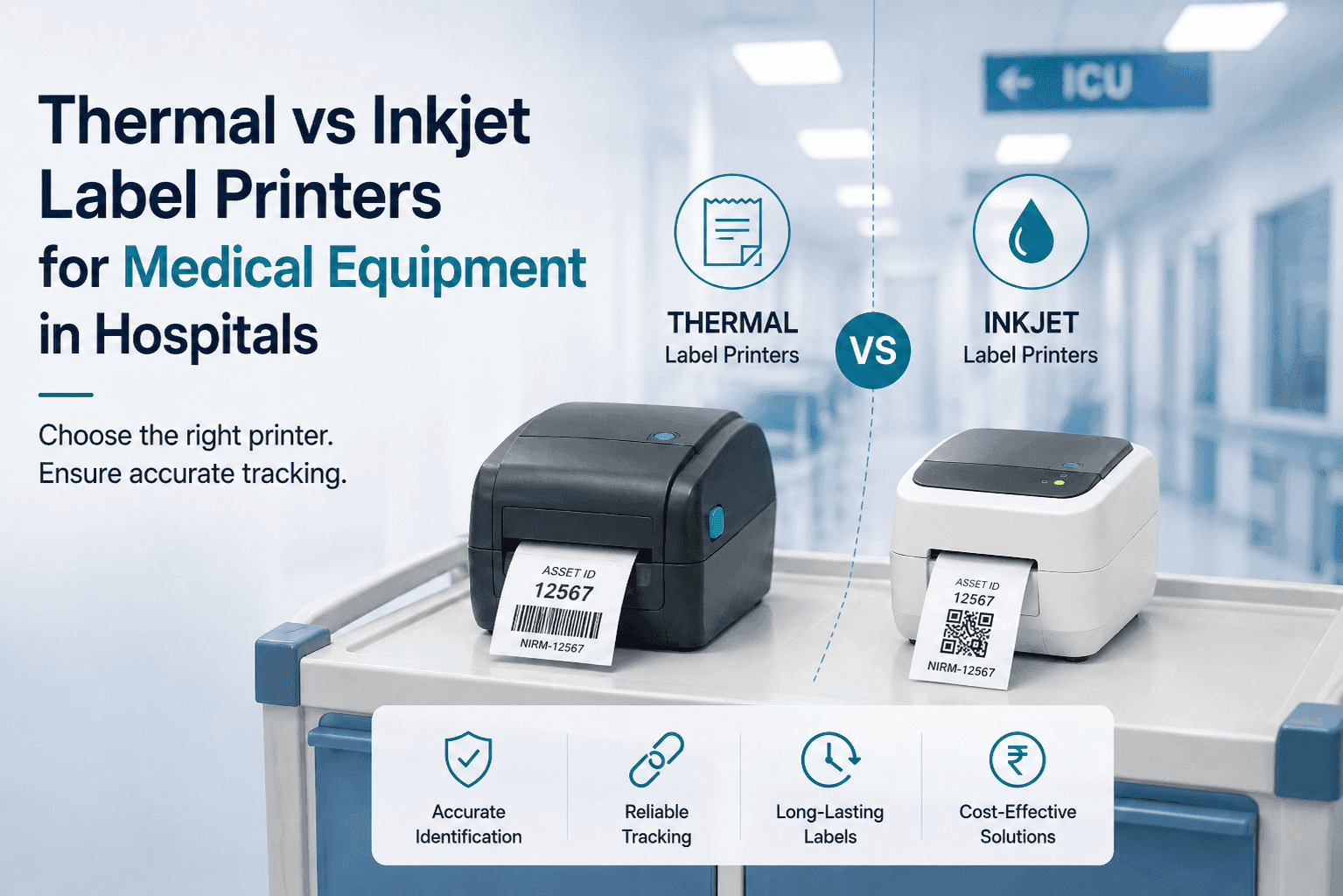
Quick answer: Use a thermal transfer label printer for medical equipment labels, never the office inkjet. Thermal transfer on polyester labels survives isopropyl alcohol, chlorhexidine, and hydrogen peroxide for 5-7 years; inkjet on coated paper fades under daily IPA cleaning within a year. Inkjet labels cost ₹2-5 each against ₹6-12 for thermal transfer, but once re-labelling is counted, thermal transfer is 60-70% cheaper over three years. A hospital-grade thermal transfer printer runs ₹40,000-1.2 lakh ($500-1,500); buy an RFID-capable model if RFID is anywhere in the plan.
Hospital procurement teams sometimes ask whether the office inkjet can print the asset labels. It is already in the building, the per-label cost looks lower, and a label is a label. In practice, no. The two technologies serve different purposes, and using inkjet on biomedical equipment is one of the costliest "savings" a hospital can make. This guide compares thermal transfer and inkjet on the five dimensions that matter for hospital asset labelling, and ends with what to buy.
Reviewed by the Assetly product team at Nirmitee.io. Last updated August 2026.
Thermal Transfer vs Inkjet At A Glance
| Dimension | Thermal Transfer On Polyester | Inkjet On Coated Paper |
|---|---|---|
| Label life in hospital conditions | 5-7+ years | 1-3 years dry; under a year with daily IPA cleaning |
| Isopropyl alcohol | Survives | Fades and smears |
| Chlorhexidine wipes | Survives | Runs |
| Hydrogen peroxide vapour (OT sterilisation) | Survives | Destroyed in one exposure |
| Autoclave | Survives with autoclave-grade stock | No |
| Print speed | 5-14 inches per second | 0.5-2 inches per second |
| Cost per label | ₹6-12 ($0.07-0.15) | ₹2-5 ($0.025-0.06) |
| 3-year cost, 1,500 assets | ≈ ₹16,500 | ≈ ₹58,000 |
| Barcode scan reliability after 12 months | High | Poor |
| RFID encoding option | Yes, on RFID-capable models | No |
How The Two Technologies Print
Thermal transfer melts wax, wax-resin, or resin ink from a ribbon onto the label under a heated printhead. With a polyester label and a resin ribbon, the image becomes part of the label surface. Direct thermal (no ribbon, heat-sensitive paper) is the cousin used for shipping labels; it darkens with heat and time, so it is wrong for equipment that lives near autoclaves and warm plant rooms.
Inkjet sprays water-based or pigment ink onto coated paper. It is excellent for colour and photographs, which asset labels do not need, and poor at the one thing they do need: staying legible under chemical cleaning.
Dimension 1: Label Durability
Thermal transfer prints durable wax-resin or resin ink onto polyester labels; the result survives 5-7+ years in hospital conditions. Inkjet prints onto coated paper; the label survives 1-3 years in dry, indoor conditions and degrades much faster under hospital chemical exposure.
Dimension 2: Chemical Resistance
This is the hospital-killer dimension. Inkjet prints fade, smear, or run under isopropyl alcohol, the most common hospital cleaning chemical. Chlorhexidine wipes are worse. Hydrogen peroxide vapour, used in OT sterilisation, destroys inkjet prints in a single exposure. Thermal transfer prints, properly paired with polyester labels and a resin ribbon, survive all three.
Dimension 3: Print Speed
Commissioning sprints mean printing hundreds or thousands of labels in a short window. Thermal transfer printers run at 5-14 inches per second; inkjet runs at 0.5-2. For 1,500 labels over a weekend, thermal transfer takes 3-5 hours; inkjet takes 1-2 days.
Dimension 4: Cost Per Label At Scale
Inkjet labels are cheaper at small volumes: ₹2-5 ($0.025-0.06) per label. Thermal transfer polyester labels are ₹6-12 ($0.07-0.15). The premium is real but small in absolute terms, and it reverses by year 3 once re-labelling is counted.
Dimension 5: Three-Year Total Cost Of Ownership
For a hospital labelling 1,500 biomedical assets, re-labelling once a year because of inkjet fade versus five-year retention with thermal transfer:
- Inkjet: ₹4,500 initial (1,500 labels) + ₹13,500 re-labelling (three cycles) + 80 staff-hours at ₹500 = about ₹58,000 over three years.
- Thermal transfer: ₹13,500 initial + ₹0 re-labelling + 6 staff-hours = about ₹16,500 over three years.
At year 3, thermal transfer is roughly 70% cheaper despite the higher per-label price. Add the cost of a scan that fails at audit time, or an untraceable ventilator, and the gap widens.
What To Buy: Hospital Label Printers
| Class | Example Models | Indicative Price | Use |
|---|---|---|---|
| Desktop thermal transfer | Zebra ZD421, TSC TE210, Honeywell PC43t | ₹35,000-70,000 ($400-800) | Departments and biomedical workshop, under 500 labels a day |
| Desktop thermal transfer with RFID | Zebra ZD621R | ₹1.2-2 lakh ($1,500-2,500) | Same, plus UHF tag encoding |
| Industrial thermal transfer with RFID | Zebra ZT411R, Honeywell PM45 | ₹1.8-3 lakh ($2,200-3,800) | Central commissioning, thousands of labels, RFID programmes |
| Portable label printer | Brady M611, Zebra ZQ511 | ₹40,000-90,000 ($500-1,100) | Ward-side re-labelling from a phone |
Prices are indicative 2026 ranges from the OEMs and their Indian distributors, excluding labels and ribbons. Buy an RFID-capable printer if RFID is anywhere in the plan, even if the first year is barcode-only; the top 10 barcode and RFID printers guide compares models, and the RFID vs barcode comparison explains when that second capability pays.
When Inkjet Is Actually The Right Choice
Inkjet has a defensible niche: low-volume admin signage that never sees chemical exposure. Visitor passes, meeting room labels, internal mail, notice boards. For any biomedical, OT, ICU, or chemical-exposed asset, inkjet is the wrong tool.
Worked Example: What "Saving" On Labels Costs
Shown as a worked scenario for a 280-bed hospital that uses the office inkjet for asset labels for 14 months. By month 14, 38% of labels are illegible after daily IPA cleaning. Re-labelling 1,400 assets costs ₹2.1 lakh ($2,500) in staff time alone, plus the disruption of an unaccounted-for ventilator that triggers an internal investigation. The hospital re-tenders for a Zebra ZD421 thermal transfer printer and Brady polyester labels; three-year cost is now about 60% lower than the inkjet path would have produced. The re-labelling is the visible cost. The audit failure is the one that gets noticed by NABH.
Key Takeaways
- Thermal transfer on polyester is the default for any medical equipment label. Inkjet is wrong for almost every hospital workflow.
- Inkjet fades or smears under IPA, chlorhexidine, and hydrogen peroxide, the three most common hospital chemicals.
- Thermal transfer is 5-10× faster, which matters during commissioning.
- Three-year cost of thermal transfer is 60-70% lower than inkjet despite the higher per-label price.
- Buy RFID-capable if RFID is anywhere in the plan.
Choosing Printers And Labels For Your Hospital?
Thermal transfer is one piece of a printer + label + software decision. Read the complete guide to hospital asset management, see the tag and label comparison, or talk to the Assetly team about printer and label specifications for your asset register. Assetly works with existing barcodes, RFID tags, or BLE beacons.