The label is what survives — or doesn't — for the next seven years
Hospitals invest heavily in barcode and RFID printers, then choose labels by lowest unit price. The result: 6 to 18 months in, between 8% and 20% of asset labels are unreadable. The biomedical team is back to manual entry, the asset register drifts from reality, and the next NABH or Joint Commission audit reveals a data integrity gap that wasn't there at go-live.
The label is the single most under-specified component in a hospital asset management program. This 2026 guide ranks the 10 label and sticker products that hold up under hospital conditions — autoclave cycles, isopropyl alcohol cleaning, chlorhexidine wipes, hydrogen peroxide vapour, and the steady abrasion of bedside use over a 5-7 year asset lifecycle.
How we evaluated
Every label is scored on five fixed criteria: material durability, adhesive performance on hospital surfaces (steel, ABS plastic, rubber, painted metal), chemical resistance against IPA / chlorhexidine/hydrogen peroxide, scan readability after 12 months of accelerated wear testing, and India / US distributor availability for procurement teams.

The ranked list
1. Brady M611 polyester labels — Best overall biomedical asset label
Brady M611 stock is the operational standard for permanent biomedical asset tagging in hospitals running multi-year asset programs. It is a high-grade polyester with an aggressive acrylic adhesive that survives repeated autoclave exposure and 5+ years of IPA cleaning. Available pre-printed, blank, or as RFID-encoded smart labels.
2. Zebra Z-Ultimate 3000T — Industrial polyester for harsh environments
Z-Ultimate 3000T is the matching label stock for Zebra's industrial printers (ZT411). Silver polyester with an aggressive permanent adhesive — it adheres to powder-coated metal, painted plastic, and even slightly oily surfaces. The favoured choice for OT instrument trays and high-cycle equipment.
3. CCL Healthcare custom labels — Best for tamper and traceability
CCL specialises in healthcare-specific labelling with FDA-registered adhesives and full traceability documentation. Worth the premium when the hospital's compliance posture demands chain-of-custody on every asset label.
4. Avery Dennison AF4J — Reliable mid-tier polyester
Avery's AF4J series is the workhorse polyester for hospitals that need durability without paying Brady or Zebra prices. Performance is 80-85% of the top-tier products at 60-65% of the cost.
5. Brady THT-15-458 — Tamper-evident labels for controlled assets
Tamper-evident labels are non-negotiable for pharmaceutical refrigerators, narcotics cabinets, and any controlled-access biomedical equipment. The Brady THT-15-458 destructs on removal attempt — leaving a visible mark that auditors look for during NABH and DEA inspections.
6. Lintec cryogenic labels — For lab and blood bank assets
Standard polyester labels fail in cryogenic storage. Lintec's cryogenic labels stay adhered at -196°C (liquid nitrogen) and survive freeze-thaw cycles. Required for blood bank, vaccine storage, and lab sample equipment.
7. Identco curved-surface labels — For instrument grips and small assets
Surgical instruments, small handheld devices, and curved equipment surfaces are notorious for label peel. Identco's curved-surface polyester uses a high-tack adhesive engineered for sub-25mm radii.
8. CIL India thermal labels — Best India-manufactured option
For hospitals managing budget constraints, CIL (Computer Impex Labels) produces hospital-grade polyester labels with adhesive performance that meets 80% of the imported Brady standard at roughly half the cost. Best for hospitals running mixed inventory — CIL for non-critical, Brady for biomedical.
9. Godex polyester label stock — Match for Godex printers
Godex's own-brand polyester is engineered to pair with Godex printers like the EZ-2250i. Cross-printer compatibility is mediocre. Choose this only if the hospital is running Godex printers as its primary commissioning machines.
10. Generic India-manufactured polypropylene — For admin assets only
Local distributors in Pune, Bangalore, and Chennai produce generic PP labels at the lowest price point. Adhesion and chemical resistance are not hospital-grade; reserve these for non-clinical assets — laptops, conference room equipment, projectors. Do not use on biomedical equipment.
Real-world: a 400-bed hospital that learned the hard way
A 400-bed tier-2 hospital in Hyderabad chose generic PP labels for its 2,800-asset commissioning in late 2024 — a 60% cost saving over Brady. By month 9, biomedical staff reported 14% of labels were unreadable. By month 18, the figure was 26%. Re-labelling consumed 280 staff-hours and triggered an internal audit finding. The hospital re-tendered to Brady M611 + Z-Ultimate for biomedical equipment, and CIL for admin assets — total premium versus the original generic procurement was 19%. Still, label survival in year 3 of the new contract sat at 99.4%.
Procurement guidance — what to put in your label RFQ
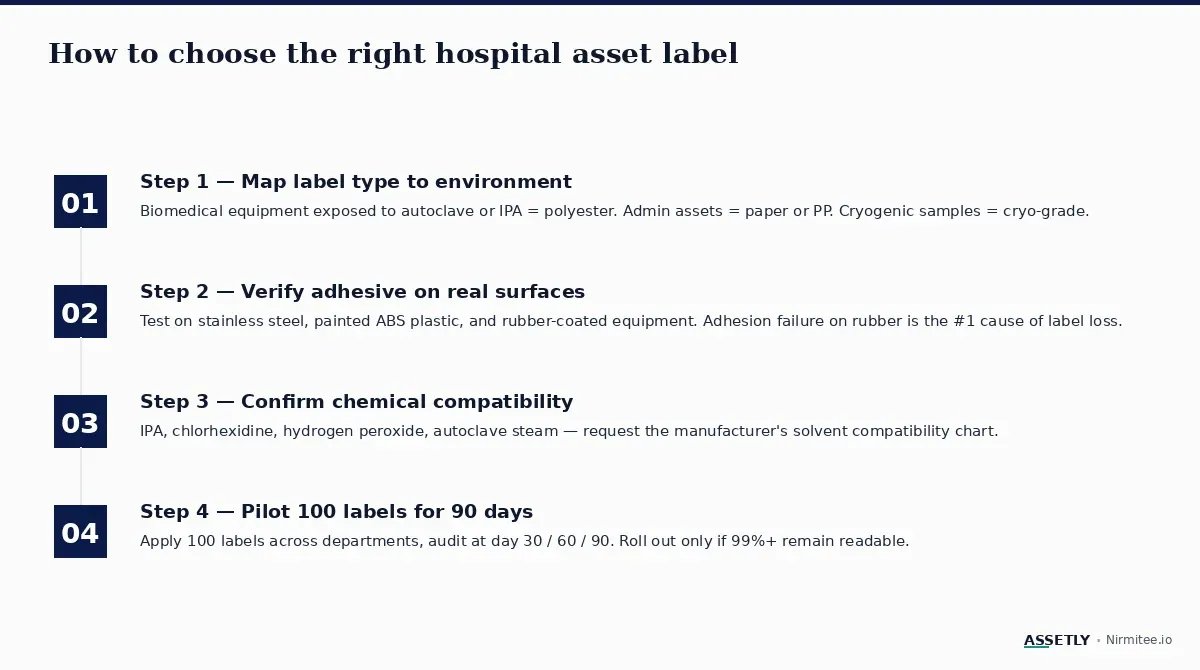
When tendering label suppliers, demand five guarantees in writing: material specification (polyester / polypropylene / paper), adhesive specification with chemical compatibility chart (must include IPA, chlorhexidine, hydrogen peroxide), accelerated-wear test results showing scan readability after 12 months, replacement policy if labels fail before 5 years, and stocking SLA — the supplier must hold inventory in India or your region for re-orders.
Key takeaways
- Polyester labels with acrylic permanent adhesive are the standard for biomedical equipment. Paper and PP labels are for short-life or admin use.
- Brady M611, Zebra Z-Ultimate 3000T, and CCL Healthcare are the top 3 for hospitals running multi-year asset programs.
- Tamper-evident labels (Brady THT-15-458) are non-negotiable for controlled-access assets.
- Cryogenic labels (Lintec) are required for blood bank, vaccine, and lab storage assets — standard polyester fails below -40°C.
- India-manufactured CIL labels are a defensible mid-tier choice. Generic PP labels are not — they fail at scale within 18 months.
Next steps
Choosing the right label is one piece of a larger decision: which printer prints them, which RFID tags integrate, and which software ties the whole stack together. Read our pillar guide on healthcare asset management, or talk to the Assetly team about specifying the right label stock for your hospital's commissioning sprint.