One label type does not fit every hospital asset
Hospitals running the same label across every asset class are either over-paying on admin equipment or under-specifying on biomedical. Most hospitals end up running 4-5 distinct label types in production — and the choice of which goes where is workflow-driven.
This guide walks through the 7 label types most hospitals deploy, what each is for, and which department uses which.
1. Standard paper barcode labels
Paper labels with thermal-transfer or direct-thermal print. Lowest cost, shortest life. Suitable only for indoor, dry, low-handling assets — admin equipment, central stores inventory, and any short-life label that won't be exposed to chemicals or autoclave.
Where it belongs: Admin assets (laptops, projectors), stores inventory tracking, internal mail / consumable labels.
2. Polyester / Polypropylene labels
The standard for biomedical equipment. Polyester face stock with a permanent acrylic adhesive survives autoclave cycles, isopropyl alcohol cleaning, chlorhexidine wipes, and 5-7 years of bedside wear. The most expensive of the durable label families, and the only one defensible for any biomedical asset above ₹50,000 unit value.
Where it belongs: Ventilators, monitors, infusion pumps, OT instrument trays, anesthesia machines — every biomedical asset with a 5+ year lifecycle.

3. Tamper-evident labels
Destructible polyethylene that fragments on removal attempt — leaving a visible "VOID" pattern or torn pieces. Required for any controlled-access asset where the audit trail demands proof that the label was not transferred between assets.
Where it belongs: Narcotics cabinets, controlled-substance pharmacy equipment, DEA-regulated assets in US hospitals, NABH MOM-relevant equipment in Indian hospitals.
4. RFID smart labels
A polypropylene or polyester label with an embedded UHF Class 1 Gen 2 or HF / NFC RFID chip. Printed and encoded in a single pass on RFID-capable thermal transfer printers. The standard for hospitals running asset programs above 2,000 items or with daily audit cadence.
Where it belongs: Central store inventory, OT instrument tray tracking, mobile assets that pass through portal readers (ICU equipment, infusion pumps, wheelchairs).
5. Cryogenic labels
Polyester face stock with a cryogenic-grade adhesive that stays adhered down to -196°C (liquid nitrogen) and survives repeated freeze-thaw cycles. Standard polyester labels fail below -40°C — they peel as the adhesive contracts.
Where it belongs: Blood bank refrigerators, vaccine storage units, lab sample cryostorage, IVF clinic egg storage — any asset operating at sub-zero temperatures.
6. Metallic / silver-faced labels
Aluminium-faced polyester labels designed for adhesion to bare metal surfaces. Standard polyester adhesives sometimes delaminate from steel and aluminium under heat cycling. Metallic labels include a primer layer that bonds to metal substrates.
Where it belongs: Stainless-steel surgical instruments, metal-bodied diagnostic equipment, machinery in central sterilization, autoclaves and sterilizers themselves.
7. Destructible single-use labels
Brittle polyethylene that tears into fragments when removed. Once applied, cannot be transferred. The label "marries" itself to the asset.
Where it belongs: Single-use lab consumables tagged for tracking, single-cycle sterilization indicators, single-application asset transfers.
Department-by-department mapping
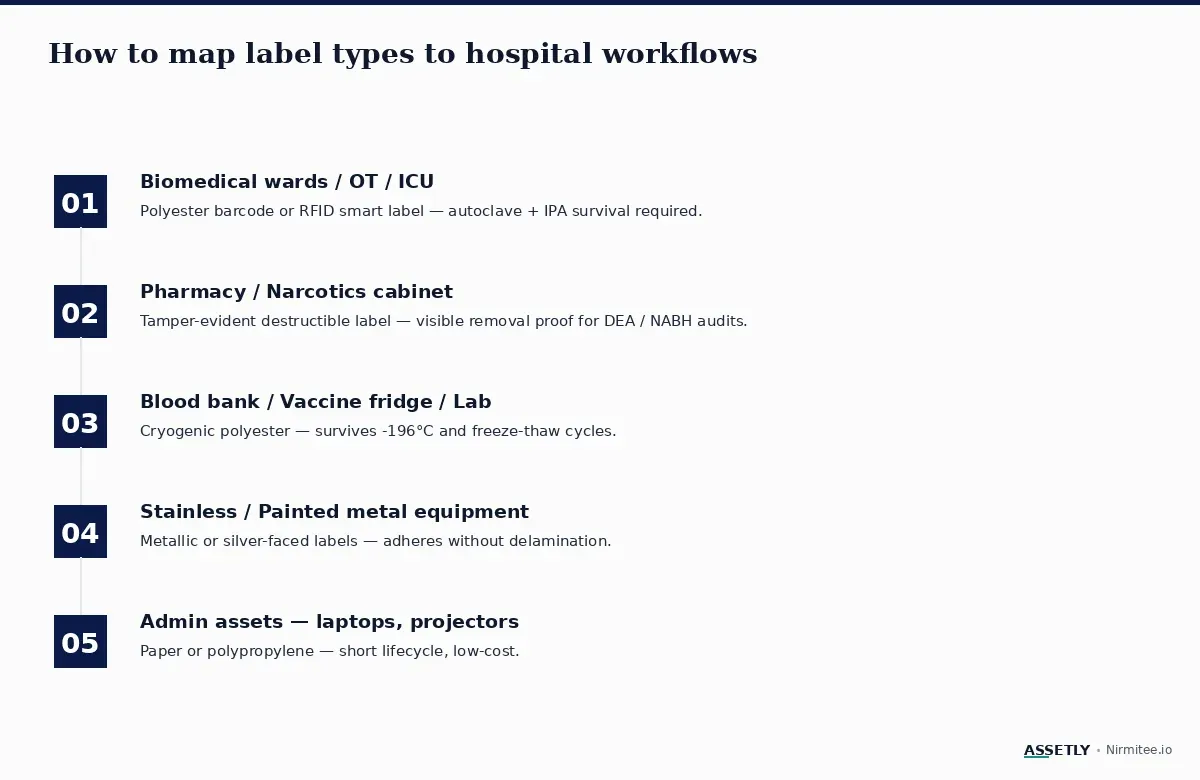
Real-world: a 500-bed hospital's label mix
A 500-bed multispecialty hospital in Mumbai runs five distinct label types in production: polyester (Brady M611) on 1,800 biomedical assets, RFID smart labels (Z-Ultimate RFID) on 600 OT instrument trays and 400 mobile pumps, tamper-evident on 80 controlled-access cabinets, cryogenic on 240 blood bank and lab freezers, and standard paper on 1,200 admin assets. The split looks complex but the per-label cost averages ₹14 ($0.17), well below the cost of single-type standardisation.
Key takeaways
- Most hospitals run 4-7 label types in production — single-type standardisation either over-spends on admin or under-specifies on biomedical.
- Polyester is the standard for biomedical equipment with 5+ year lifecycle.
- Tamper-evident is mandatory for controlled-access assets.
- Cryogenic labels are required below -40°C — standard polyester fails there.
- RFID smart labels combine print and encoding in one operation, ideal for asset programs above 2,000 items.
Choosing the right label mix?
The label specification is one of three coupled decisions — printer, label, software — that determine how the hospital's asset program scales. Read our pillar guide on healthcare asset management, or talk to the Assetly team about a label specification review for your hospital's mix.