
Why Automation Alone Is Not Enough in Healthcare Operations

Digital Growth Lead
Writes about healthcare technology, interoperability, and AI-driven transformation across modern care systems.
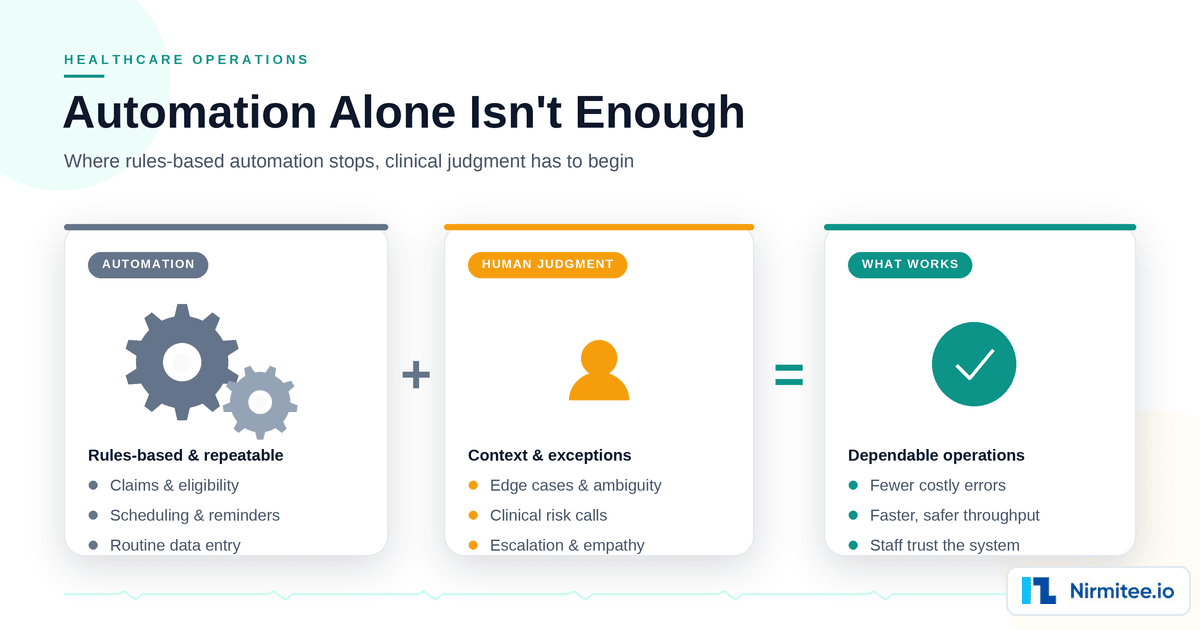
The CAQH 2024 Index estimates $20+ billion in annual savings available from fully automating administrative healthcare transactions — yet despite a decade of RPA investment, much of that potential remains unrealised. Operations teams are doing more administrative work, not less. Something doesn't add up.
The reason: traditional automation alone hits a structural ceiling that no amount of additional scripting can break. This blog explains the ceiling and what intelligent layering changes. For broader context, see our pillar on AI Agents in Healthcare.
For hands-on help with this, see our custom healthcare software development.
What "Pure Automation" Means Here
Pure automation is rule-based: RPA bots, scripted workflows, integration engines, deterministic ETL. Same input, same output. It's the dominant approach in healthcare ops today — and for the 60–70% of work that's structured and repetitive, it's the right tool.
The remaining 30–40% is where automation fails. That's the territory where workflows break despite years of automation investment.
The Three Limits of Pure Automation
Limit 1: Automation Can't Handle Variation
Every healthcare workflow has variation. Different payers, different EHRs, different physician styles, different patient presentations. Traditional automation treats variation as an exception, and exceptions route to humans. More variation, more human work — which defeats the purpose.
The RPA industry's own data: roughly half of healthcare RPA projects don't deliver expected ROI. The exception queue grows faster than the automation saves time.
Limit 2: Automation Can't Read Unstructured Data
Healthcare runs on unstructured input. Referral PDFs. Faxed prior auths. Clinical notes. Free-text claim notes. Inbox messages. Every one is a wall — either OCR + regex through it, accepting brittleness, or punt to a human.
The standard workaround ("we'll structure data at intake") works only for what you control. For everything from outside — referrals, external records, payer responses — you don't control the format. The wall is permanent until something reads unstructured input intelligently.
Limit 3: Automation Can't Make Judgment Calls
"Coverage is active but the policy expired yesterday — bill or escalate?" "The denial code is 'medical necessity' but the note clearly establishes it — appeal automatically or wait?" "The patient asked about a medication but the record shows an allergy — confirm or block?"
These aren't edge cases. They're the actual work. Pure automation either ignores them, hard-codes them brittly, or escalates them.
What Intelligence Adds
An intelligent layer — agents that reason — does three things automation can't:
- Absorbs variation — reasons about each payer's behaviour instead of branching for every quirk.
- Reads unstructured input — referrals, faxes, notes become first-class data sources.
- Makes contextualised judgment calls — within guardrails, the agent decides instead of escalating.
The point isn't to replace automation. The point is to add the layer above it.
The Layered Architecture That Works
Across production healthcare ops agents, the architecture is consistent. Three layers:
- Deterministic foundation — RPA, workflow engines, integration platforms. Handle 60–70% (structured, repetitive).
- Intelligent middle layer — agents reading unstructured input, reasoning over variation, making judgment calls within guardrails. Handle 25–35%.
- Human-in-the-loop top layer — for the 5–10% that genuinely needs judgment.
Each layer does what it's best at. Automation gives cost-efficiency. Agents give flexibility. Humans give accountability. Pull out any one, the stack collapses.
The Common Mistake: Picking a Side
The mistake most teams make is treating this as either/or. "Rip and replace with AI" — usually from a vendor with one product — promises the agent will handle everything. It won't. "We don't need AI, automation is fine" — usually from a team burned by a failed POC — leaves operational money on the table. Compare this to the strategic adoption framework for hospitals.
What This Looks Like in Practice: Denial Management
Pure automation gets you to:
- Auto-receive the denial
- Categorise by denial code
- Route to the right queue
- Then a human does everything else
Add the intelligent layer and you get to:
- Auto-receive and categorise (automation)
- Read the denial, pull clinical context, identify the gap (agent)
- Draft the appeal, format per payer rules, attach documentation (agent)
- Submit (automation)
- Escalate to human only when the agent is uncertain or the case is high-stakes
Cycle time drops from days to hours. The connection back to where AI agents deliver ROI is direct.
Real-World Example
Major US payers and providers — including Change Healthcare's published RCM analytics and Optum's stated AI investment direction — have publicly described moving from pure-RPA stacks toward "intelligent automation" or "agentic automation" precisely because the rule-based layer hit a ceiling. The same pattern shows up in KLAS RCM technology reports, which consistently identify variation and exception handling as the largest unsolved cost driver in administrative workflows.
Common Pitfalls When Layering Intelligence on Automation
Three traps cost teams the most when they try to add an intelligent layer to an existing automation stack:
- Treating intelligence as a single-vendor purchase. No agent platform fits every workflow. Teams that buy one platform and try to fit all their ops into it end up with awkward workarounds. The intelligent layer is usually a mix: one platform for some workflows, custom-built agents for others, off-the-shelf models for narrow tasks.
- Not redesigning the human-in-the-loop role. When the intelligent layer takes over reasoning work, the human role shifts from "do the work" to "review what the agent did." That's a different job, with different metrics and different training needs. Skipping this redesign produces resentment, errors, and turnover.
- Measuring at the wrong layer. Teams measure agent accuracy in isolation and miss that the overall workflow is slower because the agent's outputs aren't formatted right for the downstream RPA bot. Measure end-to-end cycle time, not per-component accuracy.
The Sequencing That Works
Most production deployments follow a four-step progression: keep existing automation untouched; identify the highest-leverage exception queue; pilot the intelligent layer there with humans reviewing every agent action; expand autonomy as accuracy proves out. Trying to skip ahead to "agents everywhere" is how programs lose executive trust before they deliver value.
Key Takeaways
- Pure automation hits three structural limits: variation, unstructured input, judgment calls.
- The production architecture is layered: automation (60–70%) + agents (25–35%) + humans (5–10%).
- Don't rip out existing automation. Add the intelligent layer at the exception queue.
- Denial management is the canonical example where the layered stack cuts cycle time from days to hours.
- The right question is "where does each layer belong?" not "AI or RPA?"
Call to Action
This blog is one piece of a larger picture. For the full overview, read the pillar guide: AI agents in healthcare.
Want to build or evaluate an AI agent for your healthcare product? Get in touch with Nirmitee — we ship FHIR-native, HIPAA-compliant AI agents for US healthtech teams and global hospitals.
Ready to scale?
Talk to our healthcare engineering team about building, integrating, and shipping faster.
Frequently Asked Questions
Isn't RPA already solving healthcare operations problems?
What three limits does pure automation hit in healthcare?
Should I replace my existing RPA with AI agents?
Where does layered automation + AI deliver the fastest ROI?


