1
The Landscape
The Five Standards You Will Actually Meet, and the One Gotcha in Each.
The Field Guide We Use Ourselves: the Questions to Answer First, Where Integrations Break and Who Must Own Each, the Honest Timeline Math, and Templates You Can Use Immediately.
PDF | 22 pages | sent to your email.
What's inside
A Standards-Level Field Guide that Applies to any EHR or Payer Integration over FHIR, HL7, X12 or DICOM.
The Five Standards You Will Actually Meet, and the One Gotcha in Each.
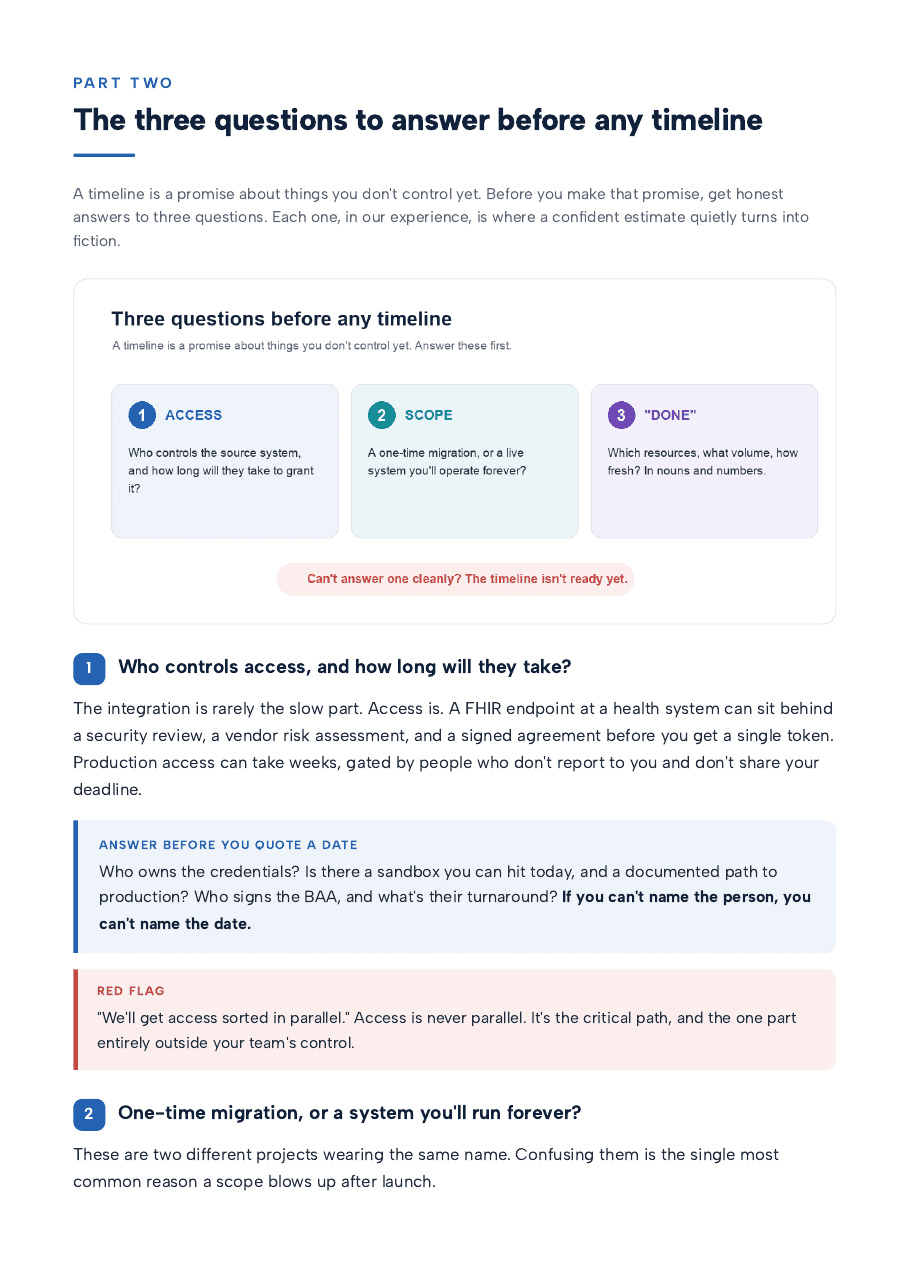
Access, One-Time Migration vs Live Connection, and What Done Means in Nouns and Numbers.
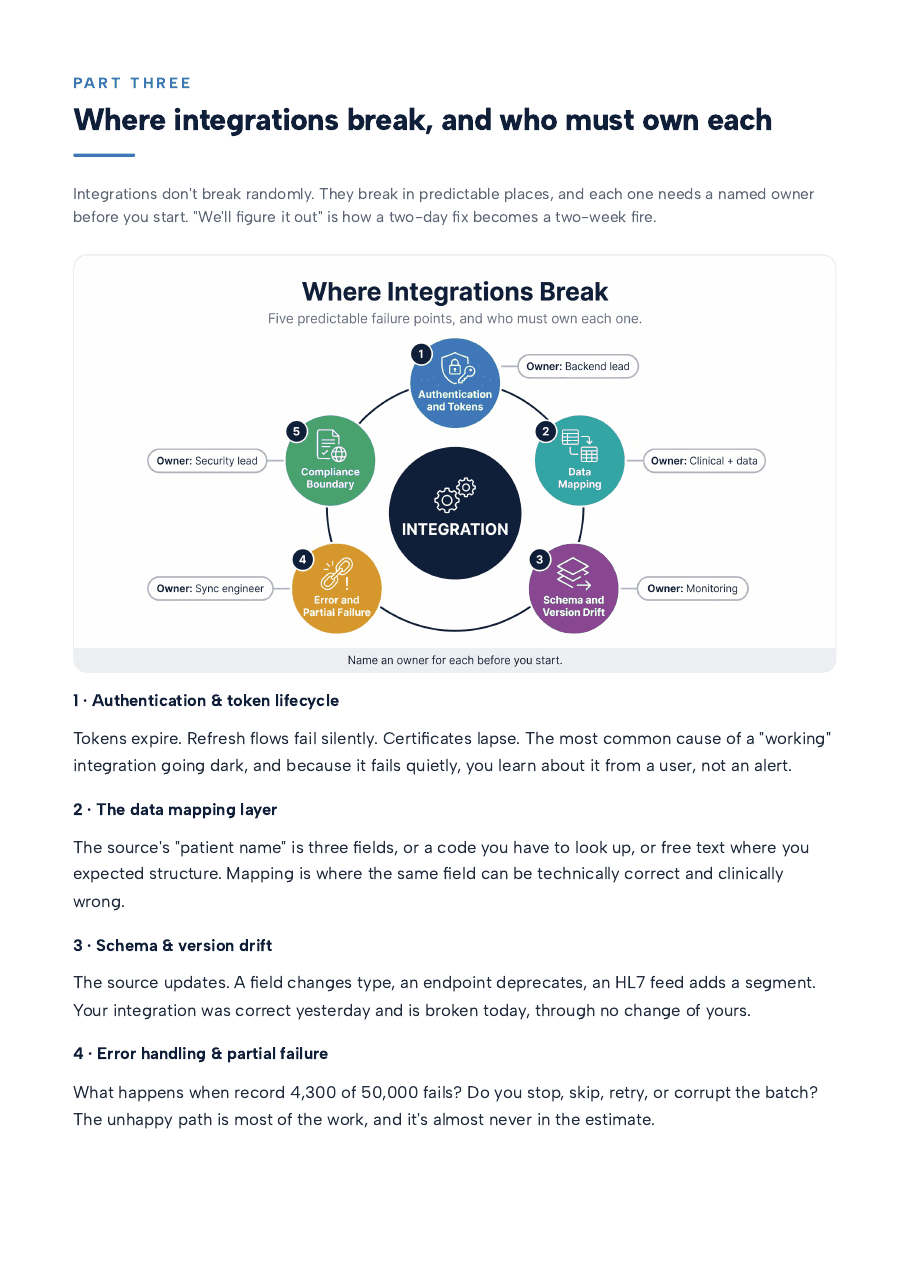
Five Predictable Failure Points across Auth, Mapping, Drift, Partial Failure, and Compliance.
Sandbox-vs-Production Reality and a Day-One Source-System Validation Checklist.
Why Estimates Miss: 20% Writing Code, 80% Access, Review, Mapping and Coordination.
The Operating Layer and Go-Live Checklist that Keep Month Four from Becoming an Emergency.
PHI, BAAs, Audit Logging and Minimum-Necessary Decisions You Cannot Skip.
A Discovery Questionnaire, an Access-Request Email, a Definition-of-Done Template, and Tools We Use.
Look inside
Clear diagrams, named owners, and fill-in-yourself checklists, not a wall of text.
Who it's for
If you have been asked how long this integration will take and you do not want to guess, this is for you.
Seed to Series B Health-Tech Teams Scoping Their First Real Integration.
Teams that need to name owners and risks before committing a board-level timeline.
Teams planning access, compliance and go-live, not just the build.
Anyone who Watched a Two-Week Integration Become Two Quarters.
FAQ
A 22-page ebook in eight parts: standards, scoping questions, failure points, source-system validation, timeline math, go-live operations, compliance boundaries, and ready-to-use templates.
Yes. It is a Free PDF Resource. Enter your Work Email and We Send it as an Attachment.
Yes. It applies to EHR and Payer Integrations over FHIR R4, HL7 v2, X12, DICOM or C-CDA, including Epic, Cerner and athenahealth.
Because Integration is Roughly 20% Writing Code and 80% Access, Credentialing, Security Review, Data Mapping and Coordination between Teams that do not Share Your Deadline.
Grab the Guide, or have our team pressure-test your timeline before you commit one.