AI for Medical Billing: 7 Automations That Cut Costs by 40%

Digital Growth Lead
Writes about healthcare technology, interoperability, and AI-driven transformation across modern care systems.
Part of our complete guide to RCM automation with agentic AI.
U.S. healthcare organizations spend over $250 billion annually on billing and insurance-related administrative functions, according to HFMA. Initial claim denial rates have climbed to 11.8% in 2024: up from 10.2% just a few years earlier, and 41% of providers now face denial rates exceeding 10%, per Experian Health's 2025 State of Claims Report. Meanwhile, fewer than 12% of denied Medicare claims are ever appealed, despite 57–82% of those appeals succeeding when actually filed.
The math is clear: manual medical billing is hemorrhaging revenue. But AI-powered automation is rewriting the equation. Organizations implementing end-to-end billing automation are seeing 25–40% cost reductions, clean claim rates jumping from 75–80% to 95–98%, and revenue cycle staff productivity increasing by 3–4x.
This is not a theoretical future. According to HFMA, 63% of healthcare organizations have already integrated AI-powered automation into their revenue cycle operations. The question is no longer whether to automate medical billing, it is which automations deliver the highest ROI fastest.
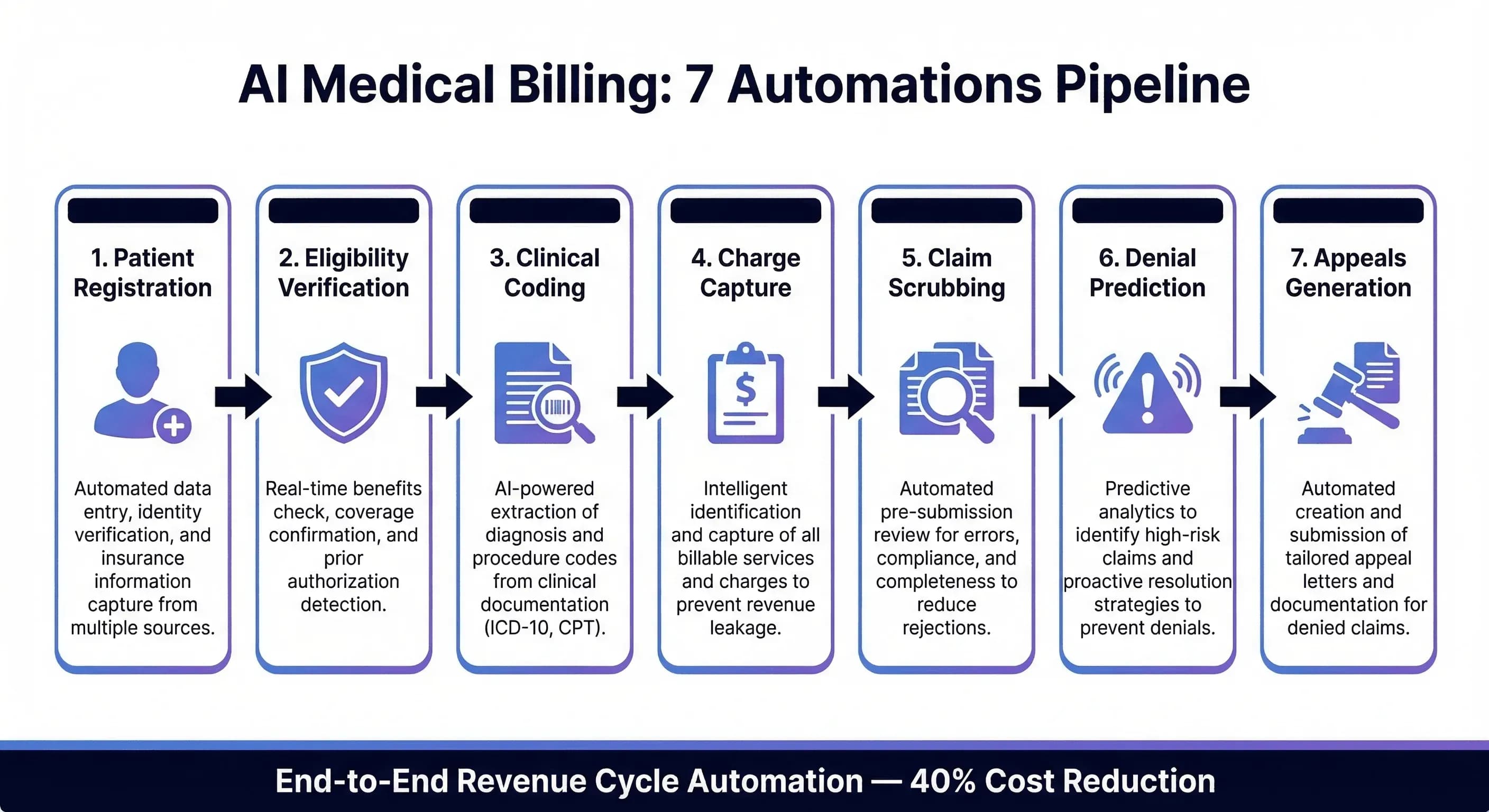
In this guide, we break down 7 specific AI automations that collectively cut billing costs by 40%, complete with system architecture, FHIR/EDI integration patterns, real ROI data, and implementable code patterns. This goes far beyond surface-level listicles, each automation includes the technical depth you need to evaluate, architect, and deploy.
Why Medical Billing Is Ripe for AI Automation
Before diving into the seven automations, it is essential to understand why medical billing has become the single highest-ROI target for healthcare AI investment:
- $166 billion in annual savings already achieved through existing electronic administrative practices, according to CollaborateMD, yet massive inefficiencies remain
- $29.84 per patient encounter saved by automating eight core administrative tasks (Aptarro)
- Manual claim status inquiries cost $12–$16 each, while electronic processing costs $1–$2
- Prior authorizations cost $10.97 manually vs. $5.79 electronically: a 47% reduction
- The AI in medical billing market is projected to reach $22.46 billion by 2032, growing at 25.4% CAGR (Precedence Research)
The revenue cycle is a sequence of interconnected, rules-based processes, exactly the kind of work where AI excels. Let us examine each automation in detail.
Automation 1: Patient Registration and Demographics Capture
The Problem
Patient registration errors are the root cause of 30–40% of all claim denials. A misspelled name, wrong date of birth, or incorrect insurance subscriber ID cascades through the entire billing pipeline. Manual data entry from insurance cards, driver licenses, and intake forms is slow, error-prone, and expensive, typically consuming 8–12 minutes per patient encounter at a cost of $4–6 per registration.
The Architecture
AI-powered patient registration combines Optical Character Recognition (OCR), Natural Language Processing (NLP), and real-time validation to automate demographics capture:
- Document Ingestion: Patient uploads insurance card photos and ID via patient portal, kiosk, or mobile app
- OCR + NLP Extraction: AI extracts: member ID, group number, payer name, subscriber name, date of birth, address, plan type, and copay/coinsurance details
- Data Normalization: Extracted fields are normalized against master patient index (MPI) rules: name standardization, address validation (USPS CASS), phone formatting
- Duplicate Detection: Probabilistic matching algorithms (Jaro-Winkler, Levenshtein distance) check for existing patient records to prevent duplicate chart creation
- FHIR Resource Creation: Validated data is structured as a FHIR Patient resource and persisted to the EHR
FHIR Integration Pattern
The FHIR R4 Patient resource maps directly to registration demographics. Here is the resource structure your automation pipeline should produce:
{
  "resourceType": "Patient",
  "identifier": [
    {
      "type": {
        "coding": [{
          "system": "http://terminology.hl7.org/CodeSystem/v2-0203",
          "code": "MB"
        }]
      },
      "system": "https://www.unitedhealth.com/member-id",
      "value": "UHC-892741563"
    }
  ],
  "name": [{
    "family": "Johnson",
    "given": ["Maria", "Elena"]
  }],
  "birthDate": "1985-07-14",
  "gender": "female",
  "address": [{
    "line": ["4521 Oak Valley Drive"],
    "city": "Austin",
    "state": "TX",
    "postalCode": "78745"
  }],
  "telecom": [
    {"system": "phone", "value": "512-555-0142"},
    {"system": "email", "value": "maria.johnson@email.com"}
  ]
}
ROI Data
| Metric | Before Automation | After Automation | Improvement |
|---|---|---|---|
| Registration time per patient | 8–12 minutes | 45–90 seconds | 85% reduction |
| Demographics error rate | 12–18% | 1.5–3% | 82% reduction |
| Cost per registration | $4–6 | $0.50–1.20 | 78% reduction |
| Downstream denial prevention | , | , | 30–40% of demographic denials eliminated |
Automation 2: Insurance Eligibility Verification (EDI 270/271)
The Problem
Eligibility-related denials account for 20–25% of all claim rejections. Staff manually verify coverage by calling payers or navigating multiple payer portals, a process that takes 15–25 minutes per verification and costs $6–12 per inquiry. With patients frequently switching plans (especially during open enrollment periods and job transitions), real-time eligibility data is critical.
The Architecture
Automated eligibility verification uses the HIPAA X12 EDI 270/271 transaction set: the industry standard for real-time eligibility inquiries:
- Trigger: Patient appointment is scheduled or patient checks in. The system automatically initiates an eligibility check
- FHIR-to-EDI Translation: The system converts the FHIR CoverageEligibilityRequest resource into an EDI 270 transaction
- Clearinghouse Routing: The 270 transaction is routed through a HIPAA-compliant clearinghouse (Availity, Change Healthcare, Waystar) to the appropriate payer
- Real-Time Response: The payer returns an EDI 271 response containing: active coverage status, plan details, copay/deductible amounts, remaining benefits, prior authorization requirements
- Response Parsing: The 271 is parsed and mapped back to a FHIR CoverageEligibilityResponse resource
- Alert Generation: If coverage is inactive, terminated, or has changed, the system alerts front desk staff before the encounter
EDI Integration Pattern
The EDI 270 inquiry structure follows the X12 5010 standard. Here is a simplified representation of the transaction flow:
// FHIR CoverageEligibilityRequest → EDI 270 Translation

// Step 1: Create FHIR CoverageEligibilityRequest
const eligibilityRequest = {
  resourceType: "CoverageEligibilityRequest",
  status: "active",
  purpose: ["benefits", "validation"],
  patient: { reference: "Patient/maria-johnson" },
  servicedDate: "2026-03-19",
  insurer: { reference: "Organization/united-healthcare" },
  insurance: [{
    coverage: { reference: "Coverage/uhc-892741563" }
  }],
  item: [{
    category: {
      coding: [{
        system: "https://x12.org/codes/service-type-codes",
        code: "30",
        display: "Health Benefit Plan Coverage"
      }]
    }
  }]
};

// Step 2: Middleware translates to EDI 270
// ISA*00* *00* *ZZ*SENDER ...
// GS*HS*SENDER*RECEIVER*20260319*1200*1*X*005010X279A1~
// ST*270*0001*005010X279A1~
// BHT*0022*13*REF001*20260319*1200~
// HL*1**20*1~
// NM1*PR*2*UNITED HEALTHCARE*****PI*87726~
// HL*2*1*21*1~
// NM1*IL*1*JOHNSON*MARIA****MI*UHC892741563~
// DMG*D8*19850714*F~
// DTP*291*D8*20260319~
// EQ*30~
// SE*11*0001~

// Step 3: Parse EDI 271 Response → FHIR
const eligibilityResponse = {
  resourceType: "CoverageEligibilityResponse",
  status: "active",
  purpose: ["benefits", "validation"],
  patient: { reference: "Patient/maria-johnson" },
  insurance: [{
    coverage: { reference: "Coverage/uhc-892741563" },
    inforce: true,
    item: [{
      category: { text: "Health Benefit Plan Coverage" },
      benefit: [
        {
          type: { text: "Deductible" },
          allowedMoney: { value: 2500, currency: "USD" },
          usedMoney: { value: 1200, currency: "USD" }
        },
        {
          type: { text: "Out of Pocket Maximum" },
          allowedMoney: { value: 6500, currency: "USD" },
          usedMoney: { value: 2100, currency: "USD" }
        }
      ]
    }]
  }]
};
ROI Data
| Metric | Before Automation | After Automation | Improvement |
|---|---|---|---|
| Verification time | 15–25 minutes | 3–8 seconds | 99% reduction |
| Cost per verification | $6–12 | $0.15–0.30 | 97% reduction |
| Eligibility-related denials | 20–25% of total | 2–4% of total | 85% reduction |
| Staff hours saved (per 1,000 patients/month) | 250–400 hours | 0 hours | 100% automated |
For a deeper dive into payer integration patterns including EDI 837/835 claims processing, see our comprehensive guide on US payer integration for eligibility, claims, and EDI.
Automation 3: AI-Assisted Clinical Coding (ICD-10/CPT from Notes via NLP)
The Problem
Medical coding, translating clinical encounters into ICD-10 diagnosis codes and CPT procedure codes, is the bottleneck of the revenue cycle. The U.S. faces a chronic shortage of certified coders (AAPC estimates a deficit of 30,000+ coders). Manual coding takes 15–45 minutes per chart depending on complexity, with error rates of 8–12% leading to claim denials, undercoding (leaving revenue on the table), and compliance audit risk.
According to Sully.ai's 2026 analysis, 48% of healthcare organizations now apply AI to documentation and coding, making it the leading AI use case in revenue cycle management.
The Architecture
AI-assisted coding uses a multi-stage NLP pipeline to extract billable information from clinical documentation:
- Clinical Note Ingestion: System receives the completed encounter note (from EHR structured data, dictated notes, or scribed documents)
- NLP Processing Pipeline
- Tokenization: Break narrative text into processable tokens
- Named Entity Recognition (NER): Identify medical entities: diagnoses, symptoms, procedures, medications, anatomical locations
- Relation Extraction: Determine relationships between entities (e.g., "bilateral" + "knee" + "osteoarthritis")
- Negation Detection: Critical: distinguish "patient denies chest pain" from "patient reports chest pain"
- Temporal Reasoning: Differentiate current conditions from historical mentions
- Code Mapping Engine: Map extracted clinical concepts to ICD-10-CM/PCS and CPT codes using trained models (BERT-based medical language models, fine-tuned on coding datasets)
- Confidence Scoring: Each suggested code receives a confidence score. High-confidence codes (>95%) can be auto-accepted; lower-confidence codes are routed to human review
- Validation Layer: Apply CCI (Correct Coding Initiative) edits, LCD/NCD (Local/National Coverage Determination) compliance checks, modifier logic, and medical necessity validation
- Human-in-the-Loop Review: Coders review AI suggestions, approve/modify, and provide feedback that improves the model over time
FHIR Integration Pattern
Coding output maps to FHIR Claim resource line items:
{
  "resourceType": "Claim",
  "status": "draft",
  "type": {
    "coding": [{
      "system": "http://terminology.hl7.org/CodeSystem/claim-type",
      "code": "professional"
    }]
  },
  "patient": { "reference": "Patient/maria-johnson" },
  "diagnosis": [
    {
      "sequence": 1,
      "diagnosisCodeableConcept": {
        "coding": [{
          "system": "http://hl7.org/fhir/sid/icd-10-cm",
          "code": "E11.65",
          "display": "Type 2 diabetes mellitus with hyperglycemia"
        }]
      },
      "type": [{
        "coding": [{
          "system": "http://terminology.hl7.org/CodeSystem/ex-diagnosistype",
          "code": "principal"
        }]
      }]
    },
    {
      "sequence": 2,
      "diagnosisCodeableConcept": {
        "coding": [{
          "system": "http://hl7.org/fhir/sid/icd-10-cm",
          "code": "I10",
          "display": "Essential (primary) hypertension"
        }]
      }
    }
  ],
  "item": [
    {
      "sequence": 1,
      "productOrService": {
        "coding": [{
          "system": "http://www.ama-assn.org/go/cpt",
          "code": "99214",
          "display": "Office visit, established patient, moderate complexity"
        }]
      },
      "quantity": { "value": 1 },
      "unitPrice": { "value": 175.00, "currency": "USD" },
      "diagnosisSequence": [1, 2]
    }
  ]
}
ROI Data
| Metric | Before Automation | After Automation | Improvement |
|---|---|---|---|
| Coding time per chart | 15–45 minutes | 3–8 minutes (review only) | 75% reduction |
| Coding error rate | 8–12% | 2–4% | 65% reduction |
| Coder throughput | 20–30 charts/day | 60–100 charts/day | 3x increase |
| Revenue capture improvement | , | , | 5–12% increase from reduced undercoding |
| Coding accuracy | 85–90% | 95%+ (with human review) | 10% improvement |
Automation 4: Charge Capture and CDM Validation
The Problem
Charge capture leakage: services rendered but never billed, costs the average hospital $1–3 million annually. Studies from the Advisory Board estimate that 1–5% of net patient revenue is lost to missed charges. This happens because charge capture relies on busy clinicians remembering to document every billable service, supply, and procedure, often hours or days after the encounter.
Additionally, the Charge Description Master (CDM), the hospital's master price list mapping services to CPT/HCPCS codes and prices, often contains errors: outdated codes, incorrect prices, unbundled charges, and missing revenue codes.
The Architecture
- Real-Time Clinical Event Monitoring: AI monitors EHR activity in real-time: orders placed, procedures performed, medications administered, supplies used, time-based services documented
- Charge Inference Engine: Compares clinical activity against the CDM to identify billable events that lack corresponding charges. For example, if a nurse documents administering IV fluids but no IV administration charge exists, the system flags it
- CDM Validation
- Code Currency Check: Verifies all CPT/HCPCS codes are current (not deleted or replaced) against annual AMA updates
- Price Benchmarking: Compares charge amounts against regional benchmarks and Medicare fee schedules to identify outliers
- Revenue Code Mapping: Ensures correct UB-04 revenue codes are associated with each charge
- Bundling Analysis: Identifies charges that should be bundled per CCI edits vs. separately billable with appropriate modifiers
- Charge Reconciliation: Before claim submission, the system reconciles all charges against the clinical record to ensure completeness and accuracy
FHIR Integration Pattern
The FHIR ChargeItem resource captures individual charges that feed into the billing pipeline:
{
  "resourceType": "ChargeItem",
  "status": "billable",
  "code": {
    "coding": [{
      "system": "http://www.ama-assn.org/go/cpt",
      "code": "96374",
      "display": "Therapeutic IV push, single substance"
    }]
  },
  "subject": { "reference": "Patient/maria-johnson" },
  "context": { "reference": "Encounter/enc-20260319" },
  "occurrenceDateTime": "2026-03-19T10:30:00Z",
  "performer": [{
    "actor": { "reference": "Practitioner/rn-sarah-chen" }
  }],
  "quantity": { "value": 1 },
  "priceOverride": {
    "value": 285.00,
    "currency": "USD"
  },
  "supportingInformation": [
    { "reference": "MedicationAdministration/iv-normal-saline-0319" }
  ]
}
ROI Data
| Metric | Before Automation | After Automation | Improvement |
|---|---|---|---|
| Charge capture rate | 85–92% | 97–99% | 8–14% improvement |
| Revenue leakage (annual, per hospital) | $1–3 million | $100K–300K | 75–90% reduction |
| CDM error rate | 5–8% of line items | <1% | 85% reduction |
| Charge lag (submission delay) | 3–7 days | Same-day | 70–85% faster |
Automation 5: Claim Scrubbing and Pre-Submission Validation
The Problem
Even with accurate coding and complete charges, claims still get denied due to payer-specific formatting rules, missing modifiers, invalid code combinations, and authorization gaps. The average hospital submits 200,000–500,000 claims annually, and each denial costs $25–118 to rework (according to the American Academy of Family Physicians). With denial rates at 11.8% and climbing, pre-submission scrubbing is not optional, it is essential.
The Architecture
AI-powered claim scrubbing applies a multi-layer validation rules engine before any claim reaches the clearinghouse:
- Layer 1, Structural Validation
- EDI 837 format compliance (Professional 837P or Institutional 837I)
- Required field completeness (NPI, tax ID, service dates, diagnosis pointers)
- Character limits and data type validation
- Layer 2, Clinical Validation
- CCI (Correct Coding Initiative) edit checks for code pair conflicts
- Medical necessity validation against LCD/NCD policies
- Age/gender appropriateness for diagnosis and procedure codes
- Modifier requirements (e.g., modifier 25 for significant E/M with procedure)
- Layer 3, Payer-Specific Rules
- Timely filing deadlines by payer (30 days for Medicare, 90–365 for commercial)
- Prior authorization verification, is the auth number on file and still valid?
- Payer-specific documentation requirements
- Contracted rate validation
- Layer 4, AI Pattern Detection
- Historical denial pattern matching, "claims with this CPT/ICD combination to BlueCross denied 73% of the time"
- Anomaly detection, unusual charge amounts, atypical service combinations
- Predictive scoring, probability of acceptance vs. denial for each claim
Integration Pattern
The scrubbing engine processes FHIR Claim resources and outputs validated EDI 837 transactions:
// Claim Scrubbing Pipeline (pseudocode)

async function scrubClaim(fhirClaim) {
  const results = {
    errors: [],    // Hard stops — claim cannot be submitted
    warnings: [],  // Soft flags — human review recommended
    score: 100     // Starting clean claim score
  };

  // Layer 1: Structural validation
  if (!fhirClaim.provider?.reference) {
    results.errors.push({
      code: "MISSING_PROVIDER_NPI",
      message: "Rendering provider NPI is required",
      field: "provider"
    });
    results.score -= 30;
  }

  // Layer 2: CCI edit check
  const cciConflicts = await checkCCIEdits(
    fhirClaim.item.map(i => i.productOrService.coding[0].code)
  );
  for (const conflict of cciConflicts) {
    results.warnings.push({
      code: "CCI_CONFLICT",
      message: `CPT ${conflict.code1} and ${conflict.code2} ` +
               `are mutually exclusive. Add modifier ${conflict.modifier} ` +
               `or remove one code.`,
      suggestion: conflict.resolution
    });
    results.score -= 15;
  }

  // Layer 3: Payer-specific rules
  const payerRules = await getPayerRules(fhirClaim.insurer);
  const authRequired = payerRules.requiresAuth(
    fhirClaim.item[0].productOrService.coding[0].code
  );
  if (authRequired && !fhirClaim.insurance[0].preAuthRef) {
    results.errors.push({
      code: "MISSING_PRIOR_AUTH",
      message: "Prior authorization required for this service",
      payerRule: payerRules.authPolicy
    });
    results.score -= 40;
  }

  // Layer 4: AI pattern matching
  const denialProbability = await predictDenialRisk(fhirClaim);
  if (denialProbability > 0.7) {
    results.warnings.push({
      code: "HIGH_DENIAL_RISK",
      message: `${(denialProbability * 100).toFixed(0)}% denial probability ` +
               `based on historical patterns`,
      historicalDenialReasons: denialProbability.topReasons
    });
  }

  return results;
}
ROI Data
| Metric | Before Automation | After Automation | Improvement |
|---|---|---|---|
| Clean claim rate (first pass) | 75–80% | 95–98% | 20–23% improvement |
| Rework cost per denied claim | $25–118 | N/A (prevented) | $25–118 saved per prevented denial |
| Claim processing time | Manual review: 5–10 min/claim | Automated: <2 seconds/claim | 99.7% faster |
| Annual savings (200K claims, 15% denial rate) | , | , | $750K–$3.5M in prevented rework |
Automation 6: Denial Prediction and Prevention
The Problem
Denial management is reactive by nature: organizations discover denials only after claims are rejected, then spend $25–118 per claim to investigate, correct, and resubmit. According to Experian Health's 2025 State of Claims report, the average hospital now faces $4.2 million annually in denied claims, with denial amounts increasing 12–14% year-over-year. This reactive approach is a losing battle.
The smarter approach is predictive denial prevention: using machine learning to identify claims that will likely be denied before submission and automatically correcting or routing them for review.
The Architecture
A denial prediction system uses supervised machine learning trained on historical claim-and-remittance data to score every claim before submission:
- Training Data Assembly: Collect 2–3 years of historical data: submitted claims (EDI 837), remittance advice (EDI 835), denial reason codes (CARC/RARC), payer contracts, clinical documentation
- Feature Engineering: Extract predictive features:
- Claim-level: CPT/ICD combination, total charge amount, number of line items, modifier usage
- Patient-level: Insurance type, coverage status, prior denial history, age/gender
- Provider-level: Historical denial rate for this provider, specialty, facility
- Payer-level: Payer-specific denial rates by code, known policy changes, contract terms
- Temporal: Day of week, month (fiscal year timing), timely filing proximity
- Model Training: Gradient Boosted Trees (XGBoost/LightGBM) consistently outperform deep learning for tabular claims data. The model outputs a denial probability score (0.0–1.0) with SHAP-based explainability showing which features drove the prediction
- Risk-Tiered Actions
- Low Risk (score <0.15): Auto-submit to clearinghouse (70% of claims)
- Medium Risk (score 0.15–0.50): Flag for billing specialist review with AI-suggested corrections (20% of claims)
- High Risk (score >0.50): Route to denial prevention team with specific correction recommendations and supporting documentation requirements (10% of claims)
Integration Pattern
# Denial Prediction Model — Feature Engineering & Scoring
import pandas as pd
import lightgbm as lgb
import shap

class DenialPredictor:
    def __init__(self, model_path: str):
        self.model = lgb.Booster(model_file=model_path)
        self.explainer = shap.TreeExplainer(self.model)

    def engineer_features(self, claim: dict) -> pd.DataFrame:
        """Extract prediction features from FHIR Claim resource."""
        features = {
            # Claim features
            "primary_cpt": claim["item"][0]["productOrService"]["coding"][0]["code"],
            "primary_icd": claim["diagnosis"][0]["diagnosisCodeableConcept"]["coding"][0]["code"],
            "total_charge": sum(item["unitPrice"]["value"] for item in claim["item"]),
            "num_line_items": len(claim["item"]),
            "num_diagnoses": len(claim["diagnosis"]),
            "has_modifier": any("modifier" in item for item in claim["item"]),

            # Payer features
            "payer_id": claim["insurer"]["reference"].split("/")[-1],
            "payer_denial_rate_30d": self.get_payer_denial_rate(claim, days=30),

            # Historical features
            "provider_denial_rate": self.get_provider_denial_rate(claim),
            "cpt_icd_combo_denial_rate": self.get_combo_denial_rate(claim),

            # Temporal features
            "days_to_filing_limit": self.calc_filing_deadline(claim),
            "submission_day_of_week": pd.Timestamp.now().dayofweek,
        }
        return pd.DataFrame([features])

    def predict(self, claim: dict) -> dict:
        """Score a claim for denial risk."""
        features = self.engineer_features(claim)
        denial_probability = self.model.predict(features)[0]

        # SHAP explanation
        shap_values = self.explainer.shap_values(features)
        top_factors = self.get_top_shap_factors(features, shap_values)

        return {
            "denial_probability": round(denial_probability, 3),
            "risk_tier": (
                "LOW" if denial_probability < 0.15
                else "MEDIUM" if denial_probability < 0.50
                else "HIGH"
            ),
            "top_risk_factors": top_factors,
            "recommended_actions": self.generate_actions(
                denial_probability, top_factors
            )
        }
ROI Data
| Metric | Before (Reactive) | After (Predictive) | Improvement |
|---|---|---|---|
| Denial rate | 10–15% | 3–5% | 65–70% reduction |
| First-pass acceptance rate | 75–85% | 95–97% | 15–20% improvement |
| Denial rework cost (annual) | $2–4 million | $500K–800K | 70–80% reduction |
| Days in A/R | 45–60 days | 28–35 days | 35–42% reduction |
| Revenue recovered (annual, per 100-bed hospital) | , | , | $1.5–2.5 million |
For an in-depth analysis of the $262 billion denial crisis and AI-powered denial management architectures, read our detailed guide on the $262 billion denial crisis.
Automation 7: Automated Appeals Generation
The Problem
When claims are denied, the appeals process is where organizations recover lost revenue, but it is brutally labor-intensive. Writing an effective appeal letter requires a billing specialist to: review the denial reason code, pull relevant clinical documentation from the EHR, cross-reference payer policies and coverage criteria, assemble a persuasive clinical justification with citations, and format the appeal per payer-specific submission requirements.
This process takes 30–60 minutes per appeal. And most organizations simply do not have the staff to appeal at scale: which is why fewer than 12% of denied claims are ever appealed, despite the fact that 57–82% of appeals succeed when filed (Health Affairs, January 2026). That gap represents billions in recoverable revenue left on the table.
The Architecture
AI-powered appeals generation combines NLP evidence extraction, template intelligence, and clinical reasoning to produce submission-ready appeal letters in minutes:
- Denial Intake and Classification
- Parse the ERA/EOB (EDI 835) to extract denial reason codes (CARC: Claim Adjustment Reason Codes, RARC: Remittance Advice Remark Codes)
- Classify denial type: medical necessity (CO-50), duplicate claim (CO-18), authorization (CO-4), coding error (CO-4/CO-16), timely filing (CO-29)
- Route to appropriate appeal template and evidence requirements
- Clinical Evidence Mining
- NLP scans the patient's EHR record to extract relevant clinical evidence: progress notes documenting medical necessity, lab results supporting diagnosis, imaging reports, prior authorization documentation, medication history
- Evidence is ranked by relevance to the specific denial reason
- Key clinical phrases are highlighted and cited with source document references
- Appeal Letter Assembly
- Select payer-specific appeal template (format, required sections, submission method)
- Populate with: patient demographics, claim reference numbers, denial details, clinical justification with embedded evidence citations, references to relevant clinical guidelines (InterQual, MCG, Milliman), applicable regulatory citations (ERISA, state prompt-pay laws, Medicare/Medicaid regulations)
- Apply persuasive writing patterns proven to increase overturn rates
- Quality Review and Submission
- Automated quality checks: completeness, citation accuracy, payer-specific formatting
- Route for human review on high-value or complex appeals
- Multi-channel submission: electronic payer portal, fax, mail (per payer requirements)
- Track appeal status and outcomes to improve future generations
Integration Pattern
# Automated Appeals Generation Pipeline
from dataclasses import dataclass
from typing import List

@dataclass
class DenialRecord:
    claim_id: str
    patient_id: str
    carc_code: str      # e.g., "CO-50" (medical necessity)
    rarc_code: str      # e.g., "N386" (missing documentation)
    denied_amount: float
    payer_id: str
    service_date: str
    cpt_codes: List[str]
    icd_codes: List[str]

@dataclass
class ClinicalEvidence:
    source_document: str   # e.g., "Progress Note 2026-03-15"
    relevant_text: str
    relevance_score: float
    citation_key: str

class AppealGenerator:
    def __init__(self, ehr_client, payer_rules_db, llm_client):
        self.ehr = ehr_client
        self.payer_rules = payer_rules_db
        self.llm = llm_client

    async def generate_appeal(self, denial: DenialRecord) -> dict:
        # Step 1: Classify denial and get appeal requirements
        appeal_type = self.classify_denial(denial.carc_code)
        payer_config = self.payer_rules.get_appeal_config(
            denial.payer_id, appeal_type
        )

        # Step 2: Mine clinical evidence from EHR
        evidence = await self.mine_clinical_evidence(
            patient_id=denial.patient_id,
            service_date=denial.service_date,
            denial_reason=appeal_type,
            icd_codes=denial.icd_codes
        )

        # Step 3: Retrieve applicable clinical guidelines
        guidelines = self.get_clinical_guidelines(
            cpt_codes=denial.cpt_codes,
            icd_codes=denial.icd_codes,
            payer_id=denial.payer_id
        )

        # Step 4: Generate appeal letter
        appeal_letter = await self.llm.generate(
            template=payer_config.appeal_template,
            context={
                "denial": denial,
                "clinical_evidence": evidence,
                "guidelines": guidelines,
                "regulatory_citations": self.get_regulatory_citations(
                    denial.payer_id, appeal_type
                ),
            },
            instructions="Generate a persuasive clinical appeal. "
                        "Cite specific clinical evidence with document "
                        "references. Reference applicable clinical "
                        "guidelines. Include regulatory basis for appeal."
        )

        # Step 5: Quality validation
        validation = self.validate_appeal(
            appeal_letter, payer_config, evidence
        )

        return {
            "appeal_letter": appeal_letter,
            "evidence_attachments": [
                e.source_document for e in evidence
            ],
            "submission_method": payer_config.submission_method,
            "deadline": payer_config.calc_appeal_deadline(
                denial.service_date
            ),
            "validation": validation,
            "estimated_recovery": denial.denied_amount,
            "success_probability": self.estimate_success_rate(
                denial, evidence, guidelines
            )
        }
ROI Data
| Metric | Before Automation | After Automation | Improvement |
|---|---|---|---|
| Time per appeal | 30–60 minutes | 3–5 minutes (with review) | 90% reduction |
| Appeals filed (% of denials) | 10–12% | 85–95% | 8x increase in appeal volume |
| Appeal success rate | 30–40% (rushed, incomplete) | 70–80% (evidence-rich, well-cited) | 2x improvement |
| Revenue recovered per 100 denials | $4,500 (12 appeals x 35% success x $1,071 avg) | $76,000 (90 appeals x 75% success x $1,126 avg) | 17x increase |
| Staff capacity | 15–20 appeals/day | 200+ appeals/day | 10–15x throughput |
For the full revenue cycle AI transformation playbook, including how agentic AI enables touchless processing, see our guide on the race to a touchless revenue cycle.
The Combined Impact: How 7 Automations Deliver 40% Cost Reduction
Each automation delivers individual ROI, but the compounding effect of deploying all seven creates transformative cost reduction. Here is how the savings stack up for a typical 200-bed hospital processing 250,000 claims annually:
| Automation | Annual Cost Savings | Revenue Recovery | Implementation Complexity |
|---|---|---|---|
| 1. Patient Registration | $180K–$320K | $120K (prevented denials) | Low |
| 2. Eligibility Verification | $420K–$680K | $350K (prevented denials) | Low–Medium |
| 3. AI-Assisted Coding | $550K–$900K | $400K–$750K (reduced undercoding) | Medium–High |
| 4. Charge Capture | $200K–$350K | $800K–$2M (captured revenue) | Medium |
| 5. Claim Scrubbing | $750K–$1.2M | $500K (prevented rework) | Medium |
| 6. Denial Prediction | $1.2M–$2M | $1.5M–$2.5M (recovered revenue) | High |
| 7. Appeals Generation | $300K–$500K | $2M–$4M (recovered revenue) | Medium–High |
| Total | $3.6M–$5.95M | $5.67M–$10.2M | , |
For a hospital with $100M in net patient revenue and $12M in billing operations costs, a $3.6–5.95M annual savings represents a 30–50% cost reduction: consistently hitting the 40% target with proper implementation.
Implementation Roadmap: Where to Start
Not all automations need to be deployed simultaneously. Here is the recommended prioritization based on ROI velocity, implementation complexity, and prerequisite dependencies:
Phase 1 (Months 1–3): Foundation
- Eligibility Verification (Automation 2): Fastest ROI, lowest risk, requires only clearinghouse integration
- Claim Scrubbing (Automation 5): Immediate denial reduction, rules-based (no ML training required)
Phase 2 (Months 3–6): Core Revenue Protection
- Patient Registration (Automation 1): Reduces upstream errors feeding into all downstream processes
- Charge Capture (Automation 4): Captures previously missed revenue
Phase 3 (Months 6–12): AI-Powered Intelligence
- AI-Assisted Coding (Automation 3): Requires NLP model training/fine-tuning, integration with clinical documentation
- Denial Prediction (Automation 6): Requires 2–3 years of historical claims data for ML model training
- Appeals Generation (Automation 7): Most complex but highest per-unit ROI
Ready to scale?
Talk to our healthcare engineering team about building, integrating, and shipping faster.
Frequently Asked Questions
What is the typical ROI timeline for AI medical billing automation?
Do these automations work with any EHR system?
How does AI-assisted coding handle specialty-specific coding requirements?
What compliance considerations exist for AI in medical billing?
Can AI medical billing automation integrate with existing clearinghouse relationships?
How does Nirmitee.io approach healthcare software development?