You've decided to build AI agents for healthcare. The next question is: which framework? LangChain, CrewAI, and AutoGen are the three leading open-source options, each with different strengths. This guide is the hands-on builder's comparison — real code, real healthcare use cases, and a practical decision framework.
For a deeper dive into orchestration patterns, including Temporal and custom approaches, see our agent orchestration comparison.
LangChain: The Swiss Army Knife
LangChain has the largest ecosystem — 600+ integrations, the most tutorials, and the broadest tool support. It's ideal for single-agent RAG pipelines and tool-calling workflows.
Healthcare Example: Patient Record Retrieval Agent
from langchain.agents import AgentExecutor, create_tool_calling_agent
from langchain_openai import ChatOpenAI
from langchain.tools import tool
import requests

@tool
def get_patient_summary(patient_id: str) -> str:
    """Fetch patient demographics and active conditions from FHIR server."""
    fhir = FHIRClient(base_url="https://ehr.example.com/fhir", token=get_token())
    patient = fhir.read("Patient", patient_id)
    conditions = fhir.search("Condition", {"patient": patient_id, "clinical-status": "active"})
    return format_patient_summary(patient, conditions)

@tool
def get_recent_labs(patient_id: str, days: int = 30) -> str:
    """Fetch recent laboratory results for a patient."""
    fhir = FHIRClient(base_url="https://ehr.example.com/fhir", token=get_token())
    labs = fhir.search("Observation", {
        "patient": patient_id, "category": "laboratory",
        "date": f"ge{get_date_days_ago(days)}", "_sort": "-date"
    })
    return format_lab_results(labs)

llm = ChatOpenAI(model="gpt-4o", temperature=0)  # Or Azure OpenAI with BAA
tools = [get_patient_summary, get_recent_labs]
agent = create_tool_calling_agent(llm, tools, prompt_template)
executor = AgentExecutor(agent=agent, tools=tools, verbose=True)
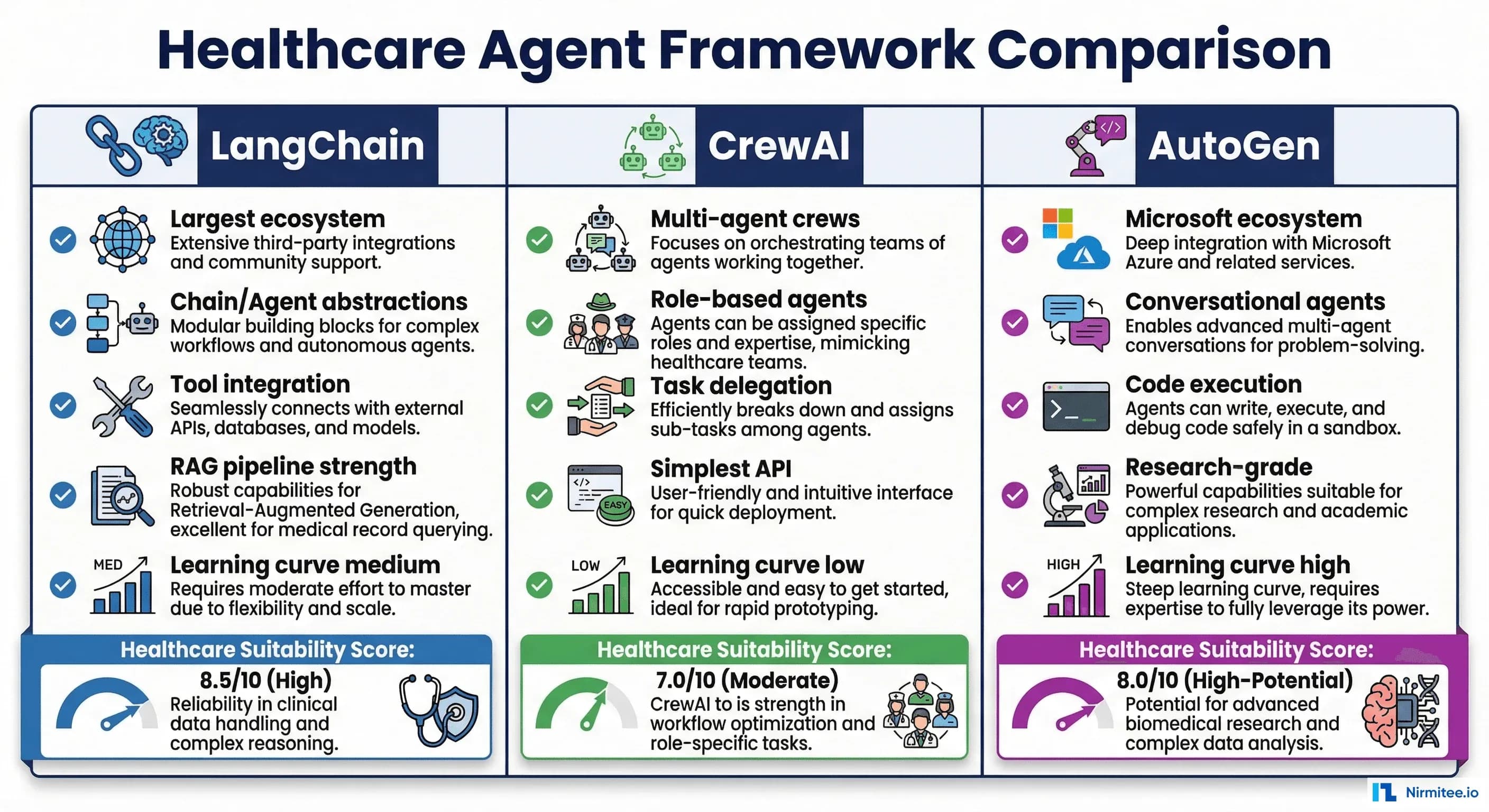
Strengths for healthcare: Largest tool ecosystem, excellent FHIR client integration, strong RAG pipeline support (critical for clinical knowledge retrieval), extensive documentation. Weaknesses: Complex abstraction layers, rapid API changes between versions, not designed for multi-agent workflows.
CrewAI: Multi-Agent Made Simple
CrewAI shines when your healthcare workflow requires multiple specialized agents collaborating on a task — which is most real-world clinical workflows.
Healthcare Example: Prior Authorization Workflow
from crewai import Agent, Task, Crew, Process

# Specialized agents for prior auth
eligibility_agent = Agent(
    role="Insurance Eligibility Specialist",
    goal="Verify patient insurance coverage and check if prior auth is required",
    backstory="Expert in insurance verification using FHIR Coverage and 270/271 EDI transactions",
    tools=[check_eligibility, get_coverage_details],
    llm=azure_openai  # BAA-covered endpoint
)

clinical_agent = Agent(
    role="Clinical Documentation Specialist",
    goal="Compile clinical evidence supporting medical necessity",
    backstory="Expert at extracting relevant clinical data from FHIR resources to build prior auth justifications",
    tools=[get_patient_conditions, get_recent_procedures, get_lab_results],
    llm=azure_openai
)

submission_agent = Agent(
    role="Prior Auth Submission Specialist",
    goal="Format and submit the prior authorization request via FHIR PAS",
    backstory="Expert in Da Vinci Prior Authorization Support (PAS) IG and X12 278 transactions",
    tools=[submit_prior_auth, check_auth_status],
    llm=azure_openai
)

# Sequential workflow
crew = Crew(
    agents=[eligibility_agent, clinical_agent, submission_agent],
    tasks=[verify_eligibility_task, compile_evidence_task, submit_auth_task],
    process=Process.sequential,
    verbose=True
)

result = crew.kickoff(inputs={"patient_id": "12345", "procedure_code": "27447"})
Strengths: Intuitive role-based design maps perfectly to healthcare teams, the simplest API of the three, excellent for multi-step workflows like prior auth, care coordination, and discharge planning. Weaknesses: Smaller ecosystem, fewer built-in tools, less flexible for single-agent use cases.
AutoGen: Research-Grade Multi-Agent
Microsoft's AutoGen excels at conversational multi-agent scenarios with human-in-the-loop feedback and code execution — making it ideal for clinical research and data analysis.
Healthcare Example: Clinical Research Assistant
from autogen import AssistantAgent, UserProxyAgent, GroupChat, GroupChatManager

# Clinical research analyst
analyst = AssistantAgent(
    name="ClinicalAnalyst",
    system_message="""You are a clinical data analyst. When asked about patient cohorts,
    write Python code to query the FHIR data lake and perform statistical analysis.
    Always validate sample sizes and check for demographic bias in results.""",
    llm_config={"model": "gpt-4o", "api_type": "azure"}
)

# Biostatistician for methodology review
statistician = AssistantAgent(
    name="Biostatistician",
    system_message="""You review statistical methodology for clinical research.
    Check for: appropriate test selection, multiple comparison corrections,
    confounding variables, and minimum sample size requirements.""",
    llm_config={"model": "gpt-4o", "api_type": "azure"}
)

# Human proxy for oversight
human = UserProxyAgent(
    name="ClinicalResearcher",
    human_input_mode="TERMINATE",  # Human reviews final output
    code_execution_config={"work_dir": "research_output"}
)

group_chat = GroupChat(agents=[analyst, statistician, human], messages=[], max_round=12)
manager = GroupChatManager(groupchat=group_chat)
Strengths: Built-in code execution sandbox, natural conversation flow between agents, excellent for research workflows with human oversight, strong Microsoft/Azure integration. Weaknesses: Steeper learning curve, less suited for production clinical workflows, research-oriented rather than operations-oriented.
Head-to-Head Comparison
| Criterion | LangChain | CrewAI | AutoGen |
|---|---|---|---|
| Learning curve | Medium | Low | High |
| Multi-agent support | Limited (LangGraph needed) | Excellent (core feature) | Excellent |
| Tool ecosystem | 600+ integrations | Growing (50+) | Moderate |
| RAG pipeline | Best-in-class | Basic | Via code execution |
| HIPAA readiness | Depends on deployment | Depends on deployment | Azure BAA available |
| Production maturity | High | Medium | Medium |
| Best for healthcare | RAG, single-agent tools | Clinical workflows | Research, analytics |
Our Recommendation
- Building a clinical knowledge retrieval system? → LangChain
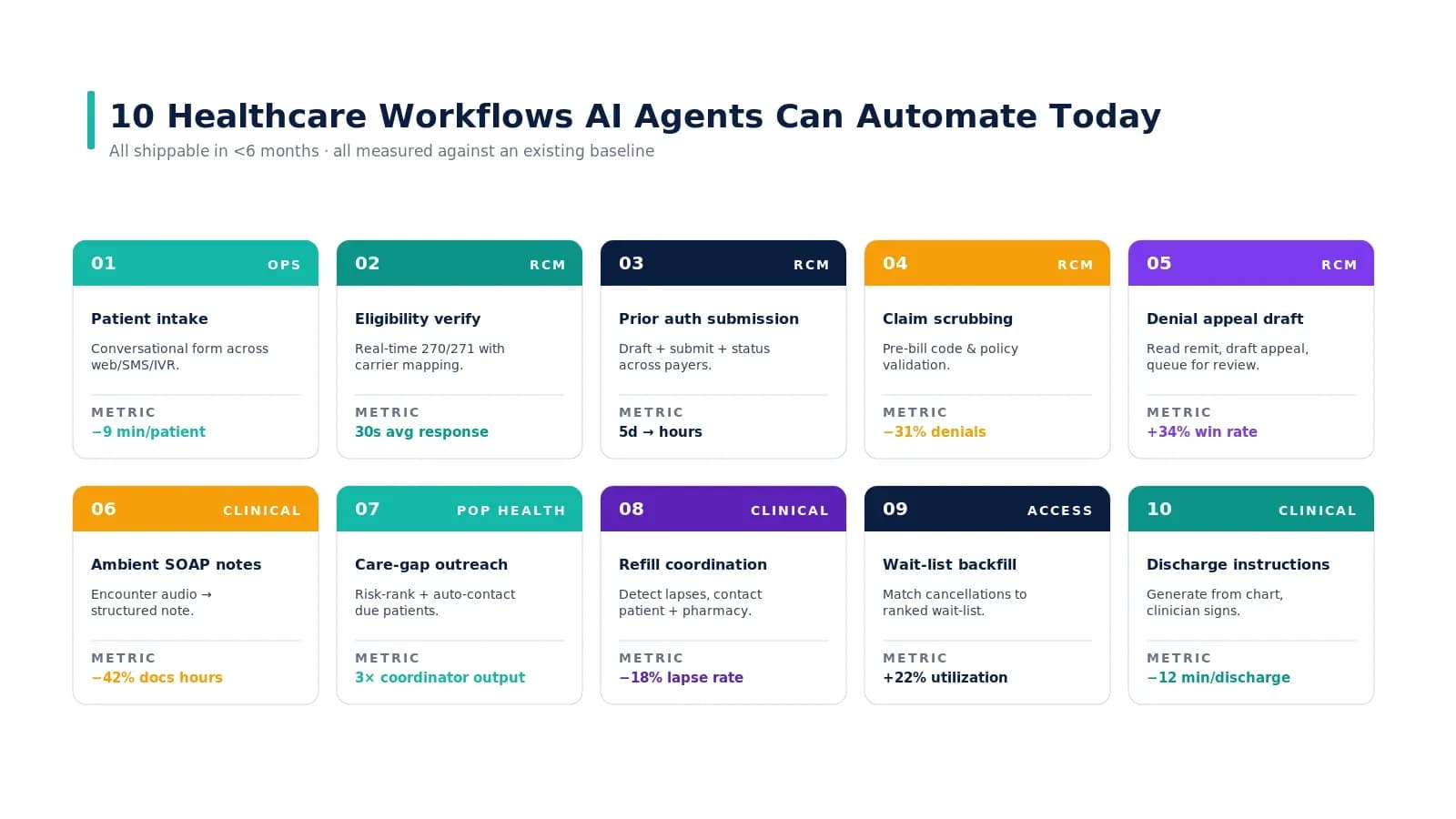
- Automating multi-step workflows (prior auth, care coordination, discharge)? → CrewAI
- Clinical research with data analysis and human review? → AutoGen
- Team under 3 developers, need to ship fast? → CrewAI
- Already on Microsoft Azure with BAA? → AutoGen
- Need maximum flexibility and ecosystem? → LangChain
None of these frameworks are HIPAA-compliant out of the box — compliance depends on your deployment architecture. See our guides on healthcare workflows for agentic AI and RPA vs agentic AI for implementation context.
At Nirmitee, we help healthcare teams select and implement the right agent framework for their use case. Let's discuss your requirements.