
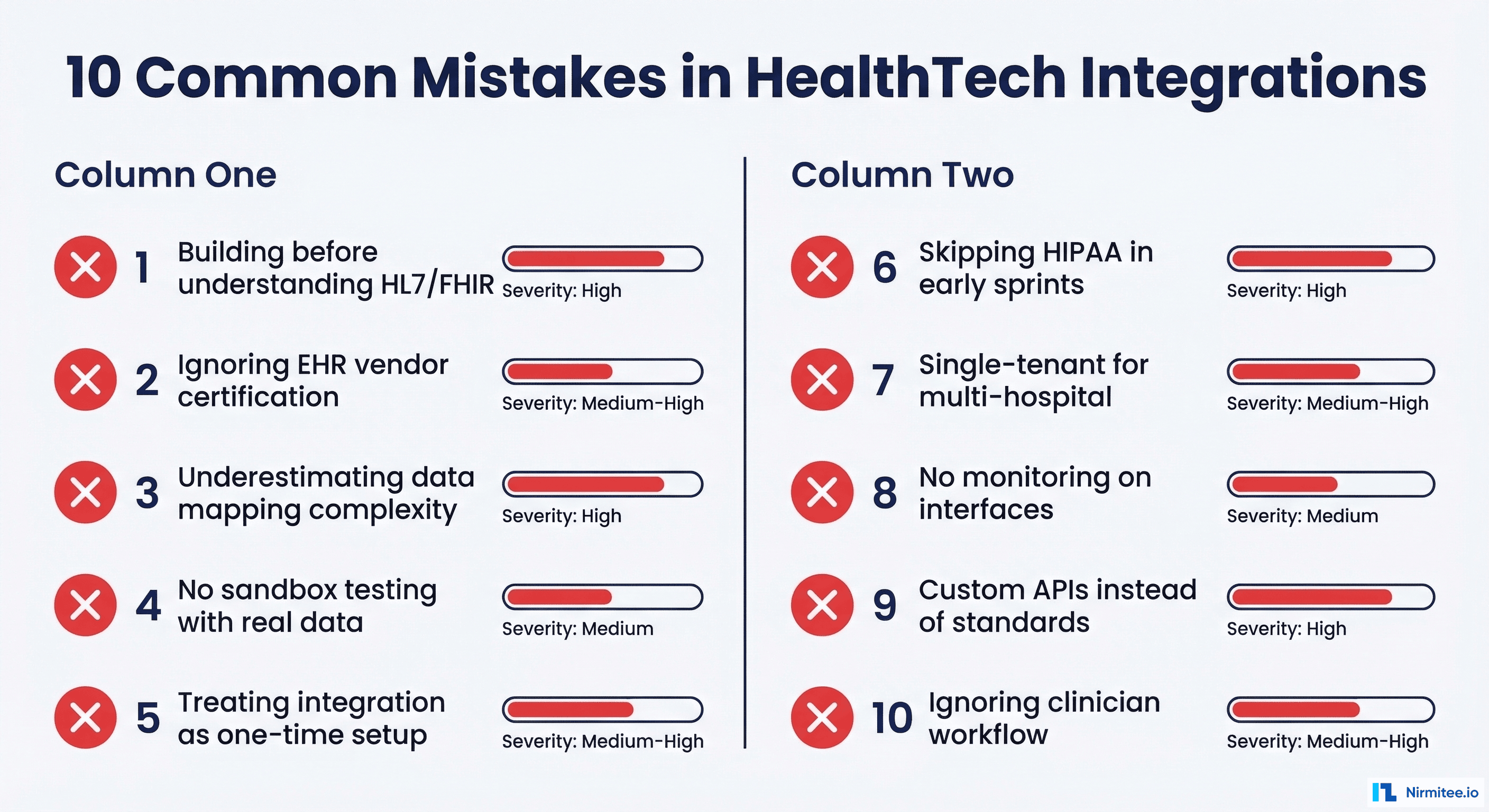

After building healthcare integrations across dozens of health systems, EHR platforms, and healthtech startups, we've seen the same mistakes repeated over and over. Each one costs months of development time, delays hospital go-lives, and sometimes kills deals entirely. Here are the 10 most common — and how to avoid them.

Mistake 1: Building Custom APIs Instead of Standards
What happens: The startup builds a REST API with custom endpoints (/api/patients, /api/lab-results) that work great with their own database. Then the first hospital asks for HL7 or FHIR integration and they realize none of their data models align with healthcare standards.
The cost: 3-6 months of rework mapping custom schemas to FHIR resources. Every hospital connection becomes a custom project instead of a configuration.
How to avoid it: Build on FHIR R4 from day one. Even if your first customer doesn't require it, your second one will. Model your internal data using FHIR resource structures — Patient, Observation, Condition, MedicationRequest. This makes every future integration a configuration exercise, not a development project.
Mistake 2: Underestimating EHR Vendor Certification
What happens: The team builds a working Epic integration in their sandbox and tells sales "we're Epic integrated." Then they learn that Epic App Market certification takes 6-12 months of security reviews, clinical validation, and production testing.
The cost: Deals stall for 6+ months while waiting for certification. Hospitals won't deploy uncertified apps in production, period.
How to avoid it: Start the certification process the moment you have a working prototype — not after you've finished the product. Epic, Cerner, and MEDITECH all have structured programs. Budget 6-12 months for Epic, 3-6 months for Oracle Health (Cerner), and engage their developer relations teams early.
Mistake 3: Treating Data Mapping as Trivial
What happens: "It's just mapping fields — how hard can it be?" Then they discover that the same lab test (hemoglobin A1c) has different LOINC codes at different hospitals, local codes that don't map to any standard, and free-text values mixed with structured data.
The cost: Every new hospital requires 2-4 weeks of custom mapping work. Data quality issues cause clinical safety concerns. A "moderate" effort turns into the biggest ongoing maintenance burden.
How to avoid it: Invest in a terminology service that maps between code systems (LOINC, SNOMED CT, ICD-10, RxNorm). Use the FHIR ConceptMap resource to manage mappings. Accept that you'll need a clinical informaticist on the team, not just software engineers.
Mistake 4: No Sandbox Testing with Real-World Data Volumes
What happens: Integration works perfectly with 50 test patients. In production, the hospital has 500,000 patients, the FHIR queries time out, the HL7 message queue backs up, and the system crashes on the first day.
The cost: Failed go-lives destroy credibility with hospital IT teams. You get one chance to make a first impression — and a day-one outage means months of trust rebuilding.
How to avoid it: Load test with production-scale data volumes. If you can't get de-identified data from the hospital, generate synthetic FHIR data using Synthea. Test with 100K+ patients, millions of observations, and realistic message throughput.
Mistake 5: Skipping HIPAA in Early Development
What happens: "We'll add HIPAA compliance later, let's just get the features working first." Then the first hospital's security team sends a 200-question HIPAA questionnaire, and the architecture doesn't support encryption at rest, audit logging, or access controls.
The cost: Architectural rework that touches every layer of the stack. 2-4 months of security remediation before any hospital will sign a BAA.
How to avoid it: HIPAA isn't a feature — it's an architecture decision. From sprint one: encrypt all data at rest and in transit, implement audit logging on every PHI access, use role-based access controls, and deploy on HIPAA-eligible infrastructure with a BAA (AWS, Azure, GCP all offer this).

Mistake 6: Single-Tenant Architecture for Multi-Hospital
What happens: The app runs great for Hospital A. Hospital B signs up, and the team realizes they need separate databases, separate FHIR endpoints, separate configurations — but the codebase assumes a single tenant everywhere.
How to avoid it: Design multi-tenant from the start. Every database query should be scoped by tenant. Every FHIR endpoint configuration should be per-tenant. Every credential store should be isolated. The marginal cost of multi-tenancy in sprint one is 10% more work. Retrofitting is 10x.
Mistake 7: No Monitoring or Alerting on Interfaces
What happens: The HL7 interface goes down on Friday evening. Nobody notices until Monday morning when the hospital calls asking why 48 hours of lab results are missing from the app.
How to avoid it: Every integration interface needs: heartbeat monitoring (is the connection alive?), message flow monitoring (are messages flowing at expected rates?), error rate alerting (are parse failures spiking?), and dead-letter queue management (where do failed messages go?). Use tools like Datadog, New Relic, or even simple CloudWatch alarms.
Mistake 8: Ignoring Clinician Workflow Impact
What happens: The app requires nurses to open a separate browser tab, log in with different credentials, and manually copy patient IDs from the EHR. After the first week, adoption drops to zero.
How to avoid it: Integrate into the existing workflow using SMART on FHIR (embedded in the EHR), CDS Hooks (actionable alerts in the EHR), or at minimum SSO with EHR-based authentication. The golden rule: zero additional clicks beyond what the clinician already does.
Mistake 9: Not Planning for EHR Version Upgrades
What happens: Epic upgrades from one version to the next. Your integration breaks because an API endpoint changed, a FHIR extension was renamed, or a search parameter was deprecated. You find out from an angry hospital IT director.
How to avoid it: Subscribe to vendor release notes. Test against new versions in sandbox before they go live. Build your FHIR client to be resilient to missing optional fields. Maintain a compatibility matrix and regression test suite.
Mistake 10: Treating Integration as a Project, Not a Product
What happens: The team builds the integration, ships it, and moves on to features. Six months later, message formats have drifted, new data requirements have emerged, and the integration is held together with duct tape.
How to avoid it: Integration is an ongoing process, not a one-time project. Assign an owner. Budget engineering time for maintenance, monitoring, and evolution. Track integration health metrics alongside feature metrics. Your integration is your product's lifeline — treat it that way.
For a deeper analysis of why FHIR specifications don't match production reality, read our FHIR implementation gap analysis. If you're deciding whether to build or buy your integration layer, see our build vs buy decision framework.
At Nirmitee, we've helped dozens of healthtech companies avoid these mistakes and build integrations that scale.
Struggling with healthcare data exchange? Our Healthcare Interoperability Solutions practice helps organizations connect clinical systems at scale. We also offer specialized Healthcare Software Product Development services. Talk to our team to get started.


