EDI 277 Claim Status Automation: Parse, Route, and Resolve with AI Agents

Digital Growth Lead
Writes about healthcare technology, interoperability, and AI-driven transformation across modern care systems.
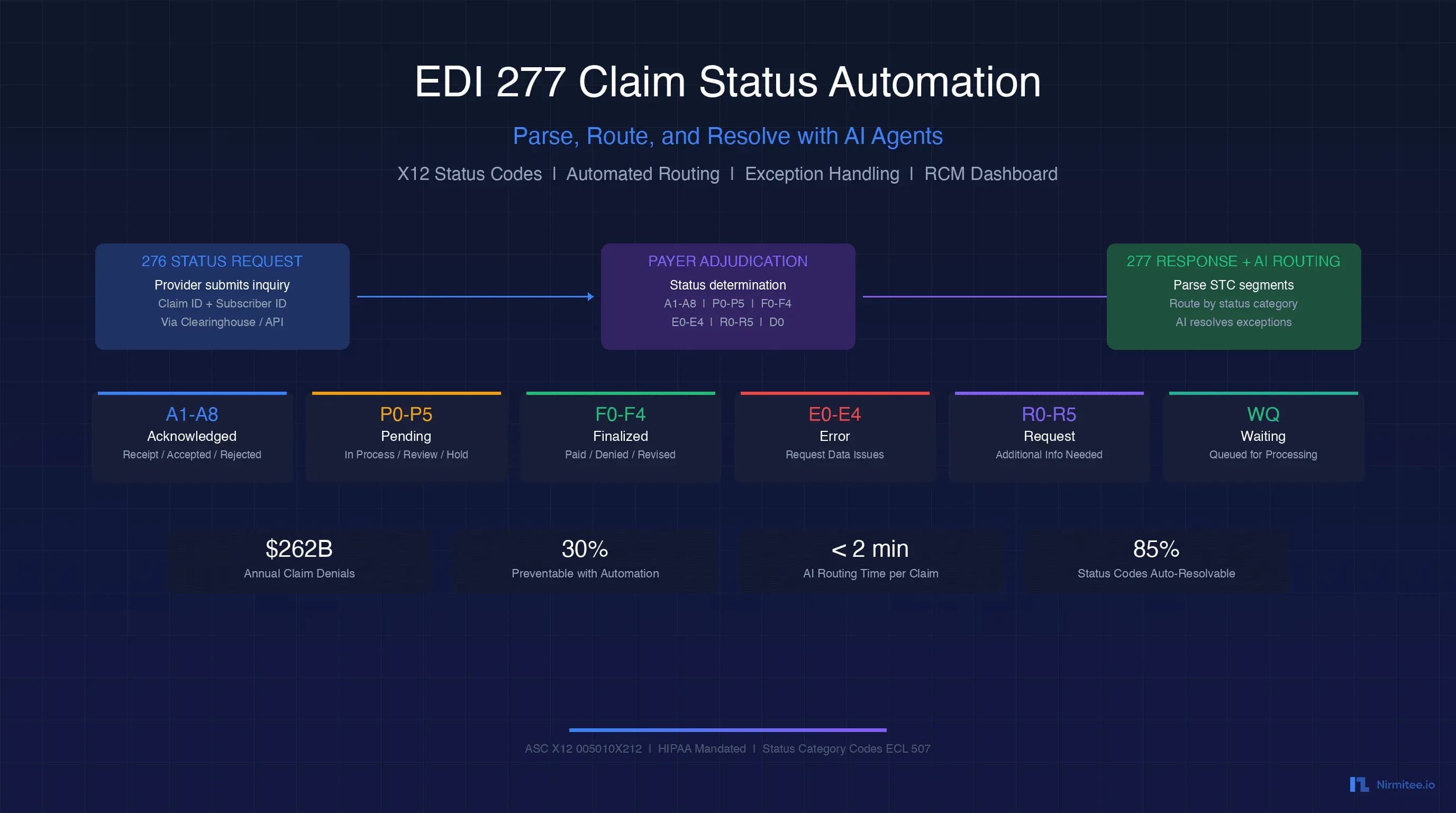
According to the CAQH Index, the healthcare industry spends $13.6 billion annually on claim status inquiries alone. Manual phone calls to payer representatives cost $7.53 per transaction, while electronic 276/277 transactions cost $0.30. That is a 96% cost reduction that most organizations have only partially captured. The real opportunity is not just the electronic submission of 276 requests, but the automated parsing, routing, and resolution of the 277 responses that come back.
This guide provides the technical depth required to build an end-to-end 277 automation pipeline: X12 segment parsing in Python, status code classification, AI-powered routing for exception handling, and integration with denial management dashboards. If you are building RCM automation, integrating with clearinghouses, or trying to reduce your days in A/R, this is the reference you need.
Related: see how we approach this in our X12 EDI integration services.
If you are new to healthcare EDI transactions, start with our Healthcare EDI 835/837/277 Developer Guide for foundational context on the X12 standard and HIPAA-mandated transactions.
What Is EDI 277?
The EDI 277 (Health Care Claim Status Response) is an X12 transaction defined under the ASC X12N 005010X212 implementation guide. It is the payer's response to a 276 (Health Care Claim Status Request) inquiry, providing the current adjudication status of one or more previously submitted claims.
The 276/277 transaction pair is mandated under HIPAA Administrative Simplification (45 CFR 162.1402), requiring all covered entities to support electronic claim status inquiries and responses. Under the CMS Interoperability and Prior Authorization Final Rule (CMS-0057-F), payers face increasing pressure to provide real-time claim status through both X12 and FHIR-based APIs by 2027.
Key Facts About EDI 277
- Implementation Guide: ASC X12N 005010X212 (Claim Status Response)
- HIPAA Mandate: Required under 45 CFR 162.1402 for all covered entities
- Trigger: Generated in response to a 276 inquiry (on-demand, not automatic)
- Transport: Delivered via clearinghouse SFTP, payer portals, or real-time API
- Code Sources: Category Codes (ECL 507), Status Codes (ECL 508), Entity Codes (ECL 1321)
- Frequency: On-demand per inquiry; most organizations batch-query daily or weekly
277 vs 277CA: Understanding the Difference
A common source of confusion is the distinction between the 277 (Claim Status Response) and the 277CA (Claim Acknowledgment). They share the same transaction set identifier but serve fundamentally different purposes in the claims lifecycle.
| Attribute | EDI 277 (Status Response) | EDI 277CA (Claim Acknowledgment) |
|---|---|---|
| Implementation Guide | 005010X212 | 005010X214 |
| Trigger | Response to 276 inquiry | Automatic on 837 receipt |
| Timing | On-demand, anytime during lifecycle | Immediate, upon claim receipt |
| Purpose | Current adjudication status | Confirms receipt, pre-adjudication validation |
| HIPAA Required | Yes (45 CFR 162.1402) | No (voluntary adoption) |
| Generated By | Payer adjudication system | Clearinghouse or payer front-end |
| Status Codes Used | Full ECL 507/508 range (A, P, F, E, R, D, WQ) | Primarily A-series (A1-A8) |
| Use Case | Claim follow-up, denial tracking, AR aging | Submission confirmation, edit validation |
The 277CA acts as a receipt: "We received your 837, and here is whether it passed initial edits." The 277 acts as a status report: "Here is where your claim stands in adjudication right now." Both are essential for a complete claim lifecycle tracking system, but they require different handling logic in your automation pipeline.
X12 277 Segment Structure: The Complete Anatomy
The 277 follows a hierarchical loop structure defined in the X12 standard. Understanding this hierarchy is critical for building a parser that correctly associates status information with the right claim and provider.
Envelope Segments
Like all X12 transactions, the 277 is wrapped in ISA/IEA (Interchange Control) and GS/GE (Functional Group) envelope segments. The GS segment identifies this as transaction type HN (Health Care Claim Status Notification).
Transaction Header
The ST segment starts the transaction with ST*277*0001*005010X212~, and the BHT (Beginning of Hierarchical Transaction) segment establishes the context with BHT*0085*08*<reference>*<date>*<time>~. The BHT purpose code 08 indicates this is a status response (versus 13 for a request).
Hierarchical Loop Structure
The 277 uses a four-level HL (Hierarchical Level) structure:
| Loop | HL Level Code | Entity | Key Segments |
|---|---|---|---|
| 2000A | 20 (Information Source) | Payer | HL, NM1*PR (Payer Name) |
| 2000B | 21 (Information Receiver) | Provider/Submitter | HL, NM1*41, TRN (Trace), STC |
| 2000C | 19 (Service Provider) | Rendering Provider | HL, NM1*85 or NM1*1P |
| 2000D | 22 (Subscriber) | Patient | HL, NM1*IL, Loop 2200D (claim detail) |
The STC Segment: The Heart of the 277
The Status Information (STC) segment is where the actual claim status lives. It is the most important segment for automation purposes. Here is its structure:
STC*{CategoryCode}:{StatusCode}:{EntityCode}*{StatusDate}*{ActionCode}*{MonetaryAmount}*{MonetaryAmount2}~

Example: STC*F1:3:PR*20260319*U*1250*1100~

Breakdown:
  STC01-01: F1 (Finalized/Payment) — Category Code from ECL 507
  STC01-02: 3 (Claim approved as submitted) — Status Code from ECL 508
  STC01-03: PR (Patient) — Entity Code from ECL 1321
  STC02: 20260319 — Date of this status (CCYYMMDD)
  STC03: U — Action Code (U = No Action Required)
  STC04: 1250 — Total claim charge amount
  STC05: 1100 — Amount paid
A single claim can have multiple STC segments, each representing a different status or status history entry. Your parser must handle multiple STC iterations within Loop 2200D.
Status Category Codes: The Complete Reference
The Claim Status Category Codes (ECL 507) define the high-level status category. These are the primary codes your routing engine will use for initial classification. The full code set is maintained by the Washington Publishing Company and X12.
Acknowledgment Codes (A0-A8)
| Code | Description | Automation Action |
|---|---|---|
| A0 | Forwarded to another entity | Log and track downstream entity |
| A1 | Receipt acknowledged | Confirm receipt, set monitoring timer |
| A2 | Accepted into adjudication | No action needed, claim processing normally |
| A3 | Returned as unprocessable | ALERT: Review errors, correct and resubmit immediately |
| A4 | Not found in payer system | Verify claim ID, cross-reference original 837 |
| A5 | Claim has been split | Create tracking entries for both resulting claims |
| A6 | Rejected for missing information | ALERT: Identify missing fields from ECL 508, resubmit |
| A7 | Rejected for invalid information | ALERT: Correct invalid data elements, resubmit |
| A8 | Rejected for relational field error | ALERT: Fix field relationships (e.g., DX pointer + CPT) |
Pending Codes (P0-P5)
| Code | Description | Automation Action |
|---|---|---|
| P0 | Pending adjudication (generic) | Schedule re-check in 14 days |
| P1 | In process | Normal processing, no intervention needed |
| P2 | Under payer review | Flag if pending > 30 days, escalate |
| P3 | Provider information requested | URGENT: Respond with requested documentation within 10 days |
| P4 | Patient information requested | Contact patient, relay information to payer |
| P5 | Administrative/system hold | Call payer to determine hold reason |
Finalized Codes (F0-F4)
| Code | Description | Automation Action |
|---|---|---|
| F0 | Finalized (generic) | Check adjudication details, post to PMS |
| F1 | Finalized/Payment | Auto-post payment, reconcile with 835 ERA |
| F2 | Finalized/Denial | CRITICAL: Route to denial management immediately |
| F3 | Finalized/Revised | Review revised adjudication, update payment records |
| F4 | Adjudication complete | Archive claim, update reporting dashboard |
Error, Request, and Other Codes
| Code | Description | Automation Action |
|---|---|---|
| E0 | Response not possible (request error) | Fix 276 request data and resubmit inquiry |
| E1 | Invalid/missing search criteria | Verify subscriber ID, claim ID, service dates |
| E2 | Information temporarily unavailable | Retry inquiry in 24-48 hours |
| R0 | Additional information requested | Provide requested documentation to payer |
| R3 | Claim must be resubmitted | Correct and resubmit claim via 837 |
| WQ | Waiting/Queued for processing | Monitor, auto-recheck in 7 days |
| D0 | Data search unsuccessful | Verify all search parameters, try alternate IDs |
For the full list of 30+ category codes and 800+ status codes, reference the X12 Official Code Lists and the CMS Status Code Update guidance.
Parsing EDI 277 in Python: Production-Ready Code
Below is a complete Python parser for X12 277 files. This parser handles the hierarchical loop structure, extracts STC segments, and produces structured claim status objects ready for your routing engine. Unlike generic X12 libraries, this is purpose-built for the 277 transaction with specific handling for multiple STC iterations and payer-specific variations.
from dataclasses import dataclass, field
from typing import Optional
import re
from datetime import datetime


@dataclass
class ClaimStatus:
    """Represents a single status from an STC segment."""
    category_code: str       # ECL 507: A0-A8, P0-P5, F0-F4, E0-E4, R0-R5, WQ, D0
    status_code: str         # ECL 508: Detailed status reason
    entity_code: str         # ECL 1321: Responsible entity
    status_date: Optional[str] = None
    action_code: Optional[str] = None
    total_charge: Optional[float] = None
    paid_amount: Optional[float] = None


@dataclass
class ClaimStatusResponse:
    """Represents a complete 277 response for a single claim."""
    payer_name: str = ""
    payer_id: str = ""
    provider_name: str = ""
    provider_npi: str = ""
    patient_name: str = ""
    member_id: str = ""
    claim_tracking_number: str = ""
    payer_claim_control_number: str = ""
    service_date_from: Optional[str] = None
    service_date_to: Optional[str] = None
    statuses: list = field(default_factory=list)

    @property
    def primary_status(self) -> Optional[ClaimStatus]:
        """Return the most recent / highest priority status."""
        if not self.statuses:
            return None
        # Priority: F > A3/A6/A7/A8 > R > P > E > A1/A2 > D/WQ
        priority = {'F': 1, 'R': 3, 'P': 4, 'E': 5, 'D': 7, 'W': 8}
        def sort_key(s):
            cat = s.category_code
            if cat.startswith('A') and cat in ('A3','A6','A7','A8'):
                return 2
            return priority.get(cat[0], 6)
        return sorted(self.statuses, key=sort_key)[0]


def parse_277(raw_edi: str) -> list[ClaimStatusResponse]:
    """Parse an X12 277 file into structured claim status objects."""
    # Detect segment terminator
    terminator = '~'
    if '~\n' in raw_edi:
        raw_edi = raw_edi.replace('~\n', '~')

    segments = [s.strip() for s in raw_edi.split(terminator) if s.strip()]

    claims = []
    current_claim = None
    current_payer = ("", "")
    current_provider = ("", "")
    current_hl_level = None

    for seg in segments:
        elements = seg.split('*')
        seg_id = elements[0]

        if seg_id == 'NM1':
            entity_type = elements[1] if len(elements) > 1 else ""
            name = elements[3] if len(elements) > 3 else ""
            first = elements[4] if len(elements) > 4 else ""
            id_code = elements[9] if len(elements) > 9 else ""

            if entity_type == 'PR':  # Payer
                current_payer = (name, id_code)
            elif entity_type in ('85', '1P'):  # Provider
                full_name = f"{name}, {first}".strip(", ")
                current_provider = (full_name, id_code)
            elif entity_type == 'IL':  # Subscriber
                if current_claim is None:
                    current_claim = ClaimStatusResponse()
                current_claim.patient_name = f"{first} {name}".strip()
                current_claim.member_id = id_code
                current_claim.payer_name = current_payer[0]
                current_claim.payer_id = current_payer[1]
                current_claim.provider_name = current_provider[0]
                current_claim.provider_npi = current_provider[1]

        elif seg_id == 'HL':
            level_code = elements[3] if len(elements) > 3 else ""
            current_hl_level = level_code
            if level_code == '22':  # Subscriber level
                if current_claim and current_claim.statuses:
                    claims.append(current_claim)
                current_claim = ClaimStatusResponse()

        elif seg_id == 'TRN' and current_claim:
            if len(elements) > 2:
                current_claim.claim_tracking_number = elements[2]

        elif seg_id == 'STC' and current_claim:
            composite = elements[1].split(':') if len(elements) > 1 else []
            status = ClaimStatus(
                category_code=composite[0] if len(composite) > 0 else "",
                status_code=composite[1] if len(composite) > 1 else "",
                entity_code=composite[2] if len(composite) > 2 else "",
                status_date=elements[2] if len(elements) > 2 else None,
                action_code=elements[3] if len(elements) > 3 else None,
                total_charge=float(elements[4]) if len(elements) > 4 and elements[4] else None,
                paid_amount=float(elements[5]) if len(elements) > 5 and elements[5] else None,
            )
            current_claim.statuses.append(status)

        elif seg_id == 'REF' and current_claim:
            ref_qual = elements[1] if len(elements) > 1 else ""
            ref_val = elements[2] if len(elements) > 2 else ""
            if ref_qual == '1K':
                current_claim.payer_claim_control_number = ref_val

        elif seg_id == 'DTP' and current_claim:
            qual = elements[1] if len(elements) > 1 else ""
            fmt = elements[2] if len(elements) > 2 else ""
            val = elements[3] if len(elements) > 3 else ""
            if qual == '472':  # Service date
                if fmt == 'RD8' and '-' in val:
                    parts = val.split('-')
                    current_claim.service_date_from = parts[0]
                    current_claim.service_date_to = parts[1]
                elif fmt == 'D8':
                    current_claim.service_date_from = val

    # Don't forget the last claim
    if current_claim and current_claim.statuses:
        claims.append(current_claim)

    return claims


# Usage example
raw_277 = """ISA*00*          *00*          *ZZ*SENDER         *ZZ*RECEIVER       *260319*1200*^*00501*000000001*0*P*:~
GS*HN*SENDER*RECEIVER*20260319*1200*1*X*005010X212~
ST*277*0001*005010X212~
BHT*0085*08*277RESP001*20260319*1200*TH~
HL*1**20*1~
NM1*PR*2*AETNA*****PI*60054~
HL*2*1*21*1~
NM1*41*2*METRO MEDICAL GROUP*****46*1234567890~
HL*3*2*19*1~
NM1*85*1*SMITH*ROBERT****XX*1234567893~
HL*4*3*22*0~
NM1*IL*1*DOE*JOHN****MI*ABC123456789~
TRN*2*CLM20260315001*60054~
STC*F1:3:PR*20260319*U*1250*1100~
REF*1K*AETNA2026031500123~
DTP*472*RD8*20260301-20260315~
SE*16*0001~
GE*1*1~
IEA*1*000000001~"""

claims = parse_277(raw_277)
for claim in claims:
    ps = claim.primary_status
    print(f"Patient: {claim.patient_name}")
    print(f"Status: {ps.category_code} - {ps.status_code}")
    print(f"Charge: ${ps.total_charge}  Paid: ${ps.paid_amount}")
This parser produces typed ClaimStatusResponse objects with a primary_status property that automatically selects the highest-priority status when a claim has multiple STC segments. The priority ordering ensures that denial statuses (F2) and rejection statuses (A3/A6/A7/A8) surface above routine pending or acknowledgment statuses.
Building an Automated Routing Engine
Once you can parse 277 responses into structured objects, the next step is building a routing engine that maps each status to an automated action. The engine operates in two tiers: a deterministic rules engine for clear-cut statuses, and an AI agent for ambiguous or exception cases.
Tier 1: Deterministic Rules Engine
The rules engine handles approximately 80% of incoming 277 statuses. Each status category maps to a predefined action:
from enum import Enum
from dataclasses import dataclass

class ActionType(Enum):
    AUTO_CLOSE = "auto_close"
    ROUTE_DENIAL = "route_denial"
    ROUTE_REJECTION = "route_rejection"
    SCHEDULE_FOLLOWUP = "schedule_followup"
    ALERT_URGENT = "alert_urgent"
    RESUBMIT = "resubmit"
    MONITOR = "monitor"
    ESCALATE_AI = "escalate_ai"
    LOG_ONLY = "log_only"

@dataclass
class RoutingDecision:
    action: ActionType
    queue: str
    priority: int  # 1=critical, 5=low
    sla_hours: int
    auto_resolved: bool
    notes: str = ""


def route_claim_status(claim: ClaimStatusResponse) -> RoutingDecision:
    """Route a 277 status to the appropriate action queue."""
    status = claim.primary_status
    if not status:
        return RoutingDecision(ActionType.ESCALATE_AI, "exceptions", 3, 24, False,
                               "No status found in 277 response")

    cat = status.category_code

    # Finalized: Payment
    if cat == 'F1':
        # Check for underpayment
        if status.total_charge and status.paid_amount:
            variance = status.total_charge - status.paid_amount
            if variance > 50:
                return RoutingDecision(ActionType.ESCALATE_AI, "underpayments", 3, 48, False,
                                       f"Underpayment detected: ${variance:.2f}")
        return RoutingDecision(ActionType.AUTO_CLOSE, "payments", 5, 24, True,
                               "Payment confirmed, reconcile with 835 ERA")

    # Finalized: Denial
    if cat == 'F2':
        return RoutingDecision(ActionType.ROUTE_DENIAL, "denials", 1, 48, False,
                               f"Denial - Status code: {status.status_code}")

    # Rejections (A3, A6, A7, A8)
    if cat in ('A3', 'A6', 'A7', 'A8'):
        return RoutingDecision(ActionType.ROUTE_REJECTION, "rejections", 1, 24, False,
                               f"Rejected: {cat} - Correct and resubmit")

    # Pending: Info Requested (time-sensitive)
    if cat == 'P3':
        return RoutingDecision(ActionType.ALERT_URGENT, "action_items", 2, 120, False,
                               "Payer requesting provider information")

    # Pending: Normal processing
    if cat in ('P0', 'P1', 'P2'):
        return RoutingDecision(ActionType.SCHEDULE_FOLLOWUP, "aging", 4, 336, True,
                               "Normal pending - recheck in 14 days")

    # Request for additional info
    if cat.startswith('R'):
        return RoutingDecision(ActionType.ALERT_URGENT, "follow_up", 2, 72, False,
                               "Additional information requested by payer")

    # Errors in request
    if cat.startswith('E'):
        return RoutingDecision(ActionType.RESUBMIT, "errors", 3, 24, False,
                               "276 request error - fix and resubmit inquiry")

    # Accepted (normal flow)
    if cat in ('A1', 'A2'):
        return RoutingDecision(ActionType.LOG_ONLY, "monitoring", 5, 168, True,
                               "Claim acknowledged, awaiting adjudication")

    # Queued
    if cat == 'WQ':
        return RoutingDecision(ActionType.MONITOR, "monitoring", 4, 168, True,
                               "Claim queued at payer - auto-recheck in 7 days")

    # Default: escalate to AI for unknown/ambiguous
    return RoutingDecision(ActionType.ESCALATE_AI, "exceptions", 3, 24, False,
                           f"Unhandled category: {cat}")
Tier 2: AI Agent for Exception Handling
The AI agent handles the 20% of cases that rules cannot resolve deterministically. These include:
- Ambiguous multi-STC claims: When a claim has both P1 (In Process) and F2 (Denial) STC segments, the AI agent uses timestamp analysis and payer-specific patterns to determine which status is current.
- Partial payment analysis: When F1 shows a significant underpayment, the AI agent compares the paid amount against contracted rates, identifies the likely adjustment reason, and determines whether an appeal is warranted.
- Timely filing risk: The AI agent cross-references claim service dates, payer filing deadlines (which vary from 90 to 365 days by payer), and current status to flag claims at risk of timely filing expiration.
- Denial pattern detection: When multiple claims from the same provider receive the same denial code, the AI agent identifies the systemic issue (e.g., missing modifier on a specific CPT code) and recommends a batch correction.
- Payer-specific behavior: Different payers use status codes inconsistently. UnitedHealthcare may use P2 where Aetna uses P0 for the same adjudication stage. The AI agent learns these payer-specific patterns and normalizes behavior.
def ai_agent_analyze(claim: ClaimStatusResponse, history: list) -> dict:
    """AI agent analysis for exception cases."""
    analysis = {
        "claim_id": claim.claim_tracking_number,
        "confidence": 0.0,
        "recommended_action": "",
        "reasoning": "",
        "timely_filing_risk": False,
        "pattern_match": None,
    }

    # Multi-STC analysis: resolve conflicts
    if len(claim.statuses) > 1:
        # Sort by date, take most recent
        dated = [(s, s.status_date) for s in claim.statuses if s.status_date]
        if dated:
            dated.sort(key=lambda x: x[1], reverse=True)
            analysis["recommended_action"] = f"Use latest status: {dated[0][0].category_code}"
            analysis["confidence"] = 0.85

    # Timely filing check
    if claim.service_date_from:
        service_date = datetime.strptime(claim.service_date_from, "%Y%m%d")
        days_elapsed = (datetime.now() - service_date).days
        payer_deadline = get_payer_filing_deadline(claim.payer_id)
        if days_elapsed > (payer_deadline - 30):  # Within 30 days of deadline
            analysis["timely_filing_risk"] = True
            analysis["reasoning"] += f" ALERT: {payer_deadline - days_elapsed} days until filing deadline."

    # Pattern detection across history
    denial_codes = [h.primary_status.status_code for h in history
                    if h.primary_status and h.primary_status.category_code == 'F2'
                    and h.payer_id == claim.payer_id]
    if denial_codes:
        from collections import Counter
        common = Counter(denial_codes).most_common(1)
        if common and common[0][1] >= 3:
            analysis["pattern_match"] = {
                "code": common[0][0],
                "count": common[0][1],
                "recommendation": f"Systemic denial pattern: code {common[0][0]} from {claim.payer_name}"
            }

    return analysis


def get_payer_filing_deadline(payer_id: str) -> int:
    """Return timely filing deadline in days for a payer."""
    deadlines = {
        "60054": 365,   # Aetna
        "87726": 365,   # UnitedHealthcare
        "62308": 180,   # Cigna
        "00901": 365,   # BCBS (varies by plan)
        "CMS":   365,   # Medicare
        "MDCAID": 365,  # Medicaid (varies by state)
    }
    return deadlines.get(payer_id, 180)  # Default 180 days
For a deeper dive into how AI agents handle denial management workflows, see our guide on denial management ROI with AI.
Integration with Denial Management Workflow
The 277 routing engine does not operate in isolation. It feeds directly into your denial management workflow. When a 277 response returns an F2 (Finalized/Denial), the claim must flow through a structured denial resolution pipeline.
Denial Resolution Pipeline
- Denial Classification: Map the ECL 508 status code to a denial category (clinical, administrative, technical, authorization).
- Root Cause Analysis: Cross-reference the denial code with the original 837 claim data to identify the specific deficiency.
- Appeal Feasibility: Determine whether the denial is appealable based on payer contract terms, denial reason, and dollar threshold.
- Documentation Assembly: Automatically pull supporting documentation from the EHR (clinical notes, prior auth references, medical necessity letters).
- Appeal Generation: Generate the appeal letter with supporting evidence, formatted per payer-specific requirements.
- Tracking: Set appeal deadlines (typically 60-180 days from denial date), monitor appeal status via subsequent 277 inquiries.
The key integration point is the mapping between ECL 508 status codes in the 277 and CARC (Claim Adjustment Reason Codes) in the 835 ERA. When the 835 arrives with the formal remittance, your system should correlate it with the 277 status history to provide a complete claim lifecycle view.
Real-Time Claim Status Dashboard
A claim status dashboard transforms raw 277 data into actionable intelligence for your revenue cycle team. The dashboard should provide visibility at three levels: executive KPIs, operational queues, and individual claim detail.
Executive KPIs
- Auto-Resolution Rate: Percentage of 277 statuses handled without human intervention (target: 90%+)
- Average Resolution Time: Time from 277 receipt to claim closure (target: < 24 hours for payments, < 72 hours for denials)
- Revenue at Risk: Dollar value of claims in denial, rejection, or timely-filing-risk status
- Payer Performance Score: Composite score based on response time, denial rate, and auto-resolution rate per payer
Operational Queues
- Denial Queue: All F2 statuses sorted by dollar amount descending, with appeal deadline countdown
- Rejection Queue: A3/A6/A7/A8 claims with identified errors and suggested corrections
- Action Items: P3/R-series claims requiring documentation or information submission
- Aging Monitor: P0/P1/P2 claims approaching payer-specific aging thresholds
- Timely Filing Alerts: Claims within 30 days of filing deadline with no finalized status
Dashboard Data Architecture
-- PostgreSQL schema for 277 claim status tracking
CREATE TABLE claim_status_277 (
    id SERIAL PRIMARY KEY,
    claim_tracking_number VARCHAR(50) NOT NULL,
    payer_claim_control_number VARCHAR(50),
    payer_id VARCHAR(20) NOT NULL,
    payer_name VARCHAR(100),
    provider_npi VARCHAR(10),
    member_id VARCHAR(50),
    category_code VARCHAR(10) NOT NULL,
    status_code VARCHAR(10),
    entity_code VARCHAR(10),
    status_date DATE,
    action_code VARCHAR(5),
    total_charge DECIMAL(12,2),
    paid_amount DECIMAL(12,2),
    service_date_from DATE,
    service_date_to DATE,
    routing_action VARCHAR(50),
    routing_queue VARCHAR(50),
    routing_priority INTEGER,
    auto_resolved BOOLEAN DEFAULT FALSE,
    ai_confidence DECIMAL(5,4),
    resolved_at TIMESTAMP,
    created_at TIMESTAMP DEFAULT NOW(),
    CONSTRAINT idx_tracking UNIQUE (claim_tracking_number, category_code, status_date)
);

CREATE INDEX idx_277_category ON claim_status_277(category_code);
CREATE INDEX idx_277_payer ON claim_status_277(payer_id);
CREATE INDEX idx_277_unresolved ON claim_status_277(resolved_at) WHERE resolved_at IS NULL;
CREATE INDEX idx_277_priority ON claim_status_277(routing_priority, created_at) WHERE resolved_at IS NULL;
Payer-Specific 277 Variations
One of the biggest challenges in 277 automation is that payers interpret the X12 standard differently. Here are documented variations you must handle in production:
| Payer | Variation | Impact on Automation |
|---|---|---|
| UnitedHealthcare | Uses P0 generically for all pending states; rarely uses P1-P5 distinctions | Cannot differentiate pending sub-types; use aging threshold instead |
| Aetna | Includes multiple STC segments with historical status progression | Must take the latest-dated STC as current status |
| BCBS (Anthem) | Returns separate 277 per service line even for single-claim inquiries | Must aggregate line-level statuses to claim-level view |
| Cigna | Uses non-standard status codes in STC01-02 element for certain dental claims | Maintain a Cigna-specific code mapping table |
| Medicare (CMS) | Fastest responder; uses full P0-P5 range accurately | Most automation-friendly payer; minimal exception handling needed |
| Medicaid (State) | Response times vary dramatically (2-30 days); status granularity varies by state | Set state-specific SLA expectations; some states only support A/F categories |
| Humana | Includes STC12 (free-form text) with additional context on denial reasons | Parse STC12 for supplemental denial intelligence; feed to AI agent |
For comprehensive payer integration patterns including eligibility and claims, see our US Payer Integration Guide for Eligibility, Claims, and EDI.
Common 277 Errors and Fixes
These are the most frequent issues teams encounter when implementing 277 automation, along with their solutions:
1. STC Segment Parsing Failures
Problem: Parser crashes when STC01 composite has fewer than 3 sub-elements (e.g., STC*F1:3*20260319~ without entity code).
Fix: Always treat STC01 sub-elements as optional. Use safe indexing: composite[2] if len(composite) > 2 else "".
2. Duplicate Status Entries
Problem: Same claim returns identical status on consecutive 277 queries, creating duplicate work items.
Fix: Implement idempotency using a composite key of (claim_tracking_number, category_code, status_date). Only create new routing actions when the status actually changes.
3. Claim Not Found (A4 / D0)
Problem: Payer returns A4 or D0 for claims you know were submitted successfully.
Fix: Wait 48-72 hours after 837 submission before first 276 inquiry. Some payers take 2-3 business days to load claims into their status systems. Also verify you are using the correct identifier (payer claim number vs. your internal claim ID).
4. Mismatched Claim Amounts
Problem: STC04 (charge amount) does not match your original 837 CLM segment charge.
Fix: Payers may recalculate charges after applying fee schedules. Log the discrepancy but do not fail the routing. Use the 835 ERA as the authoritative payment source.
5. Missing TRN Segment
Problem: Cannot match 277 response back to original 276 request because TRN is missing or uses a different tracking number.
Fix: Implement fallback matching using patient member ID + service date + charge amount. Maintain a mapping table between your internal claim IDs, 276 trace numbers, and payer claim control numbers.
6. Timezone and Date Mismatches
Problem: STC02 date does not match the expected adjudication timeline, causing false aging alerts.
Fix: STC02 uses the payer's local date. Normalize all dates to UTC in your system, and apply payer-timezone offsets when calculating SLA timers.
Production Deployment Checklist
Before deploying your 277 automation pipeline to production, verify the following:
- Parser handles all payer variations: Test with real 277 files from your top 10 payers by volume.
- Idempotency is enforced: Duplicate 277 responses do not create duplicate work items.
- Timely filing deadlines are configured per payer: Maintain a payer configuration table with filing deadlines, response SLAs, and known code variations.
- AI agent has historical training data: Feed at least 6 months of historical 277 data for pattern recognition.
- Dashboard real-time feeds work: Verify WebSocket or polling-based dashboard updates within 5 minutes of 277 receipt.
- Alert thresholds are calibrated: Tune timely filing alerts (30/15/7 day warnings), underpayment thresholds (>$50 variance), and denial spike detection (>20% above baseline).
- Audit trail is complete: Every routing decision, AI agent analysis, and human override is logged for compliance and continuous improvement.
- Fallback to manual queue: If the parser or routing engine fails, claims route to a manual review queue rather than being dropped.
Measuring ROI: The Business Case for 277 Automation
The ROI of 277 automation is measurable and significant. Based on CAQH Index data and industry benchmarks:
| Metric | Manual Process | Automated 277 Pipeline | Improvement |
|---|---|---|---|
| Cost per status inquiry | $7.53 (phone) | $0.30 (electronic) + $0.05 (processing) | 95% reduction |
| Time to identify denial | 5-14 days | < 4 hours | 97% faster |
| Denial appeal rate | 40-50% of eligible | 92% of eligible | 84% more appeals filed |
| Timely filing losses | 2-5% of AR | < 0.1% of AR | 98% reduction |
| FTE per 10,000 claims/month | 3-4 FTEs | 0.5 FTE (exception handling) | 85% labor reduction |
| Days in A/R | 45-60 days | 28-35 days | 35-42% reduction |
For a mid-size practice processing 10,000 claims per month, 277 automation typically delivers $180,000-$250,000 in annual savings from reduced labor costs, faster denial identification, and eliminated timely filing losses. The implementation cost for a custom solution ranges from $40,000-$80,000, yielding a 3-6 month payback period.
Key Takeaways
- The EDI 277 is not just a notification; it is an actionable data feed that should drive automated claim lifecycle management.
- Understanding the difference between 277 (on-demand status) and 277CA (automatic receipt acknowledgment) is essential for building correct automation logic.
- The STC segment is the heart of the 277. Master the ECL 507 category codes and ECL 508 status codes to build effective routing rules.
- A two-tier architecture (deterministic rules + AI agent) achieves 92-95% auto-resolution rates, compared to 75-80% with rules alone.
- Payer-specific variations in 277 implementation are the biggest source of parsing failures. Build your system with payer-specific configuration from day one.
- The business case is clear: 277 automation reduces cost per inquiry by 95%, cuts days in A/R by 35-42%, and virtually eliminates timely filing losses.
Related reading
For more insights, explore our guides on what AI agents do in healthcare and FHIR in Modern Healthcare.
You may also find value in EHR Software Development Guide and Building a Healthtech App.
Ready to scale?
Talk to our healthcare engineering team about building, integrating, and shipping faster.
Frequently Asked Questions
What is the difference between EDI 277 and 277CA transactions?
What are the most important STC status category codes to monitor in a 277 response?
How can AI agents improve EDI 277 claim status processing beyond rule-based automation?
What Python libraries are best for parsing X12 277 EDI files?
How do I integrate EDI 277 status data into an existing RCM dashboard?
How does Nirmitee.io approach healthcare software development?