HIPAA Security Rule 2026: The Compliance Checklist Every Health System Must Complete Before May

Founder & CEO
15+ years building healthcare technology. Led 100+ EHR integrations, FHIR implementations, and clinical AI deployments.
Part of our complete guide to HIPAA developer compliance checklist.
The 2026 HIPAA Security Rule overhaul introduced mandatory requirements that go beyond the original 2003 rule. This checklist is built for health system compliance teams — covering every new requirement, what's now mandatory vs addressable, and the May 2026 deadline items you cannot miss. This is a regulatory and audit guide, not a software development guide.
What's Changing: The Biggest HIPAA Security Overhaul in 20 Years
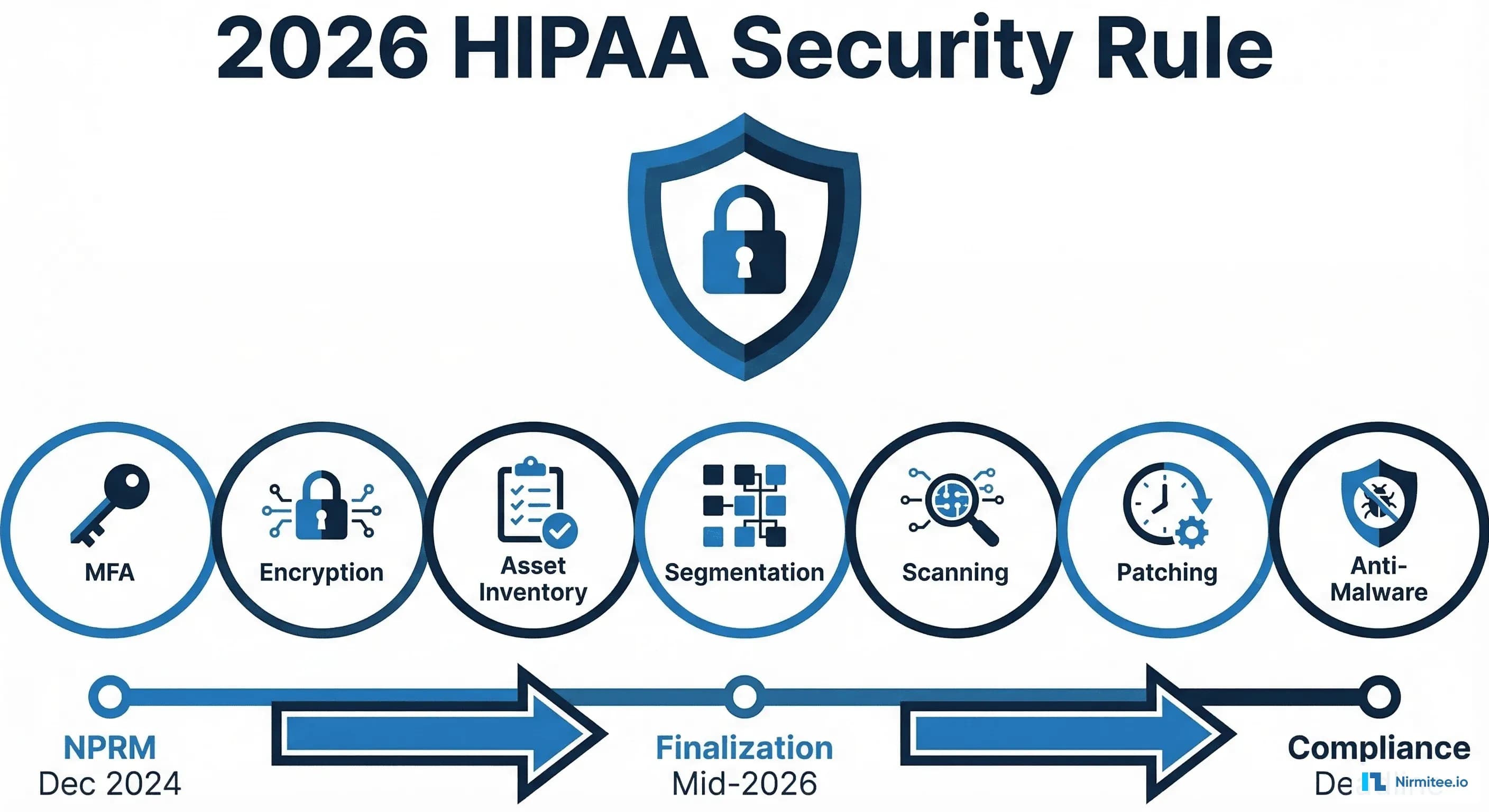
On December 27, 2024, the U.S. Department of Health and Human Services (HHS) Office for Civil Rights (OCR) published a Notice of Proposed Rulemaking (NPRM) that represents the most sweeping revision to the HIPAA Security Rule since its original adoption in 2003. Published in the Federal Register on January 6, 2025, this proposed rule responds to an unprecedented wave of healthcare cyberattacks that exposed over 167 million individuals' records in 2023 alone — a number that nearly doubled with the catastrophic Change Healthcare breach of February 2024.
Related Reading
For more insights, explore our guides on HIPAA Security Rule : Engineer Guide and FHIR in Modern Healthcare.
You may also find value in EHR Software Development Guide and Building a Healthtech App.
The catalyst is unmistakable. The Change Healthcare attack — attributed to the ALPHV/BlackCat ransomware group — compromised the protected health information (PHI) of approximately 190 million Americans, making it the largest healthcare data breach in U.S. history. UnitedHealth Group, Change Healthcare's parent company, reported total costs exceeding $2.45 billion through 2024, including $1.4 billion in direct response costs and over $1 billion in business disruption. The root cause? A lack of multi-factor authentication on a Citrix remote access portal — a safeguard that was merely "addressable" under the existing HIPAA framework.
That distinction between "required" and "addressable" safeguards — a 20-year-old concept that allowed covered entities to implement alternative measures or skip controls entirely with documented justification — is being eliminated entirely. Under the proposed rule, every safeguard becomes mandatory. No more risk-based exceptions. No more "we determined it wasn't reasonable and appropriate." This is the regulatory equivalent of a controlled demolition of the compliance status quo.
The comment period closed on March 7, 2025, generating over 4,000 public comments from hospitals, health plans, technology vendors, and patient advocacy groups. HHS is expected to publish the final rule by mid-2026, with covered entities having approximately 180 days from the effective date to achieve full compliance. For health systems that haven't begun preparing, the clock is already running.
The financial stakes extend well beyond compliance costs. OCR's enforcement posture has intensified dramatically: in 2024, the office resolved 22 investigations with corrective action plans and monetary penalties totaling over $6.6 million, including a $4.75 million settlement with Montefiore Medical Center for insider threat failures and a $950,000 penalty against Heritage Valley Health System for deficient risk analysis. The message from OCR Director Melanie Fontes Rainer has been consistent: "We will use every tool in our enforcement toolbox."
The 7 Major New Requirements That Change Everything
The proposed rule introduces approximately 28 new or substantially revised implementation specifications. Seven requirements stand out as transformative — each carrying significant implications for technology infrastructure, staffing, and budget.
1. Mandatory Multi-Factor Authentication (MFA)
The NPRM requires MFA for all access to electronic protected health information (ePHI) across every system, application, and network. This includes clinical workstations, EHR systems, remote access portals, administrative systems, and health information exchanges. The rule specifically calls for "something you know, something you have, and/or something you are" — eliminating SMS-only second factors in favor of phishing-resistant methods like FIDO2 security keys, authenticator apps, or biometric verification.
For health systems running legacy clinical applications — many of which predate modern authentication standards — this represents the single most disruptive technical requirement. Shared workstations in clinical environments, tap-badge systems, and single sign-on configurations all need re-evaluation. According to the HHS fact sheet, the lack of MFA was the proximate cause of at least 11 major healthcare breaches in 2023-2024, including the Change Healthcare incident.
2. Encryption of ePHI at Rest and in Transit — No Exceptions
Under current rules, encryption is an "addressable" specification. Organizations can document why encryption isn't feasible and implement alternative measures. The NPRM eliminates this flexibility entirely. All ePHI must be encrypted using NIST-approved algorithms (AES-256 for data at rest, TLS 1.2+ for data in transit) with no exceptions for internal network traffic, backup media, or legacy systems.
This requirement extends to:
- Database-level encryption for all ePHI repositories
- Full-disk encryption on all endpoints (workstations, laptops, mobile devices)
- Encryption of backup tapes and archival media
- TLS encryption for all internal network communications carrying ePHI
- Encrypted email for all ePHI transmissions (not just external)
The compliance cost for this single requirement is substantial. Organizations still running unencrypted SQL Server databases, legacy interface engines, or cleartext HL7v2 feeds between systems face significant remediation projects. HHS estimates the encryption-related compliance costs at approximately $2.2 billion industry-wide in the first year.
3. Comprehensive Technology Asset Inventory
The proposed rule mandates a complete, continuously updated inventory of all technology assets that create, receive, maintain, or transmit ePHI. This includes hardware (servers, workstations, medical devices, network equipment), software (applications, operating systems, firmware), and data flows (how ePHI moves between systems, including third-party integrations).
The inventory must include:
- Asset classification by criticality and data sensitivity
- Network location and connectivity mapping
- Software version and patch level tracking
- End-of-life and end-of-support dates
- Business associate relationships and data sharing pathways
This requirement addresses a chronic weakness in healthcare IT: most organizations cannot definitively answer "where is all our ePHI?" A 2024 Ponemon Institute study found that 67% of healthcare organizations could not produce a complete inventory of systems containing patient data. Without this foundation, every other security control operates on incomplete information.
For a live example of why patch management deserves its place on this checklist, see our analysis of the React2Shell critical RCE exploit.
4. Network Segmentation
For the first time, HIPAA will explicitly require network segmentation — the practice of dividing a network into isolated zones to limit lateral movement by attackers. The NPRM specifies that organizations must segment networks so that a compromise of one system or zone does not automatically grant access to ePHI across the entire environment.
Specific requirements include:
- Separation of clinical networks from administrative and guest networks
- Isolation of medical devices (IoMT) on dedicated network segments
- Micro-segmentation around high-value ePHI repositories
- Documented network architecture diagrams showing segmentation boundaries
- Access controls between segments based on the principle of least privilege
This is arguably the most architecturally demanding requirement. Many hospital networks evolved organically over decades, with flat network topologies that allow any device to communicate with any other. Re-architecting these networks while maintaining 24/7 clinical operations requires careful planning, significant capital investment, and months of implementation work.
5. Vulnerability Scanning Every 6 Months
The NPRM mandates vulnerability scanning at least every six months and penetration testing at least annually. Scans must cover all systems that contain, process, or transmit ePHI, including web applications, APIs, databases, and network infrastructure. Critically, the rule requires that identified vulnerabilities be remediated according to a risk-based priority schedule — not simply documented and deferred.
Organizations must maintain:
- Documented vulnerability management procedures
- Evidence of scan results and remediation actions
- Risk-ranked remediation timelines (critical vulnerabilities within 15 days)
- Annual penetration tests conducted by qualified internal or external teams
- Remediation verification through follow-up scanning
For organizations currently conducting annual vulnerability assessments (or none at all), this doubles the minimum scanning cadence and adds rigorous documentation requirements. Third-party penetration testing alone costs $15,000 to $50,000 per engagement for mid-size organizations.
6. Patch Management Within 15 Days for Critical Vulnerabilities
Perhaps the most operationally challenging requirement: the NPRM specifies that critical security patches must be deployed within 15 days of release for critical vulnerabilities, and within a "reasonable timeframe" for all others. This replaces the current rule's vague requirement to "protect against reasonably anticipated threats."
The 15-day window is aggressive by healthcare standards. Clinical applications often require vendor certification before patch deployment, and many medical devices run embedded operating systems that cannot be patched without manufacturer involvement. HHS acknowledged these challenges in the NPRM preamble but maintained that the timeline is necessary given the speed at which threat actors weaponize known vulnerabilities — often within 24 to 48 hours of public disclosure.
Organizations must document:
- Patch management policies with defined SLAs by severity level
- Testing and validation procedures for clinical system patches
- Compensating controls for systems that cannot be patched within the timeline
- Patch deployment verification and rollback procedures
7. Anti-Malware Protection on All Systems
The proposed rule requires anti-malware solutions deployed on all systems that access, store, or transmit ePHI. This includes not just traditional endpoint protection but also advanced capabilities such as endpoint detection and response (EDR), behavioral analysis, and real-time threat intelligence integration.
The requirement specifically addresses:
- Real-time scanning and monitoring on all endpoints
- Email gateway protection with attachment sandboxing
- Network-level malware detection (IDS/IPS)
- Protection for mobile devices accessing ePHI
- Regular signature updates and behavioral engine tuning
For organizations still relying on legacy antivirus solutions or lacking coverage on clinical workstations and medical devices, this requires a significant upgrade to modern endpoint protection platforms. The ransomware epidemic in healthcare — with attacks increasing 278% between 2020 and 2024 according to the FBI's Internet Crime Complaint Center — makes this requirement particularly urgent.
What This Means for Your Budget: Compliance Cost Estimates by Organization Size
HHS's own regulatory impact analysis estimates the total first-year compliance cost at approximately $9 billion across the healthcare industry, with annual recurring costs of approximately $6 billion thereafter. These are aggregate figures; the per-organization impact varies dramatically based on size, current security maturity, and technology infrastructure age.
Small Practices (1-10 Providers)
Estimated first-year compliance cost: $50,000 to $150,000
- MFA implementation: $5,000-$15,000 (cloud-based identity provider, hardware tokens)
- Encryption upgrades: $10,000-$30,000 (endpoint encryption, email encryption gateway)
- Vulnerability scanning: $5,000-$15,000 (managed scanning service, 2x annually)
- Asset inventory: $3,000-$8,000 (discovery tools, documentation)
- Anti-malware upgrade: $5,000-$12,000 (EDR platform licensing)
- Consulting and gap analysis: $15,000-$40,000
- Staff training: $5,000-$10,000
- Ongoing annual costs: $25,000-$60,000
For small practices already using cloud-based EHR systems with built-in security controls, costs may fall toward the lower end. Practices running on-premises servers with outdated infrastructure face the higher end — and may find that migrating to a cloud platform is more cost-effective than securing legacy systems.
Mid-Size Hospitals (100-500 Beds)
Estimated first-year compliance cost: $500,000 to $2 million
- MFA enterprise rollout: $50,000-$150,000 (identity platform, SSO integration, clinical workflow adaptation)
- Network segmentation: $100,000-$400,000 (next-gen firewalls, VLAN reconfiguration, IoMT isolation)
- Encryption infrastructure: $75,000-$250,000 (database encryption, TLS deployment, key management)
- Vulnerability management program: $50,000-$120,000 (scanning platform, penetration testing, remediation labor)
- Asset inventory and CMDB: $30,000-$80,000 (discovery tools, documentation, ongoing maintenance)
- EDR/anti-malware platform: $40,000-$100,000 (endpoint licensing, SOC integration)
- Patch management automation: $30,000-$80,000 (patch management platform, testing infrastructure)
- Additional security staff (1-2 FTEs): $120,000-$250,000
- Ongoing annual costs: $350,000-$900,000
Large Health Systems (1,000+ Beds, Multi-Facility)
Estimated first-year compliance cost: $5 million to $20 million
- Enterprise MFA and identity governance: $500,000-$2,000,000
- Network segmentation and zero-trust architecture: $1,000,000-$5,000,000
- Enterprise encryption program: $500,000-$2,000,000
- Continuous vulnerability management: $300,000-$800,000
- Enterprise asset management platform: $200,000-$500,000
- Advanced endpoint protection and SOC: $500,000-$2,000,000
- Patch management and automation: $200,000-$500,000
- Security team expansion (5-10 FTEs): $750,000-$1,500,000
- Third-party risk management program: $200,000-$500,000
- Ongoing annual costs: $3,000,000-$10,000,000
To put these costs in perspective: UnitedHealth Group's total losses from the Change Healthcare breach exceeded $2.45 billion. A single ransomware attack on a mid-size hospital averages $1.27 million in recovery costs according to Sophos' 2024 State of Ransomware in Healthcare report — excluding the operational impact of system downtime that can last weeks. The compliance investment, while significant, is a fraction of the cost of a major breach.
The 90-Day Compliance Sprint: A Week-by-Week Checklist
Whether the final rule lands with a 180-day or 360-day compliance window, the complexity of these requirements demands that organizations begin preparing immediately. Here is a structured 90-day sprint to build your compliance foundation.
Weeks 1-2: Assessment and Gap Analysis
- Conduct a comprehensive gap analysis against all 28 new implementation specifications
- Inventory all systems containing, processing, or transmitting ePHI
- Map all data flows — internal, external, and third-party
- Assess current encryption posture across all data states
- Document current MFA coverage and identify gaps
- Review network architecture and identify segmentation needs
- Engage legal counsel to review business associate agreements for compliance obligations
Weeks 3-4: Risk Prioritization and Roadmap
- Rank identified gaps by risk severity and implementation complexity
- Develop a remediation roadmap with milestones and resource requirements
- Secure executive sponsorship and budget approval
- Identify technology solutions for each requirement area
- Begin vendor evaluation for MFA, EDR, vulnerability scanning, and patch management platforms
- Establish a compliance project management office (PMO) or designate a compliance lead
Weeks 5-8: Implementation Phase 1 — Quick Wins
- Deploy MFA on all remote access systems (VPN, Citrix, RDP) — the highest-risk attack vector
- Enable full-disk encryption on all endpoints not already encrypted
- Deploy or upgrade anti-malware/EDR on all endpoints
- Conduct first comprehensive vulnerability scan across the environment
- Begin network segmentation design — start with isolating IoMT devices and guest networks
- Implement automated patch management for operating systems and standard applications
- Update incident response plan to reflect new requirements
Weeks 9-12: Implementation Phase 2 — Deep Remediation
- Complete MFA rollout to all ePHI-accessing applications, including EHR and clinical systems
- Implement database encryption for all ePHI repositories
- Deploy TLS encryption for internal network ePHI traffic
- Execute network segmentation plan — implement firewall rules, VLANs, and access controls
- Establish ongoing vulnerability management cadence (scans every 6 months minimum)
- Finalize technology asset inventory with classification and criticality ratings
- Conduct first penetration test against the updated environment
- Document all policies, procedures, and evidence for compliance demonstration
Ongoing: Continuous Compliance
- Automate continuous asset discovery to detect new devices and applications
- Implement security information and event management (SIEM) for real-time monitoring
- Schedule quarterly security awareness training for all workforce members
- Conduct tabletop exercises for incident response at least twice annually
- Review and update risk assessment annually (or after significant changes)
- Monitor OCR guidance and enforcement actions for compliance interpretation
How Modern EHR Architecture Helps Meet the New Requirements
Organizations running modern, cloud-native EHR platforms have a significant head start on compliance. The architectural choices made in newer systems — API-first design, FHIR-based interoperability, microservices architecture, and built-in security controls — directly address many of the proposed requirements.
Cloud-Native Infrastructure and Encryption
Cloud platforms like AWS, Azure, and GCP provide encryption at rest and in transit by default. Database services offer transparent data encryption (TDE), storage services encrypt all data automatically, and all API communication uses TLS 1.2+. For organizations using cloud-hosted EHR systems, the encryption requirement is largely satisfied at the infrastructure level — no separate encryption project required.
Compare this with on-premises deployments, where organizations must manage their own encryption keys, deploy certificate infrastructure, configure TLS across internal services, and retrofit encryption onto databases that weren't designed for it. The cloud advantage here is not theoretical — it is a measurable reduction in compliance scope and cost.
API-First Architecture and FHIR Audit Trails
Systems built on FHIR (Fast Healthcare Interoperability Resources) standards generate comprehensive, standardized audit trails for every data access event. Each API call is authenticated, authorized, logged, and traceable to a specific user, application, and purpose. This provides the granular access logging that the proposed rule demands.
Legacy systems relying on direct database access, file shares, or custom interfaces often lack this level of auditability. Retrofitting comprehensive audit logging onto 20-year-old clinical applications is expensive and technically challenging. FHIR-native architectures solve this problem by design.
Microservices and Network Segmentation
Microservices architectures naturally implement network segmentation principles. Each service runs in its own container or process, communicates through well-defined APIs, and can be independently secured and monitored. Container orchestration platforms like Kubernetes provide built-in network policies that enforce application-level segmentation.
This is where the architectural advantage becomes most apparent. Segmenting a monolithic application running on a flat network requires significant infrastructure investment. A microservices application deployed on a container platform achieves segmentation as a natural consequence of its architecture.
Identity and Access Management
Modern platforms integrate with enterprise identity providers (Okta, Azure AD, Ping Identity) that support MFA natively. SMART on FHIR authorization frameworks provide fine-grained, context-aware access controls that go beyond the proposed rule's requirements. Role-based access control (RBAC), attribute-based access control (ABAC), and consent-driven data sharing are built into the platform rather than bolted on.
At Nirmitee, we architect healthcare platforms with these compliance requirements as foundational design principles — not afterthoughts. Our cloud-native, FHIR-first approach means that MFA, encryption, audit logging, and API-level access controls are integral to the platform architecture. When regulatory requirements evolve, systems built on these principles adapt with configuration changes rather than re-architecture projects.
Automated Vulnerability and Patch Management
Cloud-native deployments benefit from automated vulnerability scanning integrated into CI/CD pipelines. Container image scanning detects known vulnerabilities before deployment. Infrastructure-as-code (IaC) ensures that security configurations are version-controlled and consistently applied. Automated patch management for cloud services reduces the patch deployment window from weeks to hours.
The proposed 15-day critical patch timeline is challenging for organizations managing physical servers and manual deployment processes. For organizations using automated deployment pipelines, the same patch can be tested, validated, and deployed across the entire environment in hours — well within the 15-day requirement.
Beyond Compliance: Why This Rule Matters for Patient Safety
It is tempting to view the HIPAA Security Rule update as a compliance checkbox exercise — another regulatory burden on an already overburdened healthcare system. This framing misses the point entirely.
Healthcare cyberattacks are a patient safety issue. When the Change Healthcare attack disrupted claims processing, pharmacies across the country could not verify insurance coverage. Patients went without medications. Providers went unpaid for weeks. Small practices faced closure. The Ascension Health attack in May 2024 forced emergency room diversions at 140 hospitals. The Lurie Children's Hospital attack in January 2024 disrupted care for pediatric patients for weeks.
The proposed rule's requirements — MFA, encryption, segmentation, patching — are not bureaucratic inventions. They are the minimum security controls that every cybersecurity framework (NIST CSF, CIS Controls, HITRUST) has recommended for years. The HIPAA Security Rule is catching up to established best practices, driven by the undeniable evidence that voluntary adoption has failed.
According to HHS, between 2018 and 2023:
- Reported healthcare breaches affecting 500+ individuals increased by 102%
- Individuals affected by healthcare breaches increased by 1,002%
- Ransomware attacks on healthcare increased by 278%
- The average cost of a healthcare data breach reached $10.93 million — the highest of any industry for 13 consecutive years (IBM/Ponemon 2023)
The status quo is untenable. The proposed rule, for all its compliance burden, is an overdue response to a crisis that directly threatens the healthcare delivery system and the patients it serves.
Building a healthcare app and need a developer-focused HIPAA checklist instead? See: code-level HIPAA controls
Ready to scale?
Talk to our healthcare engineering team about building, integrating, and shipping faster.
Frequently Asked Questions
When does the 2026 HIPAA Security Rule take effect and what is the compliance deadline?
What is the estimated cost of HIPAA Security Rule compliance by organization size?
Is multi-factor authentication mandatory under the new HIPAA Security Rule?
What is the critical patch deployment timeline under the new HIPAA rule?
Does the new HIPAA Security Rule eliminate the distinction between required and addressable safeguards?
How does Nirmitee.io approach healthcare software development?