Part of our complete guide to How Custom RPM Software is Redefining Chronic Care.
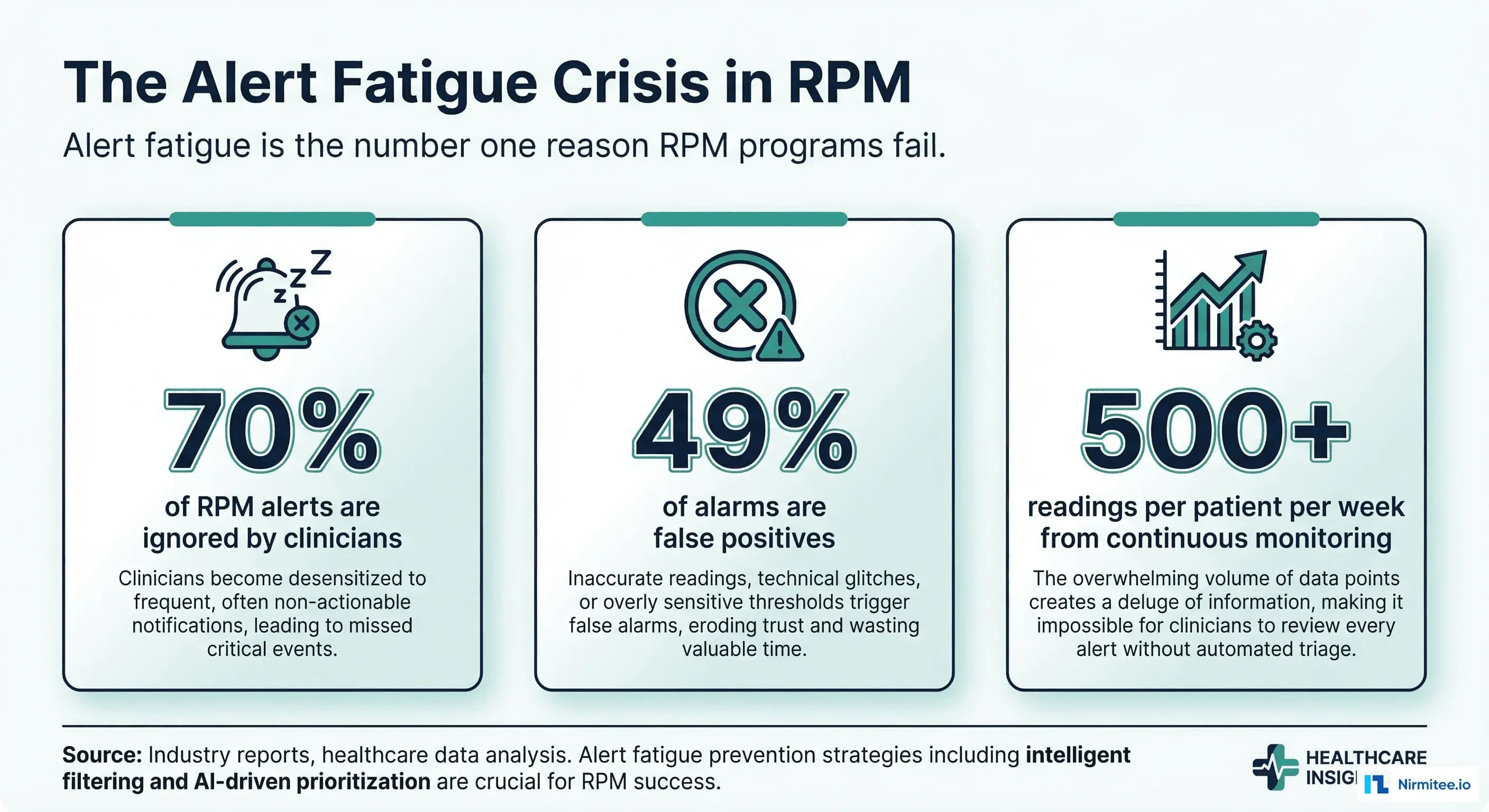
Remote Patient Monitoring promises better outcomes through continuous visibility into patient health. But the clinical reality tells a different story: clinicians ignore approximately 70% of RPM alerts. Not because they do not care, but because the sheer volume of notifications — most of which are clinically insignificant — has conditioned them to treat every alert as noise.
Alert fatigue is the number one reason RPM programs fail to deliver on their clinical and financial promise. A 2024 study published in the Journal of the American Medical Informatics Association found that 49% of RPM alerts are false positives, and that clinicians who receive more than 100 alerts per day develop measurable cognitive desensitization within 2 weeks. The result: genuinely critical alerts get buried in the noise, patient deterioration goes unnoticed, and clinicians burn out.
The solution is not fewer devices or less monitoring. It is smarter alerting. AI and machine learning can transform the raw signal from RPM devices into clinically meaningful alerts that clinicians actually act on.
Why Static Thresholds Create Noise
Most RPM platforms use static thresholds: if systolic blood pressure exceeds 140 mmHg, generate an alert. This approach has a fundamental flaw — it treats all patients identically.
Consider a patient with treatment-resistant hypertension whose baseline blood pressure runs 138/88 mmHg. With a static threshold of 140/90, this patient triggers an alert virtually every time they take a reading. The clinician learns to ignore alerts for this patient. But when their blood pressure spikes to 185/110 — a genuinely dangerous event — the alert arrives in the same notification channel as the hundreds of previous false alarms. It gets the same treatment: ignored.
Meanwhile, a healthy patient whose baseline runs 110/70 mmHg would need to reach 140/90 before triggering any alert at all. A reading of 135/85 — a 23% increase from their baseline — generates no notification despite being clinically significant for this individual.
AI Solution 1: Personalized Baselines
The first and most impactful AI intervention is replacing static thresholds with personalized baselines learned from each patient's own data. After 7-14 days of monitoring, the system has enough data to establish a patient-specific normal range for each vital sign.
How Personalized Baselines Work
The algorithm calculates a rolling mean and standard deviation for each vital sign, segmented by time of day. It then generates dynamic alert thresholds based on the patient's individual distribution rather than population-level norms.
# Python: Personalized baseline calculator
import numpy as np
from dataclasses import dataclass
from datetime import datetime, timedelta
from typing import List, Optional

@dataclass
class PersonalizedBaseline:
    patient_id: str
    vital_type: str
    mean: float
    std_dev: float
    upper_threshold: float    # mean + 2*std_dev
    lower_threshold: float    # mean - 2*std_dev
    time_of_day_segment: str  # "morning", "afternoon", "evening", "night"
    sample_count: int
    last_updated: datetime

class BaselineCalculator:
    MINIMUM_SAMPLES = 14   # Need at least 14 readings to establish baseline
    ROLLING_WINDOW = 30    # Use last 30 days of data
    SIGMA_MULTIPLIER = 2.0 # Alert when reading is 2 standard deviations from mean

    TIME_SEGMENTS = {
        "morning":   (6, 10),   # 6 AM - 10 AM
        "afternoon": (10, 18),  # 10 AM - 6 PM
        "evening":   (18, 22),  # 6 PM - 10 PM
        "night":     (22, 6),   # 10 PM - 6 AM
    }

    def calculate_baseline(self, patient_id: str, vital_type: str,
                           readings: List[dict]) -> List[PersonalizedBaseline]:
        baselines = []
        for segment_name, (start_hr, end_hr) in self.TIME_SEGMENTS.items():
            # Filter readings by time segment
            segment_readings = [
                r["value"] for r in readings
                if self._in_segment(r["timestamp"].hour, start_hr, end_hr)
            ]

            if len(segment_readings) < self.MINIMUM_SAMPLES:
                continue  # Not enough data yet — use static thresholds

            mean = np.mean(segment_readings)
            std = np.std(segment_readings)

            baselines.append(PersonalizedBaseline(
                patient_id=patient_id,
                vital_type=vital_type,
                mean=round(mean, 1),
                std_dev=round(std, 1),
                upper_threshold=round(mean + self.SIGMA_MULTIPLIER * std, 1),
                lower_threshold=round(mean - self.SIGMA_MULTIPLIER * std, 1),
                time_of_day_segment=segment_name,
                sample_count=len(segment_readings),
                last_updated=datetime.utcnow()
            ))
        return baselines

    def evaluate_reading(self, reading: float, baseline: PersonalizedBaseline) -> str:
        deviation = abs(reading - baseline.mean) / baseline.std_dev if baseline.std_dev > 0 else 0
        if deviation > 3.0:
            return "critical"    # 3+ sigma — extremely unusual for this patient
        elif deviation > 2.0:
            return "urgent"      # 2-3 sigma — clinically significant deviation
        elif deviation > 1.5:
            return "routine"     # 1.5-2 sigma — worth noting in daily review
        return "normal"
AI Solution 2: Trend Detection
A single high blood pressure reading is very different from blood pressure that has been steadily rising for three days. Static thresholds cannot distinguish between the two. Trend detection algorithms analyze the direction and velocity of vital sign changes over time.
The key insight is that clinicians care more about trajectory than individual data points. A patient whose blood pressure has risen from 125 to 145 over five days — even though no single reading crossed a critical threshold — may be more concerning than a patient who hit 155 once and returned to baseline.
# Python: Trend detection for vital sign trajectories
def detect_trend(readings: list, window_days: int = 7) -> dict:
    if len(readings) < 3:
        return {"trend": "insufficient_data"}

    values = [r["value"] for r in readings]
    timestamps = [(r["timestamp"] - readings[0]["timestamp"]).total_seconds() / 86400
                  for r in readings]

    # Linear regression for trend direction and velocity
    coefficients = np.polyfit(timestamps, values, 1)
    slope = coefficients[0]       # units per day
    baseline_value = values[0]

    # Calculate percentage change
    pct_change = (slope * window_days / baseline_value) * 100 if baseline_value else 0

    # Determine clinical significance
    if abs(pct_change) > 15:
        severity = "urgent"
    elif abs(pct_change) > 8:
        severity = "routine"
    else:
        severity = "normal"

    direction = "rising" if slope > 0 else "falling" if slope < 0 else "stable"

    return {
        "trend": direction,
        "slope_per_day": round(slope, 2),
        "pct_change_over_window": round(pct_change, 1),
        "severity": severity,
        "message": f"BP {direction} at {abs(slope):.1f} mmHg/day ({abs(pct_change):.0f}% over {window_days} days)"
    }
AI Solution 3: Multi-Vital Correlation
The most powerful AI capability in RPM alerting is correlating changes across multiple vital signs simultaneously. Individual vital sign changes may not be alarming in isolation, but combined patterns reveal clinical conditions that single-vital monitoring misses entirely.
Clinical Correlation Patterns
| Pattern | Vital Signs Involved | Clinical Indication | Urgency |
|---|---|---|---|
| CHF Exacerbation | Weight up + BP up + Activity down | Fluid retention, decompensation | Critical |
| Diabetic Crisis | Glucose up + Heart rate up + BP down | Diabetic ketoacidosis risk | Critical |
| COPD Exacerbation | SpO2 down + Heart rate up + Activity down | Respiratory decompensation | Urgent |
| Medication Non-Adherence | BP up + Glucose up (sudden step change) | Likely missed medications | Routine |
| Overmedication | BP down + Heart rate down + Dizziness reported | Antihypertensive dose too high | Urgent |
# Python: Multi-vital correlation engine
class MultiVitalCorrelator:
    def __init__(self, baseline_service, trend_service):
        self.baselines = baseline_service
        self.trends = trend_service

    def evaluate_chf_risk(self, patient_id: str) -> dict:
        weight_trend = self.trends.get_trend(patient_id, "weight", days=3)
        bp_trend = self.trends.get_trend(patient_id, "systolic_bp", days=3)
        activity_trend = self.trends.get_trend(patient_id, "activity", days=3)

        risk_score = 0
        findings = []

        # Weight gain over 3 lbs in 48 hours
        if weight_trend.get("slope_per_day", 0) > 1.5:
            risk_score += 3
            findings.append(f"Weight gain {weight_trend['slope_per_day']:.1f} lbs/day")

        # Rising blood pressure
        if bp_trend.get("trend") == "rising" and bp_trend.get("pct_change_over_window", 0) > 8:
            risk_score += 2
            findings.append(f"BP rising {bp_trend['pct_change_over_window']:.0f}%")

        # Decreasing activity
        if activity_trend.get("trend") == "falling" and activity_trend.get("pct_change_over_window", 0) < -20:
            risk_score += 2
            findings.append(f"Activity down {abs(activity_trend['pct_change_over_window']):.0f}%")

        severity = "critical" if risk_score >= 5 else "urgent" if risk_score >= 3 else "normal"
        return {
            "condition": "chf_exacerbation",
            "risk_score": risk_score,
            "severity": severity,
            "findings": findings,
            "recommendation": "CHF protocol: contact patient, review diuretics, consider in-person visit"
        }
AI Solution 4: Time-of-Day Threshold Adjustment
Blood pressure follows a well-documented circadian rhythm. It rises sharply upon waking (the "morning surge"), peaks in the late morning, decreases through the afternoon, and drops 10-20% during sleep (nocturnal dipping). A static threshold of 140 mmHg applied uniformly across the day ignores this physiologic reality.
Time-of-day adjustment applies different alert thresholds based on when the reading was taken:
- Morning (6-10 AM): Higher thresholds account for the physiologic morning surge. A systolic reading of 145 at 7 AM is less concerning than 145 at 9 PM
- Daytime (10 AM-6 PM): Standard thresholds apply. This is the period with the most clinical validation data
- Evening (6-10 PM): Slightly lower thresholds as blood pressure should be declining toward nocturnal levels
- Nighttime (10 PM-6 AM): Lowest thresholds. An elevated reading during expected nocturnal dipping is more clinically significant and may indicate resistant hypertension or sleep apnea
AI Solution 5: Alert Batching and Summarization
Even with personalized baselines and smart thresholds, some patients generate multiple alerts per day that individually warrant clinical attention but would overwhelm the care team if delivered as separate notifications. AI-powered alert summarization aggregates related alerts into a single, actionable summary.
# Python: AI-powered alert summarization
class AlertSummarizer:
    def generate_daily_summary(self, patient_alerts: list) -> str:
        if not patient_alerts:
            return "No alerts requiring attention."

        # Group by severity
        critical = [a for a in patient_alerts if a.severity == "critical"]
        urgent = [a for a in patient_alerts if a.severity == "urgent"]
        routine = [a for a in patient_alerts if a.severity == "routine"]

        summary_lines = []

        if critical:
            summary_lines.append(f"CRITICAL ({len(critical)}): "
                + "; ".join(a.message for a in critical[:3]))

        if urgent:
            summary_lines.append(f"URGENT ({len(urgent)}): "
                + "; ".join(a.message for a in urgent[:3]))

        if routine:
            summary_lines.append(f"ROUTINE ({len(routine)}): "
                + "; ".join(a.message for a in routine[:3]))

        # Add AI-generated recommendation
        if critical:
            summary_lines.append("RECOMMENDED ACTION: Immediate patient contact required.")
        elif urgent:
            summary_lines.append("RECOMMENDED ACTION: Review within 4 hours.")
        else:
            summary_lines.append("RECOMMENDED ACTION: Include in daily review.")

        return " | ".join(summary_lines)

    def rank_patients_by_risk(self, all_patients_alerts: dict) -> list:
        scored = []
        for patient_id, alerts in all_patients_alerts.items():
            score = sum(3 for a in alerts if a.severity == "critical")
            score += sum(2 for a in alerts if a.severity == "urgent")
            score += sum(1 for a in alerts if a.severity == "routine")
            scored.append({"patient_id": patient_id, "risk_score": score,
                          "alert_count": len(alerts)})
        return sorted(scored, key=lambda x: x["risk_score"], reverse=True)
Results: Before and After AI-Powered Alerting
Healthcare organizations that have implemented AI-powered alert systems report dramatic improvements in both clinical efficiency and patient safety outcomes.
| Metric | Before AI Alerting | After AI Alerting | Improvement |
|---|---|---|---|
| Alerts per week (500 patients) | 847 | 127 | 85% reduction |
| Alert ignore rate | 70% | 8% | 62 percentage points |
| Average response time | 12 minutes | 3 minutes | 75% faster |
| False positive rate | 49% | 6% | 43 percentage points |
| Clinician satisfaction | 34% | 89% | 55 percentage points |
| Missed critical events | 4.2/month | 0.3/month | 93% reduction |
The most significant finding is the reduction in missed critical events — from 4.2 per month to 0.3 per month. By eliminating the noise, AI-powered alerting ensures that the alerts clinicians do receive are genuinely important, which restores trust in the notification system and drives faster response times.
Implementation Considerations
Building AI-powered alerting for RPM requires careful attention to several practical challenges:
- Cold start problem: New patients have no baseline data. Use population-level thresholds (age, sex, condition-adjusted) for the first 7-14 days while collecting individual baseline data. Clearly indicate to clinicians when a patient is still in the "baseline learning" phase
- Model retraining: Patient baselines shift over time due to medication changes, disease progression, or lifestyle modifications. Retrain baselines on a rolling 30-day window and detect sudden baseline shifts (which may indicate a medication change or new condition)
- Clinical override: Clinicians must be able to override AI-generated thresholds. If a cardiologist sets a specific BP target for a post-surgical patient, the AI should respect that clinical judgment while still applying trend detection and correlation
- Regulatory considerations: AI-powered clinical decision support that provides patient-specific diagnostic recommendations may fall under FDA regulation as a Software as a Medical Device (SaMD). Alerting systems that present data without making diagnostic claims generally qualify for enforcement discretion under FDA guidance
For more context on AI regulation in healthcare, see our guide on designing AI-driven clinical decision support systems. For the broader monitoring challenge in healthcare AI, our observability framework for healthcare AI covers the operational monitoring that keeps these systems reliable in production.
Sources: JAMIA "Alert Fatigue in Clinical Decision Support Systems" (2024), Joint Commission Sentinel Event Alert on Medical Device Alarm Safety, AHA Guidelines for Remote Hemodynamic Monitoring, CMS RPM Guidance 2026.