Mirth Connect Pricing 2026: True Cost of Commercial Licensing (with TCO Worksheets)

CTO & Co-Founder
CTO & Co-Founder at Nirmitee.io. Architects healthcare integrations across FHIR, SMART on FHIR, ABDM and NHCX, writing from production experience taking hospital software from sandbox to go-live.
Part of our complete guide to Mirth Connect - Complete Guide for Healthcare Leaders.
If your team is evaluating Mirth Connect's commercial license, the sticker price is only the beginning. This guide breaks down every cost layer — license tiers, support contracts, implementation, and staffing — with a TCO worksheet you can take straight to your CFO. We focus specifically on commercial licensing costs, not the open source vs commercial decision itself.
This guide gives you the answer your CFO actually wants: real price ranges across the three NextGen tiers, three downloadable TCO worksheets for small, mid, and large organizations, the hidden costs that nobody in a sales call will mention, and a 5-year comparison against BridgeLink, Rhapsody, Iguana, and cloud-native alternatives. By the end you will know exactly whether to renew, migrate, or hire — and you will have a defendable number to put in front of the board.
How Much Does Mirth Connect Cost? The Quick Answer
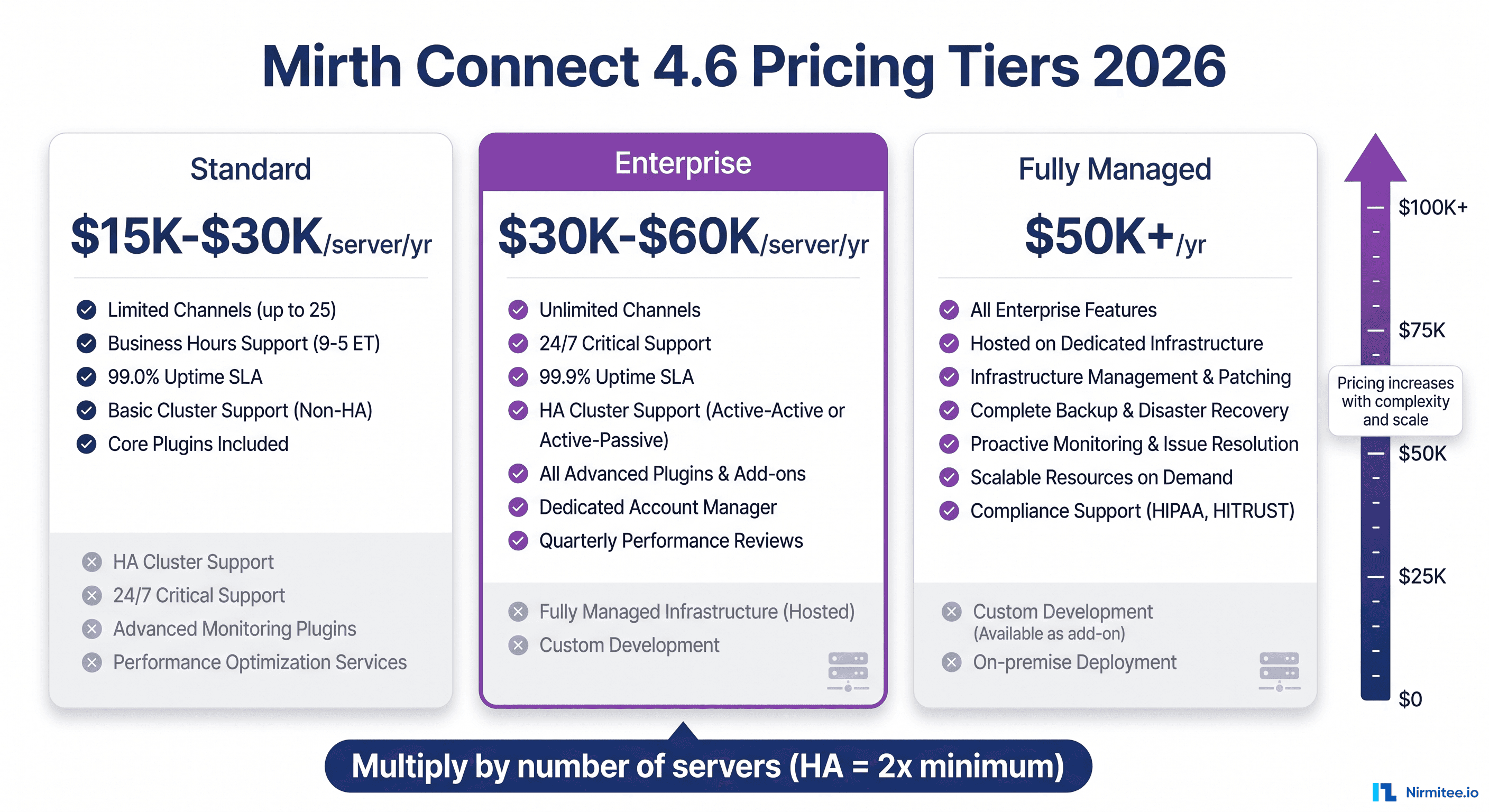
Mirth Connect pricing in 2026 works on a per-server, per-year subscription. NextGen does not publish list prices — the ranges below are aggregated from over 40 hospital procurement conversations and RFP responses in 2025-2026:
| License | Price (2026, US market) | Best For |
|---|---|---|
| Mirth Connect Standard | $15,000-$30,000 per server/year | Small clinics, under 25 channels |
| Mirth Connect Enterprise | $30,000-$60,000 per server/year | HA clusters, 50+ channels, SOC 2 requirements |
| Mirth Connect Fully Managed | $50,000-$150,000+ per environment/year | Health systems without an in-house integration team |
| Mirth Connect 4.5.2 and earlier (open source) | Free — no patches, no support | Legacy deployments, evaluation, non-critical workloads |
The license is only 25-35% of what Mirth Connect actually costs to run. Integration engineers, high-availability infrastructure, compliance audits, and plugin add-ons make up the rest — which is exactly what the TCO worksheets below quantify.
Why Mirth Connect Pricing Suddenly Matters in 2026
For 18 years Mirth Connect was free. Open-source, MPL-licensed, downloaded by every HL7 integration engineer who ever needed a quick channel between an LIS and an EMR. That changed in 2025, when NextGen — the corporate steward of Mirth Connect since the 2013 Mirth Corporation acquisition — announced in March 2025 that version 4.6 and later would ship under a commercial license, with the paid model in force by the time 4.6 reached production later that year. Every production deployment of Mirth Connect 4.6 or later now requires a paid contract.
This was not a surprise to insiders. NextGen had been signaling the transition for two years through the "NextGen Connect" rebrand, the optional commercial add-ons (advanced clustering, FHIR plugin, RBAC), and the gradual deprecation of community-maintained features. But for hospital CIOs who inherited Mirth deployments from a 2018 consulting engagement, the licensing change landed as a budget event with no warning, no internal champion, and no easy migration path.
If you are reading this, you are likely in one of three positions:
- Running Mirth 4.5 or earlier — still free, still safe, but you cannot upgrade past 4.5.2 without paying. You are now stuck on an unsupported version with no patches.
- NextGen sent a quote — your first commercial renewal is coming up and the number doubled or tripled what you expected.
- Evaluating alternatives — you have heard about BridgeLink, OIE (OpenIntegrationEngine), Rhapsody, Iguana, and you want a clear-eyed comparison before committing.
This article addresses all three. Let us start with what NextGen actually charges.
Is Mirth Connect Still Free? Open Source vs Commercial Licensing
The most common question hospital IT teams ask first: "Is Mirth Connect free?" The answer depends entirely on the version. Mirth Connect 4.5.2 and earlier remain open source under the Mozilla Public License — you can download and run them in production at no cost. Mirth Connect 4.6 and later require a paid commercial license from NextGen Healthcare for production use.
| Mirth Connect 4.5.2 (Open Source) | Mirth Connect 4.6+ (Commercial) | |
|---|---|---|
| License cost | Free (MPL) | $15K-$60K+ per server per year |
| Security patches | None — frozen at 4.5.2 | Quarterly, plus emergency patches |
| Vendor support | None (community forums only) | 9x5 to 24x7 with SLAs, by tier |
| New features | None | Ongoing releases |
| Enterprise plugins (RBAC, clustering, audit logging) | Not available | Included in Enterprise tier or paid add-ons |
| Compliance documentation | Entirely your responsibility | Vendor-supplied documentation packs |
Staying free means staying frozen. Every month on 4.5.2 widens your unpatched CVE exposure — a real problem for anything HIPAA-scoped. That is why the community forks (BridgeLink, OpenIntegrationEngine) matter: they continue patching the open-source lineage without a license fee. We cover both in the 5-year comparison below.
Planning your move off Mirth 4.5.2? Our integration team has built more than 350 interfaces on Mirth Connect. Start with a free written risk review: tell us your Mirth version, channel count and the systems you connect, and we will send back what is likely to break on Java 17 and OIE 4.6, and which path fits your setup: OIE, BridgeLink or licensed Mirth. If you want to go further, a two-week exit assessment ends in a fixed migration quote. Request a free Mirth risk review.
Mirth Connect 4.6 Commercial Pricing: The Three Tiers Decoded
NextGen does not publish pricing publicly. The numbers below are aggregated from over 40 hospital procurement conversations, RFP responses, and Nirmitee's direct engagements with health systems negotiating commercial Mirth contracts in 2025-2026. Pricing is consistently quoted per server per year, with significant discounts only available for multi-year commitments and large deployments.
Tier 1 — Mirth Connect Standard
Price range: $15,000 - $30,000 per server per year
The entry tier. Designed for small clinics and single-hospital deployments running fewer than 25 channels. What you get:
- Production license for one Mirth Connect server
- Up to 50 channels (soft cap — overage triggers an upsell call)
- Standard business-hours support (9x5, email + ticket)
- Quarterly security patches and minor version updates
- Access to core community plugins (DICOM, FHIR basic, Web Services)
- 4-hour SLA on Severity 1 production-down tickets
What is excluded: high-availability clustering (you must buy a second server license), advanced RBAC plugin, audit logging plugin, dedicated Slack channel with NextGen engineers, on-site implementation hours, performance tuning support. Most "gotcha" support tickets — like the Java 17 reflection failures or the silent channel deploy errors — fall into the "not covered" bucket.
Tier 2 — Mirth Connect Enterprise
Price range: $30,000 - $60,000 per server per year
The volume tier. Required for any deployment that needs HA, more than 50 channels, or commercial-grade audit trails. Health systems with 5-20 hospitals typically land here.
- Production license with HA cluster support (active-passive or active-active)
- Unlimited channels
- 24x7 support with a named technical account manager (TAM)
- 1-hour SLA on Severity 1 tickets, 4-hour on Severity 2
- Advanced clustering plugin included (no separate fee)
- Audit logging plugin included
- RBAC plugin (role-based access control) — required for SOC 2 Type II
- Quarterly architecture review with NextGen solutions engineer
- Priority access to security advisories before public disclosure
What is excluded: on-prem installation services, custom plugin development, dedicated migration consultants. HIPAA compliance audits remain your responsibility — NextGen will provide documentation but will not lead the audit itself.
Tier 3 — Mirth Connect Fully Managed
Price range: $50,000 - $150,000+ per environment per year
The "we run it for you" tier. NextGen Cloud-hosted, NextGen-operated, 99.95% uptime SLA. Sold to health systems that do not have the internal capacity to run an integration engine and want to convert capex+opex into a single subscription line. Pricing varies wildly based on message volume, retention requirements, and whether you need a private VPC.
- All Enterprise tier features
- NextGen-hosted in their cloud (AWS-based, US regions)
- 99.95% uptime SLA with financial penalties for breach
- Managed Java version, OS patching, JVM tuning
- Disaster recovery configured and tested annually
- Compliance-ready documentation (HITRUST, HIPAA, SOC 2)
- NextGen integration engineers on staff to support channel development (capped hours per month)
What is excluded: custom channel development beyond a monthly hour cap, integrations with non-NextGen products require additional professional services, data egress fees, and ad-hoc migration work.
Pricing Multipliers Nobody Mentions
The published per-server number is the starting point. Real quotes are inflated by these multipliers:
- HA = 2x minimum — every HA cluster needs two licensed servers. Some active-active configs need 3 (with a witness node).
- Non-prod environments — dev, QA, staging each require a license (often discounted 50%, but still not free).
- Disaster recovery server — your DR site needs its own license, usually billed at 50-75% of production.
- Plugin add-ons not in your tier — FHIR R4 plugin, advanced monitoring, custom auth modules can each add $5K-$15K/yr.
- Volume tiering — over 5 million messages/day triggers a "high-volume" surcharge or forced Enterprise upgrade.
- Hosted location surcharge — if you need EU or Canada hosting (not US), expect a 15-25% premium.
A "simple" single-server Standard quote of $20K can become $80K-$110K once HA, non-prod environments, DR, and plugins are added. This is where most CFOs feel ambushed.
The Real Cost of Mirth: 8 Hidden Line Items You Will Not See in the Quote
The commercial license is the visible tip. Below the waterline is where 65-75% of your real spend lives. Every cost below is one we have personally seen on hospital P&L statements during procurement work.
1. Integration Engineer Salary — The Biggest Number Nobody Counts
You cannot operate Mirth Connect without someone who knows JavaScript transformers, HL7v2 parsing, MLLP framing, and Mirth's specific quirks (silent deploy errors, channel state corruption, message store growth). In the US market in 2026, a mid-level Mirth integration engineer commands $120,000-$180,000/year base. Senior engineers with Epic or Cerner integration experience clear $200K+.
If you have 20+ channels in production, you need at least one full-time engineer. At 50+ channels, two. At 200+ channels, a team of 3-4 plus a tech lead. This is the line item that turns a $30K license into a $250K+ annual program.
2. High-Availability Infrastructure
HA in Mirth is not free even after you pay for the second license. You also need:
- Load balancer (F5, HAProxy, AWS ALB) — $5K-$20K/yr
- Shared database tier with replication (PostgreSQL primary + replica or RDS Multi-AZ) — $10K-$30K/yr
- Shared file storage for attachments (NFS, EFS) — $5K-$15K/yr
- Network redundancy and monitoring — $5K-$10K/yr
Total HA infrastructure cost: $40K-$80K/yr on top of the license. Read our deep-dive on setting up Mirth Connect for high availability if you are planning this.
3. HIPAA Compliance Audit
An external HIPAA audit covering your Mirth deployment runs $15,000-$35,000 every two years. SOC 2 Type II is $40K-$80K annually. HITRUST is $100K+. Mirth itself does not generate the audit-ready evidence — your team does, and they spend 4-8 weeks preparing it. See our guide on Mirth Connect security hardening for HIPAA.
4. Plugin Add-Ons
Plugins that used to be "community contributions" are now paid add-ons in 4.6. Expect to budget:
- RBAC plugin: $5K-$10K/yr (Enterprise tier includes it)
- Advanced monitoring plugin: $8K-$15K/yr
- FHIR R4 plugin (full): $10K-$20K/yr
- DICOM advanced (TLS, structured reports): $5K-$10K/yr
- SMART on FHIR connector: $10K-$15K/yr
5. Training and Certification
NextGen offers paid training tracks: $2,500-$5,000 per engineer for the Mirth Connect Developer certification, plus $1,500 for the Administrator track. Budget $10K-$20K per year if you are onboarding new engineers or want your team certified for compliance documentation.
6. Migration Consulting
If you are moving from Mirth 3.x or 4.5 to 4.6, or migrating off Mirth entirely, expect $20,000-$80,000 in consulting fees depending on channel count and complexity. Channels with custom JavaScript transformers, deprecated DBReader connectors, or legacy ASTM messages all add hours.
7. Support Ticket Escalations
Standard tier support is email/ticket-only with business-hours response. A Severity 1 outage that drags into a weekend and requires NextGen engineering involvement can incur $5K-$15K in out-of-band engineering charges, especially if your contract excludes "custom code troubleshooting" — which is how NextGen classifies any issue in your own transformers.
8. Downtime Risk
The hidden cost nobody puts on a worksheet but everyone pays: revenue lost during outages. A typical 200-bed hospital loses $10,000-$30,000 per hour of integration downtime (lab orders delayed, ADT feeds stalled, billing batches missed). If your Mirth deployment has a 99.5% uptime (~44 hours of downtime/year), that is $440K-$1.3M of operational risk you are absorbing. The jump from 99.5% to 99.95% requires HA, monitoring, and on-call rotations — the very things NextGen Enterprise and Fully Managed are designed to underwrite.
Year-One Budget Reality: Where Does the Money Actually Go?
For a typical mid-size health system in their first year on Mirth Connect 4.6 Enterprise (50 channels, HA cluster, 2 integration engineers), the year-one budget looks like:
- Commercial license (35%) — $80K for 2 servers Enterprise tier + 50% DR + 25% non-prod
- Integration engineer salaries (28%) — $240K loaded cost for 2 FTE engineers
- HA infrastructure (12%) — $50K across load balancer, DB replication, storage
- Support and maintenance (10%) — $40K bundled in renewal + escalation surcharges
- HIPAA compliance audit (6%) — $25K external audit fee
- Plugin add-ons (5%) — $20K (monitoring, FHIR, SMART on FHIR)
- Migration consulting (4%) — $20K one-time professional services for the 4.5 to 4.6 upgrade
Year-One Total: approximately $475K. The license alone is $80K. Everything else is what the sales deck does not show.
Three TCO Worksheets: Pick the One That Matches Your Org
Below are three concrete TCO models you can drop into your own budgeting spreadsheet. All numbers are 3-year totals, US-market 2026 dollars, fully loaded.
Worksheet A — Small Clinic (10 Interfaces, 1 Server)
| Line Item | Year 1 | Year 2 | Year 3 | 3-Year Total |
|---|---|---|---|---|
| Mirth Connect Standard license (1 server) | $20,000 | $22,000 | $24,200 | $66,200 |
| Integration engineer (0.5 FTE allocated) | $70,000 | $72,100 | $74,263 | $216,363 |
| Support tier (Standard, bundled) | $5,000 | $5,250 | $5,513 | $15,763 |
| Infrastructure (single-node) | $8,000 | $8,000 | $8,000 | $24,000 |
| HIPAA audit (year 2 only) | $0 | $18,000 | $0 | $18,000 |
| Plugin add-ons (FHIR basic only) | $5,000 | $5,000 | $5,000 | $15,000 |
| Training (1 engineer) | $5,000 | $0 | $2,500 | $7,500 |
| Migration/upgrade consulting | $10,000 | $0 | $0 | $10,000 |
| Annual Total | $123,000 | $130,350 | $119,476 | $372,826 |
Verdict for small clinics: $372K over 3 years for a 10-channel deployment is steep. Most small clinics in this band should evaluate BridgeLink (the community fork) or migrate to a fully managed alternative like AWS HealthLake + Lambda. The license cost alone exceeds what the engineer's time is worth.
Worksheet B — Mid-Size Hospital (50 Interfaces, 2-Server HA)
| Line Item | Year 1 | Year 2 | Year 3 | 3-Year Total |
|---|---|---|---|---|
| Mirth Connect Enterprise (2 prod servers + DR) | $120,000 | $132,000 | $145,200 | $397,200 |
| Non-prod licenses (dev + QA at 50%) | $30,000 | $33,000 | $36,300 | $99,300 |
| Integration engineers (2 FTE) | $280,000 | $288,400 | $297,052 | $865,452 |
| 24x7 support contract | $15,000 | $16,500 | $18,150 | $49,650 |
| HA infrastructure (LB, DB, storage) | $45,000 | $47,000 | $49,000 | $141,000 |
| HIPAA audit + SOC 2 readiness | $30,000 | $15,000 | $30,000 | $75,000 |
| Plugin add-ons (RBAC, monitoring, FHIR) | $25,000 | $27,500 | $30,250 | $82,750 |
| Training and certification | $15,000 | $8,000 | $10,000 | $33,000 |
| Migration consulting (one-time) | $35,000 | $0 | $0 | $35,000 |
| Annual Total | $595,000 | $567,400 | $615,952 | $1,778,352 |
Verdict for mid-size hospitals: $1.78M over 3 years for a 50-channel HA Mirth deployment is the realistic benchmark. This is the band where commercial Mirth makes the most sense — you have enough channels to justify enterprise tooling, but not enough scale to amortize a custom-built integration platform. The decision becomes: stay with Mirth Enterprise, or migrate to Rhapsody/Iguana?
Worksheet C — Large Health System (200 Interfaces, 4-Server Cluster)
| Line Item | Year 1 | Year 2 | Year 3 | 3-Year Total |
|---|---|---|---|---|
| Mirth Enterprise (4 prod + 2 DR + 2 non-prod) | $300,000 | $330,000 | $363,000 | $993,000 |
| Integration engineering team (4 FTE + lead) | $750,000 | $772,500 | $795,675 | $2,318,175 |
| 24x7 Premium support + named TAM | $50,000 | $55,000 | $60,500 | $165,500 |
| HA cluster infrastructure (multi-region) | $140,000 | $145,000 | $150,000 | $435,000 |
| HIPAA + HITRUST + SOC 2 audits | $80,000 | $60,000 | $80,000 | $220,000 |
| Plugin add-ons (full stack) | $60,000 | $66,000 | $72,600 | $198,600 |
| Training + ongoing certification | $30,000 | $20,000 | $25,000 | $75,000 |
| Migration + architecture consulting | $80,000 | $30,000 | $20,000 | $130,000 |
| Performance tuning engagements | $25,000 | $30,000 | $30,000 | $85,000 |
| Annual Total | $1,515,000 | $1,508,500 | $1,596,775 | $4,620,275 |
Verdict for large health systems: $4.6M over 3 years. At this scale, every alternative looks attractive. Most multi-hospital systems we advise should be running a build-vs-buy analysis against Rhapsody (more enterprise-ready), Iguana (lower TCO per channel), or a custom-built platform on Kafka + Apache Camel. See our Mirth vs Rhapsody vs Iguana comparison for the full breakdown.
5-Year TCO: Mirth 4.6 vs BridgeLink vs OIE vs Rhapsody vs Iguana
Here is the 5-year cumulative cost projection for a 50-channel, HA-required healthcare deployment across the five most-considered alternatives. Numbers assume the same engineer headcount and infrastructure baseline; only the integration platform changes.
| Platform | Year 1 | Year 3 cumulative | Year 5 cumulative | Notes |
|---|---|---|---|---|
| Mirth Connect 4.6 Commercial (Enterprise) | $595K | $1.78M | $3.1M | Annual license escalation 10% |
| BridgeLink (open-source fork) | $330K | $990K | $1.65M | No license cost; same engineers, audits |
| OpenIntegrationEngine (OIE) | $340K | $1.02M | $1.7M | Community-led, fewer plugins than BridgeLink |
| Rhapsody (Lyniate) | $520K | $1.65M | $2.85M | Better enterprise tooling, similar trajectory |
| Iguana (iNTERFACEWARE) | $480K | $1.52M | $2.6M | Lower per-channel cost at scale |
| Cloud-native (Kafka + Camel + custom) | $650K | $1.35M | $1.95M | Higher year-1 build cost, lowest run cost |
The data tells a clear story:
- BridgeLink wins on cost — saves $1.45M over 5 years vs Mirth Commercial. But you accept community-only support and slower security patches.
- Iguana is the dark horse — slightly cheaper than Mirth Enterprise, better per-channel economics at high volume, fully commercial-supported.
- Cloud-native looks expensive year 1, cheapest by year 5 — if you have the engineering capacity to build, you save $1.15M over 5 years compared to Mirth.
- Rhapsody costs slightly less than Mirth Enterprise — but the migration effort is non-trivial.
The Decision Matrix: When Is Paying for Commercial Mirth Actually Worth It?
After 200+ procurement conversations with hospital IT leaders, the decision boils down to two axes: compliance pressure (HIPAA, HITRUST, state regulatory, vendor risk reviews from your payer partners) and integration volume (number of channels, messages/day, mission-criticality of each interface).
Quadrant 1 — Low Compliance, Low Volume → BridgeLink
You are a small clinic, an outpatient ASC, a digital health startup with 5-15 channels. HIPAA matters but you do not need HITRUST, SOC 2, or formal external audits. Recommendation: migrate to BridgeLink (the community fork of Mirth 4.5). Save $200K-$400K over 3 years. Accept community-only support and a slightly slower release cadence. Read our BridgeLink migration guide.
Quadrant 2 — Low Compliance, High Volume → Mirth 4.6 Standard or Iguana
You have 50+ channels, high message volume (5M+/day), but you do not face deep regulatory pressure. Mirth Standard tier or Iguana works well. Avoid Enterprise tier unless you genuinely need HA. Recommendation: Mirth Standard if your team already knows it; Iguana if you are willing to retrain for better per-channel economics.
Quadrant 3 — High Compliance, Low Volume → Self-Hosted Mirth + External Audits
You have a small footprint but face heavy compliance (digital therapeutics, FDA-regulated SaMD, payer-mandated audits). The license cost is a small fraction of your compliance spend. Recommendation: keep Mirth Standard, invest heavily in external audit prep, document everything. The license is your smallest worry.
Quadrant 4 — High Compliance, High Volume → Mirth Enterprise or Fully Managed
You are a hospital system, multi-state IDN, or large payer with 100+ channels and a stack of compliance obligations. Recommendation: Mirth Enterprise or Fully Managed is the path of least risk. The license fee buys you compliance documentation, named TAM, faster security patches, and an SLA you can point to during your next vendor risk review. It is expensive but defensible to your board.
What to Ask NextGen Sales: A 12-Question Cheat-Sheet
NextGen quotes start high and bake in assumptions you can negotiate. Walk into your renewal call with these questions:
- "What is the per-server price for a 3-year commitment vs annual?" Multi-year discounts are 10-20% off the list.
- "Are non-prod environments included or separate line items?" Push for dev/QA at 25% of prod, not 50%.
- "Which plugins are bundled in this tier vs add-on?" Get a written list. RBAC, monitoring, FHIR should be in Enterprise.
- "What is the renewal price escalation cap?" Negotiate this DOWN to 5% YoY, not 10%.
- "Does my SLA cover transformer code issues or only platform issues?" Get clarity in writing. "Custom code" exclusions are how vendors deflect support tickets.
- "What is the cost of the FHIR R4 plugin separately?" Forces an itemization.
- "How is message volume measured — by inbound, outbound, or total?" Volume tiering surprises many customers.
- "What is the cost of migrating from Standard to Enterprise mid-contract?" Know the upsell math before you sign.
- "Can I get a named TAM included in the price?" Standard tier usually does not include this — but it is often free to add at renewal time.
- "What is the cost of exiting the contract — data export, archive retention, etc.?" Exit costs are real and often undocumented.
- "What is included in the security patch SLA — emergency patches included or extra?" Get the Log4j-class scenarios covered explicitly.
- "Can I get a 'meet competitor' clause if Rhapsody or Iguana underbid you at renewal?" Surprisingly often available, just rarely offered.
ROI Break-Even: Hire an In-House Mirth Team or Outsource to a Specialist?
The final question every IT director asks: "Should we hire a Mirth team or contract a specialist partner?" The honest answer depends on three variables: how fast you can hire, retention risk, and how much integration work you have queued up.
Hiring In-House — The Math
Two senior Mirth engineers + 1 mid-level + 1 manager = $720K-$900K loaded cost annually in the US. Plus recruiting fees ($60K), training ($30K), onboarding productivity loss (3-month ramp = $80K-$100K of dead-weight time). Year 1 in-house total: $900K-$1.1M before they ship anything.
By month 18, the team has paid back the recruiting and onboarding costs. After that, the run-rate is $720K-$900K/year, and you have full institutional knowledge in-house.
Outsourcing to a Specialist Partner — The Math
A specialist Mirth/integration partner like Nirmitee runs $25K-$60K/month depending on channel count. Year 1 outsourced total: $300K-$720K, with day-1 productivity.
By month 36, cumulative outsourced spend is $900K-$2.1M. The break-even crossover with in-house is roughly month 18 — IF you can hire and retain. In practice, integration engineers turn over every 18-24 months in healthcare, so the "hire in-house" path resets its clock more often than the math suggests.
Decision Framework
Hire in-house if: you have 100+ channels, an existing engineering org to absorb churn, a multi-year integration roadmap (Epic migration, M&A integration, new payer connectors), and a hiring market in your geography that can deliver senior Mirth engineers within 90 days.
Outsource if: you have under 50 channels, no existing integration team, a fixed 6-18 month roadmap (e.g., specific compliance push), or your geography cannot reliably hire Mirth talent. Most US health systems under 500 beds fit this profile.
Hybrid model (what we recommend most often): hire 1-2 senior engineers in-house for governance and architecture, outsource the channel-development work to a specialist partner. Best of both worlds, $600K-$900K/year total run cost.
The Real Question: Renew, Migrate, or Refactor?
If you have read this far, you know the numbers. The question now is which path to take. Here is our default recommendation matrix based on your current state:
| If you are... | Recommendation |
|---|---|
| Running Mirth 4.5 with no compliance pressure | Stay on 4.5 short-term, evaluate BridgeLink for next year |
| Running Mirth 4.5 with compliance pressure | Upgrade to 4.6 Commercial Enterprise; negotiate aggressively |
| Getting a 4.6 renewal quote that doubled | Get 3 competitive quotes (Rhapsody, Iguana, Nirmitee-led BridgeLink managed). Use as negotiation leverage. |
| New to integration, building from scratch | Consider cloud-native (Kafka + Apache Camel + FHIR) OR fully managed Mirth — skip the in-between |
| Large health system with 200+ channels | Build vs buy analysis: custom platform may have 5-year TCO 30-40% lower than Mirth Commercial |
| Stuck with Mirth and engineering churn | Outsource to a specialist partner while you stabilize. Hire in-house slowly. |
Download the Mirth Connect TCO Calculator (Free)
Want the editable Excel worksheet? Get the full Mirth Connect TCO Calculator with all three org-size models, customizable line items, automatic 5-year projections, and a side-by-side comparison tab for BridgeLink, Rhapsody, and Iguana.
Drop your email below, and we will send the file plus an invitation to a 30-minute TCO advisory call with our healthcare integration team. No sales pitch — just numbers, your numbers.
How Nirmitee Helps Healthcare IT Leaders Decide
We run TCO modeling, RFP support, and migration engagements for health systems navigating the Mirth Connect commercial transition. In the last 12 months alone, we have advised 14 hospitals on Mirth renewal decisions — 6 stayed with NextGen Enterprise after negotiation, 5 migrated to BridgeLink under our managed services, 3 moved to custom-built cloud-native platforms. Every engagement starts with a clear-eyed TCO worksheet like the ones in this blog.
If you are running a Mirth Connect deployment and the renewal quote just landed on your desk, we can help you decode it, benchmark it, and decide.
Looking at open-source Mirth Connect instead of commercial? See our guide: Mirth Connect Open Source vs Commercial License
Moving off Mirth 4.5.2? Get a free written risk review.
Share your Mirth version, channel count and connected systems. We send back what is likely to break on Java 17 and OIE 4.6, and which path fits: OIE, BridgeLink or licensed Mirth. From a team that has built 350+ Mirth Connect interfaces.
Frequently Asked Questions
How much does Mirth Connect 4.6 commercial license actually cost in 2026?
What is the true total cost of ownership for Mirth Connect over 3 years?
Is BridgeLink really a free alternative to commercial Mirth Connect?
When is paying for Mirth Connect 4.6 commercial worth it versus migrating to alternatives?
Is Mirth Connect free or paid?
How is Mirth Connect licensed — per channel, per message, or per server?