Part of our complete guide to Mirth Connect - Complete Guide for Healthcare Leaders.
Every year, healthcare IT leaders face the same high-stakes question: which integration engine should we build our interoperability infrastructure on? The answer in 2026 is more nuanced than ever. Mirth Connect's shift to commercial licensing with version 4.6, Rhapsody's continued dominance in KLAS rankings, and Iguana's code-first approach each serve fundamentally different organizational needs.
This guide cuts through vendor marketing. It delivers an honest, engineer-level comparison for integration architects and hospital IT directors evaluating these three platforms.
For evidence of what Mirth delivers when implemented well, see our case study on a Mirth Connect integration engine for a hospital's HL7/FHIR.
The Healthcare Integration Engine Landscape in 2026
The healthcare interoperability market reached an estimated $4.8 billion in 2025 and is projected to exceed $7.5 billion by 2028. The growth is driven by CMS interoperability mandates, TEFCA adoption, and the accelerating shift from HL7 v2 to FHIR-based workflows.
Integration engines sit at the center of this transformation, and the choice of platform affects everything from staffing costs to regulatory compliance timelines.
Three engines dominate the market: Mirth Connect (NextGen Healthcare), Rhapsody (Rhapsody Health), and Iguana (iNTERFACEWARE). Together, they power the majority of healthcare data exchange in North America. But each takes a fundamentally different approach to solving the same problem.
A Brief History That Matters
Mirth Connect launched in 2006 as an open-source integration engine under the Mirth Corporation, later acquired by Quality Systems (now NextGen Healthcare). For nearly two decades, its open-source model under the Mozilla Public License 2.0 has built the largest community of any healthcare integration tool. The latest open-source version is 4.5.2 (September 2024). Versions 4.6 and beyond are commercial-only, marking a major inflection point that is reshaping the market.
Rhapsody originated as Orion Health's integration platform before spinning out as an independent company. After acquiring Corepoint Health in 2018, Rhapsody now offers two distinct products: Rhapsody (for developers) and Corepoint (for analysts).
The platform has been named Best in KLAS for Integration Solutions for 17 consecutive years through 2026, a record no competitor has matched.
Iguana by iNTERFACEWARE has been in the market since the mid-2000s, focusing on a code-driven, Lua-scripted approach to healthcare integration. It targets organizations that want the flexibility of custom code with the guardrails of a managed platform. Its installer footprint is notably small, running on Windows, Linux, and macOS with minimal infrastructure requirements.
Architecture Deep Dive
Mirth Connect Architecture
Mirth Connect is built on Java and uses a channel-based processing model. Each channel consists of a source connector, optional filters and transformers, and one or more destination connectors. The core processing engine is called Donkey, which handles message routing, queuing, and persistence.
Key architectural characteristics:
- Channel Model: Each integration point (ADT feed, lab results, orders) is a separate channel with its own source, transformer, filter, and destinations
- Transformer Language: JavaScript (Rhino engine with ES6 support) or XSLT for XML transformations
- Inter-channel Communication: The Channel Writer (VM connector) enables message passing between channels, supporting fan-out, aggregation, and pipeline patterns
- Message Storage: Five configurable levels from DEVELOPMENT (full audit trail) to DISABLED (fire-and-forget), with significant performance implications
- Connector Types: 11 built-in connectors, including TCP/MLLP, HTTP/HTTPS, JDBC, File, SMTP, JMS, DICOM, SOAP/WSDL, and Channel Writer
- Database Backend: PostgreSQL (recommended), MySQL, Oracle, SQL Server, or embedded Derby (development only)
For organizations running Mirth in production, understanding Mirth Connect with Apache Kafka is increasingly relevant as message volumes grow.
Rhapsody Architecture
Rhapsody uses a route-based processing model with visual design tools. Routes define the path messages take from ingestion to delivery, with communication points handling protocol specifics and filters managing message transformation and routing logic.
Key architectural characteristics:
- Route Model: Visual route builder where you drag and drop communication points, filters, and connectors onto a canvas
- Communication Points: Protocol-specific adapters for TCP, HTTP, database, file, and more. Each handles connection management, error recovery, and retry logic
- Filter Pipeline: Inline JavaScript, mapper, or conditional filters that transform and route messages within a route
- Message Tracking: Built-in message tracking and search across all routes with correlation support
- Clustering: Native clustering support for horizontal scaling and failover
- Dual Products: Rhapsody (developer-focused, full scripting) and Corepoint (analyst-focused, visual-only) share the same engine but different UIs
Iguana Architecture
Iguana takes a code-first approach using Lua scripting. Rather than visual drag-and-drop or XML configuration, integration logic is written as Lua scripts that process messages through a component pipeline.
Key architectural characteristics:
- Component Model: Source components (message intake), data components (parsing/transformation), and destination components (transmission)
- Scripting Language: Lua with a built-in IDE featuring autocomplete, live debugging, and sample data testing
- Protocol Support: REST/SOAP APIs, HL7 over LLP (TCP/IP), SFTP, and database adapters
- Template System: Reusable component templates and code modules rather than fixed adapters
- Minimal Footprint: Small installer, runs on Windows/Linux/macOS with minimal infrastructure
- Epic FHIR Adapter: Pre-built adapter framework for Epic EMR FHIR integration
HL7 v2 and FHIR Support Comparison
HL7 v2 Support
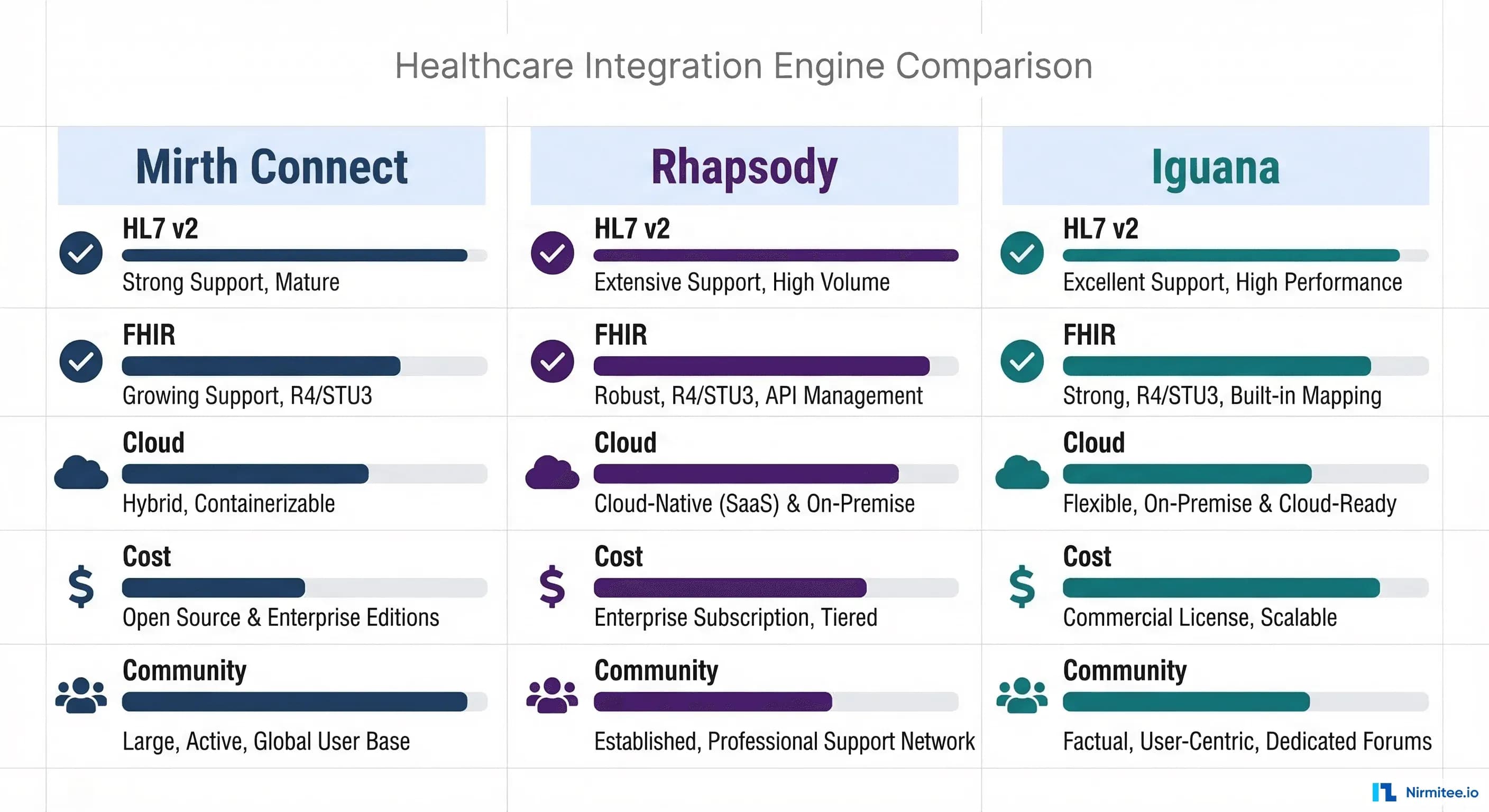
All three engines have mature HL7 v2 support, which is expected given that HL7 v2 still handles the majority of clinical data exchange in US hospitals. The differences are in how they handle the complexity:
| Capability | Mirth Connect | Rhapsody | Iguana |
|---|---|---|---|
| HL7 v2 Parsing | Built-in with auto-detection of version | Full parser with visual segment mapper | Lua-based parser with sample data preview |
| Message Validation | Configurable per-channel, supports strict/lenient modes | Profile-based validation with conformance checking | Custom validation via Lua rules |
| Segment Mapping | JavaScript drag-and-drop mapper plus code | Visual mapper with auto-suggest | Code-driven with IDE autocomplete |
| ACK Generation | Automatic with configurable rules | Automatic with enhanced error codes | Programmable ACK generation |
| Custom Z-Segments | Full support via JavaScript | Visual Z-segment definition | Full support via Lua |
| Batch Processing | File batch reader with configurable delimiters | Batch/debatch with visual configuration | File reader with Lua parsing |
FHIR R4 Support
FHIR support varies greatly across the three platforms, and this is where the differences start to matter for 2026 implementations:
| FHIR Capability | Mirth Connect | Rhapsody | Iguana |
|---|---|---|---|
| FHIR R4 Read/Write | HTTP connector + JSON transformer | Native FHIR communication point | REST API connector + Lua JSON |
| FHIR Resource Builder | JavaScript-based, manual JSON construction | Visual FHIR resource mapper | Lua templates for FHIR resources |
| SMART on FHIR | Manual OAuth 2.0 implementation via HTTP connector | Built-in SMART on FHIR support | OAuth via REST connector configuration |
| Bulk Data ($export) | Custom implementation required | Supported with async patterns | Custom Lua implementation |
| FHIR Subscriptions | Webhook listener via HTTP source | Native subscription support | REST webhook listener |
| CDS Hooks | HTTP connector, manual integration | Pre-built CDS Hooks adapter | REST connector, manual integration |
Verdict: Rhapsody has the most mature native FHIR support with purpose-built communication points. Mirth Connect and Iguana both handle FHIR effectively but require more custom development. For organizations with heavy FHIR requirements (TEFCA participation, payer-to-payer exchange, patient access APIs), Rhapsody's native support reduces development time.
Cloud Deployment and Managed Services
Cloud readiness is no longer optional for healthcare integration platforms. CMS has made cloud interoperability a compliance requirement, and health systems are increasingly rejecting on-premise-only solutions.
Mirth Connect Cloud Options
- Self-hosted: Deploy on AWS EC2, Azure VMs, or any Docker-compatible environment. The official Docker image supports multi-architecture (amd64/arm64) from version 4.4.0+.
- Mirth Fully Managed: NextGen's cloud-native SaaS offering hosted on AWS. Currently US-only. Flat-fee pricing with no per-interface charges.
- Mirth Command Center: Centralized monitoring and alerting across on-premise and cloud deployments (US-only currently).
- Docker Compose: Official Docker Compose configurations for PostgreSQL-backed deployments, widely used for development and testing.
For detailed deployment guidance, see our guide on setting up Mirth Connect for high availability.
Rhapsody Cloud Options
- Rhapsody as a Service (RaaS): Fully managed cloud deployment with Rhapsody handling infrastructure, patching, backups, and monitoring. The most mature cloud-native offering among the three.
- Self-hosted Cloud: Deploy on AWS or Azure with standard VM-based architectures.
- API Guardian: Cloud-native API management layer for securing and monitoring FHIR APIs.
- Envoy: Automated integration solution that reduces the need for custom route development.
Iguana Cloud Options
- On-premise: Traditional server installation, still the most common deployment model.
- Cloud VM: Deploy on any cloud provider's virtual machines.
- Hybrid with Tunneling: Platinum tier includes a tunneling protocol for connecting on-premise installations to cloud services securely (not available in Gold tier).
- Hosted: iNTERFACEWARE can host Iguana on your behalf, though this is less mature than Rhapsody's RaaS.
Licensing, Pricing, and the Mirth 4.6 Commercial Shift
The Mirth Connect Licensing Change
The most significant market development in 2025-2026 is Mirth Connect's transition from open-source to commercial licensing. Here is what happened and why it matters:
- Versions 4.5.2 and earlier: Open-source under the Mozilla Public License 2.0. Free to use, modify, and distribute. Community-supported with optional paid support from NextGen.
- Versions 4.6 and later: Commercial-only. Requires a paid license from NextGen Healthcare. Source code no longer publicly available.
- Pricing Model: Annual flat-fee licensing per server. No per-interface or per-data-source charges. Three tiers with varying levels of extensions and support cases.
- Open-source Forks: The community has responded with forks like BridgeLink (168 GitHub stars) and Open Integration Engine (161 stars), both maintaining the open-source codebase.
For organizations evaluating the impact of this change, our analysis of Mirth Connect integration services covers migration strategies and support options.
Pricing Comparison
| Pricing Factor | Mirth Connect | Rhapsody | Iguana |
|---|---|---|---|
| Entry Price | Free (4.5.x OSS) / $30K-$50K/yr (4.6+ commercial) | $75K-$200K/yr (varies by deployment) | $10K+/yr (Gold tier, min. 2 integrations) |
| Pricing Model | Per-server, flat fee | Per-environment or enterprise license | Per-integration count |
| Per-Interface Charges | None | Varies by contract | Based on integration count |
| Support Included | Tiered (Basic/Gold/Platinum) | Included with license | Gold: business hours; Platinum: 24/7 |
| Managed Cloud | Mirth Fully Managed (additional cost) | RaaS (premium pricing) | Hosted option (contact sales) |
| Free Trial | OSS version available; commercial trial on request | Evaluation on request | 30-day free trial |
Total Cost of Ownership: 5-Year Analysis
The license cost is just the beginning. Integration engines have high hidden costs that vary dramatically by platform:
| Cost Category | Mirth Connect (Commercial) | Rhapsody | Iguana |
|---|---|---|---|
| License (5-year) | $150K-$250K | $375K-$1M | $50K-$400K |
| Infrastructure | $30K-$60K (self-hosted) | $20K-$50K (RaaS included) | $20K-$40K |
| Staffing (1-2 FTEs) | $150K-$300K/yr x 5 | $100K-$200K/yr x 5 | $120K-$250K/yr x 5 |
| Training | $5K-$15K | $10K-$30K | $5K-$10K |
| Consulting/Implementation | $25K-$75K | $50K-$150K | $20K-$50K |
| 5-Year TCO Range | $960K-$1.9M | $955K-$2.4M | $695K-$1.75M |
Key Insight: Staffing is the largest cost for all three platforms, typically 60-70% of TCO. Rhapsody's higher license cost is partially offset by lower staffing needs due to its visual tools and vendor support. Mirth's large community means easier hiring but requires more senior engineers for complex deployments. Iguana's Lua scripting requires specific skills that may be harder to find in the healthcare market.
Community, Support, and Ecosystem
Mirth Connect
- Community: The largest open-source healthcare integration community. 1,100+ GitHub stars, 440 forks, active Slack channel, and forums. Community contributions include MirthSync (version control), Python and PowerShell API clients, Jest testing framework, and Docker images.
- Vendor Support: NextGen provides tiered support (Basic/Gold/Platinum) with the commercial license. Mirth Connect Training offers professional certification courses.
- Third-party Ecosystem: Extensive tooling including MirthSync for CI/CD, Mirth-Migrator for environment management, and multiple programming language clients.
- Talent Pool: Large. Mirth Connect has been the de facto open-source integration engine for 18+ years. Most healthcare integration engineers have Mirth experience.
Rhapsody
- Community: Smaller but more curated. Rhapsody's community portal provides documentation, forums, and training materials. Less open-source tooling, more vendor-provided solutions.
- Vendor Support: Complete support is included with all licenses. Professional services team for complex implementations. Education programs with certification paths.
- KLAS Recognition: 17 consecutive years as Best in KLAS for Integration Solutions (through 2026). This matters for procurement decisions at large health systems where KLAS ratings drive vendor shortlists.
- Talent Pool: Moderate. Rhapsody engineers are less common than Mirth engineers, which can increase hiring costs and timelines.
Iguana
- Community: Smallest of the three. InterfaceWare provides documentation, a FHIR guide, and training resources. Limited third-party tooling.
- Vendor Support: Gold tier includes business-hours support. Platinum adds 24/7 Level 3 support and external authentication integration.
- Annual Conference: IUC (Iguana User Conference) provides direct access to the product team and peer networking.
- Talent Pool: Smallest. Lua scripting for healthcare integration is a niche skill. Plan for longer onboarding times and potentially higher per-engineer costs.
Scalability and Performance
Mirth Connect Scalability
Mirth Connect can handle enterprise-scale workloads but requires deliberate tuning. Default settings (256MB heap, DEVELOPMENT message storage, embedded Derby database) are appropriate only for development. Production deployments processing 10,000+ messages per hour need PostgreSQL, 4- 8 GB heap, RAW or METADATA message storage, and multi-threaded source/destination processing.
Horizontal scaling is achieved through multiple Mirth instances behind a load balancer, with a shared PostgreSQL database. There is no built-in clustering, but the architecture supports it with external coordination.
Rhapsody Scalability
Rhapsody includes native clustering and load balancing, which is a significant advantage for large health systems. The platform is designed for high-availability deployments out of the box, with automatic failover between cluster nodes. Rhapsody as a Service (RaaS) handles scaling automatically.
Iguana Scalability
Iguana scales vertically well due to its small footprint, but horizontal scaling requires the Platinum tier's high availability features. For organizations running fewer than 50 active interfaces, Iguana's single-server performance is typically sufficient. For larger deployments, the Platinum tier is required.
Monitoring and Observability
Production integration engines need robust monitoring. Here is how the three compare:
| Monitoring Capability | Mirth Connect | Rhapsody | Iguana |
|---|---|---|---|
| Built-in Dashboard | Administrator dashboard with channel statistics | Route monitoring with visual status | Web-based dashboard with component status |
| Message Search | Search by content, metadata, date range | Full-text search with correlation tracking | Log search with programmable filters |
| Alerting | Email alerts, configurable thresholds | Multi-channel alerting (email, SNMP, webhook) | Notification components, email alerts |
| External Monitoring | REST API for Prometheus/Grafana integration, OpenTelemetry support (community) | SNMP, REST API, built-in analytics | REST API for external monitoring tools |
| Centralized Monitoring | Mirth Command Center (commercial add-on) | Built into RaaS platform | Requires Platinum tier |
| Log Retention | Configurable via Data Pruner | Configurable per route | Gold: 1 year; Platinum: unlimited |
Standards Support Beyond HL7 and FHIR
Healthcare integration extends well beyond HL7 v2 and FHIR. Here is how each engine handles the broader standards landscape:
| Standard | Mirth Connect | Rhapsody | Iguana |
|---|---|---|---|
| CDA/CCD (Clinical Documents) | XML transformer, requires custom templates | Built-in CDA support with visual mapping | Lua XML parsing with CDA templates |
| DICOM (Medical Imaging) | Built-in DICOM connector (dimse) | Image Director product for DICOM workflows | Not natively supported |
| X12/EDI (Claims/Eligibility) | Custom JavaScript parsing | EDI communication points available | Lua parsing with EDI format support |
| CCDA | XML transformer with CDA templates | Native CCDA support | XML/Lua-based CDA processing |
| NCPDP (Pharmacy) | Custom parsing via JavaScript | Supported via communication point | Custom Lua parsing |
| Direct Messaging | SMTP connector for Direct | Direct Protocol communication point | SMTP-based Direct support |
| IHE Profiles (XDS, PIX/PDQ) | Custom implementation | IHE profile support via adapters | Custom Lua implementation |
Key Takeaway: Rhapsody has the broadest native standards support, which reduces custom development time for organizations that handle multiple data formats. Mirth Connect compensates with its connector flexibility and community-contributed templates. Iguana's Lua scripting can handle any standard, but requires more upfront development.
Developer Experience and Learning Curve
The developer experience varies greatly and directly impacts time-to-first-interface and ongoing maintenance productivity:
Mirth Connect Developer Experience
Mirth's Administrator console is a Java desktop application (or web-based in newer versions) where you build channels by configuring source connectors, writing JavaScript transformers, and setting up destination connectors. The interface is functional but not modern by 2026 standards.
The learning curve for a developer with JavaScript experience is moderate: expect 2-4 weeks to become productive with basic HL7 v2 interfaces, and 2-3 months to master complex multi-channel architectures with error handling patterns.
The JavaScript transformer environment supports ES6 syntax (via the Rhino engine). The inline code editor includes basic syntax highlighting but lacks the debugging capabilities of a full IDE.
Where Mirth excels is in the ecosystem of development tools: MirthSync enables Git-based version control for channels, the Mirth-Jest-Framework allows unit testing transformers outside the Mirth environment, and Docker-based development environments enable reproducible builds. No other integration engine has this level of DevOps tooling.
Rhapsody Developer Experience
Rhapsody's visual route builder is the most polished UI of the three platforms. You drag communication points and filters onto a canvas, connect them with visual routes, and configure each component via property panels.
The visual mapper for HL7 v2 and FHIR transformations greatly reduces the code required for common mapping scenarios. For analysts and junior integration engineers, Rhapsody's Corepoint product provides an even simpler visual-only interface that eliminates scripting entirely for standard interfaces.
The learning curve is moderate for visual builders (1-2 weeks for basic interfaces) but steeper for developers who need to write complex JavaScript filters or custom communication points (4-6 weeks).
The trade-off is that Rhapsody's visual tools can become a constraint for highly complex logic that would be more naturally expressed in code.
Iguana Developer Experience
Iguana's approach is closest to traditional software development. You write Lua scripts in a built-in IDE with autocomplete, live debugging, and the ability to process sample messages interactively.
The IDE shows input data alongside your code, so you can see exactly how transformations apply to real messages. For developers who prefer code over visual tools, this is the most satisfying development experience of the three platforms.
The learning curve depends heavily on Lua familiarity. For developers with experience in Python, JavaScript, or other scripting languages, Lua's syntax is straightforward to learn (1-2 weeks).
The healthcare-specific concepts (HL7 parsing, segment mapping, ACK generation) take an additional 2-4 weeks. The primary challenge is the smaller community: when you hit an edge case, there are fewer StackOverflow answers and blog posts to reference compared to Mirth Connect.
Security and Compliance Considerations
Healthcare integration engines handle PHI (Protected Health Information) across every interface, making security and HIPAA compliance non-negotiable requirements. The three platforms approach security differently:
Mirth Connect Security
Mirth Connect provides TLS 1.2/1.3 encryption for all connectors, configurable via mirth.properties. Role-based access control manages who can view, edit, deploy, and undeploy channels. Audit logging tracks all administrative actions.
The platform was notably affected by the Log4j vulnerability (CVE-2021-44228), which required emergency patching across thousands of deployments. The commercial version includes enhanced security features and faster security patch delivery.
For HIPAA compliance, Mirth supports encrypted message storage, configurable data retention via the Data Pruner (default block size: 1,000 messages per batch), and database-level encryption when using PostgreSQL or Oracle.
Rhapsody Security
Rhapsody's security posture is the most complete out of the box. The platform includes certificate-based mutual TLS authentication, LDAP/Active Directory integration, granular permission models at the route level, and built-in audit trails that satisfy HIPAA audit requirements without additional configuration.
Rhapsody as a Service (RaaS) adds SOC 2 Type II compliance, automated vulnerability scanning, and managed certificate rotation. For organizations subject to state-level privacy regulations (CCPA, SHIELD Act) or international standards (GDPR, PIPEDA), Rhapsody's compliance documentation is the most mature.
Iguana Security
Iguana provides TLS encryption, role-based access control, and audit logging at the Gold tier. The Platinum tier adds external authentication integration (LDAP, SAML, OIDC), which is essential for organizations with centralized identity management.
Log retention is capped at 1 year on Gold (unlimited on Platinum). This can be a compliance consideration for organizations required to retain audit logs for 6+ years under HIPAA. Iguana's small attack surface (minimal dependencies, lightweight runtime) is a security advantage, but the trade-off is less mature built-in compliance tooling compared to Rhapsody.
Real-World Deployment Patterns by Organization Size
The right engine choice often correlates with organizational scale and complexity. Here are the patterns we see most frequently in the field:
Small Clinics and Ambulatory Networks (5-20 Interfaces)
Organizations running fewer than 20 interfaces typically have one integration engineer (often part-time or shared with other IT roles). At this scale, Iguana's Gold tier ($10,000+/year) provides the best value: low cost, quick deployment, and sufficient capability for standard HL7 v2 feeds (ADT, ORM, ORU) between an EHR, lab system, and imaging system.
Mirth Connect open-source (4.5.x) is also viable if the team has Java/JavaScript experience. But the lack of vendor support creates risk for a small team that cannot afford downtime during a production issue.
Community Hospitals (20-100 Interfaces)
Mid-size hospitals with dedicated integration teams typically maintain 20-100 active interfaces spanning EHR, lab, radiology, pharmacy, scheduling, revenue cycle, and public health reporting systems.
This is where the decision gets genuinely difficult. Mirth Connect (commercial) offers the best economics at this scale because the per-server pricing model means adding interfaces does not increase license cost. Rhapsody's visual tools can accelerate interface development but at a greatly higher license cost. Many hospitals at this tier run Mirth Connect commercial with a 2-3 person integration team.
Large Health Systems and IDNs (100-1,500+ Interfaces)
Integrated delivery networks running hundreds or thousands of interfaces across multiple facilities need enterprise-grade reliability, clustering, and vendor support. Rhapsody dominates at this tier because the cost of a production outage (estimated at $7,900-$10,000 per minute for a large health system) easily justifies the premium licensing.
Native clustering eliminates the need for custom high-availability engineering. The KLAS ranking also carries significant weight in procurement committees at organizations of this size. Large health systems that run Mirth Connect at this scale typically have 4-8-person dedicated integration teams and have built significant custom tooling around the platform.
Health Information Exchanges (HIEs) and Public Health
HIEs and public health agencies have unique requirements: multi-tenancy, regulatory mandates, and extreme reliability requirements. Mirth Connect powers about one-third of public Health Information Exchanges in the United States, making it the most proven platform for this use case.
The ability to customize every aspect of the platform, combined with the flat-fee licensing that scales well to thousands of interfaces, makes it the default choice. However, Rhapsody is gaining ground in this segment with its RaaS offering that eliminates the infrastructure management burden for resource-constrained public health agencies.
When to Choose Each Engine
Choose Mirth Connect When:
- You need maximum flexibility, and your team has strong Java/JavaScript skills
- Budget is a primary concern, and you can accept the open-source 4.5.x version or are willing to invest in the commercial license
- You have a large number of interfaces (100+), and the per-server pricing model favors your scale
- Community support is acceptable for your risk profile, or you are purchasing commercial support
- You need CI/CD integration with tools like MirthSync, Git, and Docker-based workflows
- Your team prefers code over visual tools for building and maintaining interfaces
Choose Rhapsody When:
- KLAS rankings matter to your procurement process, and you need a vendor with a proven enterprise track record
- You need native FHIR support with minimal custom development
- High availability and clustering are requirements from day one
- Your team includes both developers and analysts who need different interfaces (Rhapsody + Corepoint)
- Vendor support quality is critical, and you want complete SLAs
- You are a large health system (multi-facility, 500+ interfaces) where the premium license cost is justified by reduced staffing needs
Choose Iguana When:
- You prefer code-first development, and your team is comfortable with Lua (or can learn it)
- You need a lightweight platform with minimal infrastructure overhead
- Budget is constrained, and you need a commercial product at a lower entry price than Rhapsody
- Your integration count is moderate (under 50 active interfaces)
- Cross-platform deployment (Windows/Linux/macOS) is important
- You want a 30-day free trial before committing
Alternatives Worth Considering
Beyond the big three, several cloud-native alternatives are gaining traction in 2026:
Microsoft Azure API for FHIR / Azure Health Data Services
Microsoft's managed FHIR server provides a PaaS approach to healthcare data exchange. It is not a traditional integration engine but handles FHIR-native workflows (patient access APIs, payer-to-payer exchange, bulk export) without the overhead of managing an engine. Best for organizations already invested in the Azure ecosystem with primarily FHIR-based integration needs.
Google Cloud Healthcare API
Google's Healthcare API supports FHIR, HL7 v2, and DICOM data types natively in Google Cloud. It excels at de-identification, BigQuery integration for analytics, and ML pipeline integration. Best for organizations with heavy analytics requirements or those building AI/ML workflows on healthcare data.
AWS HealthLake
Amazon HealthLake is a HIPAA-eligible FHIR data store with natural language processing capabilities. It transforms unstructured clinical data into FHIR resources and supports analytics via Amazon Athena. Best for organizations building data lakes for population health analytics or clinical research on AWS.
Important caveat: These cloud services complement rather than replace traditional integration engines. A typical health system will still need Mirth, Rhapsody, or Iguana to handle HL7 v2 feeds, legacy system connectivity, and complex transformation workflows. The cloud APIs handle the FHIR-native layer.
Migration Considerations
If you are evaluating a switch between engines, consider these migration factors:
| Migration Path | Difficulty | Key Challenges |
|---|---|---|
| Mirth OSS to Mirth Commercial | Low | License procurement, minimal technical changes |
| Mirth to Rhapsody | High | Rewrite all channel logic as Rhapsody routes, retrain team, 6-12 month timeline for 50+ interfaces |
| Mirth to Iguana | High | Rewrite JavaScript transformers to Lua, different paradigm, 6-12 month timeline |
| Rhapsody to Mirth | High | Recreate routes as channels, lose visual tooling, gain community access |
| Iguana to Mirth | Medium-High | Rewrite Lua to JavaScript, similar code-first paradigm eases transition |
| Mirth OSS to BridgeLink fork | Low | Compatible codebase, community-supported, verify plugin compatibility |
Future Outlook: What to Expect in 2027 and Beyond
Several trends will reshape the integration engine landscape over the next 12-24 months:
- TEFCA Adoption Acceleration: As TEFCA (Trusted Exchange Framework and Common Agreement) goes live for more use cases, integration engines that support TEFCA-compliant data exchange patterns will have an advantage. Rhapsody has been the most vocal about TEFCA readiness among the three vendors.
- AI-Assisted Integration: Rhapsody has begun marketing "agent-ready interoperability" designed for both human operators and AI agents. Expect all three vendors to add LLM-powered mapping assistants, anomaly detection, and automated error resolution features within the next 18 months.
- HL7 v2 to FHIR Migration Wave: CMS mandates are pushing payers and providers to expose FHIR APIs. Integration engines will increasingly serve as the HL7-to-FHIR translation layer. Engines with native FHIR resource builders (Rhapsody leads here) will see growing demand.
- Consolidation: The integration engine market is ripe for consolidation. Smaller vendors may be acquired, and the open-source forks of Mirth Connect (BridgeLink, Open Integration Engine) may either gain critical mass or fade if they cannot match the security patching velocity of commercial offerings.
- Cloud-Native Becomes Table Stakes: By 2028, organizations will expect SaaS deployment options from any integration engine vendor. Platforms that remain on-premise-only will lose market share to managed cloud offerings.
Nirmitee's Perspective
At Nirmitee, we have deep expertise in Mirth Connect implementations, from initial deployment to high-availability production configurations. We have helped healthcare organizations deploy, optimize, and scale Mirth Connect across hundreds of interfaces.
Our honest assessment: there is no single "best" engine. The right choice depends on your team's skills, budget constraints, interface volume, and regulatory timeline. Mirth Connect remains our primary recommendation for organizations that value flexibility, community support, and cost-effective scaling.
But we recognize the fits elsewhere too. Rhapsody is the right choice for large health systems that need enterprise-grade support and native clustering. Iguana serves organizations well when they need a lightweight, code-driven platform at a moderate price point.
If you are evaluating integration engines and want an unbiased technical assessment of your specific environment, contact our integration engineering team.
Conclusion
The healthcare integration engine market in 2026 is more competitive and nuanced than at any point in the last decade. Mirth Connect's commercial transition has disrupted the economics that made it the default choice. Meanwhile, Rhapsody continues to dominate enterprise procurement processes, and Iguana carves out a niche for code-savvy teams with moderate budgets.
The decision framework is straightforward:
- Maximum flexibility + large community + best economics at scale: Mirth Connect
- Enterprise-grade support + native FHIR + built-in HA: Rhapsody
- Code-first development + lightweight footprint + moderate budget: Iguana
Whichever engine you choose, the implementation quality matters more than the platform selection. A well-architected Mirth deployment will outperform a poorly configured Rhapsody instance every time. Invest in your team's skills, your monitoring infrastructure, and your operational runbooks, and any of these three engines will serve your organization well.
Related guides
This article is part of our complete guide to Mirth Connect: a complete guide to Mirth Connect. Related deep-dives:
- the Mirth Connect licence change
- the BridgeLink migration guide
- alternatives to Mirth Connect in 2026
Need production-grade Mirth Connect help? See our Mirth Connect integration services.