Hire a Mirth Connect Developer : Best Practices

Digital Growth Lead
Writes about healthcare technology, interoperability, and AI-driven transformation across modern care systems.
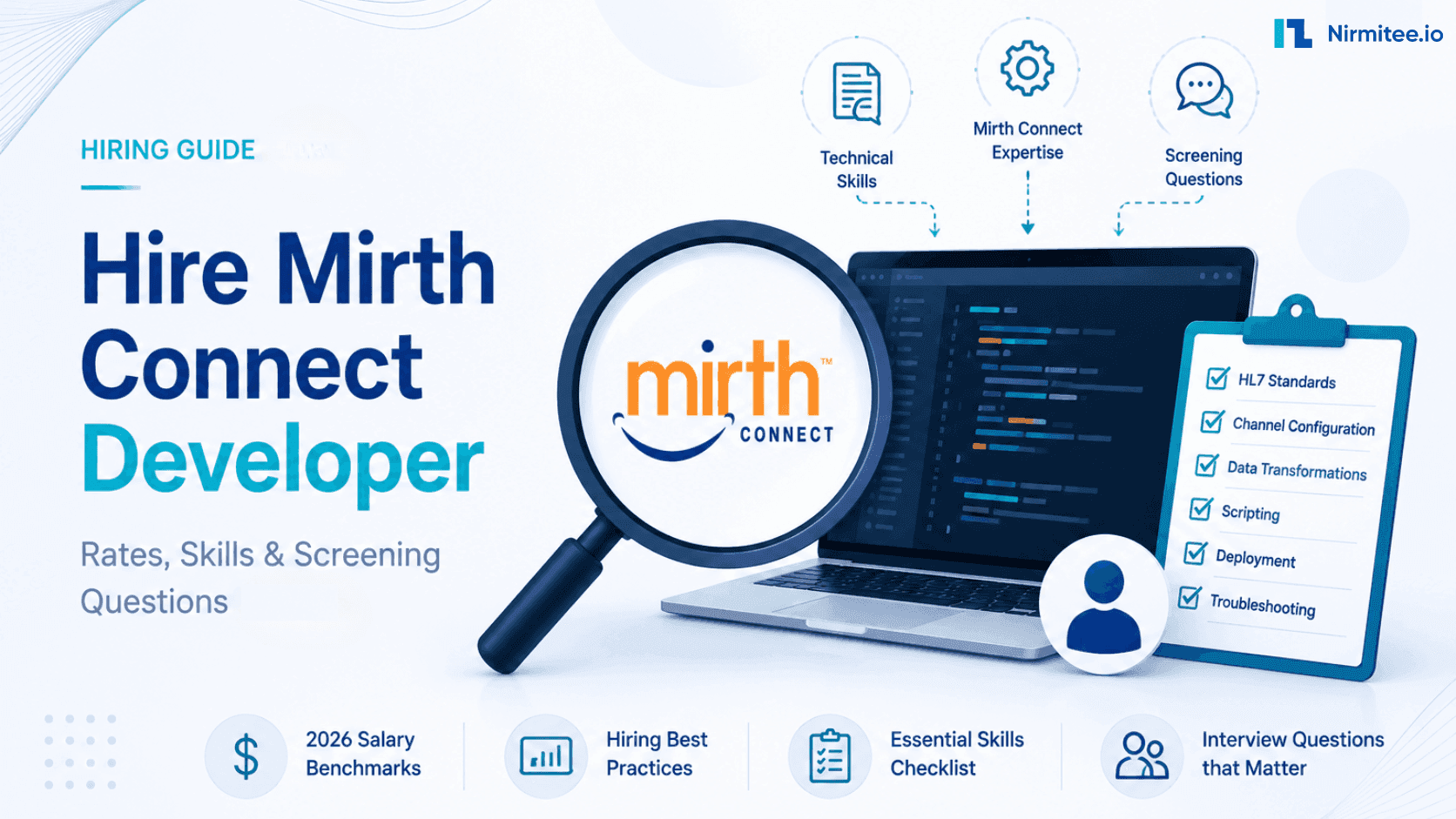
Hiring a Mirth Connect developer in 2026 is harder than it sounds. The talent pool is small, the role sits at the intersection of healthcare data, Java, and HL7, and after NextGen's August 2025 licensing change, every team needs someone who can either keep production stable on the old open-source build, migrate to the commercial edition, or fork to BridgeLink. The wrong hire will quietly burn six months of runway and a few patient safety incidents.
This guide is for engineering leaders, CIOs, and product managers who have to make that hire fast, without already being Mirth experts themselves. We cover where to find candidates, what they actually cost in 2026, how to screen them in under an hour, and how to spot the pretenders who put "Mirth Connect" on a resume after running a single tutorial channel.
Why is hiring a Mirth Connect developer uniquely hard?
Mirth Connect is not a mainstream skill. It is a niche integration engine that quietly runs HL7 v2 and FHIR traffic for thousands of hospitals, labs, and digital health platforms.
The people who know it well usually learned it on the job at an integration team that no longer exists, or at a partner who built dozens of channels for Epic, Cerner, Meditech, or Athena integrations. Universities do not teach it. Bootcamps do not cover it. No Coursera course turns a junior backend engineer into a competent interface engineer in six weeks.
Three forces converged in 2025 and 2026 to make the talent market even tighter:
- The NextGen licensing change. When NextGen moved Mirth Connect to a commercial license in August 2025, every healthcare org running the old open-source build had to decide: pay, migrate, or fork. That created a sudden surge in demand for engineers who could lead one of those three paths. See our commercial transition migration strategies guide for the playbook.
- The FHIR shift. US payers, the CMS Interoperability and Prior Authorization Final Rule, and interoperability mandates pushed integration teams to move from HL7 v2 to FHIR. Engineers who can do both and bridge them inside Mirth are now scarce.
- Senior burnout and retirement. Many of the strongest Mirth engineers in the US market started 12-15 years ago. A meaningful share retired or moved to architecture roles after COVID. Replacing them takes years, not months.
The result: a market where rates are climbing, vetting is harder, and a bad hire costs you more than just salary. A misconfigured channel that drops 0.4% of ADT messages will not fail loudly. It will fail quietly for six months, and you will only notice when a clinician calls about a patient whose chart has never been updated.
Where to find Mirth Connect developers ?
There is no single best channel. Each source has a different cost, quality, and speed tradeoff. Here is how the five practical channels actually behave today.
1. Healthcare integration agencies
Specialist agencies (Nirmitee, Redox-adjacent firms, regional HIT consultancies) are the highest-quality channel. They have a bench of engineers who have done dozens of Mirth deployments, code reviews, and migrations. You pay a premium, but you skip the vetting cost, and you get continuity if your engineer rotates off.
Use this channel when you need senior expertise fast, when the engagement is project-shaped (90-day migration, performance tuning, HIPAA hardening), or when you need EHR integration done the first time correctly. Avoid it for ongoing maintenance roles where a single full-time engineer is more cost-effective.
2. Toptal and other curated freelance networks
Toptal is the highest-signal freelance marketplace for Mirth Connect work. Their vetting process screens out about 97% of applicants, and the engineers who pass tend to be senior independents charging $120-$220/hr. The risk: Toptal is small for Mirth specifically. You might wait two to four weeks to get a shortlist, and the bench is shallow if you need multiple engineers.
3. Upwork and general freelance marketplaces
Upwork has hundreds of profiles claiming Mirth Connect experience. Maybe 5-10% are real. The rest are general Java developers who built a tutorial channel and added the skill to their profile. If you use Upwork, you must own the vetting yourself with the 7 questions later in this article. Rates range from $25/hr (offshore juniors) to $120/hr (US-based mid-level).
4. LinkedIn and direct sourcing
LinkedIn is the slowest channel but produces the strongest full-time hires. Filter by people with 5+ years at HL7-heavy employers: Epic, Cerner, Meditech, Allscripts, Iguana customers, Corepoint customers, large lab networks (Quest, LabCorp), and HIE operators. Cold outreach response rates for Mirth engineers run 15-25%, much higher than mainstream backend roles because the audience is small and flattered to be recognized.
5. Niche specialist firms and Mirth community
The Mirth Connect Slack, the Mirth Connect subreddit, and the legacy forum still see active participants who do contract work. So do firms like Nirmitee that publish Mirth content (you are reading one such firm). Engineers who post substantive answers on the forum or write blog posts about performance tuning are usually safe bets. Their public output is the vetting signal.
Mirth Connect developer rates in 2026
Rates vary by region and seniority more than any other healthcare engineering specialty. Here is what we see across hundreds of engagements and our own bench at Nirmitee.
US-based engineers
- Junior (0-2 yrs Mirth): $55-$80/hr W-2, $70-$95/hr 1099
- Mid (2-5 yrs Mirth): $85-$120/hr
- Senior (5-9 yrs Mirth): $130-$180/hr
- Independent senior / architect: $180-$250/hr (rare, in high demand for migrations)
Offshore engineers
- India (Pune, Bangalore, Hyderabad): $25-$50/hr depending on level, $60-$85/hr for senior independents at top consultancies
- Eastern Europe (Poland, Romania, Ukraine): $40-$70/hr mid, $80-$110/hr senior
- Latin America (Argentina, Mexico, Colombia): $45-$80/hr mid, $90-$130/hr senior
- Philippines: $20-$40/hr mid, $50-$75/hr senior
Why have rates risen 20-30% since 2023
Three reasons. First, the NextGen licensing change moved many engineers from "maintenance mode" engagements to "migration mode" engagements, which pay a premium. Second, FHIR-fluent Mirth engineers are a separate, smaller pool, and they command 15-25% more than HL7-only engineers. Third, AI did not absorb this work.
Code generation tools can help with destination transformers, but they cannot debug an ACK negotiation failure or a memory leak in a JavaScript step. The human stays in the loop.
The 7 screening questions that filter pretenders from experts
You can vet a Mirth developer in 45 minutes. Use these seven questions in order. The right answers reveal real production experience. The wrong answers reveal someone who read the docs last week.
Question 1: What's the difference between source and destination transformers?
Expert answer: "The source transformer runs once per inbound message, after the source connector has received and parsed it but before the channel routes to destinations. It is where I normalize, enrich, or filter the inbound message. Destination transformers run once per destination, after routing. They are where I shape the message for that specific downstream system. I use source transformers for any logic that should be shared across all destinations, and destination transformers for system-specific mappings. I also try to keep heavy work in the source transformer so destinations stay simple and idempotent."
Red flag answer: "They are basically the same, you can put logic in either." Or: silence followed by guessing. Both signal someone who has never had to debug a transformer that runs in the wrong place.
Question 2: Explain MLLP ACK and the difference between AA, AE, and AR
Expert answer: "MLLP wraps the HL7 v2 message between a start block (0x0B) and end block (0x1C, 0x0D). After the receiver processes the message it returns an ACK in the MSA segment: AA means application accept (the message was received and processed successfully), AE means application error (the message was received but the application could not process it, usually a data validation issue), AR means application reject (the message was rejected, often because of a structural problem or because the receiver does not handle that message type).
I configure the source connector to return the right ACK based on the channel's processing result, and I make sure the sender's retry logic actually re-sends on AE and AR. Many integrations get this wrong: they treat AE as fatal and stop, when the sending system would have retried."
Red flag answer: "ACK is just an OK response. I usually return AA." Or: "I don't think we use MLLP; we use REST." If the candidate does not know MLLP, they have not done real HL7 integration work.
Question 3: Walk me through a Mirth message lifecycle from receipt to acknowledgment
Expert answer: A complete answer covers: source connector receives the raw payload, message is persisted to the message store, preprocessor runs, source filter runs (if configured), source transformer runs, channel routes to destinations, each destination's filter and transformer run, destination connector sends to downstream system, response is captured, postprocessor runs, ACK is generated and sent back to the source. The candidate should also mention the role of the message queue and what happens if a destination is down (queued, retried per the queue settings).
Red flag answer: Vague answer that skips the message store, the queue, or the preprocessor/postprocessor. Cannot explain what happens when one destination fails, and others succeed.
Question 4: How do you handle large attachments in Mirth without OOM?
Expert answer: "I never load the full payload into the message object if it's over a few MB. I use the attachment handler to write large binary segments (like a DICOM blob or a base64 PDF) to a separate attachment store, then reference the attachment ID in the message. For OBX-5 segments with embedded base64 PDFs, I write the PDF to disk or S3 in the preprocessor and replace the segment content with a reference. I also tune the JVM heap and the message storage settings on the channel: raw, encoded, sent, response — keep only what you need. And I monitor for messages over a threshold size so I get alerted before they cause a heap exhaustion."
Red flag answer: "I just increase the JVM heap." Or: "I haven't run into that." Anyone who has run a production Mirth channel that handles imaging or document workflows has hit OOM at least once.
Question 5: Explain channel deployment, undeploy, and the difference between them
Expert answer: "Deploy compiles the channel and starts it on the engine: connectors are bound to ports, listeners start consuming, queued messages resume. Undeploy stops the channel and releases resources: connectors are unbound, in-flight messages finish processing or get queued depending on settings. Deploy is not the same as enable — a channel can be deployed but disabled, which keeps the configuration loaded but not actively running. In production, I always undeploy before code template changes, because Code Templates are loaded into the engine at deploy time, and a stale template will continue to run until the channel is redeployed."
Red flag answer: "Deploy starts the channel and undeploy stops it." Technically true but reveals the candidate has not hit the Code Template caching gotcha or the in-flight message question.
Question 6: Have you used Code Templates for shared functions? Why use them?
Expert answer: "Yes, heavily. Code Templates let me define a function once — say, a PID parser, an HL7 escape utility, or a logging helper — and use it across all channels. They live in a Code Template Library that's assigned to channels. Without them, you end up copy-pasting the same function into 50 channels, and the next time the spec changes, you have to update 50 places. Code Templates also reduce channel deployment errors because the shared function is reviewed and tested once. The gotcha is that Code Templates are loaded at deploy time, so changing a template requires redeploying every channel that uses it — I script that with the Mirth CLI in CI."
Red flag answer: "I haven't used them." Or: "We just copy the code into each channel." Both signal a junior who has not yet hit the maintenance cost of duplicated logic.
Question 7: How would you handle backpressure when destinations are slow?
Expert answer: "I enable the destination queue with appropriate settings: queue on failure, retry interval, retry count. I tune the queue thread count so I don't starve the source. If the downstream is consistently slow, I add a buffer channel that decouples the source from the slow destination — the buffer channel takes the message, ACKs the source immediately, and then forwards to the slow destination on its own schedule.
I monitor queue depth as a leading indicator: if the queue is growing faster than it's draining, I know I have a problem before the source starts backing up. I also make sure the source has a reasonable receive buffer size and that the upstream system has retry logic of its own. For real-time use cases, I might shift to Kafka or another stream backbone in front of Mirth."
Red flag answer: "I just retry the message." Or: "Mirth handles that automatically." Both miss the queue tuning, the buffer channel pattern, and the monitoring discipline.
Red flags that should end the interview early
- Doesn't know what an MLLP ACK is. They have not done HL7 v2 work in production.
- Thinks Mirth is "just a Java REST app." It is a Rhino-based JavaScript engine with Java extensions, an HTTP and TCP connector framework, and a clustered message store. Treating it as a Spring Boot service will cause deployment, monitoring, and performance problems.
- Cannot name the four message storage levels (raw, encoded, sent, response). Storage settings drive disk usage, OOM risk, and audit capability. Not knowing them means they have never tuned a channel for production scale.
- Confuses Mirth Connect with Mirth Match or Mirth Results. Different products from the same vendor. Reveals a resume keyword stuffer.
- "I can learn it quickly." Possibly true, but you are paying integration-engineer rates for ramp-up. Negotiate a learning rate or pass.
- No opinion on the NextGen license change. Anyone who has worked on Mirth in the past 18 months has an opinion on commercial vs BridgeLink fork vs alternative engines.
Agency vs freelancer vs full-time: which model to choose
The right hiring model depends on the shape of the work, not the budget. Here is how the three options compare in 2026.
Agency
Best for: 90-day to 9-month engagements, migrations, performance tuning, certifications, HIPAA hardening, high-availability setup, post-incident root cause work. You get a team with bench depth, peer review, and continuity if a single engineer rotates off. Cost is 1.5x-2x a freelancer's hourly rate, but you skip vetting cost, and you carry no employment risk. Most US healthcare orgs use an agency for the initial build and a full-time hire for steady-state maintenance.
Freelancer
Best for: discrete tickets, channel-by-channel work, fill-in for FMLA leave, side-of-desk additions. You own all the vetting, the security review, the HIPAA BAA, and the continuity risk. A great freelancer is cheaper than an agency. A mediocre one is far more expensive than an agency because their channels will silently fail, and you will pay an agency to clean it up next quarter.
Full-time hire
Best for: organizations that run 20+ channels in production, have ongoing build needs, and need someone on call when ADT feed breaks at 2 am. Lowest long-term hourly cost ($75-$110 fully loaded for a mid-level US engineer), highest onboarding cost (2-4 months to reach steady-state productivity), and highest continuity (or lowest, depending on retention). The hard part in 2026 is recruiting — supply is tight, and the strongest engineers already have offers.
Mirth engineer skill levels
Use this ladder to map the engineer to the work. Hiring a senior for junior work wastes money. Hiring a junior for senior work risks production.
- Junior (0-2 yrs): Can build a basic channel from a template, configure a source and destination, write simple JavaScript transformers. Should not be left alone with a production channel.
- Mid (2-5 yrs): Owns HL7 v2 expertise. Comfortable with all five segments (PID, PV1, OBR, OBX, MSH), MLLP, ACK negotiation, custom transformers, Code Templates, basic monitoring. Can troubleshoot most production issues with a senior on call.
- Senior (5-9 yrs): Adds FHIR fluency, performance tuning, HA setup, security hardening, production monitoring discipline, and SLA design. Can own a production environment without supervision and mentor mid-level engineers.
- Architect (9+ yrs): Designs multi-system integration topology, leads migrations, builds the Mirth + Kafka or Mirth + FHIR backbone, and makes the buy-vs-build call on the engine itself. Usually, a former senior who has done at least three full integration platform rebuilds.
How to hire a Mirth Connect developer in 7 days?
If you have time pressure (which most teams do), here is the compressed timeline that produces a reliable hire.
- Day 1 — Define scope. Write a one-page job spec: number of channels, message types, integration partners (Epic, Cerner, lab, payer), expected throughput, deadline, on-call expectations. Decide agency vs freelancer vs FTE.
- Day 2 — Source candidates. Send three outbound channels in parallel: agency RFP (one or two firms), Toptal request, LinkedIn outreach to 20-30 targeted profiles. Skip Upwork unless you have weeks to vet.
- Day 3-4 — Technical screen. 45-minute call covering the 7 questions above. Score each from 1-5. Anything below 3.5 average is a pass.
- Day 5 — Reference check. Call two former clients or managers. Ask: "Would you hire them again? What did they get wrong? How did they behave when production broke?" The third question matters most.
- Day 6 — Trial task. Paid 4-hour exercise: refactor a sample channel we provide, add a destination, write a Code Template. Reveals real coding style, not just interview talk.
- Day 7 — Sign contract. SOW, BAA, HIPAA training acknowledgment, security review checklist. Start work week 2.
The most common hiring mistakes in 2026
- Hiring a generalist Java developer and assuming they will "pick it up." They might. They also might take 6 months and 30% more channels than necessary while learning. Mirth is its own discipline — Rhino JavaScript, JCA connectors, message storage tuning. It is not standard backend Java.
- Optimizing only for hourly rate. A $30/hr offshore freelancer who breaks an ADT feed at 2 am costs you a clinician trust incident, an executive escalation, and an agency clean-up bill. The fully loaded cost is much higher than $30/hr.
- Skipping the trial task. Interview talk is cheap. A 4-hour paid exercise reveals real coding discipline, real attention to security, and real production instincts.
- Not negotiating the BAA up front. If the engineer is going to touch real PHI, the BAA must be signed before day one. Some freelancers will not sign — that tells you everything.
- Assuming all Mirth Connect experiences are equivalent. Mirth at a 50-channel hospital is very different from Mirth at a 3-channel lab. Ask about the scale they have run.
Skip the vetting — talk to our pre-vetted Mirth team
Nirmitee has built and maintained Mirth Connect deployments for hospitals, labs, digital health platforms, and HIE operators. Our engineers have shipped HL7 v2, FHIR, X12, and DICOM integrations against Epic, Cerner, Meditech, Athena, and dozens of niche EHRs. Every engineer on the bench passes the 7-question screen above, the trial task, and a HIPAA security review before they touch a customer environment.
Engagements start at 90 days, with a senior on every project and a working channel demo in week 2. Whether you are migrating off the open-source build, scaling past 10,000 messages/hour, hardening for HIPAA, or building a greenfield integration platform, we can scope and staff inside a week.
Need expert help with healthcare data integration? Explore our Healthcare Interoperability Solutions to see how we build and run Mirth and FHIR-based integration platforms.
Related Reading on Mirth Connect
- Mirth Connect commercial transition
- alternatives to Mirth Connect in 2026
- Mirth Connect vs Rhapsody vs Iguana: a 2026 comparison
- BridgeLink: open-source Mirth Connect fork migration guide
- Mirth Connect integration failures
- How to set up Mirth Connect for high availability
- Mirth Connect performance tuning: 10,000 messages/hour
- Mirth Connect security hardening
Ready to scale?
Talk to our healthcare engineering team about building, integrating, and shipping faster.
Frequently Asked Questions
Where is the best place to find a Mirth Connect developer?
How do I tell a real Mirth Connect expert from a pretender?
How long does it take to hire a Mirth Connect developer?
What's the biggest hiring mistake teams make with Mirth Connect?
Do I need a Mirth developer who also knows FHIR?