Mirth Connect for Startups 2026: When It Makes Sense (And When It Doesn't)

Founder & CEO
15+ years building healthcare technology. Founder & CEO of Nirmitee.io, whose teams deliver EHR integrations, FHIR and HL7 platforms, ABDM and NHCX connectivity, and clinical AI for health systems and healthtech companies.
You are building a digital health startup. You have a product that clinicians love in demo, an investor deck that shows a $50 billion addressable market, and a technical team that can build anything in React and Python. Then your first pilot customer says: "We need you to connect to our Epic system and pull ADT feeds and lab results in real time." Suddenly your elegant cloud-native architecture needs to speak HL7v2, a protocol designed in 1987, over MLLP, a transport layer that predates HTTP. Welcome to healthcare integration.
Every digital health startup faces this moment. The product works beautifully in isolation. Then it needs to live inside a hospital's EHR ecosystem, and everything gets complicated.
According to Rock Health's analysis, integration difficulties are cited as a top-three barrier to EHR adoption by 67 percent of digital health companies.
Mirth Connect (now NextGen Connect Integration Engine) is one option for solving this challenge. It is a powerful, flexible integration engine used by thousands of healthcare organizations. But is it the right choice for a startup? Sometimes yes, sometimes no. This guide helps you decide based on your specific situation, not on generic advice that ignores the realities of startup resource constraints.
Watch: What an Interface Engine Does (and Why Hospitals Need One) | Mirth Connect for Business Leaders (2:21).
The Startup Integration Challenge
Startups face a unique combination of constraints that make integration decisions different from those of established health systems or large health IT vendors:
- Limited capital: Every dollar spent on integration infrastructure is a dollar not spent on product development, sales, or hiring. Seed-stage startups typically have $1 to $3 million in funding, and Series A companies have $5 to $15 million. Spending $300,000 per year on integration engineers and infrastructure is a significant budget allocation.
- Limited time: Pilot timelines are measured in weeks, not months. Your health system customer expects to see your product live in their environment within 60 to 90 days. Spending four months building integration infrastructure before you can even start the pilot is a deal-killer.
- Limited expertise: Your founding engineering team is generalists who can build web applications, mobile apps, and APIs. They have never heard of MLLP, do not know what a PID segment is, and have no idea that HL7v2 uses a pipe character as a field separator. Healthcare integration is a specialized discipline with a steep learning curve.
- Uncertain requirements: You do not know which EHR systems your next 10 customers will use. You do not know whether you will need HL7v2, FHIR, both, or something else entirely. Building for the wrong protocol wastes precious runway.
These constraints mean that the "right" integration strategy for a startup is fundamentally different from the "right" strategy for a 500-bed hospital with a dedicated integration team and a seven-figure IT budget.
The Post-Licensing Reality for Startups
Before March 2025, startups could download Mirth Connect for free and start building. The open-source license meant zero software cost, which was enormously attractive for cash-constrained companies. That changed when NextGen Healthcare transitioned Mirth Connect version 4.6 and above to a commercial license.
The last open-source version, 4.5.2, released in September 2024, remains available. Startups can still use it, but with significant caveats:
- No new features or security patches from NextGen
- No official support channel
- Diminishing community activity as contributors migrate to the commercial version or alternative platforms
- Potential compliance concerns from health system customers who require supported software in their environments
For startups evaluating Mirth in 2026, the commercial licensing cost must be factored into the decision. The exact pricing varies by deployment size and negotiation, but it adds a line item that did not exist in the old calculus. This does not make Mirth the wrong choice, but it does shift the break-even point compared to managed alternatives.
When Mirth Connect Makes Sense for Startups
Despite the constraints, there are clear scenarios where Mirth Connect is the right choice even for early-stage companies:
1. You Plan Five or More Integrations Within 18 Months
The economics of managed integration platforms work beautifully at low connection counts. At $500 to $2,000 per connection per month, five connections cost $2,500 to $10,000 per month. But that math changes rapidly as you scale. Ten connections: $5,000 to $20,000 per month. Twenty connections: $10,000 to $40,000 per month. If your growth trajectory puts you at 20 or more connections within 18 months, starting with Mirth avoids a painful and expensive mid-growth migration.
As we detailed in our migration strategies guide, switching from a managed platform to self-hosted Mirth mid-growth is a 3 to 6-month project that diverts engineering resources from product development at exactly the moment you should be focused on growth.
2. You Need Complex HL7v2 Workflows
If your product requires deep HL7v2 integration, not just receiving ADT notifications, but complex message transformation, conditional routing, message enrichment from multiple sources, and custom acknowledgment handling, Mirth Connect is purpose-built for this. Managed platforms abstract HL7v2 behind their API, which is great for simple use cases but limiting for complex ones.
Examples of complex HL7v2 workflows that favor Mirth:
- Receiving ORU lab results, enriching them with patient context from an ADT feed, transforming them to a proprietary format, and routing them to different destinations based on result type
- Handling Z-segments (custom HL7v2 extensions) that are unique to specific EHR implementations
- Building bidirectional interfaces where you both receive and send HL7v2 messages
- Processing DICOM metadata alongside HL7v2 orders for imaging AI applications
For a thorough understanding of what Mirth can do with HL7, see our guide to building a robust HL7 interface engine.
3. PHI Must Stay on Your Infrastructure
Some startups operate in segments where data sovereignty is non-negotiable: behavioral health, substance abuse treatment, reproductive health, or genomics. If your customers require that PHI never transit through third-party infrastructure, self-hosted Mirth is one of your few options. Managed platforms necessarily route data through their systems, which may violate your customers' data governance policies regardless of HIPAA compliance.
4. You Have or Can Hire an Integration Engineer
If your founding team includes someone with healthcare integration experience, or if you can hire a mid-level integration engineer early (budget: $120,000 to $150,000 per year), Mirth becomes a force multiplier. One skilled engineer with Mirth can build and maintain 20 or more interfaces, handling everything from initial setup to ongoing monitoring. The per-interface cost drops dramatically compared to managed platform fees.
When Mirth Connect Does Not Make Sense for Startups
1. You Only Need One to Two Integrations
If your product connects to one or two EHR systems, and that is unlikely to change in the next 18 months, the overhead of running Mirth is not justified. The infrastructure cost, the learning curve, and the operational burden exceed the cost of a managed platform at this scale. Two connections on a managed platform cost $1,000 to $4,000 per month. A Mirth deployment with even a part-time engineer costs more.
2. You Need to Ship Your First Integration in Weeks
If your pilot customer needs to see a live EHR integration in three weeks and your team has never touched healthcare data standards, Mirth is not the answer for this timeline. A managed platform can get you live in that window because the EHR connection already exists on their network. Mirth requires building the channel from scratch, which takes 4 to 8 weeks for a team learning the platform for the first time.
3. You Have No Integration Expertise and Cannot Hire It
Mirth Connect is a powerful tool, but it is not a no-code platform. Building channels requires understanding HL7v2 message structure, writing JavaScript transformers, configuring MLLP connections, and debugging message processing issues. If your team cannot invest the 2 to 3 months needed to develop this expertise, and you cannot hire someone who already has it, a managed platform is the pragmatic choice.
4. Your Use Case Is FHIR-Only
If your product exclusively uses FHIR APIs (R4 or later) and does not need HL7v2, DICOM, or X12, Mirth's primary strengths are less relevant. Alternatives like HAPI FHIR (open-source FHIR server) or direct FHIR API consumption provide a simpler path. The broader landscape of healthcare interoperability standards is evolving toward FHIR, but most real-world deployments still require HL7v2 support.
Alternatives for Startups
Redox
The most established managed integration platform. Pre-built connections to major EHR systems. Modern REST API. Pricing starts at approximately $500 per connection per month but varies by volume and contract terms. Best for: startups that need multiple EHR connections quickly and can absorb per-connection fees.
Health Gorilla
Focused on clinical data access (lab results, medications, allergies, conditions). Provides a FHIR-based API for accessing patient data across a network of health systems. Best for: startups building clinical decision support, care coordination, or patient engagement tools that need read access to clinical data.
HAPI FHIR
Open-source FHIR server that can function as a lightweight integration layer for FHIR-only use cases. No HL7v2 support. No managed connections. But free, well-documented, and straightforward for developers familiar with REST APIs. Best for: startups building FHIR-native applications that do not need legacy protocol support.
1up Health
Provides a FHIR API platform focused on patient data aggregation. Connects to health plans and health systems through existing data-sharing networks. Best for: startups building consumer-facing health applications that need aggregated patient data from multiple sources.
The MVP Integration Approach with Mirth
If you decide Mirth is right for your startup, do not over-engineer the initial deployment. The MVP approach gets you to production with minimal investment and scales from there.
Phase 1: Single Channel, Single Server (Weeks 1-4)
Start with the absolute minimum:
- Infrastructure: One Docker container running Mirth Connect, one PostgreSQL database. A single cloud VM (4 vCPUs, 16GB RAM) is sufficient. Cost: approximately $100 to $200 per month on AWS or GCP.
- Channel: Build one channel for your most critical integration use case. If that is receiving ADT feeds from Epic, build one ADT channel. Do not build five channels for five potential use cases. Build one channel for the one customer who is waiting.
- Monitoring: Mirth's built-in dashboard plus a simple health check endpoint. Do not invest in Datadog or Prometheus yet.
- Testing: Manual testing with sample HL7 messages. Automated testing can come later.
# MVP Docker deployment
docker run -d \
  --name mirth \
  -p 8443:8443 \
  -p 6661:6661 \
  -e DATABASE=postgres \
  -e DATABASE_URL=jdbc:postgresql://db:5432/mirthdb \
  nextgenhealthcare/connect:4.5.2

# Or use the commercial image for v4.6+
Phase 2: Prove It Works (Weeks 5-8)
With one channel live and processing real messages, you have proven that your team can build and maintain a Mirth integration. Now document what you learned:
- Create a channel template based on your first channel
- Document the setup process so another team member can contribute
- Establish basic channel design patterns for your organization
- Set up version control for channel definitions
Phase 3: Scale Gradually (Months 3-6)
Add channels for new customers and new use cases, using the template from Phase 2. Each new channel should take days, not weeks. When you hit 5 to 10 channels, invest in:
- High-availability deployment (two Mirth instances behind a load balancer)
- Proper production monitoring with alerting
- Automated testing for transformer functions
- Performance tuning if message volume warrants it
Hiring Your First Integration Engineer
If you decide to go the Mirth route, your most important hire is your first integration engineer. Here is what to look for and what to expect:
Essential Skills
- Strong JavaScript proficiency (Mirth transformers are JavaScript)
- Understanding of HL7v2 message structure (segments, fields, components)
- SQL skills for database connectors and debugging
- Basic Linux system administration
- Familiarity with FHIR concepts (increasingly required)
Nice-to-Have Skills
- Direct Mirth Connect experience (rare in the market, but ideal)
- Experience with other integration engines (Rhapsody, InterSystems, Cloverleaf)
- Docker and container orchestration
- CI/CD pipeline experience
Cost Expectations
In the US market as of 2026:
- Junior integration engineer (0-2 years): $80,000 to $110,000
- Mid-level (2-5 years): $120,000 to $150,000
- Senior (5+ years with Mirth): $150,000 to $180,000
For a startup, a mid-level engineer is the sweet spot. They have enough experience to be productive quickly but are not priced at the senior level. Avoid hiring a junior engineer as your first and only integration person. The learning curve is too steep, and the cost of mistakes in healthcare data handling is too high.
Where to Find Them
Integration engineers are not on typical startup job boards. Look on healthcare IT-specific platforms, the Mirth community forums, LinkedIn with targeted healthcare integration keywords, and healthcare IT staffing agencies. Some managed service firms have engineers who want to transition to product companies, which can be an excellent source of candidates who understand both the technology and the business context.
Scaling from MVP to Enterprise
The path from your first Mirth channel to enterprise-grade integration infrastructure follows a predictable progression:
5 Channels: Standardize
Create channel templates, establish naming conventions, document your patterns. This is where design patterns pay off. Every new channel built from a template takes one-third the time of the first custom build.
15 Channels: Automate
Invest in CI/CD for channel deployments, automated testing for transformers, and monitoring with alerting. Manual processes that were fine at 5 channels become bottlenecks at 15.
30 Channels: Architect
Implement high availability, consider clustering for performance, and build a proper integration architecture with dedicated routing channels, error handling channels, and monitoring channels. This is also when you should consider pairing Mirth with Apache Kafka for event streaming if your message volumes warrant it.
50+ Channels: Govern
Establish an integration center of excellence, create a self-service catalog of standard interfaces, implement change management processes, and consider adding a second integration engineer if you have not already. At this scale, you are running a legitimate integration platform, not a side project.
Real-World Startup Scenarios
Scenario 1: Clinical Trial Matching Platform (Seed Stage)
A seed-stage startup building an AI-powered clinical trial matching tool. They need to access patient demographics and diagnosis data from hospital EHRs to match patients to eligible clinical trials. Initial pilot with one academic medical center running Epic.
Recommendation: Managed platform (Redox or Health Gorilla). They need one connection, their team has no healthcare integration experience, and their pilot timeline is 6 weeks. The managed platform gets them live fast. At $1,000 per month for one connection, the cost is trivial compared to the speed advantage. If the business succeeds and they scale to 15 or more health system partners, they can evaluate migrating to Mirth at that point.
Scenario 2: Remote Patient Monitoring Company (Series A)
A Series A company with $8 million in funding, building a remote patient monitoring platform for chronic disease management. They need bidirectional integration with EHRs: pulling patient lists and care plans, pushing vital signs and alerts. They have signed contracts with 8 health systems using four different EHR platforms (Epic, Oracle Health, MEDITECH, Athenahealth). Their CTO previously worked at a health system and has Mirth experience.
Recommendation: Mirth Connect. They have the expertise (CTO knows Mirth), the scale justification (8 connections growing to 20+ in 12 months), and the complexity requirement (bidirectional integration with multiple EHR platforms, including HL7v2 for MEDITECH). The CTO can build the initial channels and hire a dedicated integration engineer within 3 months. Long-term savings over managed platform fees are substantial.
Scenario 3: Patient Engagement App (Pre-Seed)
A pre-seed startup with $500,000 building a patient engagement app that sends appointment reminders and collects pre-visit questionnaires. They need to connect to one EHR (Athenahealth) to pull appointment schedules. Team of three developers, no healthcare experience.
Recommendation: Direct FHIR API. Athenahealth offers a well-documented FHIR API. For this simple, read-only, single-system use case, neither Mirth nor a managed platform is necessary. The development team can consume the FHIR API directly using standard HTTP libraries. Total cost: developer time only. If they later need HL7v2 or more complex integrations, they can revisit the decision. Understanding the difference between HL7 and FHIR will help them plan for that future.
The Bottom Line for Startup Founders
The integration decision is not a technology decision. It is a business decision that happens to involve technology. The right choice depends on your funding stage, your growth trajectory, your team's capabilities, and your customers' requirements.
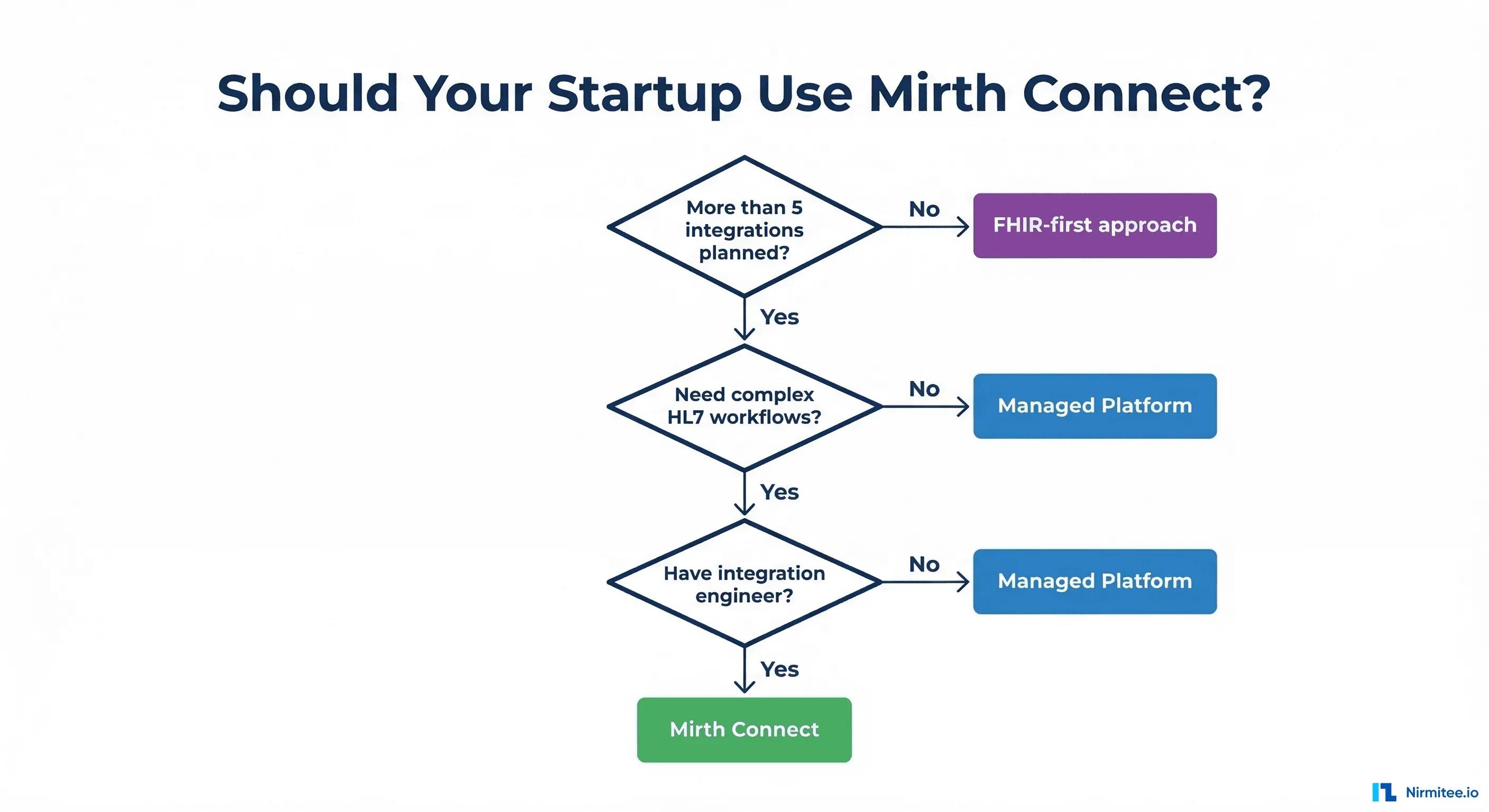
Here is the shortest possible decision framework:
- Fewer than 5 integrations, no HL7v2 expertise, need to ship fast: Use a managed platform.
- 5 or more integrations planned, complex HL7v2 needs, have or can hire expertise: Use Mirth Connect.
- FHIR-only, single EHR vendor, simple use case: Use the EHR's FHIR API directly.
- Uncertain: Start with a managed platform. Migrate to Mirth when the economics justify it.
Do not let the integration decision paralyze you. The worst outcome is spending three months evaluating platforms instead of building a product. Pick the option that gets you to your first live customer fastest, with an explicit plan to reassess at 12 months. The healthcare integration market has enough options that you can always change course. The goal is to unlock seamless interoperability for your product and your customers, using whatever approach makes the most sense for your startup today.
Frequently Asked Questions
Can a startup run Mirth Connect on the open-source 4.5.2 version to save on licensing costs?
Technically yes. Mirth Connect 4.5.2 is functional and handles most integration use cases. However, for a startup, the risks may outweigh the savings. Health system customers increasingly require that connected systems run supported software with active security patching.
If a customer's security review flags your unsupported Mirth version as a risk, the licensing cost you saved becomes irrelevant. Evaluate whether the commercial license cost (which NextGen may offer at startup-friendly terms) is justified by the credibility and support it provides.
How long does it take a developer with no healthcare experience to become productive with Mirth?
For a strong developer with JavaScript experience, expect 4 to 6 weeks to build their first production-quality channel, and 3 to 4 months to be independently productive across common integration scenarios (ADT, ORU, ORM, FHIR). The learning curve is not the Mirth platform itself, which is relatively intuitive, but rather the healthcare data standards: understanding HL7v2 message structure, segment definitions, code sets, and the unwritten rules of how different EHR systems actually format their messages (which often differ from the standard).
What is the minimum infrastructure cost to run Mirth Connect in production?
For a minimal but production-appropriate deployment: one cloud VM (4 vCPUs, 16GB RAM) for Mirth plus a managed PostgreSQL database. On AWS, this costs approximately $200 to $350 per month, depending on region and instance type.
Add $50 to $100 per month for monitoring, logging, and backup storage. Total minimum infrastructure cost: approximately $250 to $450 per month. This handles up to 5,000 messages per hour with standard transformer complexity. For high-availability (which health system customers may require), double the compute cost for a second Mirth instance.
Should a startup build integrations in-house or hire a Mirth consulting firm?
For your first 1 to 3 integrations, a consulting engagement (typically $15,000 to $30,000 per interface) can be faster than building in-house, and the consultants can train your team during the engagement. For ongoing integration development beyond 3 interfaces, in-house is more cost-effective and gives you faster response times when issues arise.
The ideal approach is a hybrid: hire a consulting firm for the initial setup and first channels, with explicit knowledge transfer to your internal team, then bring development in-house as your team gains confidence.
What happens if we outgrow Mirth Connect? Can we migrate to something bigger?
Mirth Connect scales to enterprise volumes, processing millions of messages daily at major Health Information Exchanges, so "outgrowing" it is unlikely for most startups. The more common scenario is wanting to consolidate on a different platform as part of an acquisition or strategic partnership.
If that happens, your Mirth channel logic (JavaScript transformers, routing rules, mapping specifications) documents your integration requirements in detail, making migration to any other platform a well-defined project rather than a discovery exercise. The knowledge your team builds with Mirth transfers to any integration engine.
Related guides
This article is part of our complete guide to Mirth Connect: understanding Mirth Connect. Related deep-dives:
- scoping a Mirth implementation
- Mirth Connect Pricing 2026: True Cost Breakdown
- why Mirth Connect implementations fail
Need production-grade Mirth Connect help? See our Mirth Connect integration services.
Ready to scale?
Talk to our healthcare engineering team about building, integrating, and shipping faster.
Frequently Asked Questions
Can a startup run Mirth Connect on the open-source 4.5.2 version to save on licensing costs?
How long does it take a developer with no healthcare experience to become productive with Mirth?
What is the minimum infrastructure cost to run Mirth Connect in production?
Should a startup build integrations in-house or hire a Mirth consulting firm?
What happens if we outgrow Mirth Connect? Can we migrate to something bigger?
How does Nirmitee.io approach healthcare software development?