Part of our complete guide to Hospital Asset Management: The Complete Guide.
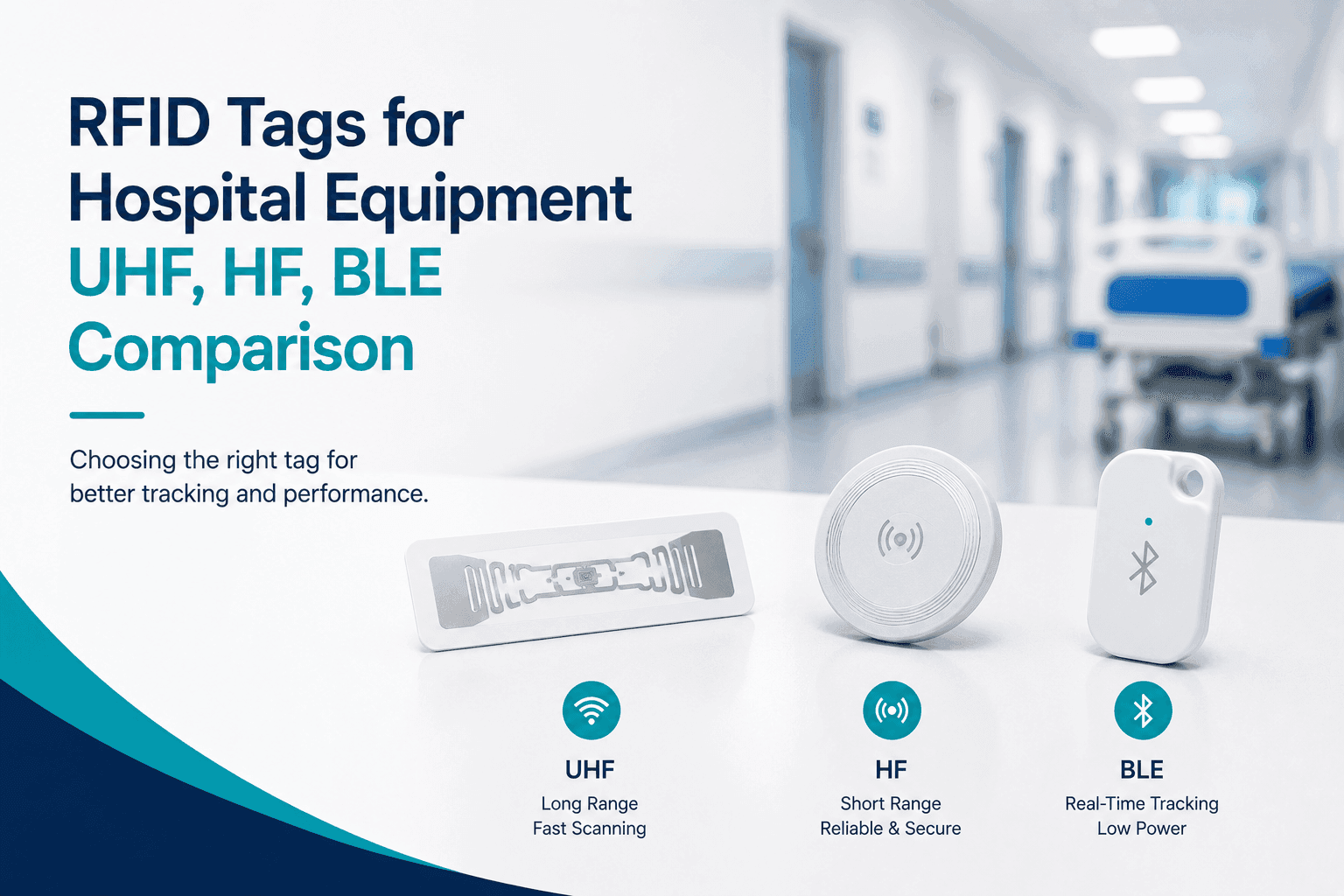
Quick answer: Hospitals use four tag families, not one. UHF passive tags (₹20-50 / $0.25-0.60) for bulk scanning in stores, OT tray check-in, and exit portals. HF/NFC tags (₹30-80 / $0.36-0.96) for single-asset bedside check-out. BLE active tags (₹350-1,500 / $4-18) for real-time location of ICU mobile equipment. On-metal UHF tags (₹150-600 / $2-7) for steel surgical trays and metal-bodied devices. Match the tag to the workflow first, then specify readers; hospitals that standardise on one family end up retrofitting at scale.
Hospitals starting an RFID program often choose one tag type — usually UHF, because it sounds the most general — and discover six months later that the workflow they actually need (real-time ICU location) doesn't work on UHF. The fix is to think workflow-first, then pick the tag. This guide compares the three RFID families used in hospital asset programs — UHF, HF/NFC, and BLE — plus the on-metal UHF variant, with tag prices in ₹ and $, battery life, autoclave survival, and a decision rule per workflow. It is written for the biomedical and IT leads who sign the tag order.
Reviewed by the Assetly product team at Nirmitee.io. Last updated August 2026.
RFID Tag Types Compared: UHF vs HF vs BLE vs On-Metal
| Tag Family | Read Range | Battery | Indicative Price Per Tag | Best For |
|---|---|---|---|---|
| UHF passive (860-960 MHz) | 1-10 m, bulk reads of 50-200 tags per pass | None | ₹20-50 ($0.25-0.60) | Stores inventory, OT tray check-in/out, exit portals, audit programs |
| HF / NFC (13.56 MHz) | 5-10 cm, one tag at a time | None | ₹30-80 ($0.36-0.96) | Bedside check-out, pharmacy item scans, single-asset confirmation |
| BLE active (2.4 GHz) | 5-50 m, continuous broadcast | 2-7 years | ₹350-1,500 ($4-18) | ICU pumps and ventilators, stretchers, real-time location |
| On-metal UHF | 1-6 m on metal surfaces | None | ₹150-600 ($2-7) | Steel surgical trays, metal-bodied diagnostic equipment |
Prices are indicative 2026 bulk ranges from mainstream tag OEMs, excluding printing and applicator labour. Indian pricing includes GST. UHF tags in India should be specified for the licence-exempt 865-867 MHz band; US deployments use 902-928 MHz.
Passive vs Active RFID Tags
The split that matters most is power. Passive tags (UHF, HF, NFC) have no battery; they wake up only when a reader's antenna energises them, which is why they cost under a dollar and last the life of the asset. The trade-off is that the system only knows where a passive tag was the last time it crossed a reader. Active tags (BLE) carry a battery and broadcast on their own every 1-10 seconds, so paired with ceiling gateways they give continuous, live position — at 10-30x the tag cost plus a battery replacement cycle. There is no "better" side: passive is the right economics for the 80% of assets that only need last-seen-at-a-portal, active is the right physics for the mobile equipment where minutes-to-locate matters.
UHF RFID Tags (860-960 MHz)
UHF Class 1 Gen 2 is the workhorse family for hospital asset programs. Read range is 1-10 metres depending on reader power and tag orientation, and bulk reads of 50-200 tags in a single antenna pass are standard. Tag cost is the lowest of the families: plain sticker inlays run ₹10-25 ($0.12-0.30) in bulk, printable label tags ₹20-50 ($0.25-0.60), and rugged hard tags ₹80-300 ($1-3.50).
Strengths: bulk scanning, longest non-battery read range, lowest tag cost, broadest reader ecosystem.
Weaknesses: read accuracy degrades around metal and water (and hospitals have plenty of both), and a passive tag only reports where it was last read, not where it is now.
Where UHF belongs: central stores inventory, OT instrument-tray check-in and check-out, zone exit portals (equipment moving from the biomedical workshop back into wards), and large-scale audit programs. Printable UHF labels come out of the same printers covered in the label printer comparison.
HF RFID And NFC Tags (13.56 MHz)
HF (and its consumer NFC variant) reads at very short range — typically 5-10 cm. Each tag must be brought to the reader, so bulk scanning is not the workflow. Tag cost is mid-range at ₹30-80 ($0.36-0.96).
Strengths: very high read accuracy at short range, no interference from neighbouring tags, rich data storage on the tag, and NFC tags are readable from any modern smartphone with no dedicated reader.
Weaknesses: single-tag scan only, no bulk read, no zone coverage.
Where HF belongs: bedside asset check-out at a nurse station, pharmacy individual-item scanning, patient-bedside equipment assignment, and single-asset confirmation by roving biomedical staff.
BLE Tags (Bluetooth Low Energy)
BLE tags are battery-powered active beacons broadcasting at 2.4 GHz with a range of 5-50 metres depending on transmit power. Paired with ceiling-mounted gateways they deliver real-time location: the hospital knows where every tagged asset is, continuously, which is what eliminates the daily equipment hunt covered in our guide to real-time location tracking.
Strengths: live location, long range, works through walls and around metal, gateways can be as simple as plug-in beacons or staff smartphones.
Weaknesses: highest tag cost at ₹350-1,500 ($4-18), battery life of 2-7 years means a replacement cycle, and it needs gateway infrastructure. BLE shares 2.4 GHz with Wi-Fi, so keep gateways at least 3 metres from access points.
Where BLE belongs: ICU mobile equipment (infusion pumps, ventilators), critical-care wheelchairs and stretchers, high-value mobile diagnostic equipment — any asset where minutes-to-locate matters more than per-tag cost.
On-Metal UHF Tags
Standard UHF tags fail when applied directly to metal: the substrate acts as a ground plane, detunes the antenna, and read range collapses to near zero. On-metal UHF tags add a foam or ferrite isolation layer that lifts the antenna off the surface and restores performance, at ₹150-600 ($2-7) per tag.
Where on-metal UHF belongs: surgical instrument trays, autoclave-cycle tagging (specify autoclave-rated encapsulated tags, typically ₹400-1,500 / $5-18), metal-bodied diagnostic equipment, and any asset whose tagging surface is bare steel.
RFID Tag Prices In India And The US
| Tag Form Factor | India (₹ Per Tag) | US ($ Per Tag) | Notes |
|---|---|---|---|
| UHF sticker / wet inlay | ₹10-25 | $0.12-0.30 | Bulk orders of 5,000+; not for harsh surfaces |
| UHF printable label | ₹20-50 | $0.25-0.60 | The default for most assets and stores inventory |
| UHF rugged hard tag | ₹80-300 | $1-3.50 | Wipe-down and impact resistant |
| HF / NFC tag | ₹30-80 | $0.36-0.96 | Smartphone-readable |
| On-metal UHF | ₹150-600 | $2-7 | Required on bare steel |
| Autoclave-rated UHF | ₹400-1,500 | $5-18 | Encapsulated; survives steam cycles |
| BLE beacon tag | ₹350-1,500 | $4-18 | Plus gateway infrastructure and battery cycle |
Two budgeting rules. First, tags are usually 20-40% of the hardware budget; readers and antennas take the larger share, covered in the reader and antenna guide. Second, price the mix, not the average: a 500-bed hospital typically runs 60-70% standard UHF labels, 10-20% on-metal, 5-10% HF, and 5-15% BLE by count, so the blended per-tag cost lands far below what a BLE-only quote suggests.
How To Choose: Match The Tag To The Workflow
The defensible decision rule: map each workflow to a tag family before specifying any reader. ICU mobility = BLE. Bulk zone scanning = UHF. Bedside individual scan = HF/NFC. Steel surgical trays = on-metal UHF. The hospital that picks one family for all four workflows ends up retrofitting at scale — and the reverse mistake, buying BLE for everything, pays 10-30x per tag for assets that never move. Tags, readers, and printers are three coupled decisions; the hardware setup guide covers all three together, and the RFID vs barcode comparison shows when a tag program beats sticking with barcodes at all.
Worked Example: A 700-Bed Hospital's Tag Mix
Shown as a worked scenario for a 700-bed multi-specialty hospital deploying Assetly across 5,800 biomedical assets: 3,200 standard UHF label tags on stationary assets and stores inventory, 1,400 BLE tags on ICU and high-acuity mobile equipment, 800 on-metal UHF tags on OT instrument trays, and 400 HF tags at nurse-station check-out points. Year-1 tag investment: about ₹19 lakh ($23,000). Every audit cycle then runs without manual counting, and the tag mix — not a single family — is what makes each workflow work.
Key Takeaways
- Passive (UHF, HF) for last-seen-at-a-portal economics; active (BLE) for live location physics. Most hospitals need both.
- UHF for bulk-read zones: stores, OT tray check-in, workshop exit portals. Lowest cost at ₹20-50 ($0.25-0.60) per label.
- HF/NFC for individual bedside check-out; readable from any smartphone.
- BLE for ICU mobile equipment where minutes-to-locate matters more than the ₹350-1,500 ($4-18) tag cost.
- On-metal UHF on bare steel; autoclave-rated encapsulated tags for steam cycles.
- Budget the mix, not the average: 60-70% UHF labels, 10-20% on-metal, 5-10% HF, 5-15% BLE by count is typical.
Planning A Hospital Tagging Program?
Read the complete guide to hospital asset management, or talk to the Assetly team for a tag-mix plan built on your asset register and equipment flows.