Mirth Connect Open Source vs Commercial License: Which Is Right for Your Health System?

Founder & CEO
15+ years building healthcare technology. Led 100+ EHR integrations, FHIR implementations, and clinical AI deployments.
Mirth Connect has two flavors: the free open-source version and NextGen's commercial edition. For most health systems, the question isn't 'how much does it cost' — it's 'which version do we actually need?'
This guide answers that before you talk to a vendor. We focus on the decision framework, not a line-by-line cost breakdown.
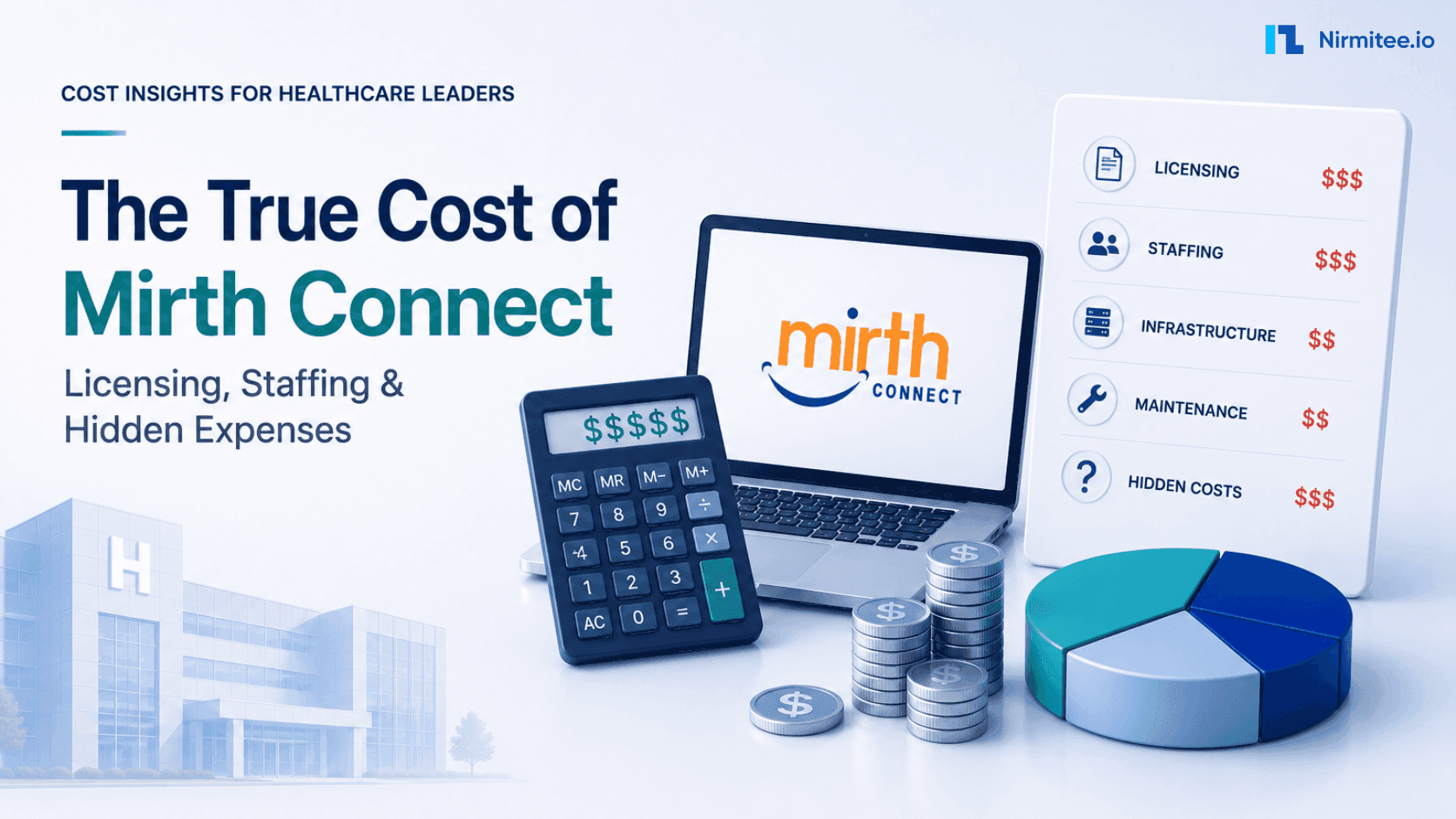
This article breaks down every cost associated with running Mirth Connect in production: the costs that appear on purchase orders and the costs that hide in engineering time, turnover risk, and 3 AM phone calls. If you are a CFO building an integration budget or a CTO justifying headcount, this is the analysis you need.
The Licensing Reality: No Longer Free
Let's address the elephant in the room. For nearly two decades, Mirth Connect's open-source license was its killer feature. Healthcare startups launched with zero integration costs. Hospital IT departments deployed it without procurement approval. Health Information Exchanges built entire networks on free software. That era is over.
What Changed
- Mirth Connect v4.5.2 and earlier: Available under an open-source license. You can still download, deploy, and use these versions at no cost. However, you do not receive security patches, new features, or vendor support.
- Mirth Connect v4.6 and later: Commercial license required. Pricing varies by deployment size, support tier, and contract terms. NextGen Healthcare does not publish standard pricing, so costs are negotiated per customer.
- Mirth Fully Managed: A cloud-hosted option from NextGen where they manage the infrastructure, upgrades, and monitoring. Subscription-based pricing that bundles hosting and support.
For a detailed analysis of what this licensing shift means for current Mirth users, see our article on migration strategies for open-source Mirth users.
The Legacy Version Trap
Running version 4.5.2 indefinitely to avoid licensing costs is a common temptation. It is also a false economy. Without security patches, your integration engine becomes a vulnerability in your healthcare infrastructure. Without new features, your team spends more time building workarounds. Without vendor support, your engineers troubleshoot every issue alone. The "free" version costs more in engineering time than most organizations realize.
Direct Costs Breakdown
Licensing and Support
NextGen Healthcare offers multiple support tiers for commercial Mirth Connect:
Support Tier        | Typical Annual Cost | Includes
--------------------|--------------------|---------------------------------
Standard Support    | $15,000 - $40,000  | Business hours support, updates,
                    |                    | security patches
Premium Support     | $40,000 - $80,000  | 24/7 support, faster SLAs,
                    |                    | dedicated account manager
Enterprise          | $80,000 - $200,000+| Custom SLAs, on-site support,
                    |                    | professional services credits

Mirth Fully Managed | $50,000 - $150,000+| Hosting, support, monitoring,
(Cloud)             | per year           | upgrades, infrastructure included
These are representative ranges based on market intelligence and customer conversations, not official NextGen pricing. Actual costs depend on the number of channels, message volume, deployment architecture, and contract negotiation. Organizations with existing NextGen relationships (e.g., for their EHR) may negotiate bundle discounts.
Infrastructure Costs
Mirth Connect requires server infrastructure and a database. Here are typical infrastructure costs:
Component               | On-Premises     | Cloud (AWS/Azure)
------------------------|-----------------|-------------------
Application Server      | $5,000 - $15,000| $200 - $800/month
  (Mirth Connect)       | (hardware)      | (EC2/VM instance)
                        |                 |
Database Server         | $5,000 - $15,000| $200 - $1,200/month
  (PostgreSQL)          | (hardware)      | (RDS/managed DB)
                        |                 |
HA/Failover Server      | $5,000 - $15,000| $200 - $800/month
  (if required)         | (hardware)      | (second instance)
                        |                 |
Storage                 | $2,000 - $5,000 | $50 - $300/month
  (message archives)    | (SAN/NAS)       | (EBS/block storage)
                        |                 |
Network/Load Balancer   | $2,000 - $5,000 | $20 - $100/month
                        | (hardware)      | (ALB/NLB)
                        |                 |
Monitoring Tools        | $0 - $5,000     | $100 - $500/month
  (Datadog/Grafana)     | (open-source)   | (SaaS monitoring)
                        |                 |
ANNUAL TOTAL            | $19,000-$60,000 | $10,000-$45,000
  (amortized for on-prem over 3 years)     |
For high availability configurations, which are essential for production healthcare environments, see our detailed guide on setting up Mirth Connect for high availability.
Planning your move off Mirth 4.5.2? Our integration team has built more than 350 interfaces on Mirth Connect. Start with a free written risk review: tell us your Mirth version, channel count and the systems you connect, and we will send back what is likely to break on Java 17 and OIE 4.6, and which path fits your setup: OIE, BridgeLink or licensed Mirth. If you want to go further, a two-week exit assessment ends in a fixed migration quote. Request a free Mirth risk review.
Staffing Costs: The Biggest Line Item
Staffing is where the real money goes. Integration engineers are specialized, scarce, and expensive. According to Glassdoor and Indeed data for 2026, here are the salary ranges for Mirth Connect engineers in the US:
Role                          | Annual Salary       | Notes
------------------------------|--------------------|--------------------------
Junior Integration Engineer   | $80,000 - $110,000 | 0-2 years Mirth experience
                              |                    | Can maintain existing channels
                              |                    |
Mid-Level Integration Engineer| $110,000 - $150,000| 2-5 years experience
                              |                    | Can build new interfaces
                              |                    |
Senior Integration Engineer   | $150,000 - $180,000| 5+ years experience
                              |                    | Architecture, HA, optimization
                              |                    |
Integration Architect         | $170,000 - $220,000| Strategic role, designs the
                              |                    | overall integration platform
                              |                    |
Contract / Consultant         | $100 - $200/hour   | Short-term engagements
                              |                    | ($200K-$400K annualized)
The Talent Scarcity Problem
There are not enough experienced Mirth engineers to fill the demand. Healthcare integration is a niche specialty that requires understanding both the technical platform and the healthcare domain (HL7 messaging, clinical workflows, HIPAA compliance). According to industry estimates, it takes 3-6 months to train a competent Java/JavaScript developer to become productive with Mirth Connect, and 12-18 months to develop true expertise.
This scarcity means:
- Recruiting takes longer. Expect 2-4 months to fill a senior Mirth engineer position. Longer in rural or non-tech-hub markets.
- Retention requires premium compensation. Experienced Mirth engineers know their skills are in demand. Counter-offers and recruiting pressure are constant.
- Turnover is expensive. When a senior Mirth engineer leaves, they take institutional knowledge about your specific interfaces with them. Replacing that knowledge takes 6-12 months of the new hire's time.
Minimum Staffing by Organization Size
Organization Size       | Minimum FTEs     | Recommended FTEs
------------------------|------------------|------------------
Small Clinic (1-5 IF)   | 0.5 (shared role)| 1 dedicated
Mid-Size Hospital       | 1-2 dedicated    | 2-3 dedicated
  (10-30 interfaces)    |                  |
Health System           | 3-5 dedicated    | 5-8 dedicated
  (50+ interfaces)      |                  |
HIE (100+ interfaces)   | 5-10 dedicated   | 8-15 dedicated
Hidden Costs: What Does Not Appear on the Budget
Every Mirth deployment has costs that never appear on a purchase order but drain engineering time and organizational capacity. These hidden costs often exceed the visible costs.
1. Documentation Debt
Integration engineers build channels, get them working, and move to the next project. Documentation is deferred because there is always another interface to build. Over time, you accumulate channels that nobody fully understands. When a channel breaks and the engineer who built it has left the organization, diagnosing the issue takes 5-10x longer than it should.
Real cost: $10,000-$50,000 per year in extended troubleshooting time and delayed implementations due to reverse-engineering undocumented channels.
2. Tribal Knowledge Risk
In many organizations, the Mirth environment is understood by one or two senior engineers. They know which channels are fragile, which transformers have workarounds, and which destinations require specific message formatting. This knowledge exists only in their heads. If they leave, take vacation during a production incident, or are unavailable at 3 AM when a critical interface fails, the organization is exposed.
Real cost: $20,000-$100,000 per departure event (knowledge transfer, extended debugging, potential clinical workflow disruptions). For more on common failure patterns that tribal knowledge prevents, see our analysis of the top 10 Mirth Connect integration failures.
3. Engineer Turnover Costs
The Bureau of Labor Statistics reports an average IT employee tenure of 3-4 years. Healthcare integration engineers follow a similar pattern. Each departure costs:
- Recruiting: $15,000-$30,000 (agency fees, hiring manager time, interview cycles)
- Onboarding: 3-6 months at reduced productivity ($40,000-$90,000 in effective salary)
- Knowledge transfer: 1-3 months of overlap if you are lucky enough to have it ($15,000-$45,000)
- Productivity gap: 2-4 months while the new hire ramps up in your specific environment
Real cost: $70,000-$165,000 per turnover event.
4. Production Debugging at 3 AM
Healthcare interfaces run 24/7. When a lab results interface fails at 3 AM, a physician does not receive critical results. When an ADT interface fails, downstream systems do not know that a patient has been admitted, transferred, or discharged. These failures require immediate response.
On-call coverage for Mirth engineers means:
- On-call pay premiums: $500-$2,000 per week per engineer
- Incident response time: 1-4 hours per incident at overtime rates
- Post-incident review and remediation: 4-8 hours per incident
- Burnout and turnover acceleration from chronic on-call demands
Real cost: $25,000-$100,000 per year for adequate on-call coverage. For strategies to reduce incidents, see our guide on reliable Mirth Connect monitoring in production.
5. Compliance and Audit Costs
Healthcare integration must comply with HIPAA, and many organizations face additional regulatory requirements (state-specific rules, CMS conditions of participation, ONC certification requirements). Maintaining audit trails, access controls, and compliance documentation for your integration engine costs time and money that rarely appear in integration budgets.
Real cost: $10,000-$30,000 per year in compliance-related engineering and documentation effort.
6. Upgrade and Migration Costs
Mirth version upgrades are not trivial. Testing all channels against a new version, resolving compatibility issues, and coordinating deployment windows takes significant planning and engineering time. Major version upgrades can take 2-4 weeks of engineering effort.
Real cost: $15,000-$50,000 per major version upgrade.
TCO by Organization Size
Small Clinic or Practice (1-5 interfaces)
Cost Category          | Annual Estimate
-----------------------|----------------
Licensing (v4.6+)      | $15,000 - $30,000
Infrastructure         | $5,000 - $15,000
Staffing (0.5-1 FTE)   | $40,000 - $110,000
Hidden costs           | $5,000 - $15,000
-----------------------|----------------
ANNUAL TOTAL           | $65,000 - $170,000
For small clinics, the staffing cost often means a shared role: an IT generalist who also manages the integration engine. This works for stable environments with few changes, but any new interface development requires external consulting ($150-$200/hour).
Mid-Size Hospital (10-30 interfaces)
Cost Category          | Annual Estimate
-----------------------|----------------
Licensing (v4.6+)      | $30,000 - $80,000
Infrastructure         | $15,000 - $40,000
Staffing (2-3 FTEs)    | $220,000 - $450,000
Training               | $10,000 - $25,000
Hidden costs           | $25,000 - $75,000
Consulting (periodic)  | $20,000 - $50,000
-----------------------|----------------
ANNUAL TOTAL           | $320,000 - $720,000
The mid-size hospital is where costs escalate quickly. You need at least two dedicated engineers for coverage and productivity. New interface development is constant as departments request new integrations, vendors upgrade systems, and regulatory requirements change.
Health System (50+ interfaces)
Cost Category          | Annual Estimate
-----------------------|----------------
Licensing (v4.6+)      | $80,000 - $200,000
Infrastructure (HA)    | $40,000 - $100,000
Staffing (5-8 FTEs)    | $650,000 - $1,400,000
Training               | $20,000 - $50,000
Hidden costs           | $50,000 - $200,000
Consulting / augment   | $50,000 - $150,000
-----------------------|----------------
ANNUAL TOTAL           | $890,000 - $2,100,000
At the health system scale, staffing is 60-70% of the total cost. The integration team becomes a critical organizational function, and the cost of poor integration directly impacts clinical operations, revenue cycle, and patient safety.
The Mirth Fully Managed Option
NextGen Healthcare's Mirth Fully Managed is a cloud-hosted integration platform where NextGen manages the infrastructure, upgrades, monitoring, and basic operations. This shifts costs from capital expenditure (servers) and operational overhead (engineer time on infrastructure tasks) to a predictable subscription.
What Mirth Fully Managed Includes
- Hosted Mirth Connect instances on cloud infrastructure
- Automated upgrades and security patches
- Infrastructure monitoring and alerting
- Database management and backups
- High availability configuration
- 24/7 infrastructure support
What It Does Not Include
- Channel development (you still build and maintain your interfaces)
- Transformer logic and business rules
- Integration testing and validation
- Vendor coordination for interface specifications
- Clinical workflow analysis and design
The managed option reduces infrastructure and some operational costs but does not eliminate the need for integration engineers. You still need engineers who understand HL7, FHIR, and your clinical workflows. The managed service handles the "keep the server running" part, not the "build and maintain the interfaces" part.
5-Year Cost Projection: On-Prem vs Cloud vs Managed
                    | Year 1     | Year 2     | Year 3     | Year 4     | Year 5     | 5-Year Total
--------------------|------------|------------|------------|------------|------------|-------------
On-Premises         | $180,000   | $120,000   | $120,000   | $150,000   | $120,000   | $690,000
  (Self-Managed)    | (setup +   | (steady    | (steady    | (upgrade   | (steady    |
                    | hardware)  | state)     | state)     | cycle)     | state)     |
                    |            |            |            |            |            |
Cloud-Hosted        | $130,000   | $110,000   | $110,000   | $115,000   | $115,000   | $580,000
  (Self-Managed)    | (setup +   | (steady    | (steady    | (steady    | (steady    |
                    | migration) | state)     | state)     | state)     | state)     |
                    |            |            |            |            |            |
Mirth Fully         | $160,000   | $130,000   | $130,000   | $130,000   | $130,000   | $680,000
  Managed           | (onboard + | (steady    | (steady    | (steady    | (steady    |
                    | migration) | state)     | state)     | state)     | state)     |
Note: These projections cover infrastructure and licensing only, not staffing. Staffing costs are similar across all three deployment models because you need integration engineers regardless of where the server runs. The managed option reduces infrastructure management effort by approximately 0.5-1 FTE, which can offset the higher subscription cost.
Cost Optimization Strategies
1. Invest in Channel Design Patterns
Well-designed channels are cheaper to maintain. Use standardized patterns for common integration types (ADT fan-out, lab results routing, order distribution). Reusable Code Template Libraries reduce development time for new interfaces. See our guide on Mirth Connect channel design patterns for proven approaches.
2. Automate Testing
Manual testing after every change is expensive and error-prone. Automated unit and integration tests catch regressions before they reach production, reducing the 3 AM incidents and the engineering hours spent on production firefighting. Our guide on automated testing and CI/CD for Mirth Connect provides the complete playbook.
3. Document Aggressively
Every dollar spent on documentation saves $5-$10 in future troubleshooting and onboarding costs. Document channel purposes, message formats, transformation logic, error handling, and known issues. This reduces tribal knowledge risk and accelerates new engineer onboarding.
4. Build for Monitoring from Day One
Proactive monitoring catches issues before they become incidents. Alerting on queue depths, error rates, and processing times prevents the 3 AM phone calls that burn out engineers and cost overtime pay. See what reliable monitoring looks like in production.
5. Consider a Hybrid Staffing Model
Maintain a core team of 1-2 senior Mirth engineers for day-to-day operations and strategic architecture. Augment with consulting firms like Nirmitee Healthtech for new interface development, major upgrades, and specialized expertise. This provides expertise on demand without the full-time cost of a large team.
6. Negotiate Multi-Year Licensing
If you are committing to Mirth Connect commercially, negotiate multi-year agreements with NextGen. Volume discounts, bundled support, and locked pricing are all available for organizations willing to commit to 3-5 year terms.
How This Compares to Alternatives
Mirth Connect's TCO should be evaluated relative to the alternatives:
- Rhapsody: Higher licensing costs (typically 1.5-2x Mirth's commercial pricing) but includes more enterprise features out of the box. The total TCO gap narrows when you factor in the operational features that Mirth organizations build or buy separately. 17 consecutive years of Best in KLAS rankings indicate consistently high customer satisfaction at the enterprise level.
- Iguana: Generally priced between Mirth and Rhapsody. Lower staffing costs for organizations with Lua expertise (Iguana uses Lua instead of JavaScript). A smaller talent pool means potentially higher recruiting costs.
- Custom-Built Integration: Building integration middleware from scratch using frameworks like Apache Camel or Spring Integration can seem cheaper initially but typically costs 3-5x more over five years when you factor in development, testing, and maintenance of features that commercial engines provide out of the box.
- iPaaS Platforms (MuleSoft, Boomi): General-purpose integration platforms can handle healthcare workloads but lack native HL7/FHIR support. TCO is competitive for organizations with existing iPaaS investments but higher for greenfield healthcare integration.
For a detailed head-to-head comparison of the leading healthcare integration engines, see our article on Mirth Connect vs Rhapsody vs Iguana.
The Bottom Line
The true cost of Mirth Connect is not the number on the licensing invoice. It is the sum of licensing, infrastructure, staffing, training, hidden costs, and the opportunity cost of integration problems that slow down clinical operations and revenue cycle processes.
For a small clinic, that total is $65,000-$170,000 per year. For a mid-size hospital, it is $320,000-$720,000. For a health system, it is $890,000-$2,100,000. These numbers are higher than most organizations' budgets because most budgets account for licensing and infrastructure but underestimate staffing and completely ignore hidden costs.
The organizations that manage Mirth Connect cost-effectively are the ones that invest in the factors that reduce long-term expenses: documentation, automation, monitoring, and channel design patterns. They treat their integration engine as critical infrastructure deserving of the same rigor as their EHR or network security, not as a back-office tool that runs itself.
Whether you are building your first Mirth budget or reviewing an existing one, the framework in this article gives you the complete picture. The most expensive surprise in healthcare IT is the one that was never budgeted for. Now you know where every dollar goes. For more on building integration infrastructure that operates reliably and cost-effectively, explore our library of healthcare integration architecture guides.
Related guides
This article is part of our complete guide to Mirth Connect: Mirth Connect basics. Related deep-dives:
- recovering a stalled Mirth rollout
- self-hosting vs a managed integration platform
- hiring and retaining Mirth engineers
Need production-grade Mirth Connect help? See our Mirth Connect integration services.
Moving off Mirth 4.5.2? Get a free written risk review.
Share your Mirth version, channel count and connected systems. We send back what is likely to break on Java 17 and OIE 4.6, and which path fits: OIE, BridgeLink or licensed Mirth. From a team that has built 350+ Mirth Connect interfaces.
Frequently Asked Questions
Can we keep running the free open-source version of Mirth forever?
What is the single biggest cost of running Mirth Connect?
Is Mirth Fully Managed worth the premium over self-hosted?
How do consulting costs compare to hiring full-time engineers?
How does Nirmitee.io approach healthcare software development?