InterQual or MCG: Which Payers Use Which, Measured Across 254 Payers

Nirmitee.io Engineering
Author
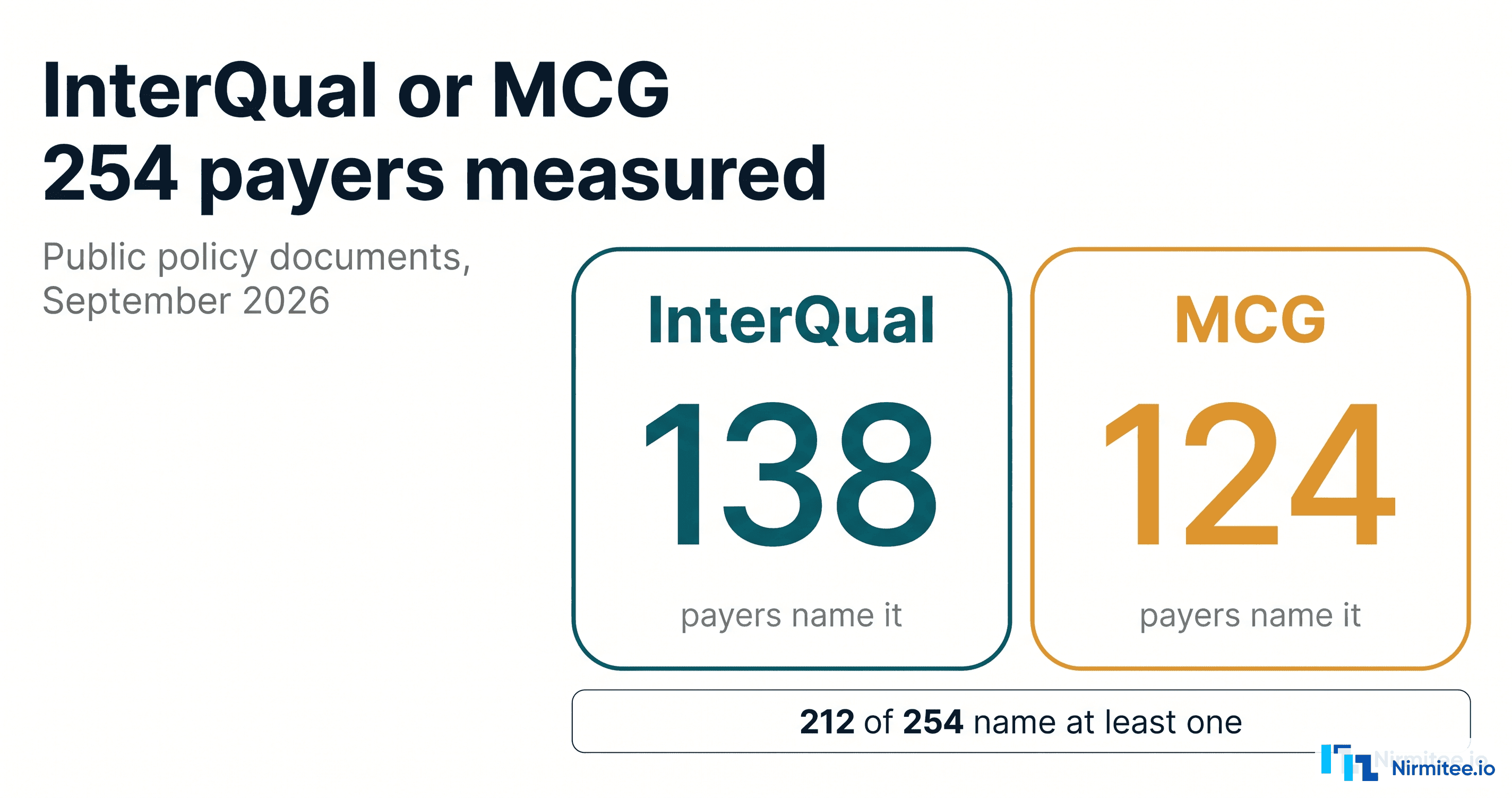
Two commercial products decide a large share of American medical necessity calls: InterQual, owned by Optum, and MCG, owned by MCG Health. Almost nobody publishes which payer uses which. We read the public policy libraries of 278 payers in September 2026 and counted: of the 254 payers with a written assessment, 212 name InterQual or MCG somewhere in their public materials. InterQual appears for 138 payers, MCG for 124, and the two overlap because many payers run one product for inpatient level of care and something else everywhere else.
What we did
In September 2026 we collected the public policy libraries of 278 payers: medical policies, clinical guidelines, prior authorization lists, payment policies, drug policies and coverage determinations, 65,851 documents in total. We read each payer's published material and wrote a structured assessment of where its medical necessity criteria actually come from, which produced 254 completed assessments. Every number below is a count of those public documents on 15 September 2026, not a survey of payers and not a count of covered members.
Finding 1: 212 of 254 payers name one of the two products
The two counts overlap. Because 138 payers name InterQual, 124 name MCG and 212 name either, exactly 50 payers name both. That arithmetic gives the full split.
| What the payer names | Payers | Share of 254 |
|---|---|---|
| InterQual only | 88 | 35% |
| MCG only | 74 | 29% |
| Both products | 50 | 20% |
| Neither product named | 42 | 17% |
| Total assessed | 254 | 100% |
Naming both is not indecision. It is usually a boundary. A payer licenses one product for a line of business or a service family and the other for the rest, and the public documents say so.
Finding 2: these are licensed products, not the payer's own policy
This is the part that surprises people who have only read payer policy PDFs. When a policy says "refer to InterQual" or "MCG criteria apply", the payer is pointing at content it rents. Three consequences follow, and all three cost money.
You cannot read, quote or automate the content without a licence. UnitedHealthcare's commercial policies page states it plainly: "UnitedHealthcare may use tools developed by third parties, such as the InterQual criteria ... The InterQual criteria are proprietary to Optum and are not published on this website." Both vendors run per payer viewing portals rather than open pages. We found MCG access portals on 27 payers' public pages, each on its own subdomain, for example the Molina Medicare portal, the Kentucky Anthem portal and the Kaiser Permanente Washington portal. We found InterQual transparency portal links on 23 payers' pages. Every one of them is a login or a terms gate.
Two payers using the same product can still decide differently. Each payer configures the criteria it licenses. Blue Cross Blue Shield of Michigan publishes its own local rules that modify InterQual post acute criteria, which is a rare public view of the delta a payer layers on top of a rented criteria set. Health Care Service Corporation, the Blues plan for five states, went the other way and retired 20 of its own medical policies effective 1 January 2026, mapping each one to an MCG guideline ID. Same product, different content, different answer.
For Medicare Advantage there is a cheaper path. CMS-4201-F, effective for coverage from 1 January 2024, requires Medicare Advantage plans to follow Medicare's own national and local coverage rules first, and permits internal criteria only where Medicare criteria are not fully established, with those criteria published. Those national and local rules are fully public. We collected 345 national coverage determinations, 864 local coverage determinations and 1,996 billing and coding articles from the Medicare Coverage Database. None of it is behind a login.
Finding 3: what the documents actually say, payer by payer
Counts are easy to argue with. Quotations are not. Here is what a sample of named payers publish about their own criteria.
Payers that name InterQual
- Blue Cross Blue Shield of Michigan. Its commercial prior authorization page sets out the hierarchy by service type: InterQual Level of Care Acute Adult and Acute Pediatric for acute medical and surgical inpatient stays, InterQual for post acute care in long term acute care hospitals, inpatient rehabilitation and skilled nursing, modified by published local rules, and InterQual CP: Procedures for selected elective inpatient and outpatient procedures. That last set is proprietary and needs an Optum login.
- Blue Cross Blue Shield of Rhode Island. Its generic prior authorization policy says InterQual is generally used unless a BCBSRI policy is listed, with Medicare national and local determinations for Medicare Advantage. Its code grids carry a column that names the criteria source per code, either a BCBSRI policy, InterQual or a national coverage determination.
- Capital Blue Cross. Its physical medicine policy records the date of the switch: "Effective 2/1/2013, Capital Blue Cross adopted InterQual guidelines for Physical Therapy services." InterQual also covers inpatient level of care.
- Blue Cross Blue Shield of Massachusetts. InterQual applies to musculoskeletal services management, some gene therapies and inpatient and post acute levels of care. Its electronic authorisation tool is InterQual integrated.
- Devoted Health. A Medicare Advantage plan that publishes about 40 of its own criteria documents and, separately, a list titled "Services reviewed using InterQual criteria", so a provider can tell from the public page which bucket a service falls into.
Payers that name MCG
- Elevance Health. Its medical policies and clinical utilisation management guidelines are public, but it licenses MCG for inpatient, level of care and precertification review, across Inpatient and Surgical Care, General Recovery Care, Recovery Facility Care, Chronic Care and Behavioral Health, and customises that content through its own medical policy committee.
- Health Care Service Corporation. For commercial plans the stated order is the member's benefit document first, then HCSC medical policy and MCG care guidelines, plus ASAM criteria for addiction. The Illinois provider manual calls medical policies "the foundation of BCBSIL's utilization review program" and sends reviewers to MCG for mental health conditions.
- Molina Healthcare. Its own clinical policies are public with numbered criteria. For Medicare it uses MCG through a registration gated portal, and services with no Molina policy fall back to proprietary criteria.
- Kaiser Permanente. Every region publishes some plan owned criteria and falls back to MCG through a regional portal. Medicare Advantage goes to national and local coverage determinations first. We found no InterQual use in any Kaiser region.
- Cigna. Evernorth Behavioral Health uses MCG Behavioral Health Guidelines, and MCG state specific guidelines apply in Alabama, Arkansas, Colorado, Connecticut, Massachusetts and Washington. Both sit behind a proprietary viewer.
Payers that name both, split by line of business
- Aetna. Commercial Clinical Policy Bulletins publish full criteria with numeric thresholds and code tables. For Medicare Advantage, Aetna follows national and local coverage determinations, uses its bulletins where Medicare has no criteria, and names MCG as supplemental criteria. The supplemental criteria themselves are proprietary: the public document gives access instructions only.
- Blue Cross Blue Shield of Arizona. The cleanest example of a product switch we found. MCG replaced InterQual on 1 November 2023, and InterQual still applies to dates of service before that. So the right answer to "which criteria applies" depends on the date of service, not just the plan.
- UnitedHealthcare. InterQual is the criteria engine, but Medicare Advantage delegated provider groups use InterQual or MCG per group, published in a Medicare provider group clinical criteria document. If you are contracted through a delegated group, the plan's own answer is not your answer.
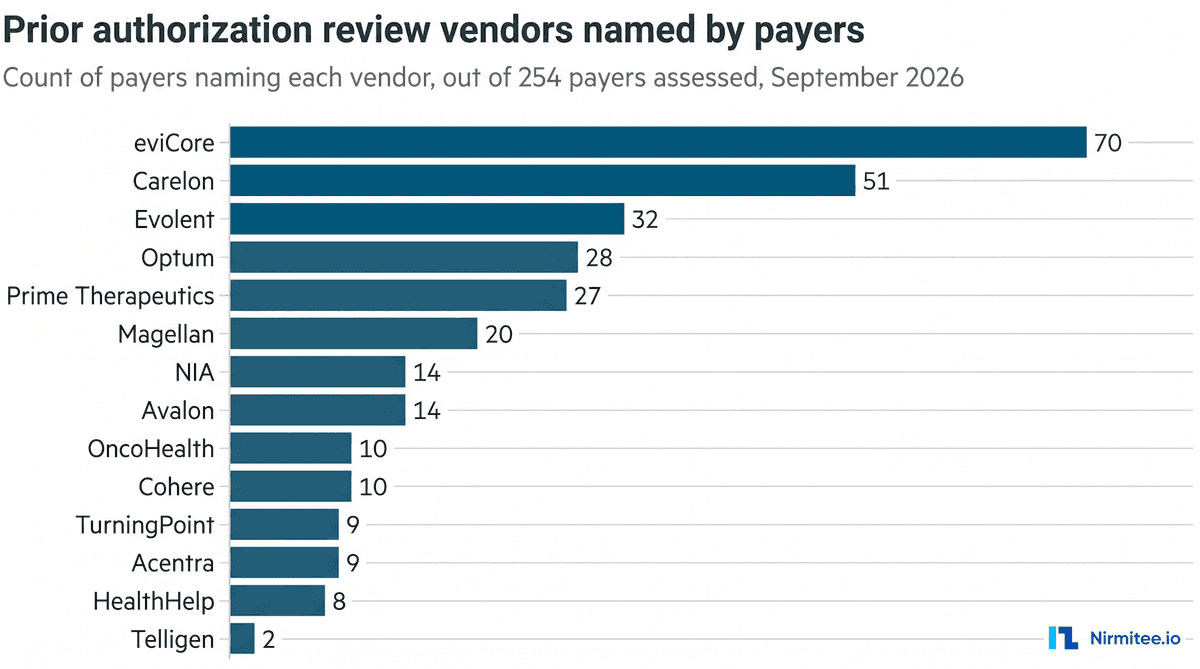
- Medical Mutual of Ohio. Plan owned medical and drug policies are public in full, with both InterQual and MCG used for utilisation management, alongside Cohere, eviCore, Avalon and Prime Therapeutics for specific service families.
- Centene. Its policy CP.MP.68 sets the order explicitly: federal and state rules, then plan specific policy, then Centene policy, then InterQual or MCG where no Centene policy exists. The same policy states that the licensed criteria cannot be publicly published or distributed.
Payers that publish their own criteria first
- Florida Blue. It writes its own Medical Coverage Guidelines with explicit criteria, coding tables and Medicare Advantage program exceptions, and its provider manual names no InterQual or MCG Health criteria set for those policies. The live guideline tree listed 760 current titles on 15 September 2026.
- Humana. Its Medicare Advantage coverage policies list the applicable national and local determinations by Medicare contractor jurisdiction, then give Humana written criteria for jurisdictions or services with no local determination. Its Medicaid policies are the ones that lean on MCG, about 45 files.
- HealthPartners. Full indications, non covered lists, codes and evidence citations in its own policies. InterQual is named only for specific levels of care, for example inpatient behavioral health.
- Select Health. States the Medicare order as national and local coverage determinations first, then InterQual where Medicare has made no determination, then the Select Health commercial policy. Its behavioral health booklet shows the commercial, Medicare and Medicaid split policy by policy.
- Community Care Inc of Wisconsin. Publishes a Prior Authorization Criteria Guide written to meet CMS-4201-F that names the criteria source for each service: Medicare statute, a national determination, or a local determination by jurisdiction, and MCG only where Medicare criteria are not fully established, for example long term acute care stays and selected Part B drugs.
Finding 4: two traps in counting this yourself
If you try to reproduce this count with a search box, two things will mislead you.
Boilerplate inflates the InterQual number. The UnitedHealthcare sentence quoted above appears in roughly 73% of its policy PDFs whether or not InterQual decides that policy. We measured the coverage rationale section of 1,834 UnitedHealthcare medical policies instead: 21% point only to InterQual, 15% mix InterQual with their own criteria, 28% carry their own criteria trees and 26% are UnitedHealthcare owned proven or unproven indication lists. So about 36% of those policies depend on InterQual for at least part of the decision, and about 64% are decidable from the public text. A plain keyword count would have said 73%.
The letters MCG are not always MCG Health. Florida Blue calls its own policy library Medical Coverage Guidelines and abbreviates it to MCG throughout its site. A naive text search returns hundreds of hits at a payer that licenses neither product for those policies. Read the sentence, not the acronym.
What this means for you
If you run a health plan
Your published criteria hierarchy is a compliance artefact and increasingly a competitive one. The payers above that state the order of application, and better, name the criteria source per service or per code, generate fewer avoidable appeals because the provider can tell before submitting which document governs. If you are a Medicare Advantage plan, CMS-4201-F already obliges you to publish internal criteria used where Medicare criteria are not fully established, so a per service criteria guide is work you owe anyway.
If you run provider revenue cycle or utilisation review
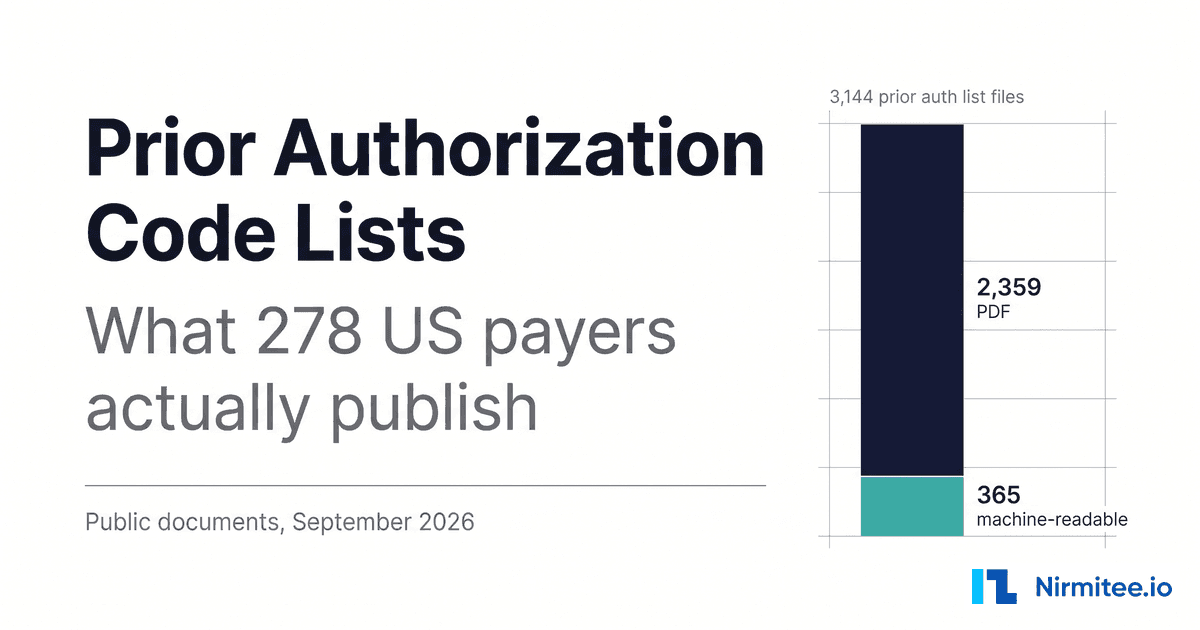
Stop asking "what does this payer use" and start asking "what does this payer use, for this line of business, for this service, on this date of service". All four qualifiers changed the answer in our sample. The Arizona switch date, the UnitedHealthcare delegated group split and the Blue Cross Blue Shield of Michigan service by service table all make the plan level answer wrong. Where a payer publishes a criteria source column in its code grid, as Blue Cross Blue Shield of Rhode Island does, pull that grid into your work queue rules. It tells your team which document to attach before the denial arrives. We measured how usable those grids are across the same corpus in our companion study of what payers actually publish in their prior authorization code lists.
If you are building or buying prior auth software
This is a licensing decision disguised as a product decision, and it sets both your bill and your coverage. Work through it in this order.
- Start with Medicare Advantage. The rule set is public and large: 345 national determinations, 864 local determinations and 1,996 billing articles. You can build real automation against it with no criteria licence at all. If your first market is Medicare Advantage, your licensing bill for criteria content is zero.
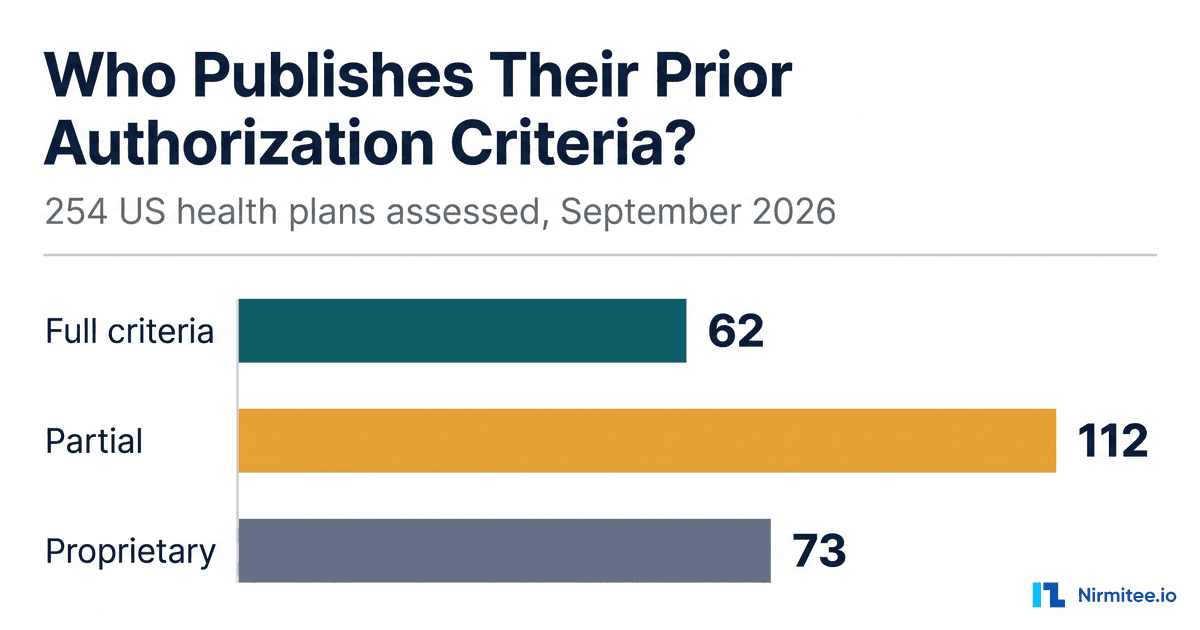
- Take the payers that publish their own criteria next. Of the 254 payers we assessed, 62 publish full criteria and 112 publish partial criteria. Those documents contain the thresholds and the code tables. They are the cheapest automation you will ever build.
- Treat inpatient level of care as the licensed zone. This is where InterQual and MCG concentrate, and where no amount of document parsing will help you. Budget for a licence, or route those cases to a human.
- Do not assume one licence covers a payer. Fifty payers name both products. Ask per line of business and per service family, and ask about the effective date of the payer's last switch.
- Never plan to re-publish licensed criteria. Centene's own policy states the licensed criteria cannot be publicly published or distributed. Your product can carry questions and outcomes, not the vendor's content.
How to check your own position this week
- Open the prior authorization page of your five highest volume payers and find the sentence that names the criteria source. It is usually on the utilisation management or clinical criteria page, not in the individual policy.
- Look for a criteria portal link. An address of the form yourplan.access.mcg.com means an MCG licence. A link to an InterQual transparency portal means an InterQual licence. We found 27 of the first and 23 of the second on public pages.
- Check whether the answer differs by line of business. Pull the Medicare Advantage page separately from the commercial page. In our sample they disagreed more often than they agreed.
- For every Medicare Advantage denial you are appealing, check the applicable national determination and the local determination for your Medicare contractor before you check anything else. Under CMS-4201-F those come first, and they are public.
- Ask each payer, in writing, for the effective date of its current criteria product and the list of services it applies to. Both are answerable and neither reveals licensed content.
Limitations
These are counts of public documents collected on 15 September 2026, not a survey and not a count of covered lives. A payer that does not name a product in public may still license one. Payer sites change weekly, so any single figure here is a snapshot. Counts are of payers with a written assessment, 254 of the 278 we collected, so read every figure as "of the 254 payers we assessed", not "of all US payers". We did not read any licensed criteria content, because reading it requires a contract we do not hold.
If you are sizing a prior auth build, the related questions are covered in our prior authorization software buyer's guide, the cost side in our data driven analysis of what prior authorization actually costs, and the regulatory deadline in CMS-0057-F explained.
Criteria licensing decides what your software can automate. The rest is an interoperability problem: getting the right document, the right codes and the right clinical evidence to the right endpoint, in FHIR, before a human has to retype it. If you are building prior auth into a payer platform or into a provider revenue cycle workflow, see how we approach healthcare AI solutions for utilisation review. Talk to our team about the payers on your list.
Ready to scale?
Talk to our healthcare engineering team about building, integrating, and shipping faster.
Frequently Asked Questions
What is the difference between InterQual and MCG?
How do I find out which criteria my payer uses?
Can I automate prior authorization decisions without an InterQual or MCG licence?
Why do some payers name both InterQual and MCG?
If two payers license the same criteria product, will they reach the same decision?