EHR Integration: The Tech Stack Digital Health Startups Actually Build On

CTO & Co-Founder
CTO & Co-Founder at Nirmitee.io. Architects healthcare integrations across FHIR, SMART on FHIR, ABDM and NHCX, writing from production experience taking hospital software from sandbox to go-live.
Most seed-to-Series B digital health startups don't fail because they built the wrong product. They fail because they built the right product on the wrong foundation — and discovered it too late, usually during a compliance audit or an EHR integration negotiation with a health system.
EHR integration is where stack decisions get tested. Whether your product can connect to Epic or Cerner, pass a HIPAA audit, and handle PHI without becoming a liability is decided months earlier, by the architecture you chose before you had a single clinical partner. This article breaks down what well-funded digital health startups are actually building on in 2026 — layer by layer — and why the EHR integration layer is the one most teams underestimate.
What EHR Integration Actually Involves in 2026
EHR integration means connecting your application to electronic health record systems — reading patient data out, writing results back, and doing both under the access rules health systems enforce. In practice there are three ways to connect: modern FHIR R4 REST APIs (see our FHIR implementation services), SMART on FHIR authorization flows for app-level access, and legacy HL7 v2 interfaces (see our HL7 integration solutions) that still carry most of the real-time clinical traffic inside hospitals.
Every major EHR vendor — Epic, Cerner (Oracle Health), and Athenahealth — now exposes FHIR R4 APIs, and the ONC's 21st Century Cures Act mandates standardized API access for certified health IT. That makes FHIR R4 the default protocol for new integrations. But EHR interoperability is not just an API question: it is an architecture question, and it touches every layer of your stack.
Why Stack Decisions Made in Month One Decide Your EHR Integration Timeline
Most founding teams lock in stack decisions within the first 90 days — before they have clinical partners, before they understand what EHR integrations actually require, and before compliance counsel has weighed in. The result is technical debt that compounds fast.
The two most expensive mistakes in healthcare software product development: building a general-purpose backend and retrofitting HIPAA compliance onto it, and choosing an API strategy that doesn't align with FHIR R4 before realizing every major health system expects it. Neither mistake is fatal. Both are expensive. And both are avoidable if you understand the stack before you build.
Layer 1: Compliance Infrastructure — Built In, Not Bolted On
HIPAA compliance is not a checklist you complete before launch. It is a set of technical controls that must be present in the architecture from the first line of code. Three controls are non-negotiable: PHI encryption at rest and in transit, audit logging for every access event, and role-based access control that limits PHI exposure to authorized users only.
The mistake most early-stage teams make is treating these as features to add in a later sprint. By then, the data model is set, the API surface is defined, and retrofitting audit logging or encryption means rearchitecting core components — not adding a library.
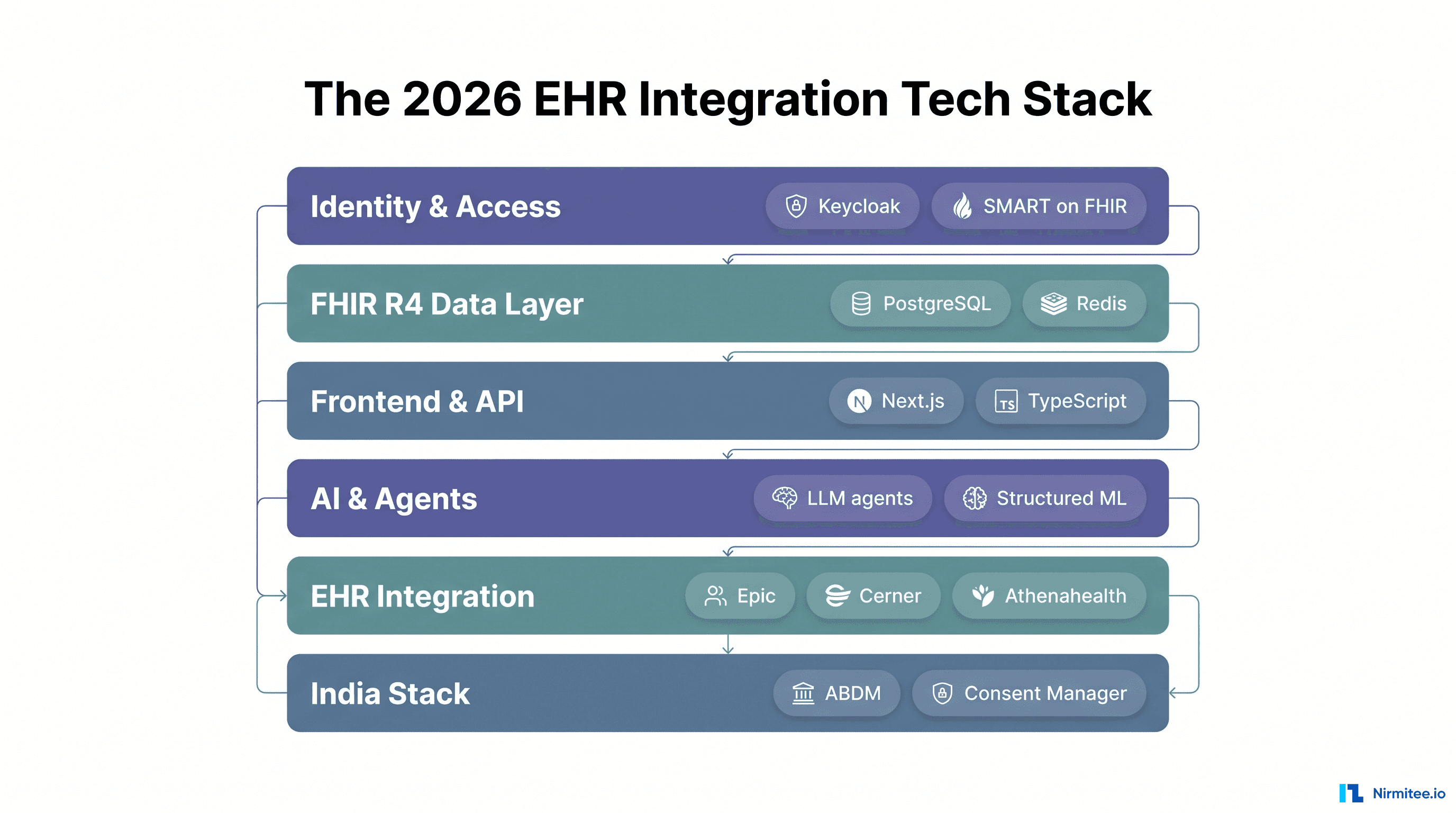
What the 2026 stack looks like here: Keycloak for identity and access management, with SMART on FHIR handling OAuth2 authorization flows. PHI encryption handled at the infrastructure layer, not the application layer. Audit logs written to an immutable store — not the same database your application writes to.
This is not over-engineering. It is the minimum viable compliance posture for any app that touches patient data — and it is the first thing a health system's security team checks before approving your EHR integration.
Layer 2: FHIR R4 as the Data Layer, Not an Integration Add-On
FHIR R4 (Fast Healthcare Interoperability Resources, Release 4) is the current standard for healthcare data exchange. Epic, Cerner, and Athenahealth all require FHIR R4-compliant APIs for third-party integrations. If your product needs to read or write patient data from any major EHR, FHIR R4 is the protocol. For a deeper walkthrough of the standards landscape, see our guide to FHIR, HL7 and other interoperability standards.
The architectural implication is significant. Building FHIR R4 natively into your data layer — rather than building a proprietary schema and translating to FHIR later — means your data model aligns with how health systems think about patient records. Lab results, medication orders, clinical notes, and encounter data all map to defined FHIR resource types. Integrations become faster, cheaper, and less fragile.
What the 2026 stack looks like here: A FHIR R4-native backend, typically built on GoFHIR R4 with PostgreSQL for persistence and Redis for caching and session management. HL7 v2 message handling — usually through an integration engine like Mirth Connect (see our Mirth Connect integration support) — for legacy system connections where FHIR isn't yet supported. SMART on FHIR for authorization when connecting to EHR app marketplaces.
The open-source headless EHR platform built on GoFHIR R4 that Nirmitee.io maintains on GitHub is a direct example of this architecture in production form — publicly available and used as a foundation for custom clinical applications.
Layer 3: The Frontend and API Layer
For patient-facing applications, the 2026 stack almost universally uses Next.js with TypeScript. The reasons are practical: server-side rendering improves performance on mobile networks, TypeScript catches type errors that become critical bugs in clinical workflows, and the ecosystem is mature enough that most healthcare UI components have established patterns.
The API layer connects the frontend to the FHIR R4 backend and to external integrations — labs, pharmacies, wearables, and EHR systems. REST over HTTPS is standard. GraphQL appears in some stacks where complex data fetching across multiple FHIR resources needs to be aggregated efficiently.
Red flag: A frontend built without role-based rendering. If a nurse and a patient see the same UI with the same data access, your access control model is broken at the application layer — regardless of what your backend enforces.
Layer 4: AI Capabilities — Specific, Not Generic
The startups building productively with AI in 2026 are not building "AI-powered platforms." They are building specific clinical functions: decision support that surfaces drug interaction alerts, agentic automation that handles prior authorization in claims processing, triage logic that routes incoming messages to the right care team member, and chronic care management tools that flag patients at risk of deterioration.
Each of these requires a different model architecture, different training data, and different validation requirements. Clinical decision support touches patient safety directly and requires clinical validation before deployment. Claims processing automation operates on structured administrative data and can be validated against ground truth payer rules.
What the 2026 stack looks like here: LLM-based agents for unstructured clinical text — intake forms, clinical notes, discharge summaries. Structured ML models for claims adjudication and prior authorization. Computer vision models for diagnostic imaging interpretation. All of these run against FHIR R4 resources, not proprietary schemas.
The critical architectural requirement: every AI output that touches a clinical decision must be logged, attributable, and auditable. This is not optional under HIPAA. It is also not optional if you want clinical partners to trust your product.
Layer 5: The EHR Integration Layer — Epic, Cerner, and Athenahealth
Integrating with Epic, Cerner, or Athenahealth is not a two-week sprint. It is a multi-month process involving sandbox access, API credentialing, data mapping, security review, and in most cases a formal review by the EHR vendor's app marketplace team — Epic's Showroom (formerly App Orchard), Oracle Health's developer program, or Athenahealth's Marketplace.
The startups that move fastest on EHR integration in 2026 are the ones that built FHIR R4 natively and have a team that understands both the technical and operational requirements of each EHR's integration program. Epic's FHIR API, for example, requires SMART on FHIR authorization and adherence to specific resource profiles that differ from the base FHIR R4 spec — US Core profiles plus Epic's own constraints.
What slows teams down most: Building a custom integration layer for each EHR instead of building to the FHIR R4 standard and handling EHR-specific deviations as configuration, not code. Teams that treat each EHR as a unique integration problem spend roughly three times as long as teams that treat FHIR R4 compliance as the foundation and EHR quirks as edge cases.
Layer 6: The India Stack — ABDM Compliance for India-Market Products
If your product operates in the Indian market, the Ayushman Bharat Digital Mission adds a distinct compliance layer. ABDM (see our ABDM integration support) requires integration with the National Health Authority's (NHA) APIs for health ID creation, health records linking, and consent management. This is required for any digital health product that wants to participate in India's national health data ecosystem.
The technical implementation requires a production-ready ABDM SDK that handles NHA API authentication, consent artifact generation, and health record exchange in the FHIR R4 format that ABDM mandates. Nirmitee.io's ABDM Node.js SDK is published on npm and is among the few production-ready open-source implementations available from a named vendor.
For India-market startups, the ABDM layer sits alongside data protection requirements under India's Digital Personal Data Protection Act — the functional equivalent of HIPAA in this context. Building both simultaneously is possible, but it requires a team that understands both regulatory frameworks at the implementation level, not just the policy level.
What the Full 2026 EHR Integration Stack Looks Like Together
| Layer | Technology / Standard | Why It Matters |
|---|---|---|
| Identity & Access | Keycloak + SMART on FHIR | HIPAA access control, EHR OAuth2 |
| Data Layer | FHIR R4, GoFHIR R4, PostgreSQL | EHR interoperability, data portability |
| Caching / Sessions | Redis | Performance, session management |
| Frontend | Next.js + TypeScript | Clinical UI, SSR, type safety |
| HL7 Integration | Mirth Connect + integration engine tooling | Legacy system connectivity |
| AI / Agents | LLM agents + structured ML | Clinical decision support, claims automation |
| India Compliance | ABDM SDK (Node.js, npm) | NHA API integration, consent management |
| Compliance Infrastructure | PHI encryption, audit logging, RBAC | HIPAA by default |
This is not a theoretical stack. These are the components that appear in production digital health applications built for clinical environments in 2026.
What This Means for Your Build Decision
If you are a CTO or Founder-CTO at a seed-to-Series B digital health company, the stack decisions you make in the next 90 days will shape your compliance posture, your EHR integration timeline, and your ability to deploy in clinical environments for the next three to five years.
The fastest path to a production-ready, HIPAA-compliant, FHIR R4-native application is not hiring five FHIR engineers and building from scratch. It is working with a team that already has the pre-built healthcare components, compliance infrastructure, and EHR integration experience in place.
Nirmitee.io builds digital health products on exactly this stack — HIPAA compliance, FHIR R4 architecture, and AI capabilities for clinical workflows built in from day one, not added later. The development speed advantage comes directly from pre-built healthcare components and AI-assisted pipelines, not from cutting corners on compliance.
Planning an EHR integration or building on this stack? Explore our interoperability and EHR integration solutions to see how we connect clinical systems, and our Healthcare Software Product Development services for the full build. Talk to our team to get started.
Ready to scale?
Talk to our healthcare engineering team about building, integrating, and shipping faster.
Frequently Asked Questions
How long does an EHR integration with Epic or Cerner actually take?
What is FHIR R4 and why does it matter for EHR integration?
What HIPAA technical controls does a healthcare app need from day one?
What is ABDM and which startups need to comply with it?