Release of Information Software: How to Automate HIPAA Authorizations, Release Gates and Secure Delivery

Nirmitee.io Engineering
Author
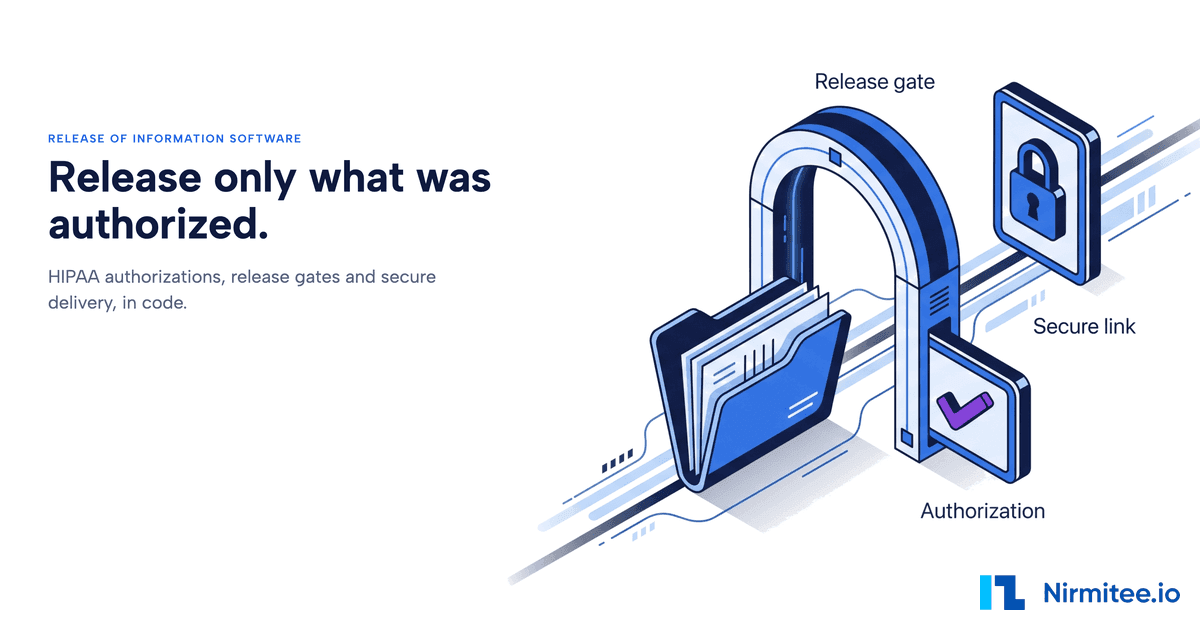
Release of information software manages the disclosure of patient records outside the practice: capturing the patient's authorization, checking each request against it, assembling the right records, delivering them securely and keeping an audit trail of what left, when and why. The hard part is not generating a PDF. It is the release gate: deciding, for every request type, whether a valid HIPAA authorization is required, whether the one on file actually covers this recipient, these records and these dates, and whether it has been revoked since. This guide shows how to build that gate and the workflow around it into an EHR or practice management product.
It is based on the records release module we built for a multi-clinic behavioral health platform, where requests come from attorneys, disability programs, workers' compensation carriers, other treating providers and payers. Regulatory references are to the HIPAA Privacy Rule text; this is engineering guidance, and your compliance team should own the policy choices.
Key takeaways
- A valid authorization has required elements under 45 CFR 164.508, including a specific description of the information, the recipient, the purpose, an expiration and a signature.
- Gate by request type. Some disclosures must be blocked without an authorization, payer disclosures for payment and operations can warn, and a patient's own records follow the right of access.
- Never broaden a disclosure. Record categories and date ranges must be a strict subset of what the authorization allows.
- Re-check at every release, not just at generation, because authorizations can be revoked in writing at any time.
- Separate the right to generate from the right to release.
- Secure links should carry no identity before the recipient confirms, expire, and be revocable.
Why build release of information into the product
Many hospitals outsource release of information to specialist vendors. Smaller practices and behavioral health groups usually handle it themselves, often with a fax machine, a folder of signed forms and a staff member's memory. That creates real risk: records sent without a matching authorization, sent after the patient revoked it, or sent with more than the authorization allowed.
For an EHR or practice management vendor, a built-in release workflow is a feature that saves staff hours every week and removes a category of privacy incident. It also connects to parts of the product an outside tool cannot see: which records exist, which are psychotherapy notes, which are finalized, and who on the staff is allowed to release them. For the wider data-access picture, see our guide to healthcare data governance and access control, and for tenant isolation in multi-clinic products, our guide to multi-tenant healthcare SaaS architecture.
Start with the request, not the document
Every release begins as a request, and the intake decides how smoothly the rest goes. Capture these at intake:
| Field | Why |
|---|---|
| Request type | Drives the gate policy and the packet template |
| Requester and verification | Who is asking, and how their identity or authority was confirmed |
| Received date | Starts the right-of-access or accounting clock where one applies |
| Records and date range requested | Compared with the authorization as a strict subset |
| Delivery method | Portal, secure link, mail or fax, each with its own audit |
| Status | Received, awaiting authorization, in preparation, released, denied, withdrawn |
A request tracker with due dates and statuses turns release of information from an inbox into a queue that a practice can staff and measure. It also makes denials explicit: when a request cannot be fulfilled, the reason and the date are recorded, which matters if the patient later disputes it. Verification deserves care in its own right. A request that claims to come from an attorney or another provider should be checked against something other than the request itself before anything is released, and the method of verification recorded.
What makes a HIPAA authorization valid
Under 45 CFR 164.508(c), a valid authorization must contain these core elements and required statements. Your data model should capture each one as a field, not as a scanned image alone, so the gate can check them.
| Required element | Field in your data model |
|---|---|
| A specific and meaningful description of the information to be disclosed | Record categories and a date range |
| Who may make the disclosure | The practice or named providers |
| Who may receive it | Recipient name, organization and contact |
| Each purpose of the disclosure | Purpose, such as legal, disability, continuity of care |
| An expiration date or event | Expiry date or an expiry event |
| Signature and date | Signer, relationship if a representative, signed date, signed document |
| Statement of the right to revoke in writing | Template text and a revocation record |
| Statement about conditioning treatment or payment | Template text |
| Statement about possible redisclosure by the recipient | Template text |
Two rules shape the workflow. Under 164.508(b)(5), an individual may revoke an authorization at any time, in writing, except to the extent the practice has already relied on it. And under 164.508(a)(2), psychotherapy notes need their own authorization for most disclosures, which in behavioral health means they must be a separate record category that a general authorization never includes by default.
The release gate: block, warn or exempt
Not every disclosure needs an authorization. HIPAA permits many disclosures for treatment, payment and health care operations without one, under 45 CFR 164.506. A patient's request for their own records is the right of access, not an authorization. And a legal release to an attorney needs a valid, matching authorization every time. A single rule for all requests is wrong in both directions. Our gate applies a policy per request type:
| Policy | Request types in our platform | Behavior |
|---|---|---|
| Block without a valid, matching authorization | Legal releases, disability programs, workers' compensation, treatment records leaving the organization | Generation and delivery are refused until a matching authorization exists |
| Warn, never block | Payer audits, prior authorization and supporting records, utilization and continued-stay review | Findings are shown to staff; disclosure proceeds for payment and operations purposes |
| Exempt | Superbills, paid receipts and invoices; the patient's own portal download | No authorization check; the patient's own records follow the right of access |
The policy lives in one place, as a small table of request types, deliberately. When compliance review decides a type should move from warn to block, it is a one-line change with no change to the gate's logic. The classifications above were the practice's decision; yours may differ, which is exactly why they should be configuration.
Matching: never broaden a disclosure
An authorization on file is not enough; it has to cover this request. The gate checks:
- Status: active, not expired, not revoked.
- Recipient: the intended recipient matches the one the patient named.
- Record categories: every category in the packet is included in the authorization. A strict subset check, so an authorization for "treatment summary" never releases "full chart".
- Date range: every record's date falls inside the authorized range, again as a subset check.
- Purpose: we recommend also matching the authorized purpose to the request type; it is the next check we would add.
The principle in our module is written into its design: the system never silently broadens a disclosure. When a request asks for more than the authorization allows, the gate reports exactly which category or date is outside it, and the staff member either narrows the packet or obtains a new authorization.
Check again at every release, not just once
The most important timing decision: the gate runs at preflight, when staff start a request and see a banner; at generation, when the packet is assembled; and again at every download or delivery of a gated packet. An authorization revoked after the packet was generated must block the next release. The gate itself never changes any data; it evaluates and reports, so running it often is safe.
That rule follows directly from revocation being allowed at any time. A system that only checks at generation will happily re-send a packet a week after the patient withdrew consent.
Who may release: separate generating from releasing
Assembling a packet and sending it outside the organization are different powers. In our module, clinic administrators hold release authority by role; any other staff member needs an explicit per-user grant to release records externally, override the gate or manage authorizations. Patients never hold release authority; their own access runs through separate portal endpoints. Generating a packet is governed separately, by role and by the staff member's caseload.
The separation matters in practice. A clinician can prepare a treatment summary for a referral, and a trained staff member with release authority sends it. The audit trail shows both steps and both people.
Review your release workflow against this gate. Describe how your product captures authorizations and sends records today, and we will map it against each check in this guide, from authorization fields and request-type policy to re-checks on delivery and link security, and return the gaps in priority order. See our HIPAA compliant software development work or send us your workflow.
The patient's own records: right of access
When the patient asks for their own records, the rules are different. Under 45 CFR 164.524, the practice must act on a request no later than 30 days after receiving it, with a single extension of no more than 30 days if it notifies the patient in writing within the first period. Copies must be provided in the form and format requested if readily producible, including electronic copies of electronic records, and any fee must be reasonable and cost-based.
For a product, that means a patient portal download path that bypasses the authorization gate, a request tracker with the 30-day clock, and an electronic format that is readily producible, such as a PDF packet. Financial documents such as superbills and receipts are the simplest case and belong in the portal by default.
Minimum necessary and accounting of disclosures
Two further Privacy Rule duties belong in the same module, and they are the ones most home-grown release workflows miss.
Minimum necessary. For disclosures that are not for treatment, not to the patient and not under an authorization, 45 CFR 164.514(d) expects the practice to limit what it discloses to the minimum necessary for the purpose. In a release workflow, that means packet templates per request type that include only the relevant record categories, so a payer audit packet does not carry the full chart by default.
Accounting of disclosures. Under 45 CFR 164.528, patients can ask for an accounting of certain disclosures made in the six years before the request. Disclosures for treatment, payment and operations, disclosures to the patient, and disclosures under an authorization are among the exceptions, so the accounting mostly covers disclosures such as those required by law or to public health. Each entry needs the date, the recipient's name and address, a brief description of what was disclosed, and the purpose. The practice must act within 60 days, with one 30-day extension, and the first accounting in any 12 months is free.
The practical consequence: record every release with those four fields at the moment it happens, tagged with whether it is accountable. Reconstructing an accounting from fax logs years later is the kind of task that never gets done well.
| Duty | Rule | What the software does |
|---|---|---|
| Valid authorization | 164.508 | Structured fields, gate, revocation |
| Right of access | 164.524 | Portal path, 30-day clock, electronic copies |
| Minimum necessary | 164.514(d) | Packet templates per request type |
| Accounting of disclosures | 164.528 | Release log with date, recipient, description, purpose |
| Personal representatives | 164.502(g) | Record who signed and their authority to act |
Personal representatives, such as a parent for a minor or a guardian, are treated as the individual for most purposes under 45 CFR 164.502(g), with state law exceptions that matter in behavioral health, particularly for adolescents. Capture who signed, in what capacity, and the basis for their authority, and let compliance configure state-specific rules.
Secure delivery links
Delivery to an outside recipient by link replaces fax and mail for many requests. Our link design, each part tested:
- The token is the authorization. Links carry a signed token; the database stores only its hash, and every call checks the hash, the expiry and whether the link or the packet has been revoked.
- No identity before confirmation. Before the recipient confirms, the page shows a generic label such as "Records packet", never the client's name.
- Expired links fail clearly, with a friendly "link expired" page rather than an error.
- Revocation works after sending. Revoking the packet or the link stops further downloads immediately.
- Gated packets re-run the release gate on download, so a revoked authorization blocks the link too.
What we learned
- Classify request types before writing the gate. Most of the policy is a table; the table is a compliance decision, not an engineering one.
- Subset checks prevent the quiet overshare. Most release errors are "sent more than was authorized", not "sent with no authorization".
- Revocation makes generation-time checks insufficient. Check at release, every time.
- Separate generating from releasing. It matches how practices actually work and it makes the audit trail meaningful.
- Anonymous endpoints need explicit checks. A link recipient has no login, so every lookup must verify the token, expiry and revocation directly.
Measure the release workflow
Once requests live in a tracker, the practice can finally see its release of information operation. Useful measures: requests received per week by type, median days from receipt to release, requests past the 30-day right-of-access deadline, requests waiting on an authorization, gate blocks by finding (expired, revoked, recipient mismatch, categories or dates outside the authorization), and overrides with their reasons. The gate findings are especially telling. A high share of "categories exceeded" usually means staff are building packets from the full chart instead of the request-type template, which is a training fix, not a software one.
Release of information software checklist
- Authorizations stored as structured fields for every required element, plus the signed document.
- Psychotherapy notes as a separate category, never included by default.
- Revocation captured in writing, with its date, and applied immediately.
- A request-type policy table: block, warn or exempt.
- Strict subset matching on recipient, categories and dates, plus a purpose match.
- The gate evaluated at preflight, generation and every release.
- Release authority separate from generation authority, with per-user grants.
- A right-of-access path with a 30-day clock and electronic delivery.
- Secure links with hashed tokens, no identity before confirmation, expiry and revocation.
- An audit trail of every generation, release, download and revocation, with accountable disclosures tagged for the accounting.
- Minimum necessary packet templates per request type.
Related reading: our HIPAA Security Rule checklist covers the safeguards around this workflow, our guide to a HIPAA compliant AI scribe shows the same code-enforced approach applied to AI documentation, and HIPAA logging without exposing PHI covers the audit side. Payer requests often arrive with claims work; our guides to claim scrubbers and Good Faith Estimate software cover the billing side of the same platform.
Building a records release workflow? We build release of information modules into EHR and practice management platforms: structured authorizations, request-type gates, right-of-access tracking and secure delivery. Tell us your request volume and types and we will outline the first release. See our healthcare software product development services or talk to our team.
Ready to scale?
Talk to our healthcare engineering team about building, integrating, and shipping faster.
Frequently Asked Questions
What is release of information software?
What makes a HIPAA authorization valid?
Can a patient revoke a HIPAA authorization?
Do all records disclosures need an authorization?
How long does a practice have to respond to a patient's records request?
Do psychotherapy notes need a separate authorization?