EDI Testing for Healthcare Claims: How to Test a Clearinghouse Integration Before Go-Live

Nirmitee.io Engineering
Author
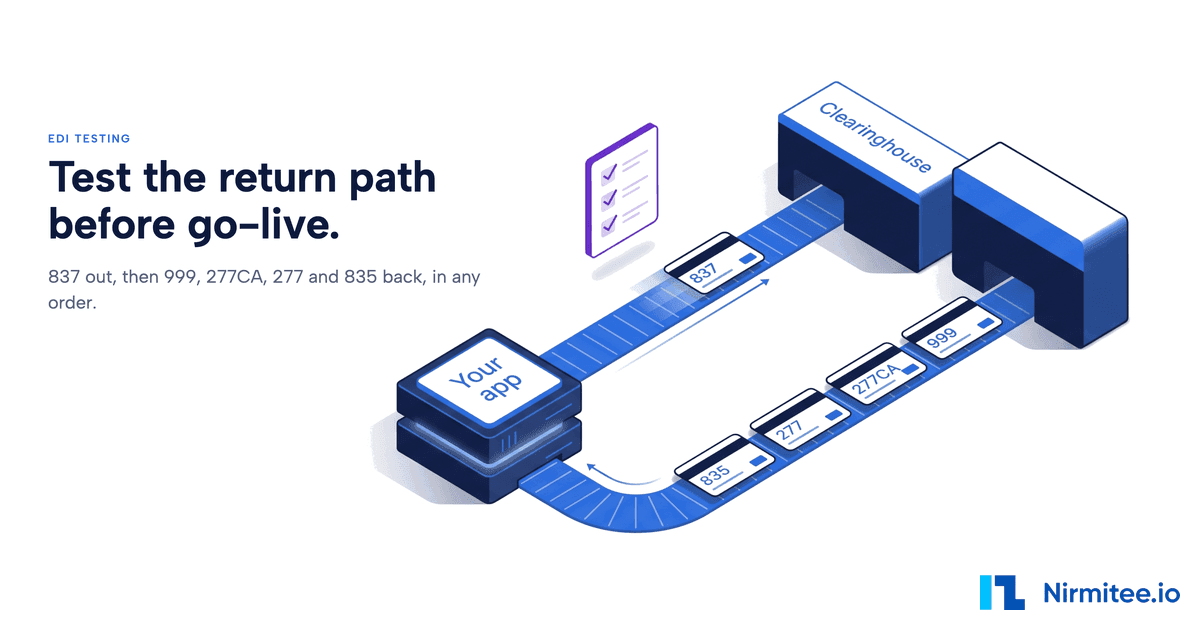
EDI testing for healthcare claims means proving that your system builds valid X12 transactions, sends them the way the clearinghouse expects, and correctly processes everything that comes back: the 999 acknowledgment, the 277CA claim acknowledgment, the 277 status response and the 835 remittance. Syntax validation is only the first of those. Most production failures in a clearinghouse integration come from the return path: files routed to the wrong parser, statuses applied out of order, retries that create duplicates. This guide shows how to test all of it before go-live, without waiting weeks on a clearinghouse sandbox.
It comes from the claims integration we engineer for a multi-clinic behavioral health platform that submits professional claims to a national clearinghouse over SFTP. The traps below are ones we met in that integration, and the test suite is the one that now keeps them from coming back.
Key takeaways
- Test the return path as hard as the 837. Acknowledgments, statuses and remittances are where state goes wrong.
- Validate in SNIP levels, from syntax to trading-partner rules, and know which level each tool covers.
- Route inbound files by content, not filename. The 277 and 277CA share a transaction code and differ in
BHT06. - Build a clearinghouse simulator that returns realistic 999, 277CA and 835 files for your own claims.
- Status must never move backwards. A late rejection must not downgrade a claim the payer later accepted.
- Turn every production incident into a replay test with a de-identified file.
Why EDI testing decides your go-live date
A clearinghouse integration has long lead times that have nothing to do with code: IP allowlisting, trading-partner setup, payer enrollment per provider and per transaction type. Teams often wait on those and then test against live payers in the first week of production. That is when routing bugs, duplicate submissions and misapplied statuses surface, with real revenue attached.
For a software vendor, a bad first month on a new clearinghouse costs more than engineering time. Practices see claims stuck in "submitted", billers re-key work, and the vendor's support team becomes the integration's monitoring system. A test suite that runs before any of that is the cheapest insurance in the project. We cover the integration itself in our clearinghouse integration guide; this post is about proving it works.
The transactions you are actually testing
| Transaction | Direction | What it tells you | Typical test risk |
|---|---|---|---|
| 837P / 837I | Outbound | The claim | Invalid segments, wrong provider loops, missing situational data |
| TA1 / 999 | Inbound | The file or functional group was accepted or rejected for syntax and implementation guide rules | Not correlated back to the batch; rejected batches look submitted |
| 277CA | Inbound | Each claim was accepted into or rejected from the clearinghouse or payer front end | Parsed as a payer status; claim matched by the wrong key |
| 276 / 277 | Outbound / inbound | The payer's current status for a claim, only when you ask | Never polled, so claims go stale |
| 835 | Inbound | Payment, adjustments and denials | Adjustment segments misread; reversals and corrections mishandled |
CMS companion guides describe the order: syntax and implementation-guide errors come back on the 999, and the 277CA follows with claim-level acceptance or rejection for claims that passed. The Medicare 837P companion guide is a good reference for how one large receiver sequences them. Your tests should expect every one of those files, for every batch, in any order.
Validation levels: what "valid" means
The industry breaks X12 validation into seven WEDI SNIP types, summarized in state Medicaid guidance such as Ohio Medicaid's SNIP testing types:
| SNIP type | Checks | How to test it |
|---|---|---|
| 1. EDI syntax integrity | Valid segments, elements and envelopes | X12 validator in CI on every generated file |
| 2. Implementation guide requirements | Required segments, repeat limits, qualifiers | Validator loaded with the 005010 implementation guide |
| 3. Balancing | Line amounts sum to the claim total; 835 balances | Unit tests on your generator and parser |
| 4. Situational rules | If this element exists, that one must too | Validator plus scenario tests for your own branches |
| 5. External code sets | Valid ICD-10, CPT, place of service, taxonomy, reason codes | Reference tables versioned by date of service |
| 6. Product or service specific | Rules that differ by service type | Scenario tests per specialty and claim type |
| 7. Trading partner specific | A payer's or clearinghouse's own rules | Companion guide checklist and replayed rejections |
Most off-the-shelf EDI testing tools and X12 validators cover types one to five well. Types six and seven depend on your payers and your product, and they are where real rejections cluster. That is why a validator is necessary and never sufficient.
The outbound path: generate, validate, name, transmit
Four checks cover most outbound failures.
- Every generated file passes a validator in CI. Build representative claims from fixtures, including supervised clinicians, secondary claims and multiple service lines, and fail the build on any SNIP type one or two error.
- Pre-transmission gates run before the file is built. A claim missing a rendering NPI or place of service should fail with a clear message in your product, not become a 999 rejection. Our claim scrubber guide covers that layer.
- File naming and routing match the clearinghouse's rules. Clearinghouses often route by file extension, with different extensions for professional, institutional and dental claims and for eligibility. We test the file name as its own unit, because one wrong extension silently sends a batch to the wrong queue.
- One bad claim cannot poison a batch. We test that a single claim failing generation is isolated and the rest of the batch still transmits.
Secondary and tertiary claims deserve their own fixtures. Coordination of benefits adds the other payer's subscriber loops and the primary's adjudication at claim and line level, and it is where hand-built generators most often produce files that pass syntax checks and still reject.
Transmission errors need their own test. Error messages from the transport or the generator can carry patient data, so we redact them before they reach logs or the screen, and assert that in a test.
The return path: where integrations actually break
Route by content, not by filename
The single most expensive defect we have seen in a claims integration: the 277CA (clearinghouse claim acknowledgment) and the 277 (payer claim status response) both carry ST01 = 277. They differ in BHT06: TH for the acknowledgment, DG for a status response. Code that routes on the transaction set code alone parses payer statuses as acknowledgments, or the reverse, and claim states drift without a single error. Route every inbound file by reading its envelope and header, and test each file type against the router.
Correlate every file to what you sent
Each inbound file has a different correlation key: the 999 points at the interchange and group control numbers, the 277CA at the claim's trace or patient control number, the 835 at the payee and then the patient control number. Test that each one finds the right claim, and that an unmatched file lands in a review queue instead of being dropped. Reuse control numbers on retries, and never rewrite the payer's claim number; record matches alongside the claim.
Status must never move backwards
Files arrive out of order, and some clearinghouses send more than one 277CA for the same claim. A weaker, later response must not undo a stronger earlier one, and a rejection followed by an acceptance must leave the claim accepted. The rule behind it is a claim state machine with allowed transitions and terminal states, tested directly.
Status only arrives if you ask
Acknowledgments and remittances arrive on their own. Current payer status does not; you have to send a 276 and receive a 277. If nothing polls, claims sit in "accepted" for months. Test the aging-poll loop as a scheduled job with a fake clock.
Remittances are a parsing minefield
The 835 CAS segment carries one group code followed by up to six reason, amount and quantity triplets. A loop that assumes one triplet per segment reads a quantity as the next group code and misposts money silently. We keep a parser suite with one case per shape, including provider-level adjustments in the PLB segment and reversal and correction pairs. Our guide to reading an ERA explains the segments.
Get a test plan for your clearinghouse integration. Tell us which clearinghouse, transactions and payers you support, and share a de-identified sample of your inbound files. We will return the scenarios your current tests miss, from routing and correlation to out-of-order statuses and 835 edge cases. See our RCM software development work or send us the details.
Build a clearinghouse simulator
Clearinghouse test environments are shared, slow to set up and rarely produce the awkward responses you need. A simulator you control fills the gap. We built one and released it as open source: the clearinghouse simulator is a drop-in stand-in for a real clearinghouse's SFTP integration, with around 120 scenarios across 270/271, 278, 837, TA1/999, 277CA, 835 and 276/277, matched against a production corpus.
The design choices that make a simulator useful, whichever one you use:
- Same transport as production. Your application uploads 837 and 270 files by SFTP and polls a directory for responses. Point the settings at the simulator and nothing else in your code changes, so the transport, file naming and polling are tested too.
- Your own values echoed back. Trace numbers, control numbers, patient control numbers, member IDs and charges in the responses come from your request, so every correlation key lines up as it would in production.
- Real X12 shapes. The same delimiters, interchange identity and file name patterns as live traffic, with transport and file conventions held in a profile so a second clearinghouse is configuration, not a fork.
- Failure modes on demand. Rejections with chosen reasons, partial payments, denials, reversals, and the responses you can never ask a payer to reproduce.
Because the simulator speaks real X12, every downstream component runs for real: routing, parsing, correlation, state transitions, posting and work queues. Scenario tests then read like billing stories: submit, reject, correct, resubmit, accept, pay, reverse. Test patients are synthetic, so no PHI is involved, and the simulator should be impossible to confuse with a live endpoint by configuration mistake.
One regression from our own suite shows why this matters. Some clearinghouses send the receipt acknowledgment and the intake decision as separate 277CA files. In our case a rejection and a later acceptance arrived days apart, and the claim had to end as accepted. The test uses the simulator's real X12 output end to end. It also exposed a subtle trap: the date that orders those events is a calendar date with no time of day, so two responses on the same day tie, and a test that uses same-day files can pass for the wrong reason. We only trusted the test once it failed against the old code.
Turn incidents into replay tests
The best test data is what production already sent you. Every time an inbound file surprises you, de-identify it, add it to a replay folder, and write a test that asserts the correct outcome. Over time the suite becomes a record of every payer quirk you have met, and a refactor of the parser cannot quietly reintroduce one. The rule we apply to every defect: first a test that reproduces it for the reported reason, then the fix.
Two cautions. De-identify properly, because real 835s and 277s are full of PHI, and keep replay files out of any repository that does not meet your PHI controls. And keep the originals' structure intact, since whitespace, segment terminators and repeat counts are often the bug.
After go-live: monitor what tests cannot
Tests prove the logic; production proves the environment. The first weeks with a new clearinghouse or payer need monitoring built for the return path:
| Signal | Why it matters | Alert when |
|---|---|---|
| Batches with no 999 | The file may never have been picked up | No acknowledgment within the clearinghouse's usual window |
| Claims with no 277CA | Accepted batches whose claims never reached intake | Past the expected delay for your clearinghouse |
| Unmatched inbound files | Correlation keys are wrong or changed | Any file in the unmatched queue |
| Rejections by status code | A new payer rule or a data problem | A code appears that the suite has never seen |
| Claims stuck in accepted | Status polling is not running or not matching | No payer status after the aging threshold |
| 835 balance failures | Parsing or posting errors that move money | Any remittance that does not balance |
Rejection status codes come from the X12 claim status category code list; alerting on codes you have never seen is a cheap way to learn about payer changes before billers do. Every alert that turns out to be a real defect should end in a replay test, which closes the loop with the section above.
Plan the cutover too. Run the first batches for a small set of clinics or payers, compare every acknowledgment with what the simulator predicted, and widen only when the unmatched queue stays empty. When eligibility is part of the same connection, test the 270/271 round trip the same way; our guide to automating eligibility verification covers that flow.
What we learned
- The return path deserves most of the testing budget. The 837 gets attention because it is visible. The state bugs live in inbound processing.
- Shared transaction codes are a trap. Read the header before you pick a parser.
- Out-of-order files are normal. Design state transitions for them and test the ugly orderings.
- Non-code lead times dominate. Ask for IP allowlisting and payer enrollment on day one and gate go-live on them, while the simulator lets engineering finish.
- Error text can leak PHI. Redact transmission errors and test the redaction.
EDI testing checklist
- Validator in CI on every generated 837, covering SNIP types one to five.
- Scenario fixtures for your product's claim shapes, including supervised and secondary claims.
- File naming and routing tests per transaction type.
- Batch isolation: one failing claim never blocks the rest.
- Inbound routing by envelope and header, with 277 versus 277CA covered.
- Correlation tests for 999, 277CA, 277 and 835, with an unmatched-file queue.
- A claim state machine with no backward transitions, tested with out-of-order files.
- A 276 polling job tested with a fake clock.
- An 835 parser suite covering multi-triplet
CAS,PLB, reversals and corrections. - A clearinghouse simulator on the production transport, such as our open-source clearinghouse simulator, and a growing replay suite of de-identified production files.
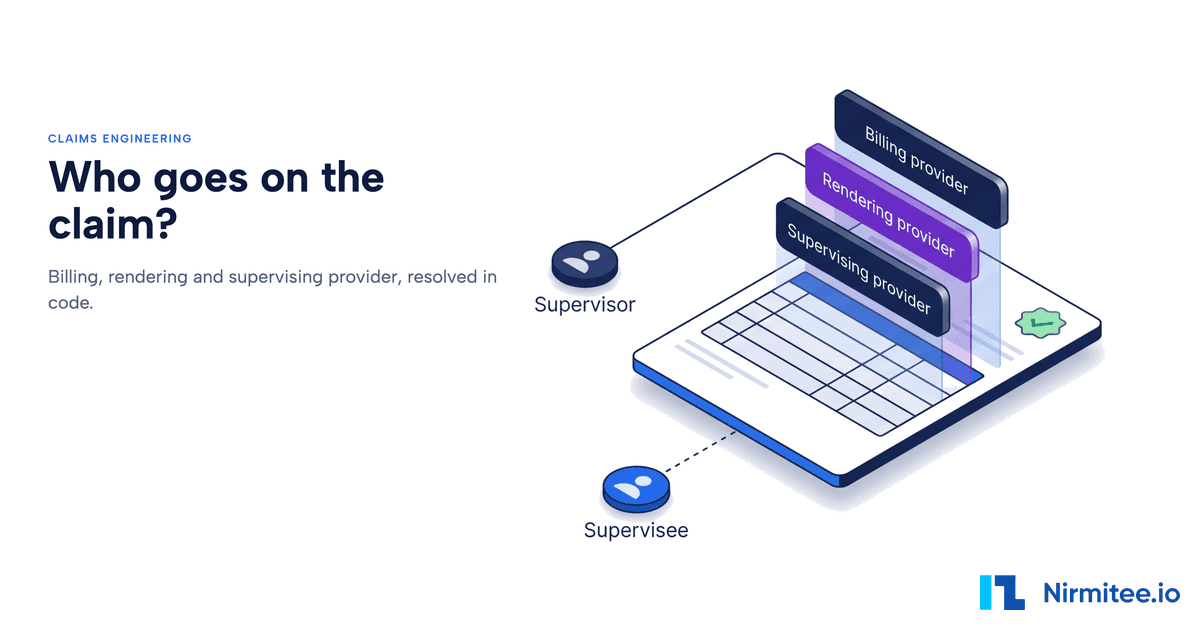
For the transaction set in depth, see our X12 EDI developer guide, and for testing interface engines, our guide to automated Mirth Connect channel testing. Provider identity, the most common 837 content problem we see, is covered in rendering vs billing provider.
Going live with a clearinghouse soon? We build and test claims integrations for EHR and billing platforms, including clearinghouse simulators, replay suites and the inbound processing that keeps claim states correct. Tell us your target date and we will outline what to test before it. See our healthcare interoperability services or talk to our team.
Ready to scale?
Talk to our healthcare engineering team about building, integrating, and shipping faster.
Frequently Asked Questions
What is EDI testing in healthcare?
What is the difference between a 999 and a 277CA?
How do you tell a 277CA from a 277 claim status response?
What are the WEDI SNIP levels?
Do we need a clearinghouse simulator?
What EDI testing tools should we use?