Rendering Provider vs Billing Provider vs Supervising Provider: How a Claim Engine Decides Who Goes on the 837

Nirmitee.io Engineering
Author
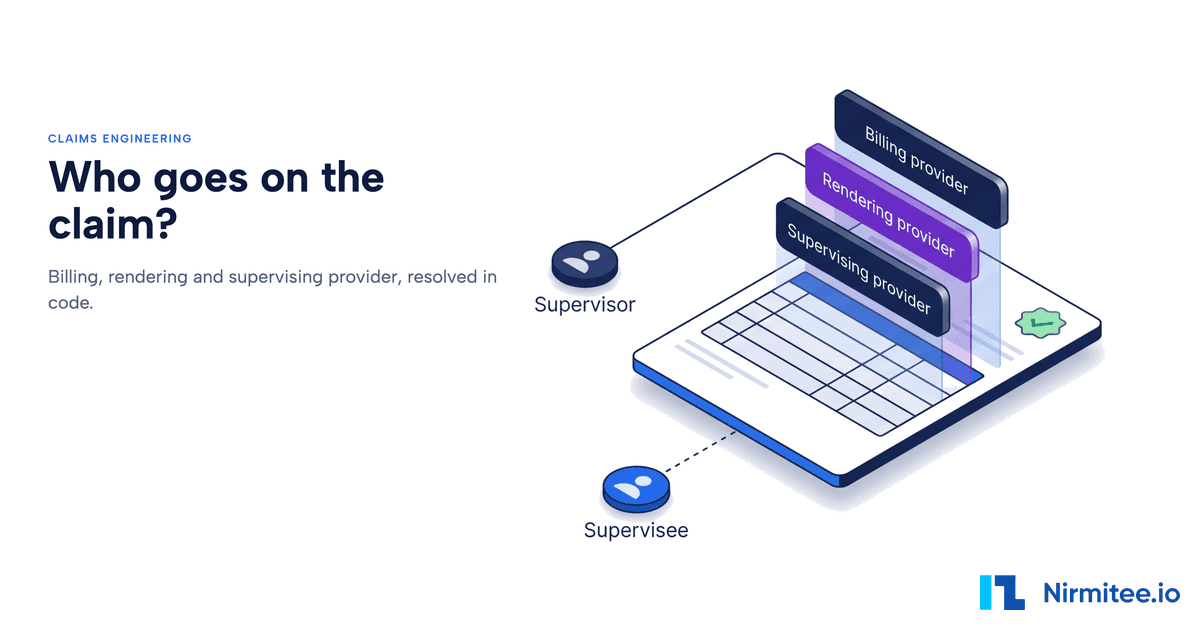
The rendering provider is the individual clinician who performed the service, reported on a professional claim in loop 2310B as NM1*82 with their own NPI. The billing provider is the entity that gets paid, usually the practice, reported in loop 2010AA as NM1*85 with the group NPI and tax ID. The supervising provider, reported in loop 2310D as NM1*DQ, is the licensed clinician responsible for a service delivered by someone they supervise. Getting those three identities right on every claim is one of the most rule-heavy jobs a claim engine does, and one of the most common reasons claims bounce.
This guide is for product and engineering teams building claim generation into an EHR or practice management product. It is based on the claim engine we engineer for a multi-clinic behavioral health platform, where supervised, pre-licensed clinicians deliver a large share of sessions. That makes provider identity the difference between a clean claim and a rejection on almost every visit.
Key takeaways
- Three roles, three loops. Billing provider in 2010AA (
NM1*85), rendering provider in 2310B (NM1*82), supervising provider in 2310D (NM1*DQ). - The organization NPI never substitutes for a rendering NPI. Rendering is always an individual.
- Name and NPI must describe the same person. A supervisor's NPI with the supervisee's name is a rejection.
- Supervised clinicians are a policy decision, not a default. Many payers require the credentialed supervisor as rendering; the engine must resolve which supervisor, and stop when it cannot.
- Snapshot the identity at claim creation so resubmissions stay consistent even after staff changes.
- Check the right person's credentials before billing. For a supervised note, readiness checks belong to the supervisor, not the supervisee.
Rendering provider vs billing provider: the short answer
| Billing provider | Rendering provider | Supervising provider | |
|---|---|---|---|
| Who | The entity paid for the claim, usually the group practice | The individual who performed the service | The licensed clinician responsible for a supervised service |
| 837P loop | 2010AA | 2310B (claim) or 2420A (line) | 2310D (claim) or 2420D (line) |
| Entity code | NM1*85 | NM1*82 | NM1*DQ |
| NPI type | Type 2 organization NPI, or Type 1 for a solo practitioner | Type 1 individual NPI | Type 1 individual NPI |
| Also carries | Tax ID, billing address | Taxonomy (PRV*PE*PXC), sometimes state license (REF*0B) | Name and NPI |
| Can it be omitted | Never | Only when it is the same person as the billing provider | Only when no supervision applies |
The implementation guide rule that trips new teams most often: loop 2310B is only required when the rendering provider differs from the billing provider. In a group practice that is almost every claim, so treat it as always present unless you are billing for a solo practitioner under their own individual NPI.
Why this matters to your product's revenue
Provider identity errors rarely show up as dramatic failures. They show up as a steady trickle of front-end rejections: a 277CA that says the rendering provider name does not match, a Medicaid payer that wants a taxonomy code, a commercial payer that has never credentialed the clinician on the claim. Each rejection means a biller opens the claim, finds the cause, fixes the provider record and resubmits, and each day of delay pushes cash out.
For a software vendor, that trickle becomes a support queue and a renewal risk. Practices judge billing software by how often claims come back. The vendors that win in behavioral health, physical therapy and other supervised-care specialties are the ones whose claim engine gets provider identity right without a biller's intervention. We cover the broader rejection picture in why claims get denied; this post is about the provider slice of it. For how payer connections and enrollment fit together, see our US payer integration guide.
The billing provider: the entity that gets paid
The billing provider is the easy part, and it still fails. It needs an organization NPI, the practice's tax ID, and a street billing address, because the 5010 implementation guide does not allow a post office box in 2010AA. Our scrubber treats a missing billing provider NPI, tax ID or complete address as errors that block the claim before it is built, with rule codes that tell the biller exactly which field to fix.
One design point matters for multi-clinic platforms: the billing identity belongs to the clinic, not the platform. In our engine each organization carries its own billing profile, and the claim takes the billing provider from the organization that owns the appointment. That sounds obvious until a background job with no signed-in user builds claims for several clinics in one batch.
The rendering provider: one person, one coherent identity
The rendering provider must be an individual with a Type 1 NPI. Two rules in our engine prevent most rendering rejections.
The organization NPI is never a substitute
When a clinician's individual NPI is missing, the tempting fallback is the group NPI. Payers reject it, and worse, some accept it and pay under the wrong identity. Our engine refuses to build the claim and tells the biller to add the clinician's NPI to their credentials. Manually entered NPIs also carry noise, such as a trailing full stop or a dash placeholder, so the engine strips punctuation and then hard-fails anything that is not exactly ten digits.
Name and NPI must match the same person
One rejection we saw in production reads "rendering provider name matching required": the claim carried one person's NPI with another person's name. It happens whenever the name and the NPI are looked up from different places, for example the NPI from the supervisor and the name from the appointment. The fix is to resolve the rendering provider as a single identity, name and NPI together, from one source, and never assemble it field by field.
The supervising provider and supervised clinicians
This is where claim engines earn their keep. In behavioral health, pre-licensed clinicians (associates, interns, residents working toward licensure) deliver care under a licensed supervisor. Many payers have never credentialed the supervisee and will not pay under their NPI.
How to report a supervised service depends on the payer and program, which is exactly why it must be configurable rather than hard-coded:
| Payer rule | Rendering provider (2310B) | Supervising provider (2310D) |
|---|---|---|
| Supervisee is credentialed and may render | Supervisee | Supervisor, if the payer asks for it |
| Supervisee not credentialed; supervisor must render | Supervisor | Often omitted, or supervisor |
| Medicare incident-to | The supervising practitioner who bills | Per payer instruction |
| Supervised services not payable at all | Not billable to that payer | Not applicable |
In the platform we work on, the dominant case is the second row: the credentialed supervisor is the rendering provider, name and NPI, and the supervisee who documented the note stays the clinician of record inside the product but never appears in NM1*82. The supervisor's taxonomy and state license travel with them into PRV*PE*PXC and REF*0B, because Medicaid-type payers check both.
Which supervisor? Resolve it, or stop
A supervisee can have more than one supervisor. The engine must pick the right one, and our rule has three branches, each covered by a test:
- If the clinic has designated a primary billing supervisor, use that supervisor.
- If there is exactly one supervisor and no designation, use them.
- If there are several supervisors and none is designated, fail closed: block the claim with a message naming the missing designation, rather than guessing.
Guessing is the expensive option. A claim rendered under the wrong supervisor can be paid, and then it is a compliance problem instead of a rejection.
Snapshot the identity when the claim is created
We stamp the resolved supervisor onto the claim at generation: user, name and NPI. Rendering then keys off that snapshot. Two things follow. A resubmission months later still carries the same rendering identity even if the supervisee has since changed supervisors. And fixing the supervisor on a claim that was created wrongly corrects every line at once, with no per-line patching.
Model supervision as per-payer configuration
Because the correct answer differs by payer, the supervision rule belongs in payer configuration, next to the payer ID and filing indicator, not in the claim generator. The fields we recommend on each payer (or payer plus program) record:
| Setting | Values | Effect on the claim |
|---|---|---|
| Supervisee may render | Yes / No | Chooses the supervisee or the supervisor for NM1*82 |
| Supervising provider loop | Required / Omit / If different | Controls whether 2310D is sent |
| Taxonomy required | Yes / No | Sends PRV*PE*PXC for the rendering provider and makes it a blocking check |
| State license required | Yes / No | Sends REF*0B and makes it a blocking check |
| Supervised services payable | Yes / No | Blocks the claim before it is built when the payer will not pay supervised care |
| Effective dates | From / to | Applies the rule in force on the date of service |
Two design notes. Effective dating matters because payers change these policies, and a resubmission of an older claim should follow the rule that applied on its date of service. And every setting change should be audited, since a wrong flag here changes who is paid for every claim to that payer.
Validate identifiers before they reach a claim
Most identity failures can be caught at data entry, long before billing:
- NPI format and check digit. Under 45 CFR 162.406, the NPI is a 10-position numeric identifier with a check digit in the tenth position. Validate the check digit when a clinician's credentials are saved, not when a claim fails.
- Registry lookup. The NPPES NPI Registry offers a free public API. Looking up each NPI on entry confirms it exists, that it is an individual (Type 1) rather than an organization, and that the name on file matches the clinician.
- Taxonomy codes. Taxonomy values come from the NUCC provider taxonomy code set. Offer a picker from that list rather than free text, and store the code, not its description.
- License per state. A clinician licensed in two states has two license numbers; the one sent should match the state where the service was rendered.
Entry-time validation turns a rejection weeks later into a correction the clinician makes in seconds. It also keeps your claim engine simple: it can trust that identifiers are well formed and focus on choosing the right person.
Incident-to billing: the Medicare version of the same problem
Incident-to billing is Medicare's framework for services delivered by auxiliary personnel as part of a physician's or other practitioner's care. Under 42 CFR 410.26, only the supervising physician or practitioner may bill Medicare for incident-to services, and the supervising practitioner need not be the same one treating the patient more broadly. The regulation also allows behavioral health services to be furnished under general supervision rather than direct supervision, and permits direct supervision through real-time audio and video, excluding audio-only.
For a claim engine the lesson is the same as above. Who renders, who supervises and who bills are separate facts, each governed by payer rules, and each must be resolved and recorded explicitly. Incident-to has further conditions on the plan of care and the relationship to the patient that belong in your clinical workflow, and your compliance team should own that rule set. The engine's job is to make the chosen rule executable and auditable.
Check the right person before you bill
Most rendering rejections are predictable before the claim leaves. Our documentation readiness check runs before billing and looks at the person who will actually be on the claim:
- For a supervised note, it checks the supervisor's NPI, taxonomy, license and saved signature, not the supervisee's.
- A supervisor missing a taxonomy is a warning named after the supervisor, so the biller knows whose profile to fix.
- If the primary supervisor cannot be resolved, it flags that root cause instead of reporting a misleading missing-credential error.
- Credentials that belong to another organization, or that are inactive, do not count.
Each of those is an automated test. The wording of the message matters as much as the rule: "Supervisor Dr. A has no taxonomy code" gets fixed in a minute, while "rendering taxonomy missing" gets escalated.
Find the provider-identity rejections in your claim engine. Send us a de-identified sample of your recent 277CA rejections and your provider data model, and we will map which rejections come from rendering, billing or supervising identity and what rule change removes each one. See our RCM software development work or send us the sample.
Rejection signals and the fix for each
| What the payer or clearinghouse says | Usual cause | Where to fix it |
|---|---|---|
| Rendering provider name does not match NPI | Name and NPI taken from different people | Resolve rendering identity as one record |
| Rendering provider not credentialed or not on file | Supervisee rendered for a payer that requires the supervisor | Per-payer supervision setting |
| Missing or invalid taxonomy | No taxonomy on the person in NM1*82 | Readiness check on the supervisor's profile |
| Invalid NPI | Punctuation, a placeholder or the group NPI | Entry-time check digit and registry validation |
| Billing provider address invalid | Post office box or incomplete address in 2010AA | Clinic billing profile validation |
Map your own rejection history onto a table like this. The rows that repeat tell you which rule to build next.
What we learned building it
- Every fallback is a future rejection. Group NPI for a missing individual NPI, the appointment clinician when the supervisor is unknown, a default place of service: each one hides a data problem until the payer finds it. We removed them and made the engine refuse with a precise message instead.
- Name mismatches come from assembling identity field by field. Resolve the person once and copy both fields from the same record.
- Ambiguity should stop the claim, not pick an answer. Fail-closed supervisor resolution turns a possible wrong-supervisor payment, which is a compliance problem, into a visible blocked claim that a biller fixes in minutes.
- Snapshots beat live lookups for claims. A claim is a legal record of who rendered the service on that date; it should not change because someone's supervisor changed later.
- Error text is a feature. The biller should know whose profile to open from the message alone.
Implementation checklist
- Model billing, rendering and supervising provider as separate fields on the claim, not derived at transmission time.
- Require a Type 1 NPI for rendering; never fall back to the organization NPI.
- Normalize NPIs and reject anything that is not ten digits.
- Resolve rendering identity as one record, name and NPI together.
- Make supervised-clinician handling a per-payer rule, not a global default.
- Resolve the supervisor deterministically, and block when ambiguous.
- Snapshot the resolved identities onto the claim at generation.
- Send taxonomy and license for the person in
NM1*82, not the documenting clinician. - Run readiness checks against the person who will be on the claim.
- Write error messages that name the person and the field.
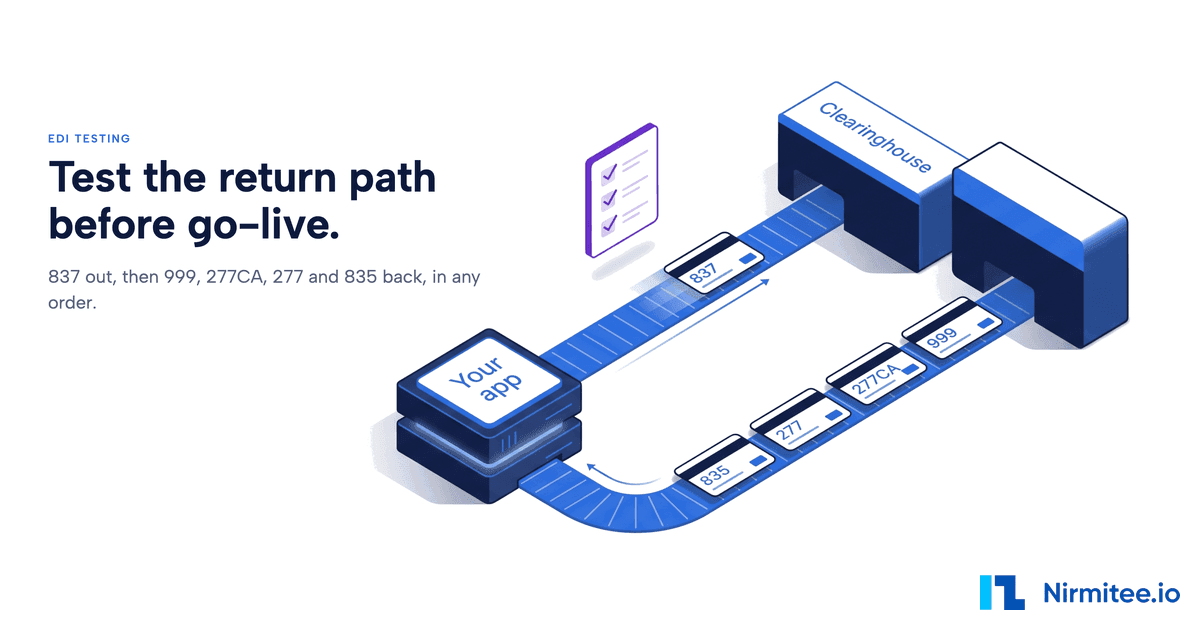
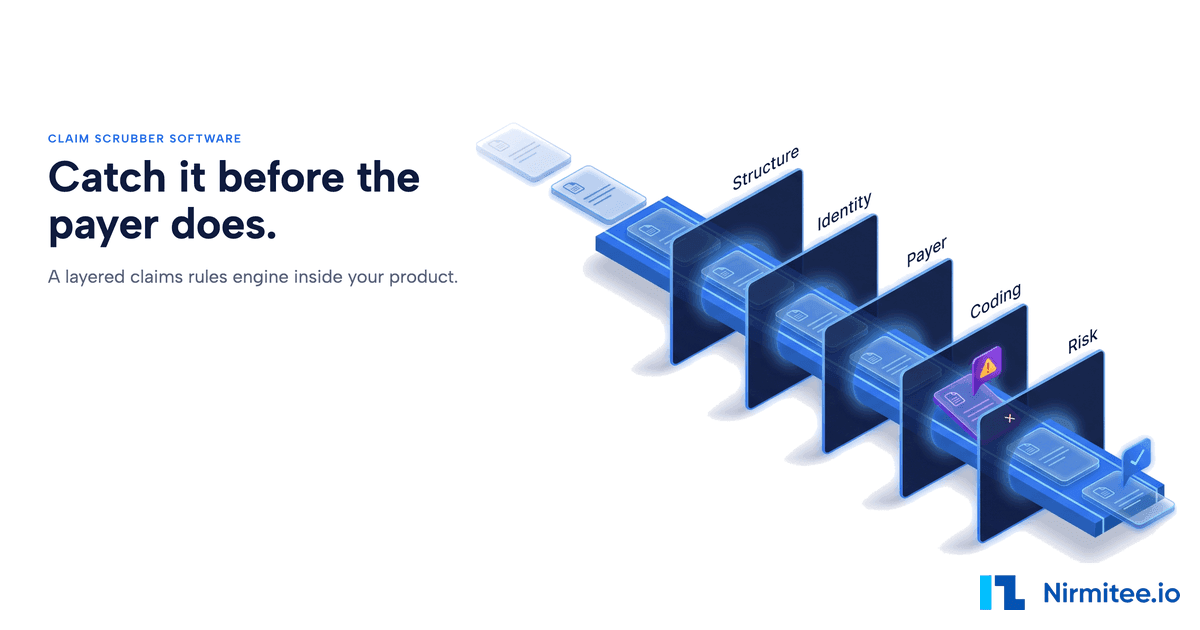
Provider identity is one input to the wider claim quality gate. Our guides to building a claim scrubber and to EDI testing before go-live cover the rest, and our X12 EDI developer guide covers the transaction set end to end. For the clearinghouse side, see our Waystar integration guide.
Building claim generation for supervised care? We design and build claim engines for EHR and practice management platforms, including per-payer supervision rules, provider identity resolution and pre-billing readiness checks. Tell us which payers and supervision models you support and we will outline the rule set and data model your engine needs. See our healthcare interoperability services or talk to our team.
Ready to scale?
Talk to our healthcare engineering team about building, integrating, and shipping faster.
Frequently Asked Questions
What is the difference between a rendering provider and a billing provider?
Can the rendering provider and billing provider be the same?
Who is the rendering provider for a pre-licensed clinician?
What is the supervising provider loop on an 837P?
Who bills Medicare for incident-to services?
Why do claims reject for rendering provider name mismatch?