You're building a healthcare integration and someone on your team asks: "Are we using X12 or HL7?" If you're not immediately sure how to answer — or why the answer matters — this article is for you.
X12 and HL7 are both healthcare data standards, but they solve different problems. Picking the wrong one doesn't just create technical debt. It can break payer connectivity, stall EHR integrations, or put you on the wrong side of a compliance audit. Here's a precise breakdown of what each standard does, where it applies, and how to make the right call for your architecture.
What X12 Actually Is
X12 (formerly ASC X12) is an ANSI-accredited standards body that publishes EDI (Electronic Data Interchange) transaction sets used primarily for administrative and financial healthcare workflows. When your system sends a claim to a payer, checks eligibility, or receives a remittance advice, it almost certainly uses X12.
The most common X12 transaction sets in healthcare:
- 837P / 837I — Professional and institutional claims submission
- 835 — Electronic Remittance Advice (ERA), used for payment reconciliation
- 270 / 271 — Eligibility inquiry and response
- 276 / 277 — Claim status request and response
- 278 — Prior authorization request and response
- 834 — Benefit enrollment and maintenance
X12 transactions are structured, flat-file formats. They use segment identifiers, element delimiters, and loop hierarchies that look nothing like modern JSON or XML. Machine-readable by design, not human-readable. The format is dense and unforgiving — a misplaced delimiter breaks the entire transaction.
HIPAA mandates X12 for covered entities. Under the HIPAA Transactions and Code Sets rule (45 CFR Part 162), covered entities must use specific X12 versions for standard administrative transactions. This is not optional. If you're building a billing module, a clearinghouse integration, or a payer-facing claims workflow, X12 is the required standard — not a preference.
What HL7 Actually Is
HL7 (Health Level Seven International) is a standards organization that publishes specifications for clinical and operational healthcare data exchange. The HL7 family spans multiple generations and use cases. If you want the broader standards landscape, our guide to FHIR, HL7 and other interoperability standards covers it in depth.
HL7 v2.x
HL7 v2 is the most widely deployed clinical messaging standard in the world. Hospitals have used it for decades to exchange ADT (Admit, Discharge, Transfer) messages, lab results (ORU), orders (ORM/OML), and scheduling data (SIU). It uses a pipe-delimited format and is deeply embedded in legacy hospital infrastructure.
If you're integrating with a hospital's existing systems — particularly anything built before 2015 — you will encounter HL7 v2 messages. Integration engines like Mirth Connect exist specifically to translate and route these messages between systems.
HL7 FHIR R4
FHIR (Fast Healthcare Interoperability Resources) is HL7's modern API-based standard. FHIR R4 is the current production-stable release and the version mandated by the ONC's 21st Century Cures Act for certified EHR interoperability in the US. It uses RESTful APIs, JSON or XML resources, and OAuth2 authorization via SMART on FHIR.
FHIR R4 is what you use when you're building:
- Patient-facing apps that pull data from Epic, Cerner, or Athenahealth
- Clinical decision support tools that need structured clinical data
- Care coordination platforms that aggregate records across providers
- Any integration that needs to work with modern EHR APIs
HL7 v3 and CDA
HL7 v3 and its document standard CDA (Clinical Document Architecture) are largely superseded by FHIR for new development. You'll still encounter CDA documents — particularly Continuity of Care Documents (CCDs) — in transitions of care workflows. For greenfield builds, FHIR R4 is the right target.
HL7 v2 vs FHIR R4: The Difference That Trips Teams Up
Because both come from HL7 International, teams often treat "HL7" and "FHIR" as interchangeable. They are not. The difference between HL7 v2 and FHIR is generational: v2 is an event-driven messaging format from the late 1980s that pushes pipe-delimited messages over hospital networks; FHIR R4 is a resource-based REST API standard designed for the modern web. v2 moves data when something happens (a patient is admitted, a lab result is ready). FHIR lets an application ask for exactly the data it needs, when it needs it.
In practice: new integrations target FHIR R4; hospital-internal feeds still speak v2. Roughly 95% of US hospitals run HL7 v2 internally even where they expose FHIR R4 APIs externally — which is why v2 skills and tooling remain essential in 2026.
What These Formats Actually Look Like
The fastest way to understand the difference is to see the same patient encounter from each standard's point of view. Here's a glucose lab result as an HL7 v2 ORU message — the way a hospital LIS broadcasts it:
MSH|^~\&|LAB|GENHOSP|EMR|CLINIC|202607291201||ORU^R01|MSG00001|P|2.5.1
PID|1||MRN12345^^^GENHOSP^MR||DOE^JANE||19800101|F
OBX|1|NM|2345-7^Glucose^LN||98|mg/dL|70-99|N|||F
The same result as a FHIR R4 Observation resource — the way a modern EHR API serves it:
{
  "resourceType": "Observation",
  "status": "final",
  "code": {
    "coding": [{ "system": "http://loinc.org", "code": "2345-7", "display": "Glucose" }]
  },
  "subject": { "reference": "Patient/mrn12345" },
  "valueQuantity": { "value": 98, "unit": "mg/dL" }
}
And when the visit that ordered that lab gets billed, the claim travels to the payer as an X12 837 — a different world entirely:
CLM*PATIENT001*125.00***11:B:1*Y*A*Y*Y~
HI*ABK:E119~
SV1*HC:80048*125.00*UN*1***1~
Three formats, three jobs: v2 announces clinical events, FHIR serves clinical data on request, and X12 moves the money. The CLM segment carries the claim amount, HI the ICD-10 diagnosis code, SV1 the procedure and charge. Nobody reads these by eye in production — but your architecture has to parse, validate, and route all three correctly.
X12 vs HL7: The Core Distinction
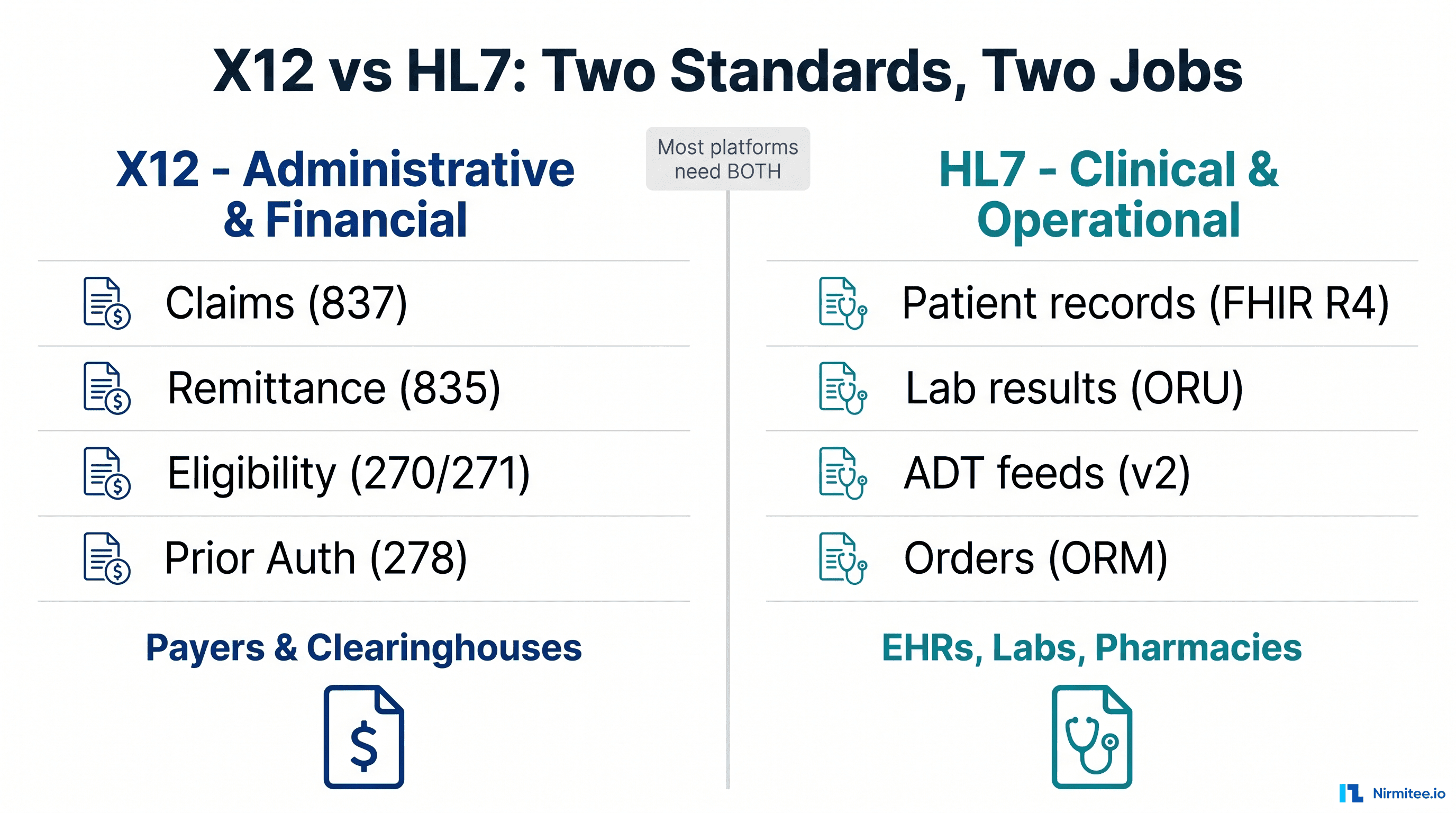
The clearest way to separate them: X12 handles money and administrative transactions; HL7 handles clinical data and care workflows.
| Dimension | X12 | HL7 (FHIR R4 / v2) |
|---|---|---|
| Primary domain | Administrative, financial | Clinical, operational |
| Typical use | Claims, eligibility, remittance | EHR data, lab results, orders |
| Format | EDI flat-file (delimited segments) | REST/JSON (FHIR R4), pipe-delimited (v2) |
| Compliance mandate | HIPAA Transactions rule (45 CFR 162) | ONC Cures Act (FHIR R4 for certified EHRs) |
| Integration partners | Payers, clearinghouses, billing systems | EHRs, labs, pharmacies, health apps |
| Human readability | Low | High (FHIR R4) / Low (v2) |
| Modern API support | Limited | Native (FHIR R4) |
These standards don't compete. Most production healthcare systems use both. The question isn't which one to pick — it's which one applies to the workflow you're building right now.
When You Need X12
You need X12 when your integration touches the revenue cycle or payer ecosystem.
Claims submission: If your platform submits 837P or 837I transactions to payers or clearinghouses, you need X12. There is no FHIR-based alternative that satisfies HIPAA's transaction standards rule for claims.
Eligibility verification: Real-time eligibility checks (270/271) run over X12. Some clearinghouses offer REST wrappers, but the underlying transaction is still X12.
Remittance processing: Payment reconciliation against 835 ERA files requires X12 parsing. If you're building an automated payment posting workflow, you're working with X12.
Prior authorization: The 278 transaction set handles prior authorization requests and responses. Da Vinci Project FHIR profiles are emerging for prior auth, but X12 278 remains the dominant standard in production payer systems as of 2026.
Red flag: A vendor tells you they handle claims processing "using FHIR." Ask specifically how they map to X12 for payer submission. FHIR can carry clinical data that supports a claim, but the claim itself still travels as X12 in most production environments.
When You Need HL7 FHIR R4
You need FHIR R4 when your integration touches clinical data, EHR systems, or patient-facing applications.
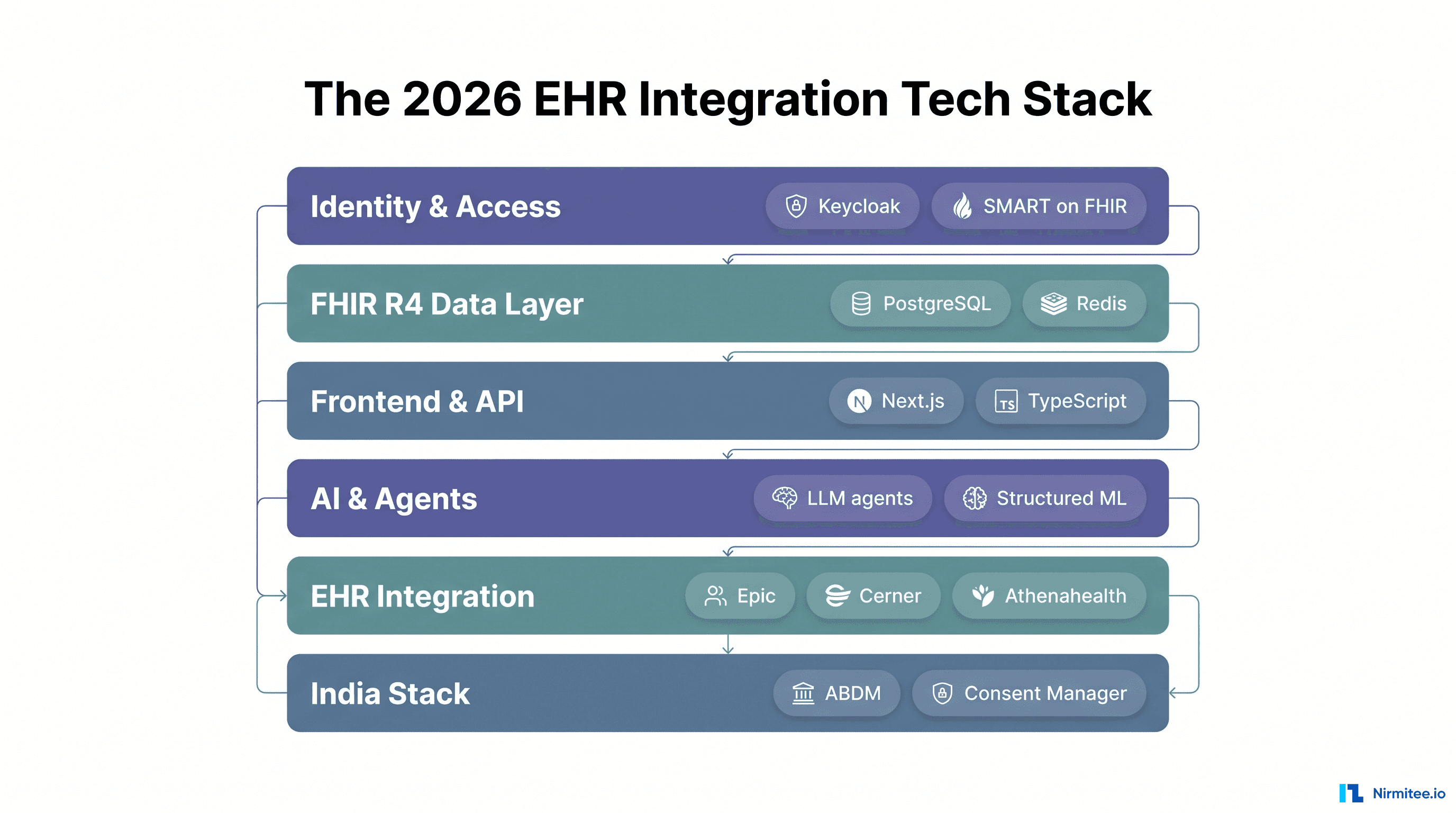
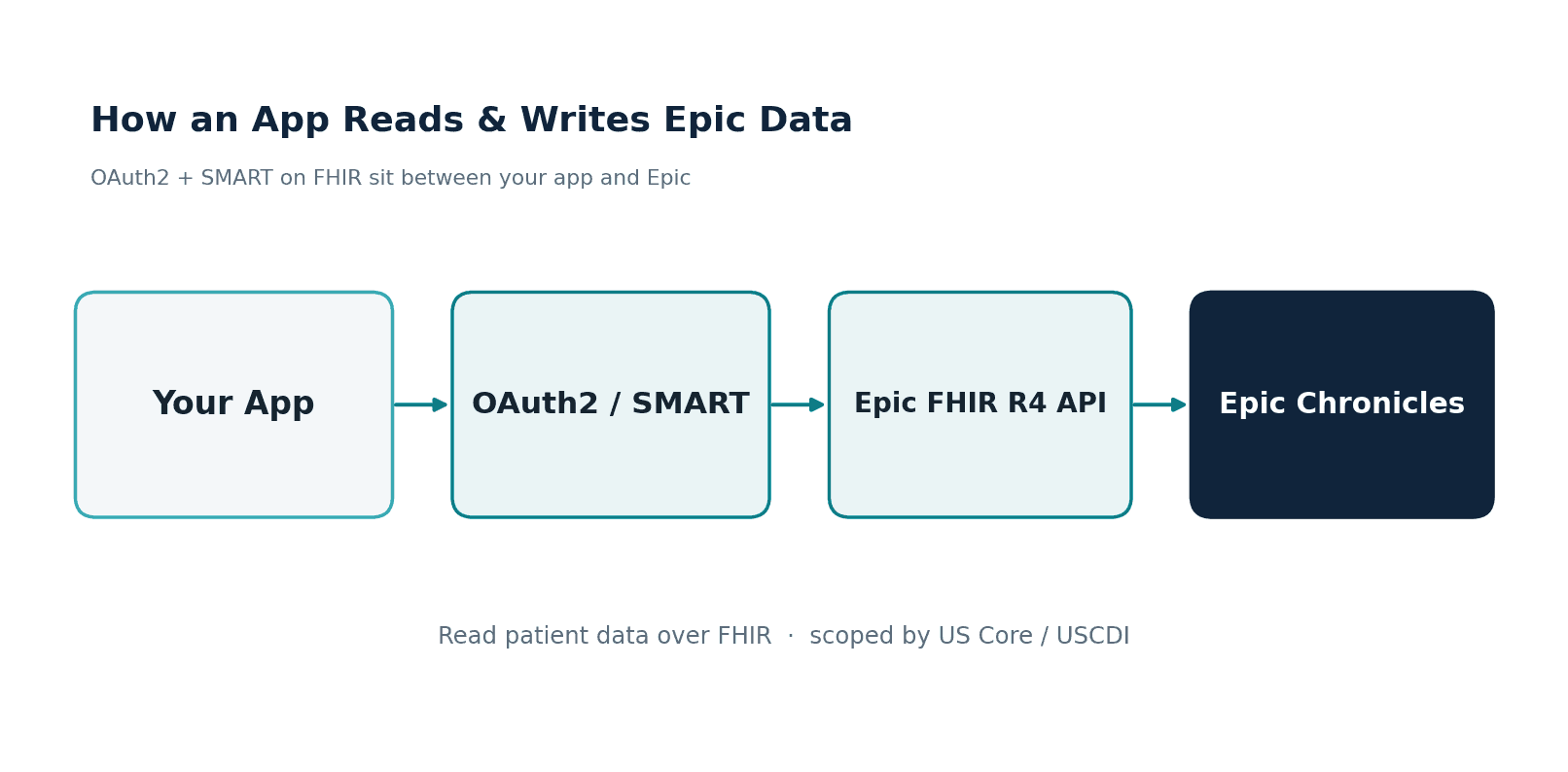
EHR integration: Epic, Cerner, and Athenahealth all expose FHIR R4 APIs. Pulling patient demographics, medication lists, lab results, or clinical notes means working with FHIR R4 resources — Patient, Observation, MedicationRequest, DiagnosticReport. We covered the full stack around this in EHR Integration in 2026: The Tech Stack Digital Health Startups Actually Build On.
Patient-facing apps: The ONC's 21st Century Cures Act requires certified EHRs to support patient access via FHIR R4 APIs. If you're building a patient portal, a chronic care management app, or a health data aggregator, FHIR R4 is the standard.
Clinical decision support: CDS Hooks — the standard for real-time clinical decision support within EHR workflows — runs on FHIR R4. If your AI agent needs to surface a recommendation inside a clinician's workflow, FHIR R4 is the integration path.
Care coordination: Sharing structured clinical data between providers, across care settings, or with health information exchanges (HIEs) uses FHIR R4.
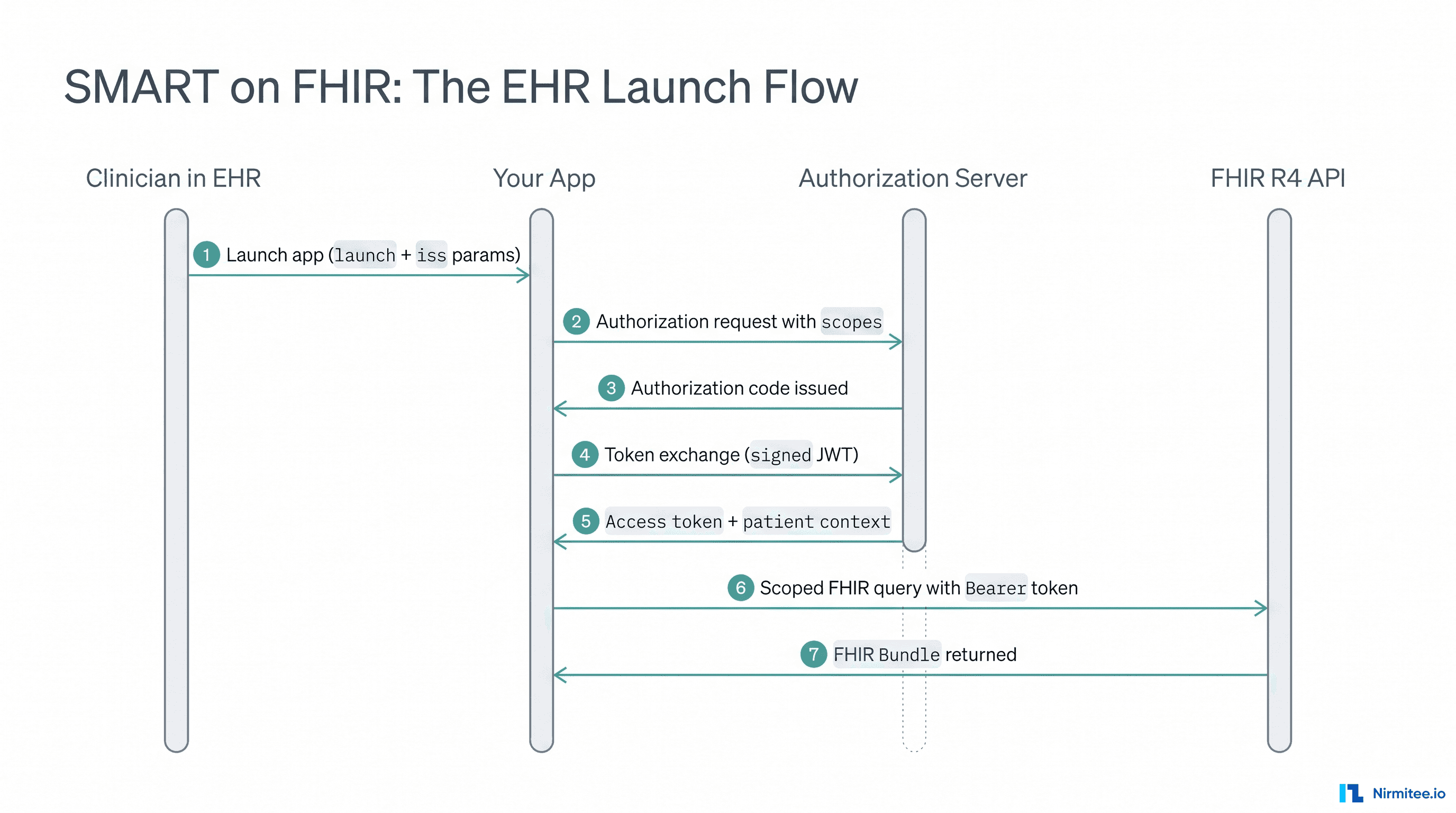
SMART on FHIR: OAuth2 authorization for healthcare apps uses the SMART on FHIR profile. This is how your app authenticates against an EHR without handling credentials directly.
When You Need HL7 v2
HL7 v2 is not going away. Roughly 95% of US hospitals still use it for internal messaging, even where FHIR R4 APIs have been added externally.
You need HL7 v2 when:
- You're integrating with a hospital's ADT feed to track patient admissions, discharges, and transfers
- You're receiving lab results from a hospital LIS (Laboratory Information System)
- You're connecting to a legacy HIS or practice management system that hasn't migrated to FHIR
- You're building an integration engine that bridges old and new systems
Mirth Connect (now NextGen Connect) is the most common open-source tool for processing HL7 v2 messages. Nirmitee.io's OpenMirth Console is built specifically for Mirth Connect tooling — an open-source project that makes working with these message flows significantly more manageable for engineering teams. If you're deploying it in production, our walkthrough on setting up Mirth Connect for high availability covers the architecture that keeps ADT feeds alive through failures.
The Architecture Reality: You'll Likely Need Both
A digital health startup building a telehealth platform with billing capabilities needs:
- FHIR R4 to pull patient records from Epic or Cerner before a visit
- X12 270/271 to verify eligibility before the visit
- X12 837P to submit the claim after the visit
- X12 835 to reconcile payments after the payer processes the claim
- HL7 v2 ADT if they're also integrating with hospital systems for care coordination
These aren't competing choices. They're different layers of the same system. Your architecture needs to handle all of them cleanly — which is why integration engines, FHIR servers, and clearinghouse APIs all coexist in production healthcare infrastructure.
How FHIR R4 Is Starting to Bridge the Gap
The Da Vinci Project — a collaboration between payers and providers under the HL7 umbrella — is actively building FHIR R4 profiles for administrative workflows that have historically been X12-only. Prior authorization (via the Coverage Requirements Discovery and Prior Authorization Support implementation guides) and claims attachments are two areas where FHIR-based workflows are gaining real traction, accelerated by CMS's interoperability and prior authorization rules pushing payers toward FHIR APIs.
This doesn't replace X12 today. But if you're building a platform that will still be in production five years from now, designing your claims and prior auth workflows to accommodate FHIR-based payer APIs alongside X12 is the right architectural posture.
Making the Decision for Your Integration
Three questions cut through most of the ambiguity:
1. Who is the integration partner?
Payer or clearinghouse → X12. EHR, lab, pharmacy, or health app → FHIR R4. Legacy hospital system → HL7 v2.
2. What data is moving?
Financial or administrative data → X12. Clinical data (diagnoses, medications, lab results, orders) → FHIR R4 or HL7 v2.
3. What does compliance require?
HIPAA Transactions and Code Sets → X12 for covered administrative transactions. ONC 21st Century Cures Act → FHIR R4 for EHR interoperability. ABDM in India → FHIR R4 with NHA-specific profiles.
If you're building in India and navigating Ayushman Bharat Digital Mission compliance, the answer is FHIR R4 — specifically the NHA's ABDM FHIR profiles. X12 is not part of India's national health data exchange architecture.
What This Means for Your Engineering Team
Getting these standards right from the start saves months of rework. The common failure mode is building an integration that handles clinical data correctly but breaks at the payer interface — or vice versa. Both are expensive to fix post-launch.
At Nirmitee.io, the architecture is FHIR R4-native by default, with pre-built components for HL7 v2 translation via OpenMirth Console and X12 transaction handling for revenue cycle workflows. HIPAA compliance infrastructure — PHI encryption, audit logging, access control — ships in every engagement, not as an afterthought. If your team is evaluating Epic, Cerner, or Athenahealth integrations right now, the Healthcare CTO's AI Glossary is a useful reference for aligning on terminology before the architecture conversation starts.
Working through which standards your integration needs? Explore our Healthcare Interoperability Solutions for X12, HL7 v2 and FHIR R4 architectures, or our Custom Healthcare Software Development services for the full build. Talk to our team to map your integration before you write a line of code.