
What Is C-CDA (CCDA)? Document Types, Versions and FHIR Explained

CTO & Co-Founder
CTO & Co-Founder at Nirmitee.io. Architects healthcare integrations across FHIR, SMART on FHIR, ABDM and NHCX, writing from production experience taking hospital software from sandbox to go-live.
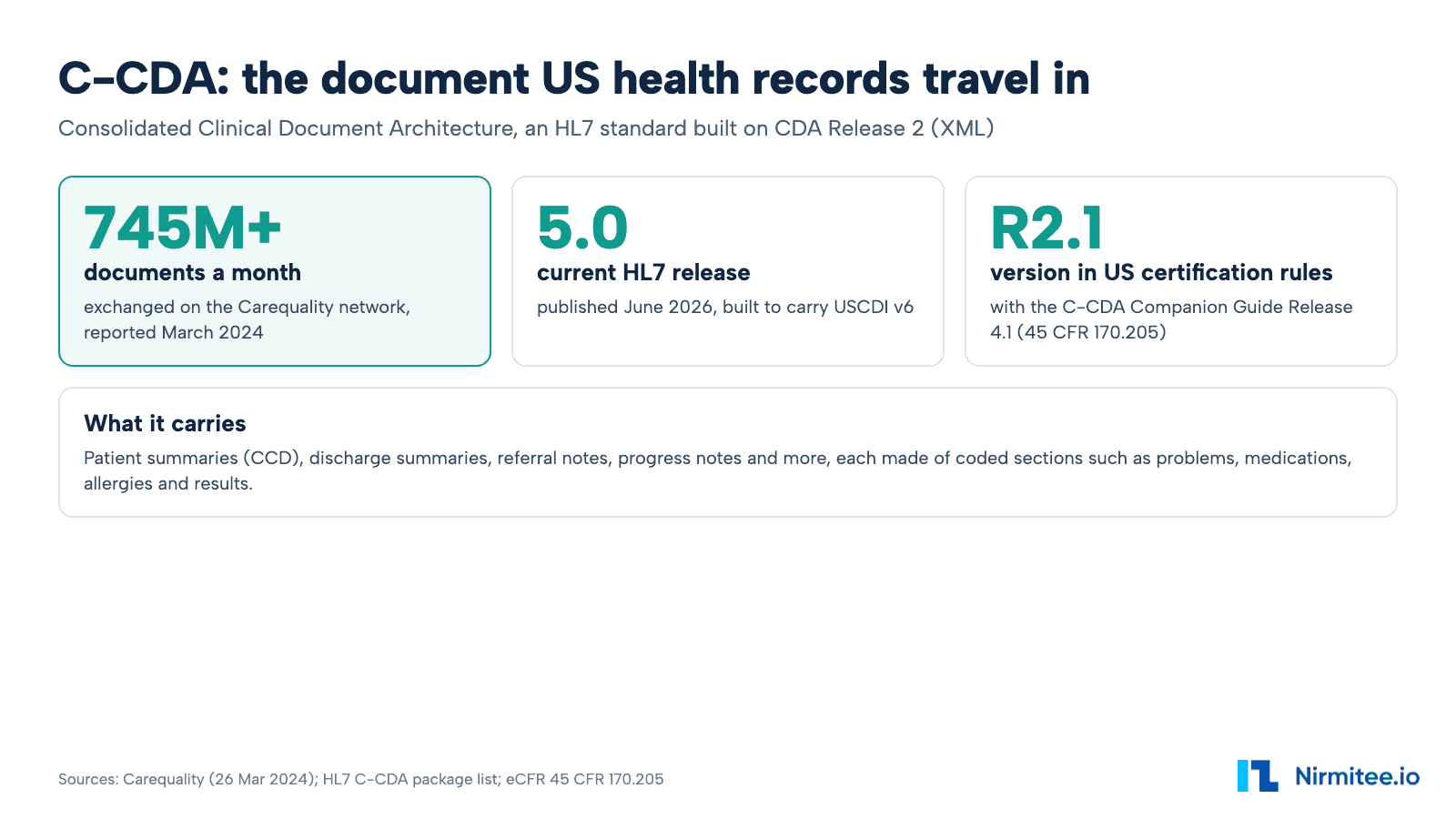
C-CDA (Consolidated Clinical Document Architecture) is the US standard document that electronic health record systems use to send a patient's record to each other. A referral letter, a discharge summary or a full patient summary leaves one hospital's EHR as a C-CDA document and arrives in another system in a shape that system can read. It is the backbone of US healthcare interoperability between EHRs.[1]
This guide explains C-CDA from a business point of view: what it is, why it exists, how big it is, what it costs to work with, where US policy is taking it, and what that means for anyone building or connecting health software.
What C-CDA Is
C-CDA is an HL7 implementation guide built on HL7 CDA Release 2, an XML format for clinical documents.[1] Every C-CDA document has three layers:
- A header that says who the patient is, who wrote the document, for which organization and when.
- A document type, such as the Continuity of Care Document (CCD, the patient summary), Discharge Summary, Referral Note, Progress Note, Consultation Note, History and Physical, Operative Note, Care Plan or Unstructured Document.[1]
- Sections such as Problems, Medications, Allergies, Results, Vital Signs and Immunizations. Each section carries narrative text a clinician reads and coded entries (SNOMED CT, LOINC, RxNorm) a computer can use.
Think of it as a standard envelope with standard compartments. The receiving system knows where the medication list is, even if it has never talked to the sender before.
Why C-CDA Exists
C-CDA solved a coordination problem. Before it, several overlapping clinical document guides existed in the US, and vendors implemented them differently. When the federal government began paying providers to adopt certified EHRs, it needed one document format it could test in certification. HL7 consolidated the earlier guides into one, which is where the word "consolidated" comes from.
Today the US certification program still names C-CDA in its regulations. The standard adopted at 45 CFR 170.205 is C-CDA Release 2.1 together with the C-CDA Companion Guide; the Companion Guide Release 2 adoption expired on 1 January 2026, and Companion Guide Release 4.1 is the current adopted version.[3]
What If C-CDA Had Never Existed
- Every pair of EHRs would need its own custom interface, so each new referral partner would be a project.
- Fax and PDF would remain the normal way to share records, and the data inside would not be searchable or reusable.
- National exchange networks would have no common document to pass between members.
In short, nationwide record exchange as it works today depends on there being one agreed document.
A Short History of C-CDA Versions
HL7 now publishes a C-CDA release roughly once a year, each aligned with a newer version of USCDI (the US list of data elements every certified system must support):[2]
| Release | Published | Carries |
|---|---|---|
| Release 2.1 with Companion Guide | Earlier release | The version named in US certification rules[3] |
| 3.0.0 | 18 May 2024 | USCDI v4; first release in the FHIR-style publishing format |
| 4.0.0 | 20 June 2025 | USCDI v5 |
| 5.0.0 (STU5) | 13 June 2026 | USCDI v6 |
Certified developers may move to a newer approved release voluntarily through ASTP/ONC's Standards Version Advancement Process (SVAP). The 2026 SVAP approves C-CDA Release 5.0.0 for criteria including transitions of care, view/download/transmit and the all-data API request.[4] The version written in the regulation remains the baseline. For how USCDI itself is mapped to FHIR, see our USCDI v3 data elements and FHIR mapping guide.
How Big C-CDA Is
Carequality, one of the national exchange frameworks, reported in March 2024 that more than 745 million documents were exchanged each month on its network, and more than 6 billion in 2023, up from 59 million in 2018.[5] Most of that traffic is clinical documents, which in the US means C-CDA. We have not found a comparable published volume figure for CommonWell or TEFCA.
Pros and Cons for Business
| Pros | Cons |
|---|---|
| Every certified EHR can create and receive it | Vendors fill optional parts differently, so parsers break |
| Already flows at national scale | Deep, nested XML that is slow to work with |
| Readable by people and computers | Narrative text is not always backed by codes |
| Proven for referrals and discharge | A query can return many overlapping summaries for one patient |
The cons are what turn C-CDA into ongoing engineering work. Teams that receive documents have to normalize them, remove duplicates and reconcile them before the data is useful. Our guide on processing C-CDA and CCD documents in Mirth Connect covers the technical side.
C-CDA and FHIR
FHIR is the newer HL7 standard that exchanges individual resources, such as one patient or one lab result, through web APIs. C-CDA exchanges whole documents. Policy is moving toward FHIR for new capabilities, but the national networks already carry billions of C-CDA documents, and replacing them costs money that no current mandate pays for. In practice most organizations will run both for years, and the work is connecting the two, often by converting C-CDA into FHIR for modern applications.
Where C-CDA Is Going: HTI-5
In December 2025 ASTP/ONC proposed HTI-5, a rule that would cut many certification criteria.[7] Several touch C-CDA:[6]
| Criterion | Proposed action | Proposed timing |
|---|---|---|
| Transitions of care, 170.315(b)(1) | Revise | 1 January 2027 |
| Clinical information reconciliation, (b)(2) | Remove | 1 January 2027 |
| Security tags, (b)(7) and (b)(8) | Remove | Final rule effective date |
| Care plan, (b)(9) | Remove | Final rule effective date |
| View, download and transmit, (e)(1) | Revise | Final rule effective date |
| C-CDA creation performance, (g)(6) | Remove | Final rule effective date |
| Application access, all data request, (g)(9) | Remove | 1 January 2027 |
HTI-5 is a proposal. As of 10 October 2026 no final rule has been published, and the final version may change these actions and dates. The American Hospital Association asked ASTP/ONC to keep the transitions of care criterion.[8] If the rule is finalized as proposed, C-CDA support becomes less of a certification guarantee and more of a commercial choice for vendors, while the network traffic continues. We cover the full rule in our HTI-5 proposed rule guide.
Deadlines That Matter
- 1 January 2026: the C-CDA Companion Guide Release 2 adoption expired; Release 4.1 is the adopted version.[3] USCDI v3, which C-CDA documents must carry, became the certification baseline on the same date.[10]
- 1 January 2027: the proposed date for the HTI-5 changes to transitions of care, reconciliation and the all-data request, only if the rule is finalized with these dates.[6]
Why C-CDA Matters to Product and Integration Companies
- Any product that needs patient history will receive C-CDA. Digital health apps, care management tools and analytics platforms that pull records from networks get documents, not tidy APIs.
- Someone has to make the data usable. That means parsing, removing duplicates, reconciling and often converting to FHIR or the product's own data model.
- Joining a network means sending C-CDA too. Products that query national networks are expected to answer with valid documents.
- Every new release is conformance work. Templates change between releases, and validation against the HL7 schema and rules has to keep up.
Who the Customer Is
| Customer | Why they pay |
|---|---|
| EHR vendors | Certification and network exchange |
| Hospitals and clinics | Referrals, discharge and HIE connections |
| HIEs and national networks | Routing, aggregating and cleaning documents |
| Payers | Clinical data for quality and risk programs |
| Digital health and life sciences companies | Patient history from networks |
Why, Why, Why: The Root Causes
- Why is there so much C-CDA work? Because the national networks were designed around documents, and certified EHRs already produce them.
- Why do parsers break? Because the standard allows many optional parts, so each vendor fills them differently.
- Why is there so much duplicate data? Because each visit produces a new snapshot document instead of updating one shared record.
- Why will FHIR not replace C-CDA overnight? Because billions of documents already flow, and switching networks costs money no current mandate covers.
Need to turn C-CDA documents into clean, usable data, or connect C-CDA and FHIR systems? Explore our Healthcare Interoperability Solutions, including Mirth Connect integration services. Talk to our team to get started.
Sources
- HL7 C-CDA Implementation Guide, Release 5.0.0 (STU5), US Realm
- HL7 C-CDA publication history (package list)
- eCFR 45 CFR 170.205: content exchange standards (C-CDA R2.1 and Companion Guide)
- ASTP/ONC Standards Version Advancement Process (SVAP)
- Carequality: 10-year anniversary and growth milestone (26 March 2024)
- ASTP/ONC HTI-5 Proposed Rule Chart
- Federal Register: HTI-5 proposed rule, 90 FR 60970 (29 December 2025)
- AHA comments on the HTI-5 proposed rule (27 February 2026)
- ONC Standards Bulletin 2022-2 (USCDI v3)
- ASTP/ONC HTI-1 Final Rule
Ready to scale?
Talk to our healthcare engineering team about building, integrating, and shipping faster.
Frequently Asked Questions
What is C-CDA in simple terms?
What is the difference between C-CDA and CCD?
Which C-CDA version is current?
Is C-CDA being replaced by FHIR?
Does HTI-5 remove C-CDA?