Custom Development Companies: 7 Picks for Healthcare

Nirmitee.io Engineering
Author
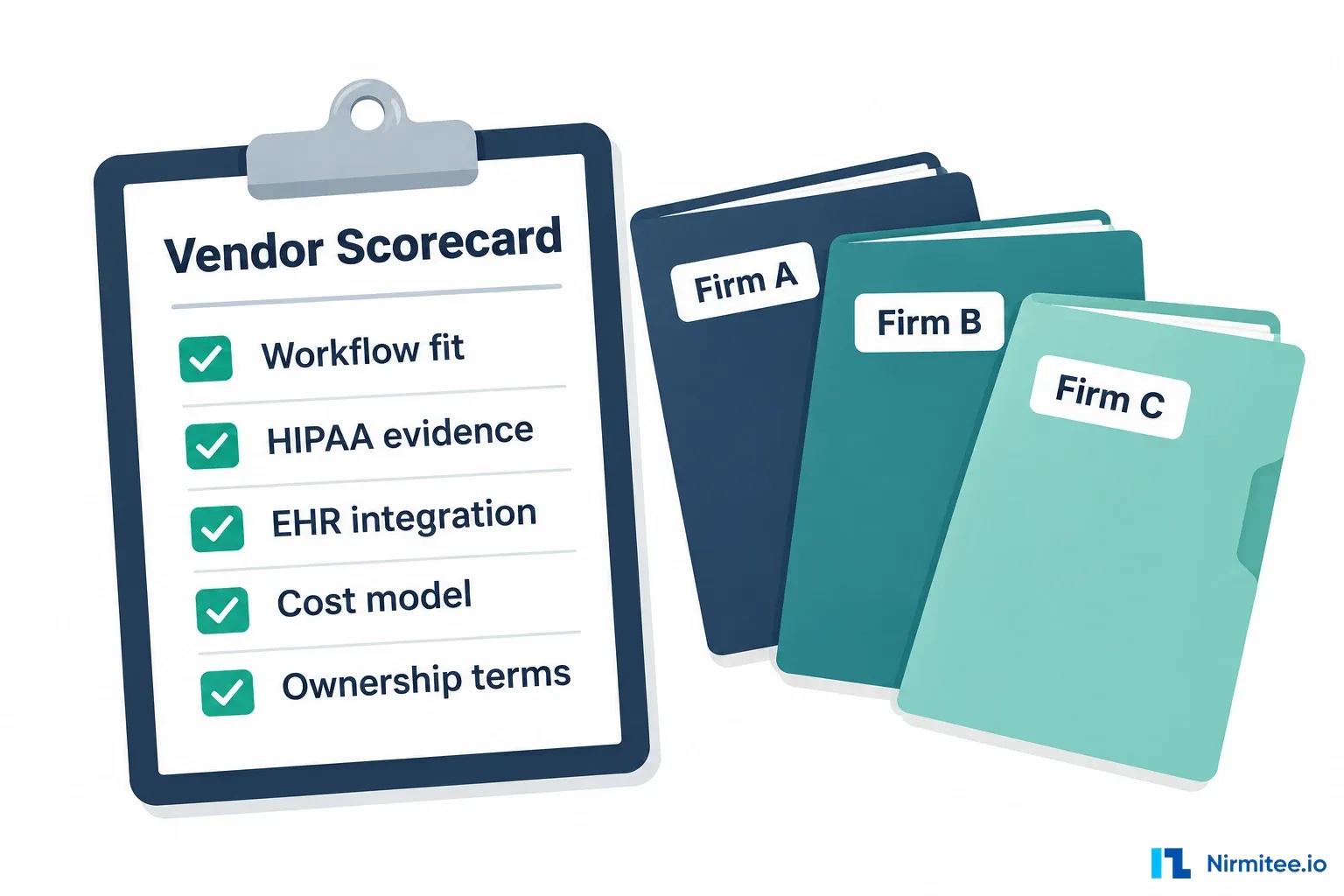
Pick among custom development companies for healthcare by testing each one against your own workflow, not its brochure. Define the clinical workflow and integrations first, shortlist firms with healthcare delivery history such as ScienceSoft, Simform and Itransition, verify HIPAA and security evidence, compare cost models, and confirm ownership and monitoring terms before you sign.
Who this guide is for: US founders, CTOs and engineering or product leaders who already know they need tailored healthcare software and now have to choose who builds it.
Why Choosing Custom Development Companies for Healthcare Takes a Process
You have already decided that a packaged product will not fit your workflow. The harder decision comes next: which firm builds it. The field of custom development companies is crowded, and most vendor lists rank agencies by brand recognition or hourly rate. They rarely show you how to vet one against a clinical workflow, an EHR integration scope or a compliance review.
The market explains the crowding. Data Bridge Market Research valued the custom healthcare software market at USD 18.42 billion in 2025 and expects it to grow at an 11.40% CAGR through 2033. That figure covers healthcare only. Separately, Grand View Research reports that the broader global custom software development market reached USD 45.4 billion in 2025. The two come from different reports with different scopes, so read them as two views of one trend, not one number.
As money and vendors pile in, more buyers end up comparing firms that look alike on a website. A weak choice shows up late: an interface that fails in production, a compliance gap found during security review, or a codebase your team cannot maintain.
This guide turns the shortlist into a repeatable process. You define the workflow and integrations, build a shortlist of candidates, check compliance and interoperability evidence, compare cost models, and settle ownership and go-live terms. For the service-side view of what a build involves, our page on custom healthcare software development covers scope and delivery in more detail.
Is Custom Software Better Than Off-the-Shelf for Healthcare?
Choose custom software when your workflow depends on integrations a packaged product cannot support. If a commercial product fits your workflow and connects to your EHR, labs and billing systems without changes, buy it. If it forces clinicians to work around it, or cannot exchange data the way your systems require, custom development is the stronger option.
Integration is usually what decides it. A survey of 850 IT decision-makers by NashTech found that 70% prefer custom software over commercial off-the-shelf (COTS) products because of integration needs. NashTech is a software vendor, so treat the figure as directional. It does match what we see in delivery: build versus buy is rarely about features. It comes down to whether the software can read from and write to the systems your clinicians already use.
Try this test: list the three systems your software must exchange data with, then ask each packaged vendor to demonstrate that exchange in a sandbox, not on a slide. If any of the three fails, price the custom path.
Step 1: Define the Workflow and Integrations You Need
Before you contact any vendor, write down the workflow the software must support and every system it touches. A vendor can only quote accurately against a defined scope. A vague brief gets you vague proposals that are hard to compare.
Capture these items in one document:
- The workflow: who does what, in what order, and where the current process breaks (for example, intake, documentation, orders, or claims follow-up).
- The systems involved: the EHR (Epic, Oracle Health/Cerner, athenahealth or eClinicalWorks), labs, devices, and billing or claims platforms.
- The interfaces needed: the standards each connection uses, such as HL7 v2, FHIR R4 (the current Fast Healthcare Interoperability Resources release) or C-CDA documents, and whether each is read-only or needs write-back.
- Access prerequisites: which connections depend on provider sponsorship or customer authorization. Write-back is not universally available, so confirm what each EHR vendor allows for your use case.
- Environments: how sandbox testing will stay separate from production access.
- Failure handling: what happens when an interface drops, a message is rejected or a mapping is wrong, and who is alerted.
- Acceptance criteria: the observable result that counts as done, such as a specific message type flowing in both directions with errors routed to a named owner.
If you plan AI scribe or voice-agent features, include them here along with the human review step. This document becomes your yardstick in the steps below. It also reflects how healthcare product engineering works in practice: the workflow comes first and the technology follows. Our overview of healthcare product engineering and modernization explains how we scope that work.
Step 2: Shortlist Seven Custom Software Companies Worth Evaluating
Build a shortlist of seven custom software companies and score each against the document from Step 1. Three have vendor-supplied profiles below, one is a US-only product engineering option, and two are named only as generalist vendors to test. Treat the profiles as starting points. The sources are directory and review sites, so confirm every claim yourself.
- ScienceSoft: Provides full-cycle development, including HIPAA-compliant software for healthcare providers, payers and MedTech companies, plus data and security services. Directory sources credit it with more than 36 years in IT and strong experience in regulated, compliance-heavy builds.
- Simform: Offers cloud-native product engineering, AI development and modernization for healthcare, fintech and enterprise clients. Reviewers cite a 100% responsiveness rating and healthcare and education experience (per clutch.co and gartner.com).
- Itransition: Delivers complex enterprise systems and long-term IT support, with roughly 13% of its portfolio in healthcare (per itprofiles.com). It serves mid-sized businesses and large enterprises, with strengths in application security and enterprise mobility.
- Nirmitee.io: A US-only product engineering and integration option. It connects EHRs (Epic, Oracle Health/Cerner, athenahealth, eClinicalWorks), labs, devices and operational systems, and works in HL7 v2, FHIR R4 and C-CDA data engineering. Scope depends on supported interfaces, provider sponsorship and customer authorization.
- Miles Technologies and Appit Ventures: Include both as generalist custom software companies and test them against the same criteria. We have no verified profile for either, so we make no claim about their services, rates or locations.
- Seventh slot: Reserve it for a firm from your own network, or a referral from a peer organization, and hold it to the same scorecard.
Our research did not turn up hourly rates, team size, headquarters or case studies for these firms, so ask each one directly. One data point on scale: an edvido.com analysis found that 49.6% of offshore firms in South and Southeast Asia employ 50 or more people (2026). Larger teams can absorb turnover, but ask who actually works on your project.
| Firm | Primary focus | Healthcare specialization |
|---|---|---|
| ScienceSoft | Full-cycle development, data and security | HIPAA-compliant software for providers, payers, MedTech |
| Simform | Cloud-native engineering, AI, modernization | Healthcare among core sectors |
| Itransition | Enterprise systems, long-term IT support | About 13% of portfolio |
Ask every candidate for a healthcare case study you can check with a reference call, plus the tech stack they would use and why.
Step 3: Check HIPAA, Security and Interoperability Evidence
Ask for evidence, not assurances. Any firm can write "HIPAA compliant" on a services page; fewer can show you what sits behind it. Request each item below in writing before you cut the list to two or three.
| What to verify | What to ask for | Red flag |
|---|---|---|
| HIPAA readiness | A signed Business Associate Agreement (BAA) template, the firm's HIPAA policies, and its breach notification process | Refusal to sign a BAA before a paid engagement |
| Security certifications | Current ISO 27001 or HITRUST certificates, with scope and expiry dates, or a statement that none are held | A logo with no certificate |
| Security practices | Recent penetration test summary, access controls, and how production data is kept out of test environments | Real patient data used in sandboxes |
| Standards fluency | A walkthrough of an HL7 v2 or FHIR R4 interface the team built, including mapping and error handling | Only "we support FHIR" with no specifics |
| EHR experience | Which of Epic, Oracle Health/Cerner, athenahealth or eClinicalWorks they have integrated, and under what access terms | Promises of universal write-back |
| Tech stack | Languages and frameworks (for example Python or React) and why they fit your workflow | A stack chosen before the workflow is understood |
| AI features | Human review step, audit trail and data handling for any scribe or voice workflow | AI output written to the chart unreviewed |
Our research found no evidence that ScienceSoft, Simform or Itransition holds ISO 27001 or HITRUST status, so do not assume it. Ask each to produce the certificate, and treat a missing one as a finding. HIPAA itself has no official vendor certification, so a "HIPAA certified" badge is marketing, not proof.
Score each answer from 0 to 2 and total it. For a deeper checklist, see our CTO framework for evaluating healthcare interoperability vendors.
Step 4: How Much Does a Custom Healthcare Software Project Cost?
Budget by project type, then confirm with a scoped quote. Pricing is rarely published, so treat any range as a planning estimate, not an offer.
Nirmitee.io does not list prices on its main site and scopes projects on a call. Its published blog guidance puts a custom specialty EHR at roughly $45K to $70K, or $90K to $160K for a fuller build with orders, e-prescribing and billing over 4 to 6 months. A single Mirth Connect interface runs about $3K to $50K, with most between $8K and $20K. Retainer packages are reported to start around $10,000 a month. These are estimates; your integration count and EHR access terms will move them.
For the other firms, we have only a qualitative placement. ScienceSoft, Simform and Itransition all sit in a budget-tier price band per our research, but we cannot give you a figure. Request a written estimate against your Step 1 document.
| Cost model | How it works | Best fit |
|---|---|---|
| Fixed scope | One price for a defined deliverable | A single EHR or interface with stable requirements |
| Time and materials | You pay for hours worked | Evolving scope or discovery-heavy work |
| Retainer | Monthly fee for ongoing capacity | Continuous product work and support |
Watch minimum project sizes. An analysis of over 1,000 firms found that 60.0% of software development companies require a minimum project size of at least $10,000 (2026, edvido.com). If your first project is a small interface, confirm the vendor takes work at that size before you spend time on a proposal.
Ask what the quote leaves out. Sandbox access fees, third-party licenses, security testing and post-launch monitoring are the usual surprises.
Step 5: Lock Down Ownership, Monitoring and Go-Live Terms
Settle these terms in the contract before any code reaches production. They are the hardest to renegotiate after go-live.
- Mappings and ownership: Confirm in writing that your team owns the interface mappings, source code and documentation, so you can switch vendors.
- Failure handling: Define what happens when a message is rejected or an interface drops, and name the person alerted.
- Monitoring: Agree who watches production and the response time for a failure.
- Environments: Keep sandbox testing separate from production access, with no real patient data in test.
- Human review: For AI scribe or voice workflows, require a clinician review step and an audit trail before anything reaches the chart.
Demand for AI features is outrunning vendor skill: NashTech reports that 43% of enterprises lack the internal skills for agentic AI development. Before you commit to the full build, run a short pilot against your Step 1 acceptance criteria.
Prices and plan limits verified as of November 2026.
Conclusion
The right partner is the one that performs best against your own workflow. Define the workflow and integrations, shortlist on verifiable healthcare delivery history, request compliance evidence in writing, compare cost models using scoped quotes, and settle ownership and monitoring terms before go-live.
Start by writing the Step 1 document this week, then send it to three firms and score their answers the same way. A pilot against your acceptance criteria will tell you more than any proposal.
Need a partner that can show the evidence? Explore our custom healthcare software development services and our healthcare interoperability solutions. Talk to our team to scope your Step 1 document.
Ready to scale?
Talk to our healthcare engineering team about building, integrating, and shipping faster.
Frequently Asked Questions
How much does it cost to start a custom healthcare software project?
What are the benefits of choosing custom software over off-the-shelf solutions in healthcare?
Which custom development companies are best for healthcare compliance?
Do offshore custom software companies work for HIPAA-regulated projects?
What certifications beyond HIPAA should a healthcare software vendor hold?
How long does a custom specialty EHR build usually take?