
Eligibility Verification Takes 15 Minutes Per Patient. An Agent Does It in 30 Seconds.

Founder & CEO
15+ years building healthcare technology. Led 100+ EHR integrations, FHIR implementations, and clinical AI deployments.
In every healthcare practice, someone is doing this right now: opening a payer portal, entering patient demographics, navigating through three screens, copying a coverage status, switching to the EHR, updating the record, then doing it all over again for the next patient. Fifteen minutes per patient, 200 patients per day, 250 days per year.
📌 Related: for the full eligibility-verification workflow (the 270/271, the three checkpoints, the denial math), see our eligibility verification guide.
That is 12,500 hours per year spent on a task that an AI agent can complete in 30 seconds. Not an estimate — a measured result from production systems.
This blog walks through the technical architecture of an eligibility verification agent, the exact cost breakdown of human versus agent processing, and the implementation path from manual process to fully automated workflow.
The Manual Process: Where 15 Minutes Actually Goes
When we time-study eligibility verification in healthcare practices, the 15-minute average breaks down like this:
- Portal login and navigation (3 minutes) — Staff maintain credentials for 5-15 payer portals. Each has different URLs, login flows, and session timeout behaviors. Multi-factor authentication adds friction.
- Patient lookup (2 minutes) — Entering demographics, searching for the patient, selecting the correct record. Misspellings and name variations cause false negatives requiring multiple search attempts.
- Coverage verification (4 minutes) — Navigating to the coverage section, interpreting plan details, checking effective dates, verifying copay and deductible information. Every payer displays this information differently.
- EHR data entry (3 minutes) — Switching to the EHR, finding the patient record, navigating to the insurance section, entering coverage details, saving. Copy-paste errors are common.
- Exception handling (3 minutes average) — Coverage not found, plan terminated, patient has secondary insurance, payer portal is down. These exceptions add variable time that makes scheduling unpredictable.
The Agent Architecture: What Actually Happens in 30 Seconds
An eligibility verification agent is not a screen scraper. It is not an RPA bot clicking through portals. It is an orchestration engine that uses APIs, understands healthcare data structures, and reasons about exceptions.
The Core Pipeline
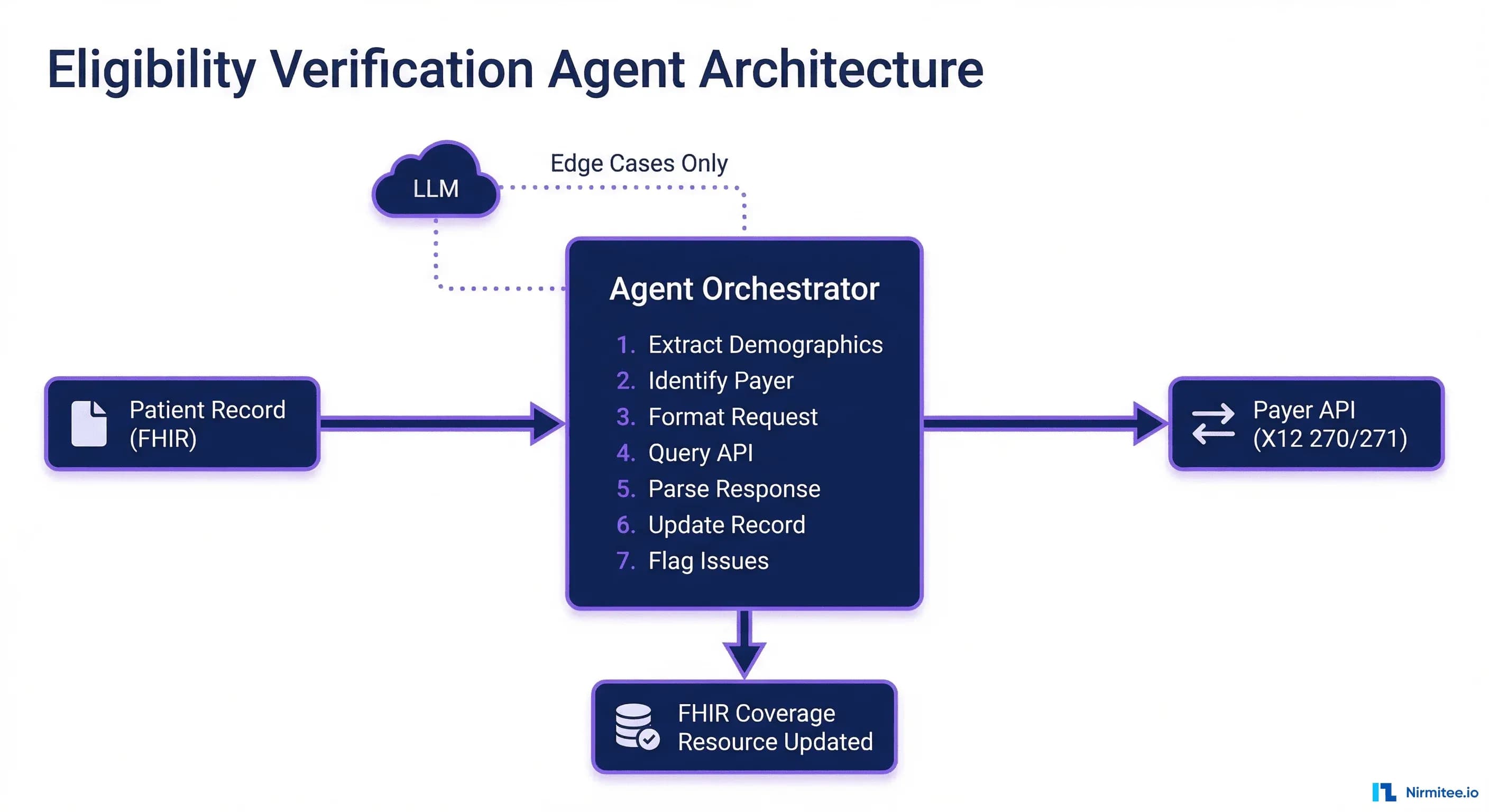
Here is what happens when the agent processes an eligibility check:
1. Trigger: New patient appointment scheduled or walk-in registered
2. Extract: Pull patient demographics from FHIR Patient resource
3. Identify: Determine payer(s) from Coverage resource or patient-provided info
4. Format: Build X12 270 eligibility inquiry transaction
5. Query: Send to payer API or clearinghouse (parallel for multiple payers)
6. Parse: Interpret X12 271 eligibility response
7. Map: Convert response to FHIR Coverage and EligibilityResponse resources
8. Update: Write structured results back to EHR via FHIR API
9. Flag: If confidence is below threshold, route to human for review
10. Log: Record full audit trail with reasoning and data accessed
Steps 2 through 8 execute in under 30 seconds. Most of that time is network latency waiting for payer API responses.
Why LLMs Matter Here
You might ask: if this is just API calls and data mapping, why do you need an LLM? Because real-world eligibility verification is messy.
Patient names do not always match exactly between systems. Insurance IDs have different formats across payers. Coverage responses contain free-text fields that describe plan limitations in natural language. Payer APIs return error codes that need contextual interpretation.
The LLM handles these edge cases — fuzzy matching patient identities, interpreting free-text coverage descriptions, reasoning about which error codes are transient versus permanent, and deciding when confidence is too low for autonomous action.
For the 85-90% of checks that are straightforward, the LLM adds minimal cost (a few cents in tokens). For the 10-15% that involve ambiguity, the LLM is the difference between a useful agent and a brittle automation that breaks on real data.
The FHIR Integration
The agent reads and writes standard FHIR resources:
// Input: FHIR Patient resource
GET /fhir/Patient/patient-123
// Returns demographics needed for payer lookup

// Input: FHIR Coverage resource (if exists)
GET /fhir/Coverage?beneficiary=Patient/patient-123
// Returns existing insurance information

// Output: Updated FHIR Coverage resource
PUT /fhir/Coverage/coverage-456
// Updates with verified coverage details

// Output: FHIR EligibilityResponse
POST /fhir/CoverageEligibilityResponse
// Stores full verification result for audit
This FHIR-native design means the agent works with any FHIR-compliant EHR. The integration surface is standard, not custom.
The Cost Breakdown: Human vs Agent
Human Process Cost Per Check
- Staff time: 15 minutes at $30/hour fully loaded = $7.50
- Portal licenses: $1-2 per check (amortized across portal subscription costs)
- Error rework: 8-12% of manual checks contain errors requiring correction = $1-2 average
- Opportunity cost: Staff doing eligibility checks are not doing patient-facing work = $2-3
- Total: $11.50 - $14.50 per check
Agent Process Cost Per Check
- LLM tokens: $0.02-0.05 (Claude API for edge case reasoning)
- Clearinghouse API: $0.01-0.03 (X12 270/271 transaction)
- Compute: $0.005 (cloud hosting amortized)
- Human review (10% of checks): $0.50 amortized across all checks
- Total: $0.55 - $0.61 per check (including the amortized human review)
Annual Impact at Scale
For a practice processing 200 patients per day:
- Manual cost: 200 x $13 average x 250 days = $650,000/year
- Agent cost: 200 x $0.58 average x 250 days = $29,000/year
- Infrastructure and maintenance: $40,000/year
- Net annual savings: $581,000
The agent pays for its entire development cost in the first month of operation.
Implementation Path: From Manual to Agent in 3 Weeks
Building an eligibility verification agent does not require a six-month project. Here is a realistic timeline for a team with healthcare domain experience:
Week 1: Foundation
- Set up FHIR data connector (read Patient, Coverage resources)
- Integrate with one clearinghouse API for X12 270/271
- Build the LLM orchestrator with basic prompts for edge case handling
- Implement audit logging for every agent action
Week 2: Intelligence
- Add confidence scoring and human-in-the-loop routing
- Handle multi-payer scenarios (patient with primary and secondary insurance)
- Build fuzzy matching for patient identity across systems
- Add retry logic with exponential backoff for payer API failures
Week 3: Production Hardening
- Load testing with realistic patient volumes
- Error handling for every payer-specific edge case discovered
- Dashboard for operations team to monitor agent performance
- Gradual rollout: agent processes alongside human, results compared
By the end of week 3, you have an agent running in parallel with your human process, validating results before you trust it autonomously. Most teams reach 95%+ accuracy within the first week of parallel operation, moving to full autonomy (with human review for low-confidence checks) by week 4.
What Makes This Agent Healthcare-Grade
A generic automation tool cannot do this. Healthcare eligibility verification requires specific domain knowledge that no foundation model was trained on:
- X12 270/271 transaction standards — The binary format that payers use for eligibility inquiries and responses. This is not in any LLM training data.
- Payer-specific quirks — Each payer formats responses differently, uses different error codes, and has different API rate limits. This is operational knowledge earned through integration experience.
- FHIR Coverage resource mapping — Translating between X12 eligibility responses and FHIR Coverage resources requires understanding both standards and the gaps between them.
- Compliance requirements — Every data access must be logged, PHI must be handled per HIPAA, and the agent must demonstrate minimum necessary access in its audit trail.
This is why domain expertise matters more than AI capability. The LLM is a commodity. The healthcare integration knowledge is the moat (see X12 vs HL7).
The Bottom Line
Eligibility verification is the single best first agent for most healthcare products. It is high volume, low clinical risk, measurable, and the ROI math is undeniable — saving over half a million dollars annually for a mid-size practice.
More importantly, building this agent creates the infrastructure for every future agent: the FHIR connector, the LLM orchestrator, the compliance logger, and the human-in-the-loop router. Your second agent will take half the time. Your third, even less.
The 15-minute manual process is not just slow — it is a scaling bottleneck. Every new patient adds 15 minutes of labor. An agent makes that marginal cost nearly zero. That is not optimization. That is a fundamentally different cost structure.
Shipping healthcare software that scales requires deep domain expertise. See how our healthcare product engineering services practice can accelerate your roadmap. We also offer specialized Agentic AI for Healthcare services. Talk to our team to get started.
Related reading
For more insights, explore our guides on how AI agents are transforming care delivery and FHIR in Modern Healthcare.
You may also find value in EHR Software Development Guide and Building a Healthtech App.
Ready to scale?
Talk to our healthcare engineering team about building, integrating, and shipping faster.
Frequently Asked Questions
What is an AI eligibility verification agent in healthcare?
How long does manual insurance eligibility verification take per patient?
How much does automated eligibility verification cost compared to manual checks?
Why does eligibility verification automation need an LLM instead of simple API calls?
How long does it take to implement an eligibility verification agent?
How does Nirmitee.io approach healthcare software development?