
AI voice agent for dental practices that books into the practice's own schedule
We built an AI front desk for a US startup: a voice agent that answers, finds real openings and books them in Open Dental and other scheduling systems, plus an AI scribe, voice intake and owner reports. It serves dental practices and is designed for behavioral health practices too.
November 22, 2026 · 18 min read · Jitendra Choudhary, CTO & Co-Founder

Shared with the client's permission. The client, its practices and its people are not named, and every screen uses sample data. We publish a client's work only with their written approval. If you work with us, your system stays private unless you say otherwise.
This was an AI agent for healthcare build from day one: voice, scheduling, documentation and the screens around them.
Where a dental or therapy practice loses patients: the phone
Most new patients still call. A small practice has one or two people at the front desk, and they are also checking patients in, taking payments and chasing insurance. Calls that ring out after 5 pm, at lunch or during a busy morning often go to a competitor.
No dollar figures from us: we did not measure the client's revenue. The client's team reports more than 1,100 after-hours calls handled and about $50K in revenue opportunity in 6 weeks at one deployment. That is their estimate, and we have not verified it.
Behavioral health practices have the same front desk problem, with longer sessions and recurring weekly visits. The platform was designed so the same agent and adapters can serve them; those connections are planned.
Why the product started
The client, a US startup building with practicing dentists, wanted one AI layer that sits on top of the scheduling system a practice already uses. No practice wants to switch systems to get a phone agent. So the agent had to read and write the practice's own schedule, the same one the front desk sees.
- 1
Oct 2025
First commit: portals, sign-in, intake
- 2
Winter
AI scribe, patient summaries, Open Dental adapter
- 3
Spring
Voice agent and per-practice scheduling rules
- 4
Summer
Voice agent dashboard, sync partner adapter
- 5
Live
Practices answering real calls
Dates from the commit history, read Nov 22, 2026. Season labels group months of work.
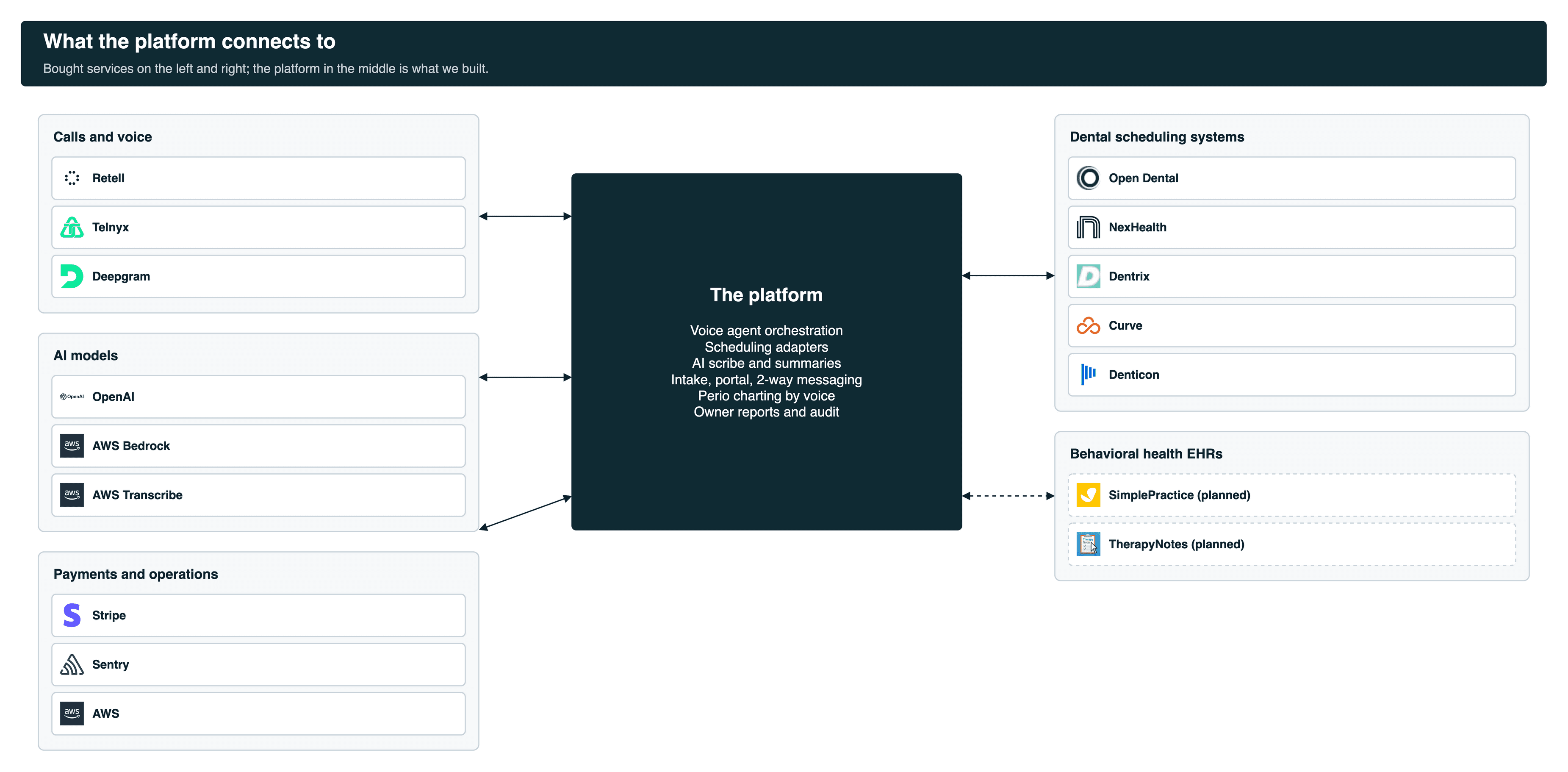
What the platform connects to
 Open full size
Five people, one front desk: what each one does now
Screens below show the delivered product, restyled. We kept its layout, fields and words. Concepts appear only in "What comes next". Sample data only; no patient data.
The patient who calls
Calls at 7:40 pm about an overdue cleaning. Nobody is in the office. The agent answers on the second ring.
Is recognized
The caller's number is looked up before the greeting ends.
Spells their name
First, then last, read back letter by letter. Date of birth read back.
Hears two real times
From the live schedule, for the right visit type and length.
Is booked
The agent confirms only after the schedule says yes.
Fills the form by voice
Speaks medications and allergies; checks what was filled in.

Intakes. Every form, with what still needs review.

Callbacks. Who to call, why, and how long they waited.

Staff on the go. The overview, on a phone.
The front desk
Arrives in the morning to a list, not a voicemail box. Every call has a summary, an outcome and, when needed, a callback with the reason.
- Overview: calls, callbacks and booking rate against the week before.
- All calls: recording, transcript, summary and staff notes in a side panel.
- Callback queue: who to call, why, and how long they have waited.

Voice agent overview. Sample data.
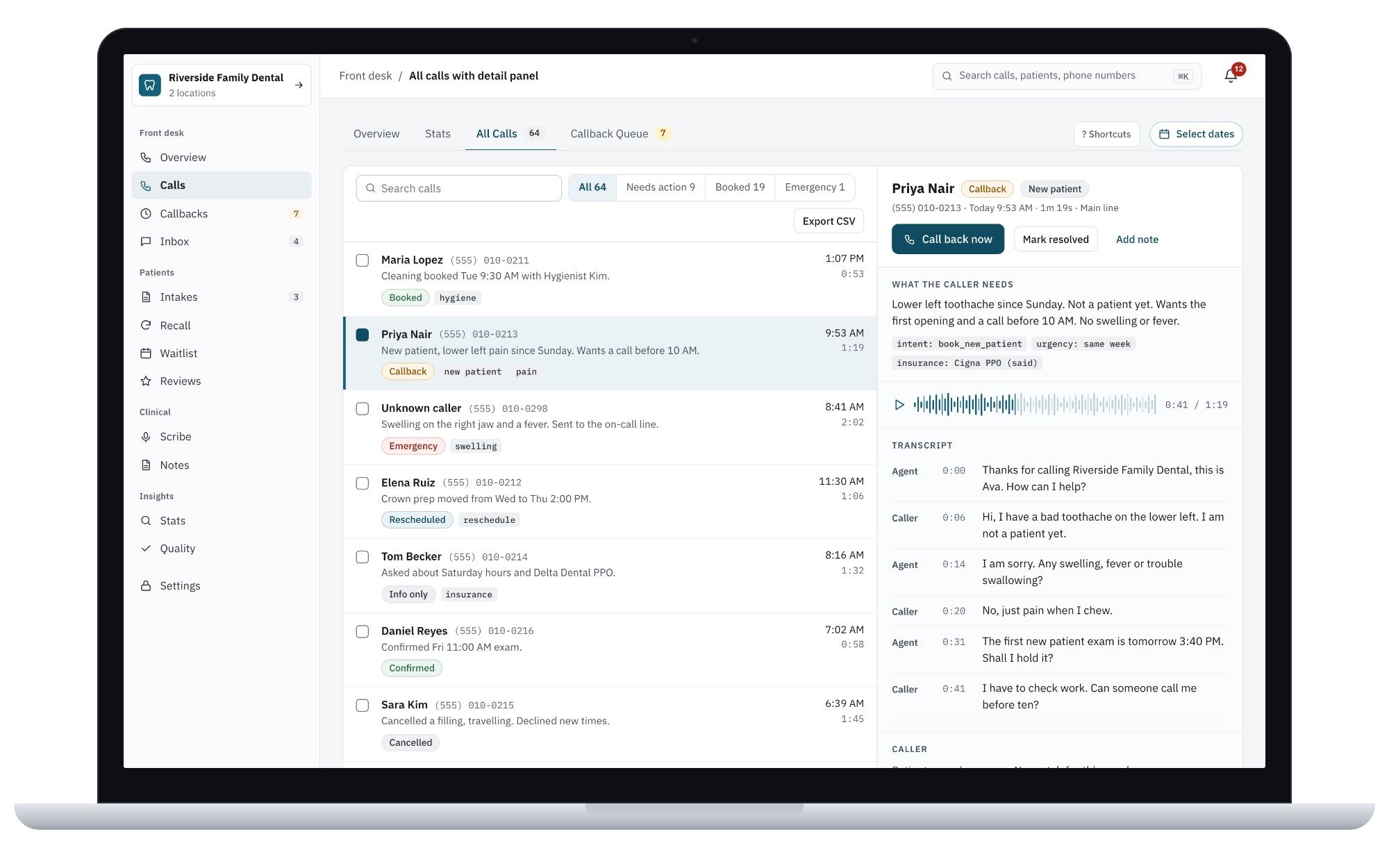
All calls, with the call detail panel.

Callback queue. Each callback shows the held slot and its expiry.
The dentist and hygienist
Start Scribe at the chair. By the time the patient is at checkout, the SOAP note and a plain-language summary are waiting for review.
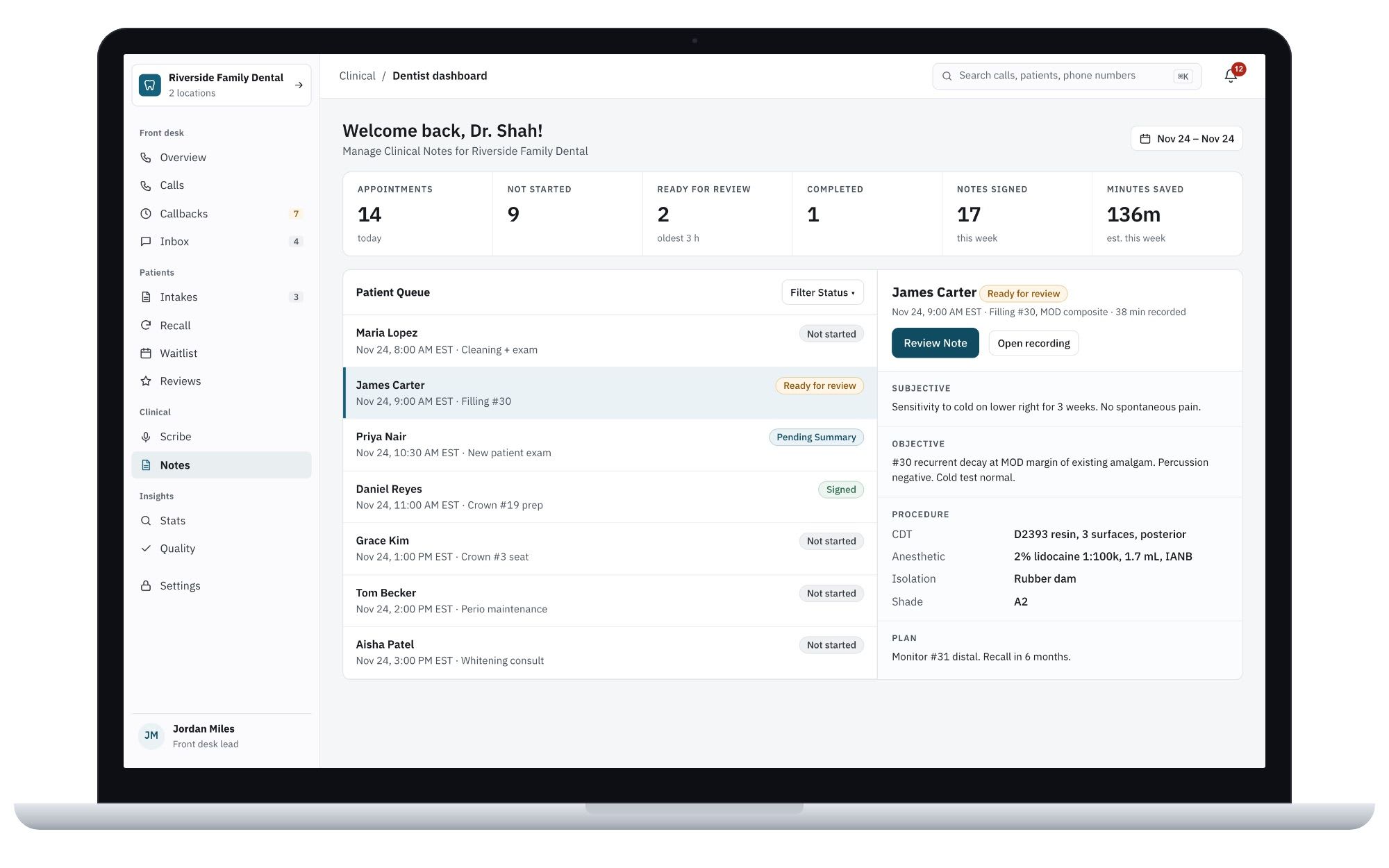
Patient queue: Not started, Ready for review, Pending Summary, Signed.
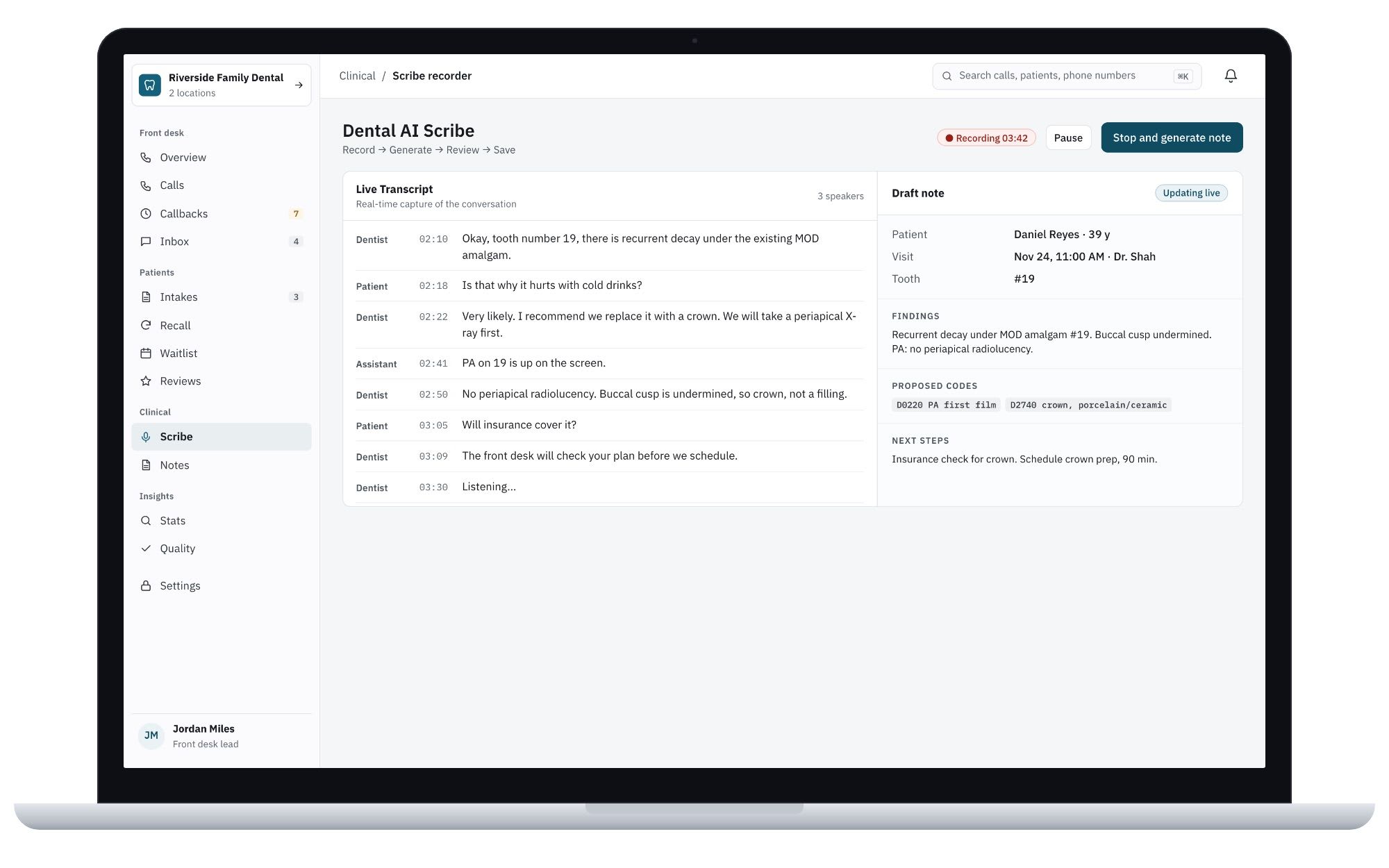
Scribe recorder: live transcript beside the draft note.
The therapist (designed, planned)
The same pieces fit a therapy practice: the agent books the next weekly session, the scribe drafts a DAP note, and measures such as the GAD-7 come in through the portal. If a caller or a message mentions a safety concern, the agent does not counsel; it gives the crisis line and flags the clinician.
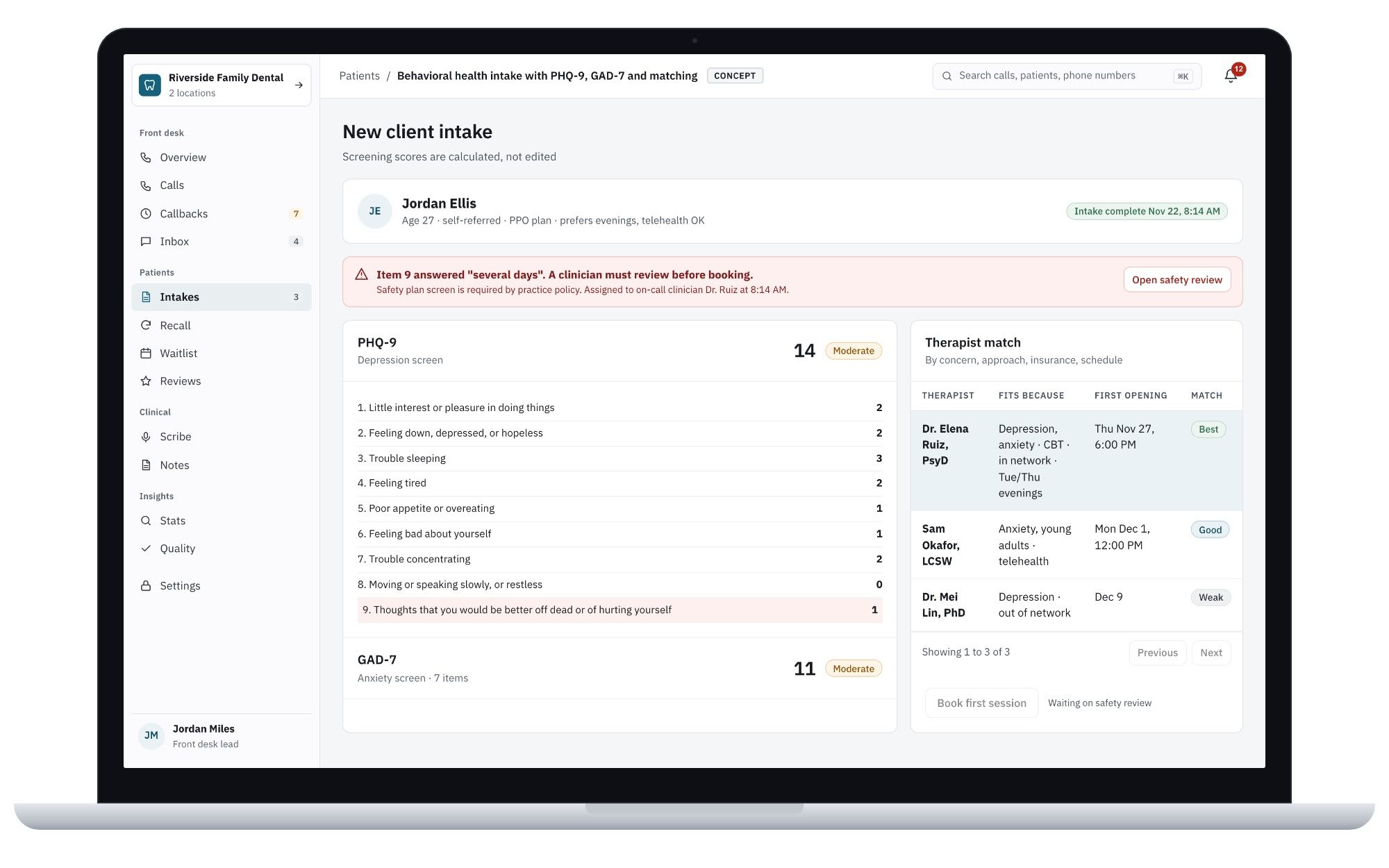
Planned module, shown as a design: intake with PHQ-9 and GAD-7.

Stats. Sample data, not client results.
The practice owner
Wants three answers: how many calls did we catch, how many became visits, and what is still waiting on my team. The owner also decides what the agent may do.
- Stats: calls, booking funnel, first-call resolution, when callers reach out.
- Notifications: every booking, reschedule and cancellation the agent made.
- Incident reports: anything the agent got wrong, tracked to a fix.
- Staff & Access: who sees what, and the BAA, roles, two-step sign-in and the audit trail.
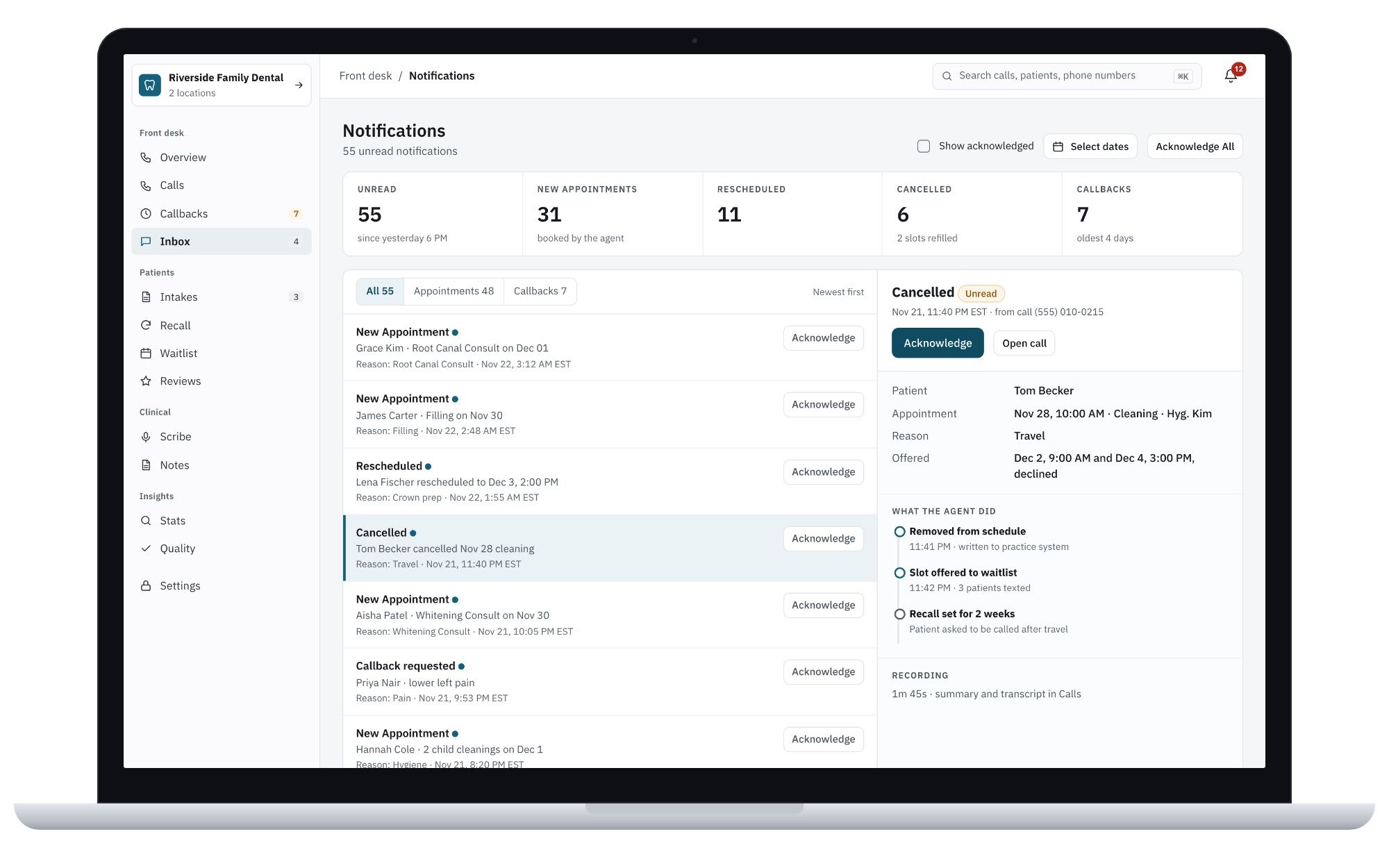
Notifications.
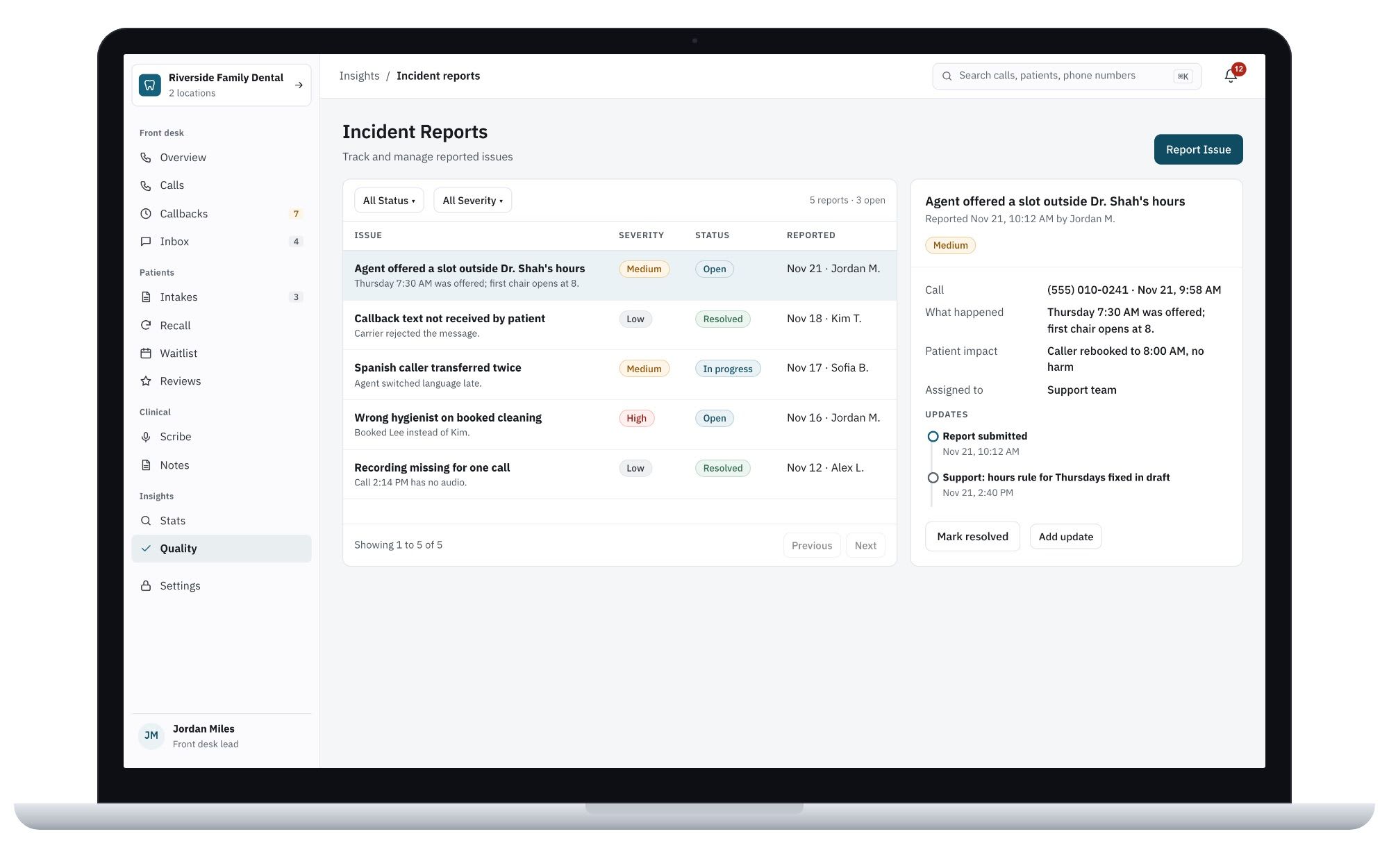
Incident reports.

Staff & Access.
How the voice agent works, step by step
The agent runs on Retell. Its prompt, tools and analysis fields live in the code, one set per practice, pushed from a single source. Every fact the agent says about the schedule comes from one of our tools; the prompt forbids it to invent a time.
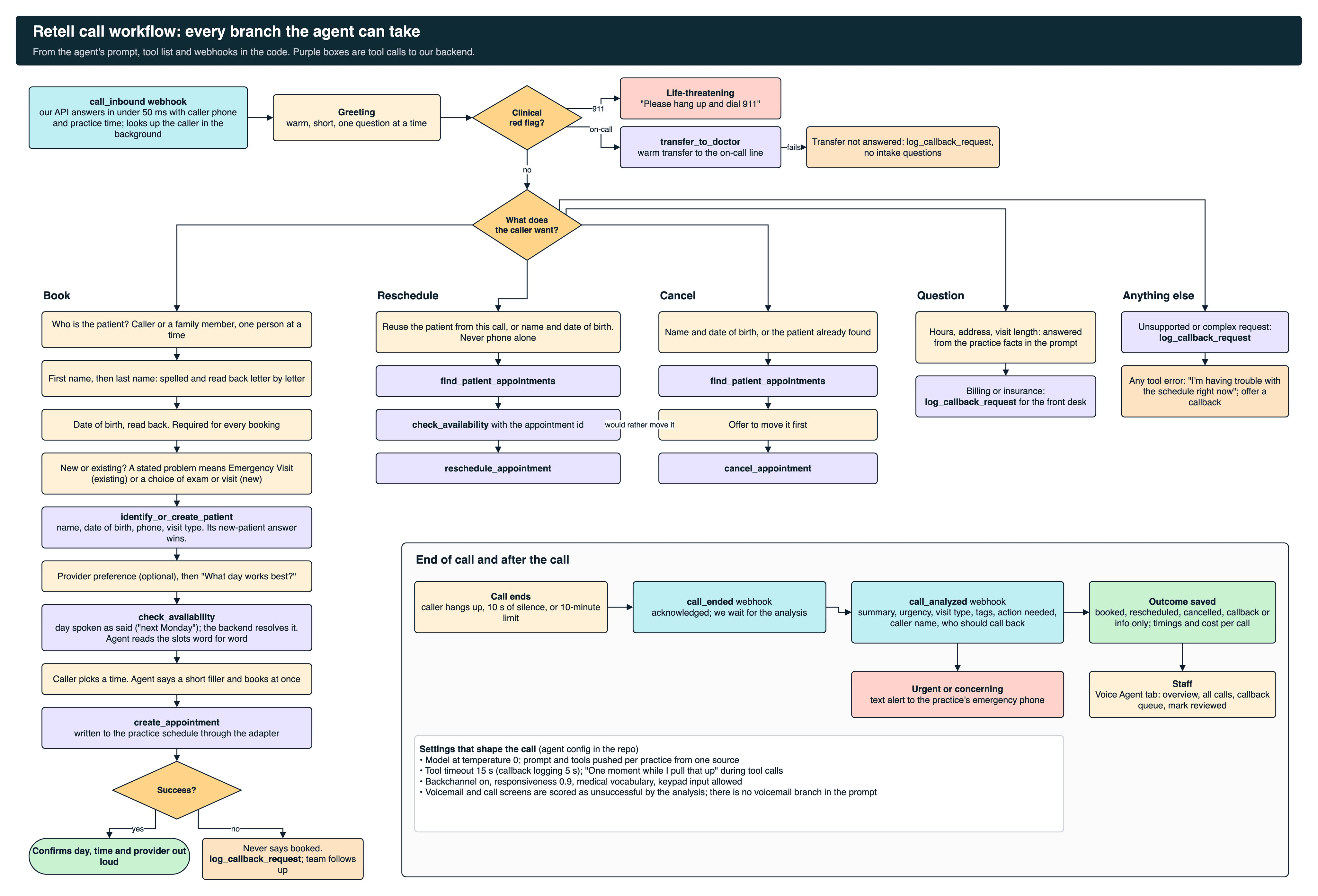 Open full size
Purple boxes are tool calls. Each tool waits up to 15 seconds (5 for logging a callback) and the agent says "One moment while I pull that up" meanwhile.
The tools the agent can call
| Tool | What the agent sends | What comes back | If it fails |
|---|---|---|---|
| Find or create the patient | Name (spelled), date of birth, phone, new or existing, reason | The patient's record in the practice system, and whether they are new | Agent offers a callback; never guesses a record |
| Check availability | Day as spoken ("next Monday"), visit type, reason, preferred provider | Open slots and a sentence the agent reads word for word | "Trouble with the schedule right now"; callback offered |
| Book the appointment | The chosen slot, visit type, reason, provider | Success, written to the practice schedule | Agent never says "booked"; logs a callback |
| Find the patient's appointments | Name and date of birth; never phone alone | Upcoming appointments | Asks for date of birth if a phone is shared |
| Move an appointment | The appointment id and the new slot | Success | Callback logged |
| Cancel an appointment | The appointment id, after offering to move it | Success | Callback logged |
| Log a callback | Who, why, and who should call back | Saved to the callback queue | Short timeout so the call is never stuck |
| Transfer to the on-call doctor | Warm transfer, caller shown as the caller | A live person on the line | Calm apology and a callback; no intake questions |
From the agent configuration and backend handlers in the repository. A ninth handler warms the cache when a call starts; it is not a spoken step.
One booking, message by message
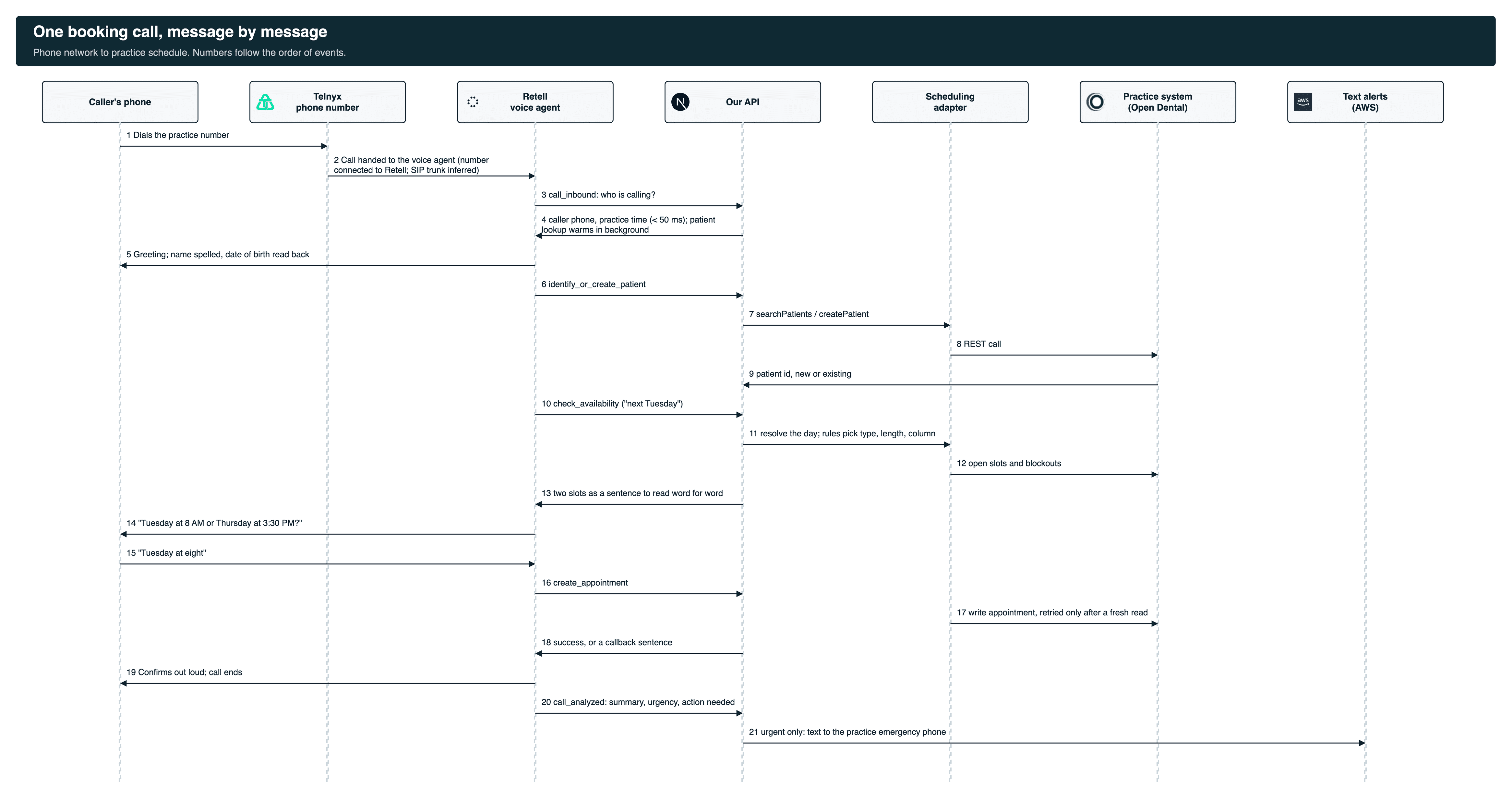 Open full size
How the Telnyx number hands calls to Retell is our reading of the setup; the code confirms the numbers and the agent, not the trunk details.
The call, as five lanes
 Open full size
Every call ends in one visible outcome
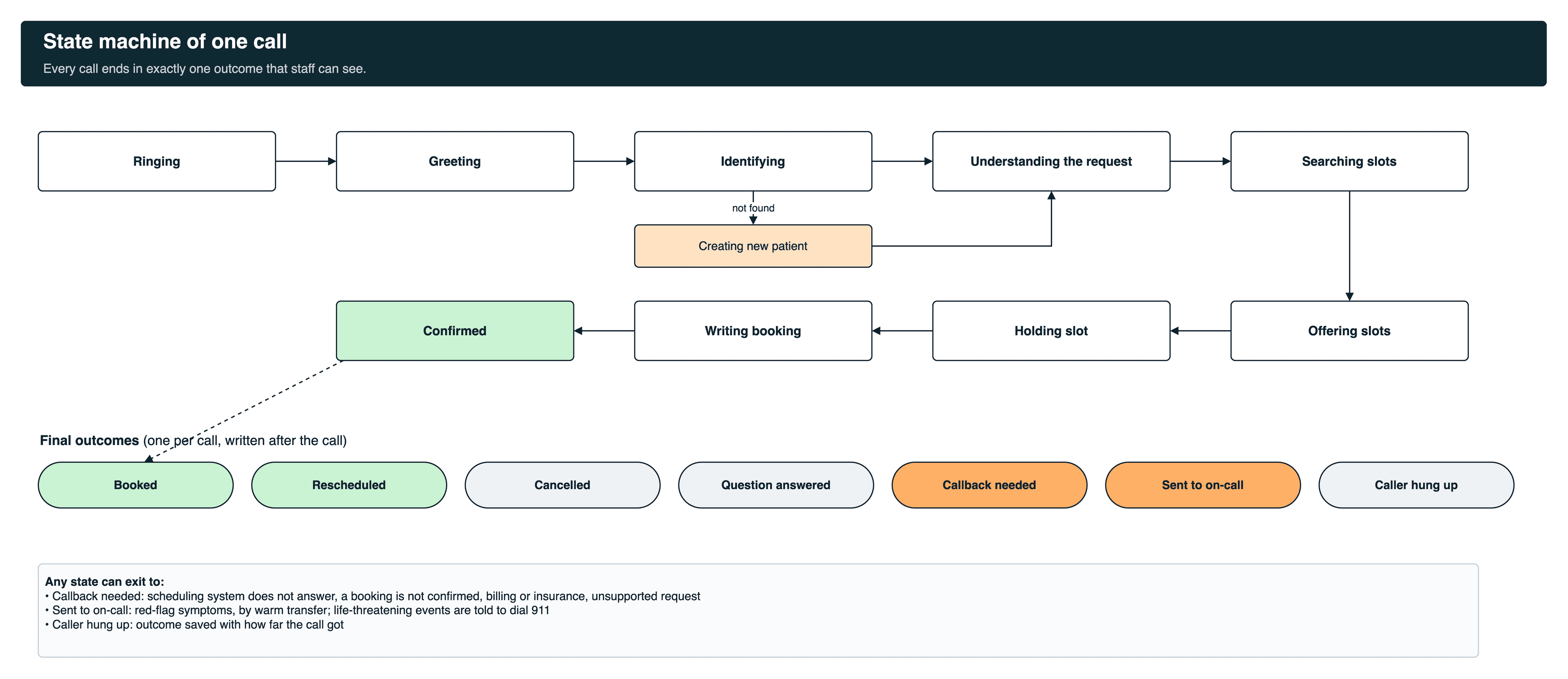 Open full size
166
calls across the workspace, Aug 26 to Sep 22, 2026
about 1 min
average call length (1 min 3 s)
2
most calls at the same moment
2.3 s
average response latency in the same window
Measured in the voice platform's analytics for the whole workspace, which includes demo lines. These describe use, not business outcomes. No before-and-after measure of bookings or staff time exists yet.
Guardrails written into the agent
No clinical advice. The agent schedules. It does not diagnose, and it does not tell a caller whether a symptom is serious.
Emergency routing. Life-threatening events: "Please hang up and dial 911." Red-flag dental symptoms: warm transfer to the on-call doctor, before any intake questions.
Minimum patient data. Name, phone, date of birth and a short reason. Never medical history, insurance numbers or ID numbers on the call.
A person when it matters. Billing, insurance and anything unsupported become a callback with the reason. Urgent calls also text the practice's emergency phone.
True state only. "Booked" is said only after the practice system confirms it. Times come only from the tool's answer.
Honest promises. Callbacks are promised "during our regular business hours", never "as soon as possible", so callers do not ring back all night.
The scheduling adapter layer
Each practice runs its own scheduling system, and a wrong booking is heard by a real patient. So everything in the platform speaks to one interface, and one adapter per system translates. Adding a system means writing an adapter, not changing the agent.
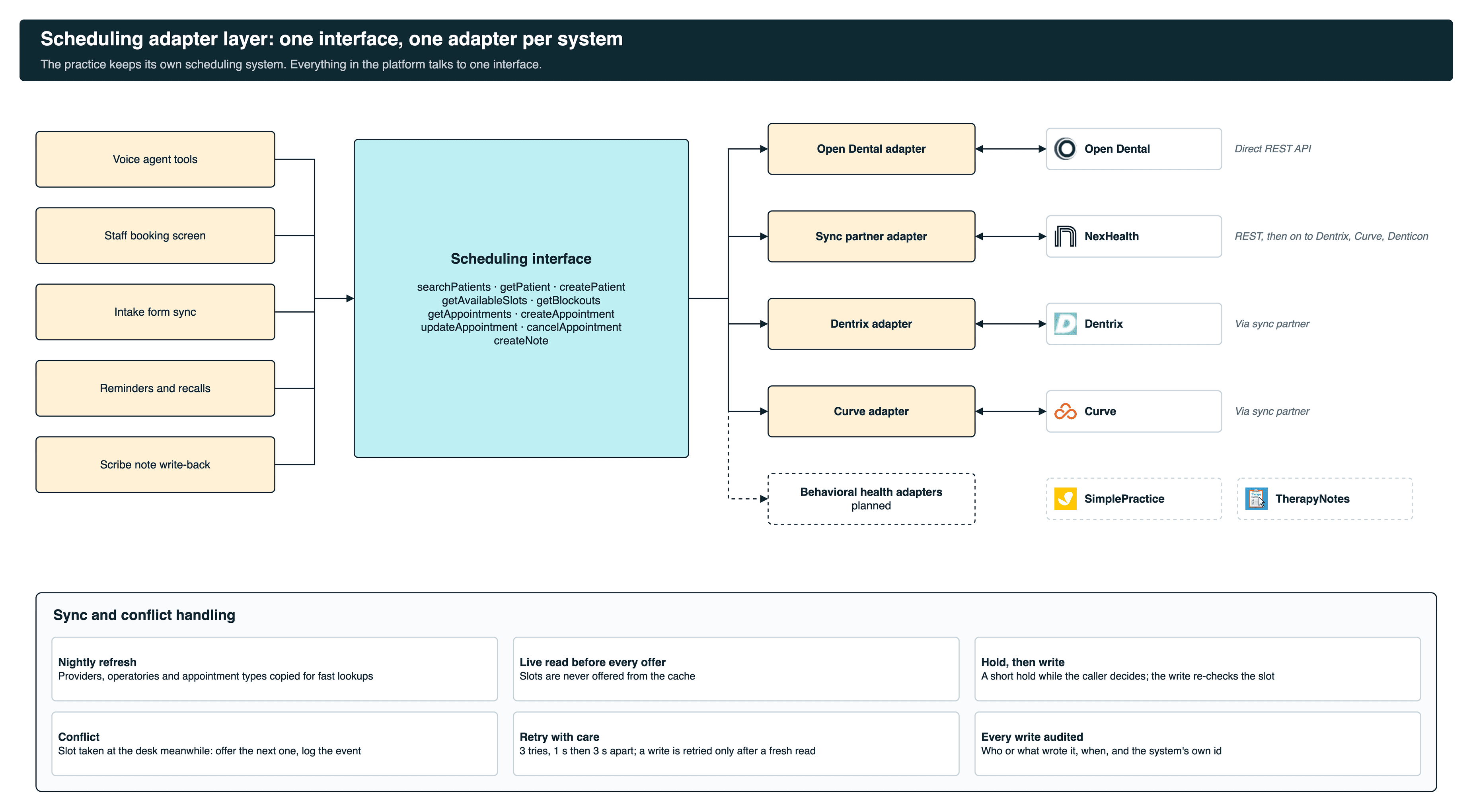 Open full size
What the agent hears, and where it lands
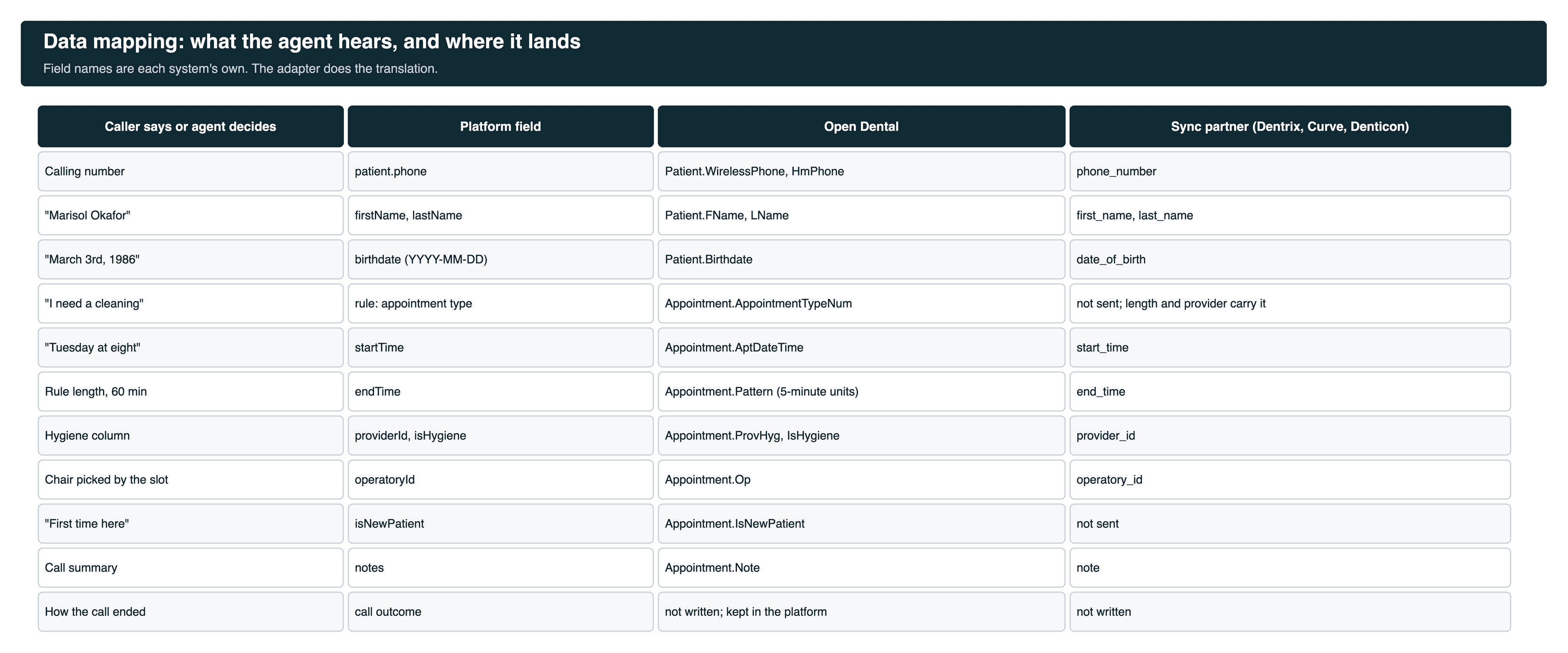 Open full size
Field names checked against the adapter code on Nov 22, 2026. Rules per practice decide operatory, length and whether a visit goes to the hygiene or doctor column; some practices only allow new patients inside reserved blockouts.
The AI scribe and patient summaries
The scribe records the visit, labels who spoke, and drafts two things in parallel: the clinical note and a summary the patient can understand. The dentist approves each one. Only then does it go to the chart, the PDF and the portal.
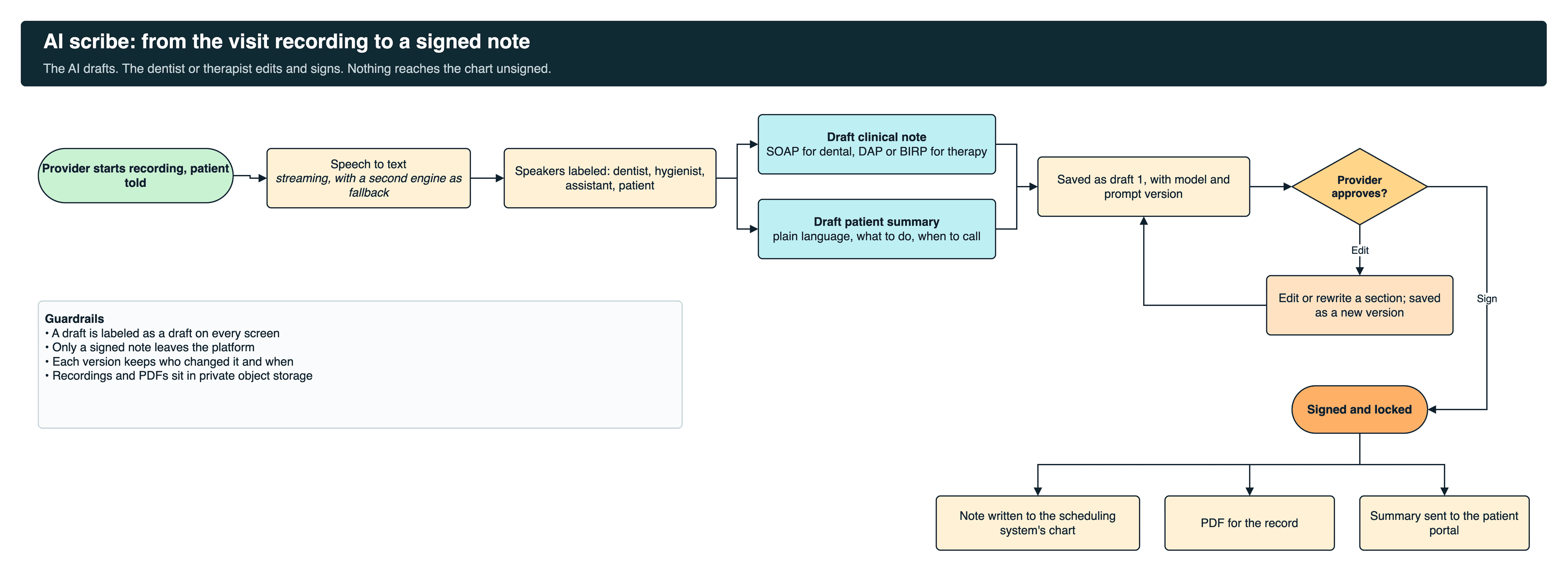 Open full size
The architecture
One Next.js codebase serves the staff, dentist and patient portals and the API the agent calls. Work after a call runs on a queue. Everything runs on AWS in a US region.
119
API routes
33
screens
85
database migrations
118
test files, unit and end-to-end
2,200
commits, Oct 2025 to Sep 2026
Counted in our copy of the main repository on Nov 22, 2026. The client's latest code is newer than our copy.
The whole system on one page
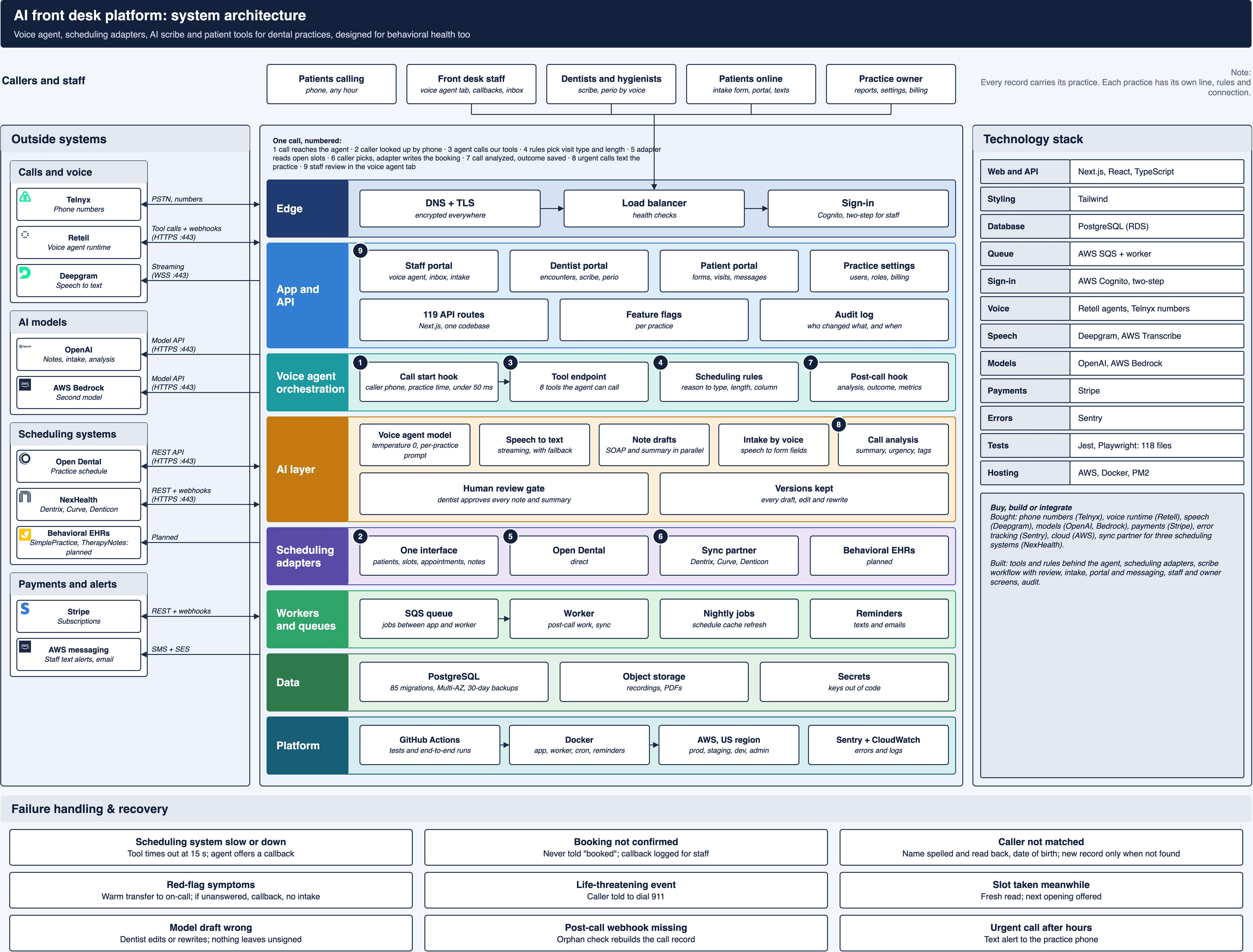 Open full size
Follow the black circles 1 to 9 to see one call move from the phone to the staff screen.
Deployment on AWS
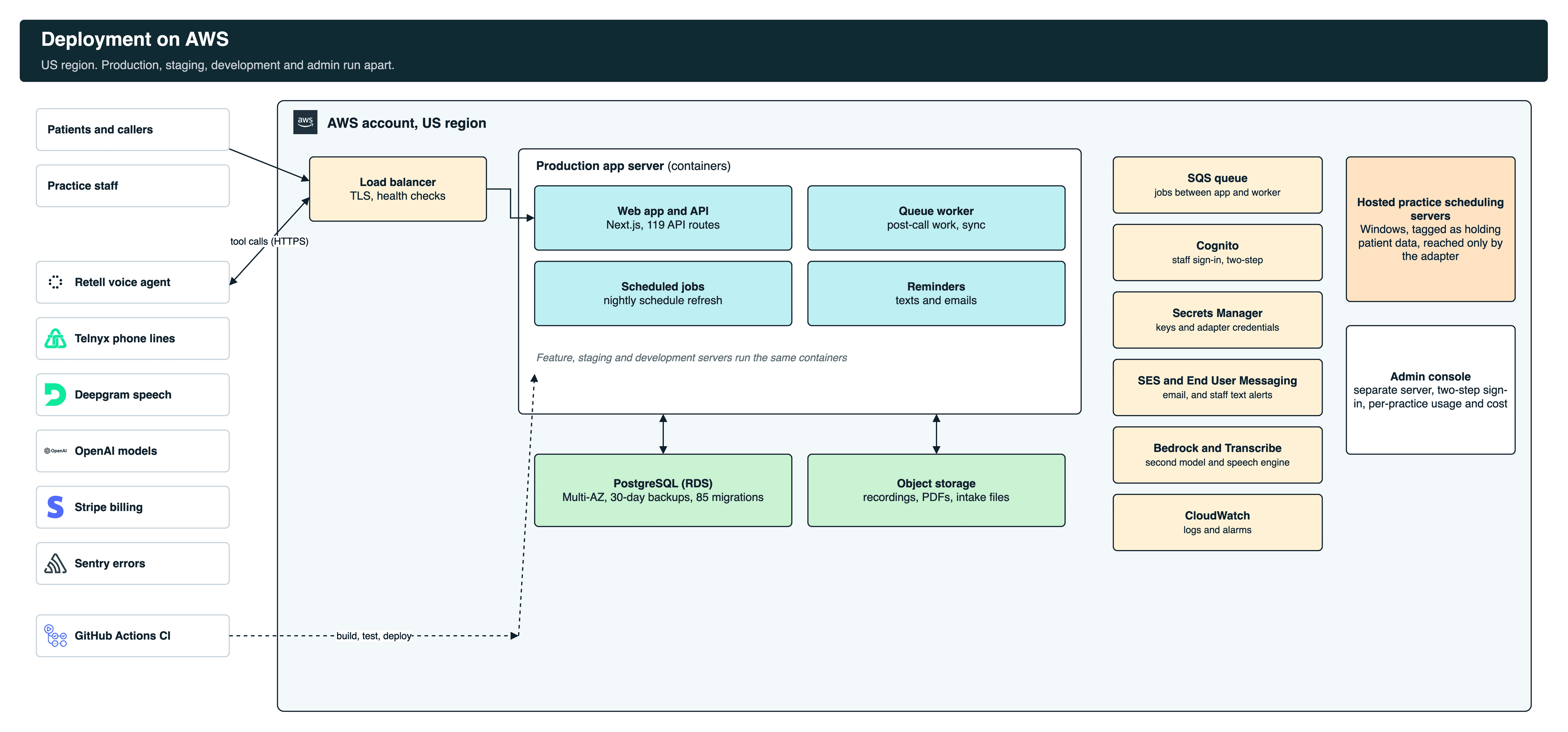 Open full size
Buy, build or integrate
The client bought proven services where they exist, and we built the parts that make a front desk agent safe to put on a practice's phone line.
| Capability | Options | What we chose | Why |
|---|---|---|---|
| Phone numbers | Carrier contracts, or a programmable carrier | Bought: Telnyx | Numbers by API for each practice line. |
| Voice agent runtime | Build turn-taking and speech, or a voice agent platform | Bought: Retell | Turn-taking, interruptions, voices and transfers were ready. Two other voice providers were tried along the way; the code keeps one interface across all three. |
| Speech to text | One engine, or two | Bought: Deepgram, AWS Transcribe | Streaming for the scribe, with a second engine available. |
| Models | Train, or hosted models | Bought: OpenAI, AWS Bedrock | Hosted models behind our prompts and schemas. |
| Payments and errors | Build, or buy | Bought: Stripe, Sentry | Subscriptions and error tracking are not where a practice wins. |
| Three scheduling systems | One adapter each, or a sync partner | Integrated: NexHealth | One connection reaches Dentrix, Curve and Denticon practices. |
| The product's edge | Buy a generic answering service, or build | Built by us | The agent's tools and rules, the adapters, the scribe review workflow, intake, portal, messaging, staff and owner screens, and the audit trail. |
Where AI acts and where a person decides
The agent can book on its own because every booking goes through rules and the practice system's own answer. Everything clinical waits for a person. More in our healthcare AI solutions.
When things go wrong
What the platform does in the bad cases.
The scheduling system is slow or down+
The booking is not confirmed+
The slot was taken at the desk while the caller decided+
Two family members share one phone+
A caller describes an emergency+
The post-call report arrives without a call record+
The AI draft of a note is wrong+
Security as standard practice
These are the defaults we bring to every healthcare build, and the ones this platform uses.
BAA on request
The platform offers a business associate agreement and a data processing addendum to practices on request.
Audit trail
Who viewed or changed a record, and when, including support staff who open a practice's view.
Less patient data on calls
The agent collects only what booking needs. Staff text alerts go through an AWS service covered by the AWS BAA.
Keys out of code
Secrets in a managed store, two-step sign-in for staff, and roles that limit each screen.
We do not claim a certification for this platform. Compliance is a practice's and vendor's shared responsibility, and we document our part.
What we found, what we decided, what improved
A phone agent is judged by callers in real time. These are the lessons we now bring to every voice project.
| What we found | What we decided | What it improves |
|---|---|---|
| Models are unreliable at working out "next Tuesday" from today's date. | The agent passes the words as spoken; the backend resolves the date against the practice's clock. | Fewer wrong-day offers. |
| Names heard over the phone are often misspelled. | First and last name asked separately, spelled, and read back letter by letter. | Records found instead of duplicated. |
| "As soon as possible" made callers phone back all evening. | Callbacks are promised "during our regular business hours". | Calmer callers, fewer repeat calls. |
| Each practice books differently: hygiene columns, child lengths, new-patient blocks. | Scheduling rules stored as data per practice, not in the prompt. | A new practice is configuration, not code. |
| Three voice providers were tried over the year. | One provider interface and one metrics format for all of them. | Latency and cost compared fairly; switching is cheap. |
| Booking bugs are hard to test with real calls. | A scenario catalog run against a fake Open Dental server and a test agent. | Changes tested before a patient hears them. |
Designed, not built yet
What comes next
These screens are concepts we designed with the client's team. None of them is in the product today. Each one reuses the same call data, scheduling adapter and review steps.

Concept. Insurance check with the payer page cited for each benefit.

Concept. Recall campaigns that fill open hygiene chairs.

Concept. No-show risk, with the reasons shown.

Concept. One view across locations, with stale data marked.
How we work with a team like yours
How this engagement ran
Time and material, from the first commit. Our engineers worked as an embedded consultant team inside the client's tools, using accounts the client issued, so the code history carries the client's name. Partner engineers joined under our engagement when the scope grew. The client set priorities week by week with their dentists.
You own the code
Repositories, cloud and vendor accounts sit in your name.
Clinicians in the loop
Your dentists or therapists review the agent's wording and the note formats.
US hours overlap
Engineers in India with daily overlap for stand-ups and demos.
Planned next steps
Behavioral health adapters
SimplePractice and TherapyNotes on the same interface
Measure before and after
bookings after hours, staff phone time
Revenue next to cost
per practice, in the owner report
Recall campaigns
the agent calls overdue patients
These are planned steps, not shipped features.
Want a voice agent that books into your practice's schedule?
Tell us which scheduling system you run and what your front desk misses today. We will show you what an AI agent can safely take on, built as custom healthcare software with real interoperability.
Sources: commit history and source code of the main repository, read Nov 22, 2026; agent configuration in the same repository; voice platform analytics for Aug 26 to Sep 22, 2026. Screens show our redesign of the delivered product with sample data. No patient data is shown. No outcome percentages are claimed.