Salesforce Health Cloud Integration: FHIR, EHR Guide 2026

CTO & Co-Founder
CTO & Co-Founder at Nirmitee.io. Architects healthcare integrations across FHIR, SMART on FHIR, ABDM and NHCX, writing from production experience taking hospital software from sandbox to go-live.
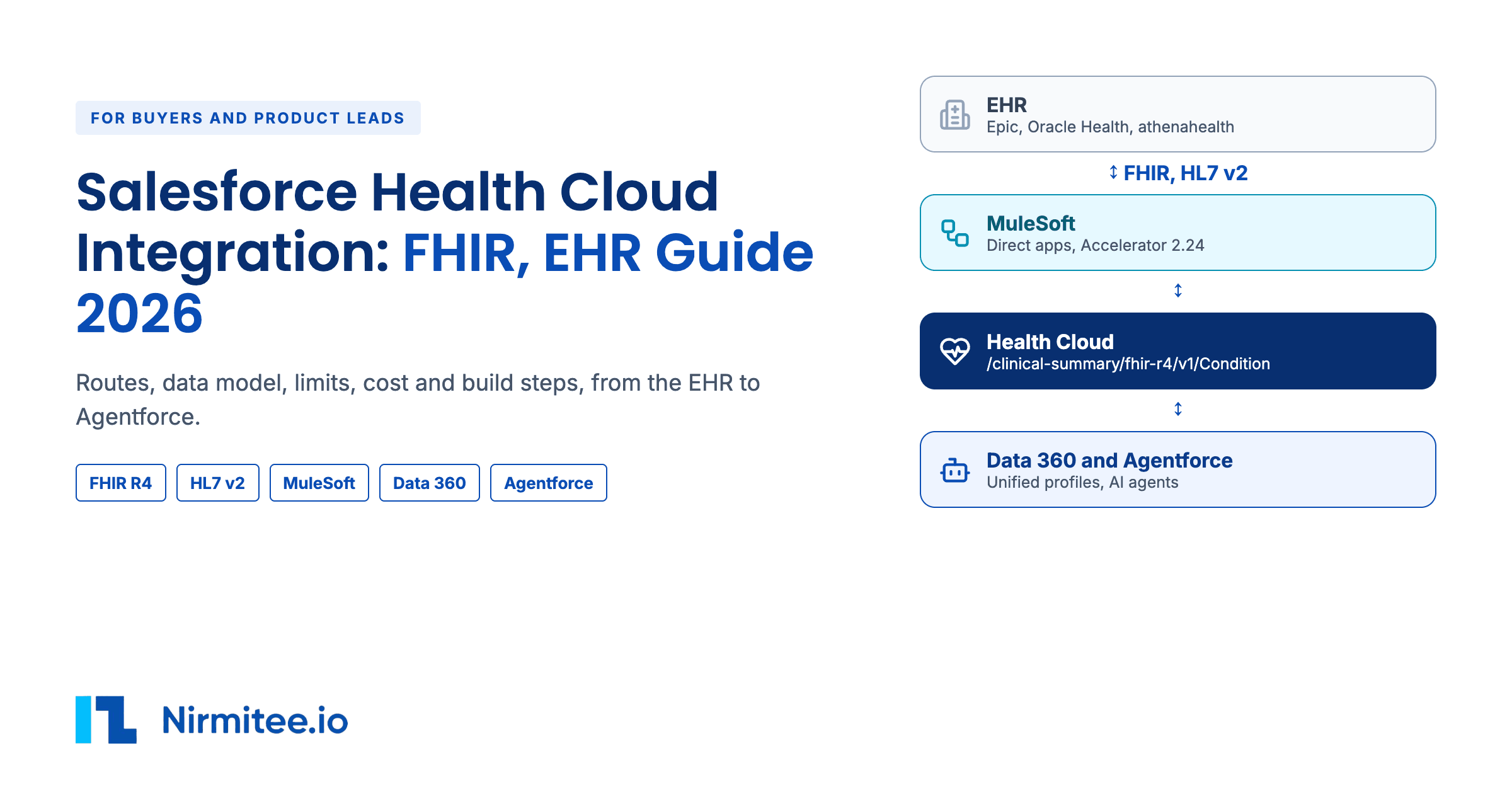
A Salesforce Health Cloud integration connects Health Cloud to the systems that hold clinical and payer data: the EHR, labs, payers, devices and national networks. Salesforce gives you four ways in. The first is a FHIR R4 Healthcare API. The others are the Health Cloud Business APIs, the core platform APIs, and MuleSoft apps that read from and write to EHRs.
This guide is for a buyer or a product lead who has to plan that work. It covers why teams integrate, what data to move and where Health Cloud sits next to the EHR. It then covers every documented route, real requests, limits and prices. It ends with what Salesforce leaves unpublished and what to ask before you sign.
Last checked Nov 23, 2026.
Salesforce Health Cloud integration at a glance
| Question | Short answer |
|---|---|
| Who grants access? | Salesforce, through your Health Cloud org. FHIR APIs need a $0 SKU from your account executive. Each EHR grants its own access, for example Epic through Epic on FHIR. |
| Who signs for the customer? | The Health Cloud customer signs with Salesforce, and Salesforce does not publish its BAA signing steps on the pages we could read in full; ask your account executive. On the EHR side, an Epic community member activates your app for its own system. |
| Is there public documentation? | Yes. Salesforce publishes the Healthcare API guide, the Health Cloud Developer Guide and the platform limits. |
| Which routes exist? | The FHIR R4 Healthcare API, Business APIs and platform APIs. MuleSoft Direct apps cover EHRs, HL7 v2, claims and prior authorization. |
| What does it cost? | Health Cloud lists at $350 to $725 per user per month. FHIR APIs carry no added cost today. MuleSoft and Accelerator prices are not published. |
| How long does it take? | Salesforce publishes no implementation time. Our own estimates are in the timeline section, labeled as estimates. |
| What is the biggest limit? | The Healthcare API: about 3 seconds per response, and at most 5 concurrent requests per org is the recommendation. |
Why integrate Salesforce Health Cloud with your EHR and payer systems?
Health Cloud is where your teams talk to patients and members. The EHR is where the clinical record lives. Integration shows the clinical facts to the people who call, schedule and follow up. They no longer log in to a second system.
The business case usually rests on four outcomes.
- One view of the person. A care coordinator sees conditions, medications, recent results and open care plans next to the call history. Salesforce's own MuleSoft Accelerator names this use case "Patient 360".
- Faster follow-up after events. An admission, a discharge or a lab result can start a task in Health Cloud. Salesforce standard objects accept HL7 v2 ADT and ORU messages through middleware.
- Less paper in prior authorization and intake. Salesforce lists MuleSoft apps for Da Vinci prior authorization and claim submission. Its Healthcare API carries Questionnaire and QuestionnaireResponse.
- A base for AI agents. Agentforce Health agents act on the same data. Salesforce announced an EHR Read-Write agent that retrieves patient data, registers patients, updates demographics and submits refills with EHRs such as athenahealth, through MuleSoft connectors.
Integration does not move the legal record. The EHR stays the source of truth for clinical documentation, and Health Cloud holds what engagement needs. The next section shows that split.
Where does Salesforce Health Cloud fit next to the EHR?
Health Cloud is a system of engagement: it runs outreach, care coordination, service and enrollment. The EHR is the system of record for clinical care. Most designs read clinical data into Health Cloud and write back only a short, governed list of items.
The pieces around Health Cloud are these.
| Layer | What it does | Source |
|---|---|---|
| EHR (Epic, Oracle Health, athenahealth and others) | Holds the clinical record and exposes FHIR APIs and HL7 v2 feeds. | |
| MuleSoft (Anypoint, Accelerator for Healthcare, MuleSoft Direct apps) | Converts and routes messages. Salesforce says a middleware solution is required to convert HL7 and FHIR messages to its objects. | |
| Health Cloud | Stores the FHIR-aligned clinical data model and runs care programs, service and scheduling. | |
| Healthcare API (FHIR R4) | Lets outside systems read and write Health Cloud clinical data over FHIR. | |
| Data 360 (formerly Data Cloud) | Unifies profiles from many sources through identity resolution. MuleSoft apps load FHIR Bulk and C-CDA data into it. | |
| Agentforce Health | AI agents that act on that data. | |
| Experience Cloud portals | Patient and member portals. Portal users need the "FHIR R4 for Experience Cloud Sites" permission set. |
Salesforce markets its healthcare AI agents as Agentforce Health. This guide uses "Health Cloud" for the product, because the pricing page still uses that name.
System of record against system of engagement
| Question | EHR (system of record) | Health Cloud (system of engagement) |
|---|---|---|
| Who documents care? | Clinicians | Care coordinators, service agents, outreach teams |
| Which record wins in a conflict? | The EHR for clinical facts | Health Cloud for contact preferences, tasks and program status |
| What flows in? | Orders and results from the care team | Clinical summaries, events and results from the EHR |
| What flows out? | Events, results, documents | A governed list: demographics updates, appointment requests, questionnaire answers, refill requests |
The write-back list is a decision for your clinical and compliance leads. Salesforce's own examples of EHR writes are registering a patient, updating demographics and submitting refills.
What data can a Salesforce Health Cloud integration move?
Almost every clinical and administrative domain has a Health Cloud object or a Healthcare API resource. The table maps each domain to the object, the FHIR resource and the usual direction.
FHIR is a web standard for health records, made of "resources" such as Patient and Observation. HL7 v2 is the older message standard most hospitals use for events.
| Domain | Health Cloud object | FHIR resource (Healthcare API module) | Usual direction | Source |
|---|---|---|---|---|
| Patient demographics | Account and Contact fields (the data model setting adds Account.SourceSystemIdentifier and Contact.Gender), with PersonName and Identifier | Patient (admin) | EHR to Health Cloud; demographic updates back | |
| Encounters | ClinicalEncounter (plus Diagnosis, Facility, Provider, Reason) | Encounter (admin) | EHR to Health Cloud | |
| Conditions | HealthCondition | Condition (clinical-summary) | EHR to Health Cloud | |
| Medications | MedicationStatement, MedicationRequest, MedicationDispense, MedicationAdministration | MedicationStatement, Medication (clinical-medications); MedicationRequest (clinical-workflow) | EHR to Health Cloud; refill requests back | |
| Labs and observations | CareObservation, DiagnosticSummary | Observation, DiagnosticReport (clinical-diagnostics) | EHR or lab to Health Cloud | |
| Allergies | AllergyIntolerance | AllergyIntolerance (clinical-summary) | EHR to Health Cloud | |
| Immunizations | PatientImmunization | Immunization (clinical-medications) | EHR or registry to Health Cloud | |
| Procedures | PatientMedicalProcedure | Procedure (clinical-summary) | EHR to Health Cloud | |
| Care plans and goals | Object names not read | CarePlan, Goal (care_management) | Both ways, by design | |
| Scheduling | Business API: Book Slot Chain, Visits | Not in the Healthcare API list | Health Cloud to EHR scheduling | |
| Claims and benefits | Event: CareBnftVrfyRqstStsChgEvent | Claim (prior-auth); BCDA and Blue Button apps | Payer to Health Cloud | |
| Prior authorization | Not published on the pages we could read in full; ask Salesforce | Claim (prior-auth), Da Vinci apps | Both ways with payer | |
| Devices and remote monitoring | CareObservation (biometric data from external systems) | Observation | Device platform to Health Cloud | |
| Consent | Not published on the pages we could read in full; ask Salesforce | Not in the Healthcare API list | Health Cloud is often the owner | |
| Documents and fax | Not published on the pages we could read in full; ask Salesforce | DocumentReference (clinical-diagnostics) | Both ways | |
| Provider directory | HealthcareProvider, HealthcareFacility, HealthcarePractitionerFacility | Practitioner, PractitionerRole, Organization, Location (admin) | Directory or EHR to Health Cloud | |
| Specimens | Specimen (API 64.0) | Not in the Healthcare API list | Lab to Health Cloud |
Three details matter for the mapping work.
- Coded values are flattened. A FHIR CodeableConcept can hold many codings. Health Cloud stores them through CodeSetBundle, which has 15 lookups, CodeSet1Id to CodeSet15Id.
- Complex types become plain fields. Period, Quantity, Range and Ratio split into separate fields. FHIR code and URI types become strings. Simple value sets become picklists.
- The clinical objects need an org setting. Turn on "FHIR-Aligned Clinical Data Model" under Setup, FHIR R4 Support Settings. Objects such as HealthCondition and ClinicalEncounter need it. CareObservation, CodeSet and Identifier do not.
What can you build on a Salesforce Health Cloud integration?
Nine use cases follow, from a care coordinator's patient view to prior authorization. Each one points to a row in the read and write table further down. Build complexity is our own rating, and each build estimate is our estimate for one EHR and one environment.
1. Show a live patient summary to care coordinators
medium
- Who it is for: provider groups, care management companies and digital health firms that run outreach in Health Cloud.
- The value: coordinators see problems, medications and recent results during the call, without opening the EHR.
- Build complexity: medium.
- How well it works: well for reads. Salesforce's Generic FHIR Client app reads EHR FHIR APIs in real time without storing the data in Salesforce, and names Epic, Oracle Cerner and athenahealth. See rows P1 and P9.
- Typical build estimate: 4 to 6 weeks for read-only views (our estimate).
2. Turn lab results into follow-up tasks
medium
- Who it is for: care management teams, chronic care programs and labs that serve them.
- The value: an abnormal result opens a task for the right nurse the same day.
- Build complexity: medium.
- How well it works: well. Salesforce standard objects accept HL7 v2.3 ORU messages through middleware, and the Event-based Ingestion app feeds HL7 v2 into the clinical data model. See rows P3 and P8.
- Typical build estimate: 4 to 6 weeks per feed (our estimate).
3. Alert transition-of-care teams on admission and discharge
medium
- Who it is for: value-based care groups, payers and post-acute networks.
- The value: the team calls the patient within a day of discharge.
- Build complexity: medium.
- How well it works: well for events. ADT is one of the six HL7 v2 message types Salesforce maps. A platform event or Change Data Capture event can then notify outside systems. See rows P8 and P13.
- Typical build estimate: 3 to 5 weeks (our estimate).
4. Bring remote monitoring readings into the care record
medium
- Who it is for: remote patient monitoring vendors and device makers.
- The value: nurses see blood pressure or glucose trends next to the care plan.
- Build complexity: medium.
- How well it works: well. CareObservation is the object for observed values from external systems with biometric data, and the Healthcare API accepts Observation. Watch the concurrency limit for high-volume devices. See row P3.
- Typical build estimate: 3 to 5 weeks (our estimate).
5. Book, change and cancel EHR appointments from Health Cloud
medium to high
- Who it is for: contact centers, access centers and patient apps.
- The value: an agent books into the EHR schedule while the patient is on the line.
- Build complexity: medium to high.
- How well it works: depends on the EHR. Salesforce's athenahealth Integration Client app schedules, modifies and cancels appointments. Salesforce does not publish, on the pages we could read in full, whether its Epic scheduling supports cancellation; ask your account executive. Epic lists Appointment $find and $book for STU3 only, with no R4 version. See row P10.
- Typical build estimate: 6 to 8 weeks for one EHR (our estimate).
6. Run prior authorization from the CRM
high
- Who it is for: specialty practices, utilization management teams and payers.
- The value: staff pull clinical evidence, submit the request and see status in one place.
- Build complexity: high.
- How well it works: shown in Salesforce's app list. The Prior Authorization EMR Retrieval app follows Da Vinci. The claim submission app sends to a clearinghouse or payer, with status inquiry and attachments. The Healthcare API exposes Claim under prior-auth, with system scopes only. See row P7.
- Typical build estimate: 10 to 14 weeks (our estimate).
7. Enroll a population into a care program
low to medium
- Who it is for: payers, employers' health programs and disease management firms.
- The value: a risk list from analytics becomes enrolled members with tasks in one run.
- Build complexity: low to medium.
- How well it works: well. The Care Program Enrollments API enrolls up to 200 patients per request and needs CareSystemFieldMapping records. See row P12.
- Typical build estimate: 2 to 4 weeks (our estimate).
8. Build a member view with claims history
medium
- Who it is for: Medicare Advantage plans, ACOs and payer care teams.
- The value: the care manager sees past claims next to open gaps.
- Build complexity: medium.
- How well it works: shown in Salesforce's app list. The BCDA app reads Medicare A, B and D claims through FHIR Bulk, and the Claims app syncs Blue Button 2.0 and CARIN data into the clinical model and Data 360. See row P11.
- Typical build estimate: 5 to 8 weeks (our estimate).
9. Collect intake forms and send answers to the record
low to medium
- Who it is for: digital front door vendors, behavioral health and specialty clinics.
- The value: patients fill forms once, and staff stop retyping them.
- Build complexity: low to medium.
- How well it works: well inside Health Cloud. The forms module carries Questionnaire and QuestionnaireResponse. Writing answers into the EHR depends on the EHR's write scopes. Epic lists QuestionnaireResponse.Create in R4. See rows P6 and P16.
- Typical build estimate: 3 to 5 weeks (our estimate).
The nine Salesforce Health Cloud use cases compared
| Use case | Who it is for | Build complexity (our rating) | Row in the read and write table |
|---|---|---|---|
| 1. Live patient summary for care coordinators | Provider groups, care management firms | Medium | P1, P9 |
| 2. Lab results into follow-up tasks | Care management teams, labs | Medium | P3, P8 |
| 3. Admission and discharge alerts | Value-based care groups, payers | Medium | P8, P13 |
| 4. Remote monitoring readings | RPM vendors, device makers | Medium | P3 |
| 5. EHR appointment booking | Contact centers, patient apps | Medium to high | P10 |
| 6. Prior authorization from the CRM | Specialty practices, UM teams, payers | High | P7 |
| 7. Care program enrollment | Payers, disease management firms | Low to medium | P12 |
| 8. Member view with claims history | Medicare Advantage plans, ACOs | Medium | P11 |
| 9. Intake forms to the record | Digital front door vendors, clinics | Low to medium | P6, P16 |
How do you get access to the Salesforce Health Cloud APIs?
You need a Health Cloud org, the $0 FHIR API SKU from your account executive, and an External Client App with OAuth 2.0 and the right custom scopes. Each EHR then has its own approval.
The steps on the Salesforce side
| Step | Who acts | What happens |
|---|---|---|
| 1. Confirm the org version | Customer admin | The Healthcare API needs Winter '23 (API v56.0) or later. |
| 2. Ask for the FHIR SKU | Customer, with the account executive | FHIR APIs carry no added cost, but need a $0 SKU. |
| 3. Turn on the data model | Customer admin | Setup, FHIR R4 Support Settings, "FHIR-Aligned Clinical Data Model". |
| 4. Confirm the account model | Customer admin, with Salesforce | Salesforce's account setup pages for Health Cloud would not load in full for us. Ask your account executive how patients and members should be modeled before any data load. |
| 5. Create an External Client App | Customer admin or integrator | OAuth 2.0, with custom scopes per resource, such as system_condition_write. The refresh_token scope must be assigned. |
| 6. Sign the BAA | Customer, with Salesforce | Salesforce does not publish the signing steps on its public pages; ask your account executive. Covered services include Health Cloud, Shield and Data 360. |
| 7. Connect MuleSoft, if used | Customer admin | For MuleSoft Direct apps: accept terms, connect Salesforce to your MuleSoft instance, enable the integration. Salesforce creates a Named Credential per deployed instance. |
The steps on the EHR side (Epic example)
Epic on FHIR offers four app types: EHR launch, standalone, backend services and Subspace. A server-to-server feed into Health Cloud usually uses backend services, which is system-level access with the client_credentials grant and no redirect URI.
- Register the app on Epic on FHIR. You get a production client ID and a non-production client ID.
- Build against the sandbox at
https://fhir.epic.com/interconnect-fhir-oauth/. - Publish a JWK Set URL. Since May 2026, Epic customers no longer accept static keys for backend OAuth and must configure your JWK Set URL.
- An Epic community member, meaning the hospital or clinic, activates the app for its own system.
We found no Epic page about Salesforce or CRM integration in particular.
Oracle Health documents FHIR R4 (4.0.1), JSON only, with SMART v1 and v2 scopes. Which scopes a hospital switches on is the hospital's decision.
Who signs on the customer side
Salesforce signs with the Health Cloud customer. The EHR customer, usually the same health system, activates your EHR app. If you are a vendor building for many Health Cloud customers, each one repeats the Salesforce steps in its own org.
How does Salesforce Health Cloud API authentication work?
The Healthcare API uses an External Client App with OAuth 2.0 and custom scopes per resource. It does not accept the SMART on FHIR scope format, because Salesforce scopes cannot use wildcards.
- Scopes come per resource and per mode, for example
user_condition_read,system_condition_write,user_all_readandsystem_all_write. - Claim (prior authorization) has system scopes only, and a Bundle POST needs
system_bundle_readorsystem_bundle_write. - The
refresh_tokenscope must be assigned to the app. - Epic backend services apps sign a JWT with RS256, RS384 or RS512, with an expiry no more than 5 minutes ahead, and use the client_credentials grant. Since May 2026, Epic customer environments no longer accept static keys, so each customer must configure your JWK Set URL.
A Salesforce Health Cloud integration that also talks to an EHR holds two sets of credentials: one for Salesforce and one per EHR. Keep them in your middleware, and never in a browser.
What does Salesforce Health Cloud access give you?
Access gives you sandboxes and production orgs, the FHIR API in four regions, the Business APIs, and the platform APIs with their daily limits.
Environments
The Healthcare API runs in four data centers: US East, EU, Canada and Australia. Each has its own domain, and a sandbox org adds /sandBox/ to the path.
| Region | Domain |
|---|---|
| United States | api.healthcloud.salesforce.com |
| European Union | eu.api.healthcloud.salesforce.com |
| Canada | ca.api.healthcloud.salesforce.com |
| Australia | au.api.healthcloud.salesforce.com |
Sandboxes come in four kinds.
| Sandbox | Refresh | Data storage | What it copies | Included |
|---|---|---|---|---|
| Developer | 1 day | 200 MB | Metadata only | 25 (Enterprise), 100 (Unlimited, Performance) |
| Developer Pro | 1 day | 1 GB | Metadata only | 5 (Unlimited, Performance) |
| Partial Copy | 5 days | 5 GB | Metadata plus sample data, template required | 1 (Enterprise, Unlimited, Performance) |
| Full | 29 days | Same as production | All data | 1 (Unlimited, Performance); none in Enterprise |
A Full sandbox gets a daily allowance of 5,000,000 API calls, and a Developer Edition org gets 15,000. Plan load tests with those figures in mind.
The FHIR modules and resources
| Module (path segment) | Resources |
|---|---|
admin | Patient, Practitioner, PractitionerRole, Encounter, Organization, Location, RelatedPerson |
clinical-summary | AllergyIntolerance, Condition, Procedure |
clinical-diagnostics | DiagnosticReport, DocumentReference, Observation |
clinical-workflow | ServiceRequest, MedicationRequest |
clinical-medications | Medication, Immunization, MedicationStatement |
care_management | CarePlan, Goal |
forms | Questionnaire, QuestionnaireResponse |
prior-auth | Claim |
bundle | Bundle (batch only) |
Source for the table: Salesforce Healthcare API guide. Methods are GET, POST and PUT, and Bundle takes POST only.
The Health Cloud Business APIs
These follow Connect REST conventions. The Patients API lives at /services/data/vXX.X/connect/health/patients and /connect/health/patients/{patientId}, from API 53.0, with GET, POST and PUT. Other Health Cloud resources include Care Program Enrollments, Visits, Book Slot Chain, Contact Encounter, Digital Verification and Census Bulk Upload Status. Shared industry APIs such as benefits verification, prior authorization and provider search sit in the Industries Common Resources guide, which we could not open.
One change to watch: when we reread the Business API resources page on Nov 23, 2026, it listed only five Health Cloud resources. They were record creation and update with content or received documents, and Omniscript. The Patients API page itself still documents its path. Confirm with Salesforce which resources it still supports before you build on them.
What can you test in the Salesforce Health Cloud sandbox?
You can call the Healthcare API from a sandbox org by adding /sandBox/ to the path, and test against four sandbox types that differ in refresh time and data. Enterprise Edition includes no Full sandbox, so a full-data rehearsal needs Unlimited or Performance.
| Sandbox | Refresh | What you can test |
|---|---|---|
| Developer | 1 day | Metadata, scopes and request shapes with your own test data (200 MB) |
| Developer Pro | 1 day | The same, with 1 GB of data |
| Partial Copy | 5 days | Mapping and matching on sample production data, through a template (5 GB) |
| Full | 29 days | A dress rehearsal on all production data |
Source for the table: Salesforce sandbox page. Because a Full sandbox refreshes only every 29 days, book your rehearsal date early. On the Epic side, test against https://fhir.epic.com/interconnect-fhir-oauth/ with a JWK Set URL from the first day.
What are the ways to integrate with Salesforce Health Cloud?
Salesforce documents five families of routes: the FHIR Healthcare API, the Business APIs, the platform APIs, MuleSoft Direct apps, and the MuleSoft Accelerator for Healthcare. The right one depends on direction, volume and whether you need to store the data.
| Route | What Salesforce documents | Fits when |
|---|---|---|
| Healthcare API (FHIR R4) | <domain>/<module>/fhir-r4/v1/<Resource>, OAuth custom scopes, batch Bundle of up to 30 entries. MuleSoft is not needed to call it. | Another system reads or writes clinical data in Health Cloud over FHIR. |
| Health Cloud Business APIs | Patients, Care Program Enrollments, Visits, Book Slot Chain and more, on Connect REST. | You need Health Cloud functions such as enrollment or slot booking. |
| Platform REST, Composite and Bulk API 2.0 | Composite: 25 subrequests counted as one call. Bulk 2.0 suggested above 2,000 records. | Initial loads, nightly syncs, custom objects. |
| Platform Events, Change Data Capture, Pub/Sub API | Outbound events with a 72-hour replay window. | Outside systems must react to changes in Health Cloud. |
| MuleSoft Direct for Health Cloud | Packaged apps: Generic FHIR Client, Event-based Ingestion (HL7 v2), EMR Synchronization, Bulk Data, C-CDA, BCDA, Claims, CDS Hooks, prior authorization, QHIN through Kno2, athenahealth client. Needs a purchased MuleSoft instance. | You connect an EHR, a payer or a network and want a documented starting point. |
| MuleSoft Accelerator for Healthcare (v2.24) | APIs, connectors, templates and reference architectures for nine use cases, with HL7 v2, X12 and C-CDA to FHIR converters. | You run your own Anypoint integration layer. |
| Agentforce Health agents | EHR Read-Write agent, Claims and Coverage agent and others, announced March 5, 2026. | You want an agent to act on EHR data. |
Salesforce says both of these are true, and they are easy to mix up: you do not need MuleSoft to call the Healthcare API, and you do need a MuleSoft license for the Industry Integrations and for heavy customization.
Salesforce Health Cloud integration strategies: which pattern for which job?
Three choices decide most architectures. Make each one per data domain, not once for the whole project.
Read-through or replicate. Read-through means Health Cloud asks the EHR at the moment of use and keeps no copy. Salesforce's Generic FHIR Client app does this. Replicate means you copy the data into Health Cloud objects. Replicate when you need reporting, automation, Data 360 segments or agent actions on the data. Read through when the data changes often and the user only needs to see it.
Event-driven or batch. Use HL7 v2 events for admissions and results that need same-day action. Use Bulk API 2.0 or FHIR Bulk for history and nightly catch-up. Most programs need both: a first load in batch, then events.
Hub through MuleSoft, direct FHIR, or Data 360.
| Pattern | Use it when | Watch for |
|---|---|---|
| Hub through MuleSoft | Several EHRs, HL7 v2 feeds, transforms, write-back to the EHR | License cost is not published. |
| Direct FHIR to the Healthcare API | One partner system already speaks FHIR and writes to Health Cloud | 5 concurrent requests per org, no code set validation. |
| Data 360 | Many sources, unified profiles, segments and analytics | Identity resolution limits; profiles from all active rulesets count toward billed usage. |
How do you get real-time data out of Salesforce Health Cloud?
Use Platform Events or Change Data Capture (CDC), and subscribe through the Pub/Sub API. Both share one daily delivery allocation: 50,000 deliveries for Unlimited and Performance, 25,000 for Enterprise and 10,000 for Developer.
| Mechanism | What it gives you | Limits to plan for |
|---|---|---|
| Platform Events | Events your org or Health Cloud publishes. Health Cloud names CareBnftVrfyRqstStsChgEvent and ApplnFormAppealStsChgEvnt. | Publishing up to 250,000 an hour on Enterprise and up. Publishing through REST, SOAP or Bulk also uses API calls; Pub/Sub, Apex and flows do not. |
| Change Data Capture | An event each time a selected record changes | 5 selected entities by default; events over 1 MB become gap events. The CDC add-on removes the 5-entity cap and adds 100,000 deliveries a day. |
| Pub/Sub API | One gRPC interface to publish and subscribe | Each event up to 1 MB, a publish batch under 3 MB, at most 100 events per Subscribe request, 200 managed subscriptions per org. |
| FHIR Subscription for Utilization Management | A MuleSoft Direct app that creates an Interoperability Topic Subscription Event record and sends it through MuleSoft | Needs a purchased MuleSoft instance. |
Events are kept 72 hours, and a subscriber can replay them by Replay ID. Store the last Replay ID you processed, so a subscriber that was down can catch up inside that window. Delivery counts only for Pub/Sub, CometD, empApi and event relays, and not for Apex triggers or flows.
What can you read and write in Salesforce Health Cloud?
Through the Healthcare API you can read and write every resource in the module table, with GET, POST and PUT. What you can write back to the EHR depends on the EHR, and every EHR write route we read runs through MuleSoft.
"Read" means data leaves Health Cloud or the EHR for your system. "Write" means data enters it.
| Row | Function | Read | Write | Evidence |
|---|---|---|---|---|
| P1 | Patient and demographics in Health Cloud | Yes | Yes | Patient in the admin module. Patients Business API, GET, POST and PUT. |
| P2 | Conditions, allergies, procedures | Yes | Yes | clinical-summary module. |
| P3 | Observations, diagnostic reports, documents | Yes | Yes | clinical-diagnostics module. CareObservation holds biometric data from external systems. |
| P4 | Medications, immunizations, orders | Yes | Yes | clinical-medications and clinical-workflow modules. |
| P5 | Care plans and goals | Yes | Yes | care_management module. |
| P6 | Questionnaires and answers | Yes | Yes | forms module. |
| P7 | Prior authorization | Yes | Yes | Claim in prior-auth, system scopes only. Da Vinci retrieval, PAS submission and claim submission apps. |
| P8 | HL7 v2 messages into Health Cloud | n/a | Yes | ADT, ORM, ORU, MDM, VXU and RDE from v2.3 systems, through middleware. |
| P9 | Real-time EHR read without storing | Yes | No | Generic FHIR Client app. |
| P10 | EHR appointments | Yes | Yes, by EHR | athenahealth client schedules, modifies and cancels. Epic cancellation: not published on the pages we could read in full; ask Salesforce. |
| P11 | Claims history (Medicare, Blue Button, CARIN) | Yes | n/a | BCDA and Claims apps. |
| P12 | Care program enrollment | n/a | Yes | Up to 200 patients per request. |
| P13 | Outbound change events | Yes | n/a | Platform events, CDC, Pub/Sub. Named events: CareBnftVrfyRqstStsChgEvent, ApplnFormAppealStsChgEvnt. |
| P14 | Bulk loads | Yes | Yes | Bulk API 2.0. FHIR Bulk from the EMR to Data 360. |
| P15 | National network records | Yes | n/a | QHIN integration through Kno2. |
| P16 | Write-back to the EHR | n/a | Yes, by EHR and scope | EMR Synchronization app. EHR Read-Write agent registers patients, updates demographics, submits refills. Oracle Health write scopes include Patient, Encounter, Condition, Observation, Appointment, DocumentReference and MedicationRequest. Epic lists R4 create APIs for Patient, Condition, AllergyIntolerance, Observation, DocumentReference and QuestionnaireResponse. |
| P17 | FHIR subscriptions for utilization management | n/a | Yes | Creates an Interoperability Topic Subscription Event record, sent through MuleSoft. |
A blank "n/a" means the route is one-way by design. Ask Salesforce which EHR write operations it supports today for Epic and Oracle Health.
What is not possible with a Salesforce Health Cloud integration?
Some things are closed or missing in what Salesforce documents. Each comes with the usual workaround.
- No built-in HL7 or FHIR parsing into objects. Salesforce says a middleware solution must convert the messages. Workaround: MuleSoft Event-based Ingestion, or your own integration engine.
- No code set validation on the Healthcare API. The API does not check that a code is valid, so the caller must send correct codes, for example CPT on Procedure. Workaround: validate in your middleware before you send.
- No SMART on FHIR scope format. Salesforce scopes cannot use wildcards, so SMART scopes such as
patient/*.readare not supported. Workaround: request the named custom scopes, such asuser_condition_read. - No Bundle transactions. Bundle is batch only, up to 30 entries, and only 10 of them can be reads or searches. Workaround: split work, and handle HTTP 424 for failed dependents.
- Not all of US Core yet. Salesforce's FAQ says not all US Core APIs are available. Check each resource you need.
- Little room to extend the FHIR API. Extensibility is minimal, and heavy customization needs an Anypoint license.
- No native write-back to Epic that we could find. We found no Salesforce statement of a write to Epic without MuleSoft or a partner. Workaround: MuleSoft apps, within the scopes the hospital grants.
- New customers cannot use the old EHR objects. Since Spring '23, new customers cannot create records in packaged EHR objects that have FHIR-aligned counterparts. Salesforce says all future development is on the FHIR R4-aligned model.
- Agentforce may not diagnose. Einstein Services may not be used for medical advice, diagnosis or treatment, or to infer or predict health status.
What are the Salesforce Health Cloud integration limits?
The tightest limits are on the Healthcare API: about 3 seconds per response and at most 5 concurrent requests per org. The platform adds a shared daily API budget and a shared daily event budget.
Healthcare API and Business APIs
| Limit | Figure | Source |
|---|---|---|
| Expected response time | About 3 seconds | |
| Concurrent requests per org (recommended maximum) | 5 | |
| Bundle entries per call | 30, of which up to 10 reads or searches | |
| Patients API concurrent requests (recommended) | 5 | |
| Patients per Care Program Enrollment request | 200 |
At 5 concurrent requests and about 3 seconds each, one org moves on the order of 100 requests a minute. That figure is our arithmetic from Salesforce's two numbers, not a Salesforce figure. Plan initial loads on Bulk API 2.0 instead.
The daily API budget
The rolling 24-hour allowance is 100,000 plus a per-license amount plus add-ons. Enterprise Edition adds 1,000 per Salesforce or Salesforce Platform license, and Unlimited or Performance adds 5,000. An Enterprise org with 15 licenses gets 115,000. REST, SOAP, Bulk, Bulk 2.0 and most Connect REST APIs count, per org. Salesforce does not publish the per-license figure for a Health Cloud license on that page.
Monitor the budget with the Sforce-Limit-Info response header or the /limits resource. Long-running requests (20 seconds or more) are capped at 25 at once in production.
Bulk, Composite and events
| Limit | Figure | Source |
|---|---|---|
| Bulk batches per 24 hours (Bulk and Bulk 2.0 combined) | 15,000 | |
| Records uploaded per 24 hours | 150,000,000 | |
| Bulk 2.0 upload file | 150 MB base64 (about 100 MB CSV) | |
| Composite subrequests per call | 25, counted as one API request | |
| Event deliveries per 24 hours, shared by platform events and CDC | 50,000 (Unlimited, Performance), 25,000 (Enterprise), 10,000 (Developer) | |
| Event publishing per hour | 250,000 (Enterprise and up) | |
| CDC entities by default | 5; the CDC add-on removes the cap and adds 100,000 deliveries a day | |
| Event retention for replay | 72 hours | |
| Pub/Sub event size | 1 MB per event; keep a publish batch under 3 MB |
Event delivery errors to watch for: LIMIT_EXCEEDED on publish, and sfdc.platform.eventbus.grpc.subscription.limit.exceeded on Pub/Sub.
Data 360 identity resolution
| Limit | Figure |
|---|---|
| Rulesets per data model object per data space | 5 |
| Match rules per ruleset | 10 |
| Runs per ruleset per 24 hours | Up to 4 |
| Real-time matching methods | Exact and Exact Normalized only |
| Source profiles per unified profile | 50,000 |
| Source records skipped | Over 15 KB |
Source for the table: Data 360 limits page.
Storage
Salesforce's storage allocation page would not load in full for us, so we do not quote a figure. Ask your account executive for your org's data and file storage before you load device data, because clinical observations fill it quickly.
Salesforce Health Cloud API errors and how to fix them
Most errors in a Salesforce Health Cloud integration come from budgets, tokens, scopes and Bundle rules. The table lists only errors and behaviors Salesforce documents, plus two standard Salesforce REST error codes.
| What you see | What it means | How to fix it |
|---|---|---|
REQUEST_LIMIT_EXCEEDED (standard Salesforce REST error code) | The org has used its rolling 24-hour API allowance. | Watch Sforce-Limit-Info or /limits, move loads to Bulk API 2.0, and group calls with Composite, where 25 subrequests count as one call. |
INVALID_SESSION_ID (standard Salesforce REST error code) | The access token is missing, expired or revoked. | Refresh the token. The app needs the refresh_token scope for that. |
| Request refused for a resource or mode | The app lacks the custom scope for that resource, or used a SMART-style scope. Salesforce does not publish the exact error text on the pages we read. | Add the exact scope, such as system_condition_write; Bundle POST needs system_bundle_read or system_bundle_write. |
| Failures when many calls run at once | Salesforce recommends at most 5 concurrent Healthcare API requests per org; above that, requests can fail. | Queue calls in middleware and cap concurrency at 5 per org. |
| A Bundle with more than 30 entries | A batch Bundle takes up to 30 entries, at most 10 of them reads or searches. Salesforce documents the limit, not the error body. | Split into batches of 30 or fewer. |
| HTTP 424 on a Bundle entry | A dependent entry was cancelled because the entry it pointed to failed. | Read the status of every entry, fix the first failure, and resend the chain. |
| Wrong codes stored without an error | The Healthcare API does no code set validation. | Validate codes in middleware against your terminology service before you send. |
| Slow responses or timeouts | Expect about 3 seconds per Healthcare API response. Platform REST and SOAP calls time out at 10 minutes, and only 25 calls of 20 seconds or more can run at once in production. | Set client timeouts above 3 seconds, retry with backoff, and keep long jobs in Bulk API 2.0. |
LIMIT_EXCEEDED on publish, 403::Organization total events daily limit exceeded on CometD, or sfdc.platform.eventbus.grpc.subscription.limit.exceeded on Pub/Sub | The shared event allocation is used up. | Cut subscribers, select fewer CDC entities, or buy the CDC add-on. |
On the EHR side, Oracle Health returns 409 on a stale update and 422 on a business-rule failure.
How much does a Salesforce Health Cloud integration cost?
Health Cloud licenses list at $350 to $725 per user per month, billed annually. FHIR APIs carry no added cost today. MuleSoft, the Accelerator, Shield and API add-ons have no published list price.
| Item | Published price | Source |
|---|---|---|
| Health Cloud Sales and Service Core | $350 per user per month | |
| Health Cloud Sales and Service Advanced | $525 per user per month | |
| Health Cloud Service Max or Sales Max | $700 per user per month | |
| Health Cloud Sales and Service Max | $725 per user per month | |
| Healthcare API (FHIR) | No added cost, $0 SKU; usage-based pricing planned | |
| Agentforce actions | Not confirmed on a page we could read in full; ask Salesforce | |
| Data 360 | Not confirmed on a page we could read in full; ask Salesforce | |
| MuleSoft Anypoint, Accelerator, MuleSoft Direct | Not published | |
| Shield, Provider Network Management, API add-ons | Not published |
The pricing page says prices are subject to change and carries no date.
Ask Salesforce for a written quote on:
- MuleSoft Anypoint tier, and whether the Accelerator is included.
- MuleSoft Direct app licenses for the apps you need.
- When usage-based pricing starts for the Healthcare API, and the meter.
- API call add-ons, and the API allowance per Health Cloud license.
- Shield, if your compliance team asks for it.
How long does a Salesforce Health Cloud integration take?
Salesforce publishes no implementation timeline for Health Cloud or for an EHR integration. The plan below is our estimate for one EHR, one region and three to four data domains. It is not a Salesforce figure.
| Phase | Our estimate | What drives it |
|---|---|---|
| Discovery and data mapping | 2 to 3 weeks | Domains in scope, code sets, patient matching rules |
| Org setup and access | 1 to 2 weeks, in parallel | FHIR SKU, data model setting, account model, External Client App |
| EHR app approval and activation | 2 to 6 weeks, in parallel | The hospital's own review; Epic customers must configure your JWK Set URL |
| Build: inbound feeds | 4 to 6 weeks | HL7 v2 and FHIR mapping, CodeSetBundle work |
| Build: write-back and events | 3 to 4 weeks | Governance rules, EHR write scopes |
| Testing in sandbox and a full-data rehearsal | 2 to 3 weeks | A Full sandbox refreshes only every 29 days |
| Go-live and hypercare | 2 weeks | Volume, monitoring of the API and event budgets |
End to end, our estimate is 12 to 16 weeks for a first EHR, and 6 to 8 weeks for each further EHR on the same middleware. The EHR approval step is outside your control and is often the longest wait.
Ask Salesforce or your systems integrator for a reference timeline for your named use case and your EHR.
How do you build a Salesforce Health Cloud integration, step by step?
Build in this order: data model, identity, access, inbound feeds, write-back, events, then monitoring. Each step below names the Salesforce part it rests on.
- Turn on the FHIR-aligned data model and confirm the account model with Salesforce.
- Decide the source of truth per field. Write it down before mapping. EHR wins for clinical facts.
- Map each domain. Use the FHIR mapping pages, which cover 46 FHIR types. Plan the CodeSetBundle and the flattened fields.
- Set the patient matching rule. Decide which identifier links an EHR patient to a Person Account. Account.SourceSystemIdentifier is one of the fields the data model setting adds.
- Create the External Client App and scopes. Ask only for the scopes you need.
- Register with each EHR. For Epic backend services, sign JWTs with RS384 and an expiry no more than 5 minutes ahead.
- Build inbound feeds. HL7 v2 through middleware, FHIR reads through the Generic FHIR Client or your own client.
- Build write-back with a review step. Only the agreed list, with a log of who approved what.
- Publish events for downstream systems. Use Pub/Sub API and keep within the delivery budget.
- Monitor. Watch
Sforce-Limit-Info, the event errors and the 424 rate on Bundles.
Example: write a Condition through the Healthcare API
The request follows Salesforce's documented path pattern. The body follows the FHIR R4 Condition resource. All data is synthetic. Check Salesforce's reference for the fields and search parameters it supports on each resource.
POST https://api.healthcloud.salesforce.com/clinical-summary/fhir-r4/v1/Condition
Authorization: Bearer <access token from your External Client App, scope system_condition_write>
Content-Type: application/fhir+json

{
  "resourceType": "Condition",
  "clinicalStatus": { "coding": [{ "system": "http://terminology.hl7.org/CodeSystem/condition-clinical", "code": "active" }] },
  "code": { "coding": [{ "system": "http://snomed.info/sct", "code": "44054006", "display": "Diabetes mellitus type 2" }] },
  "subject": { "reference": "Patient/TEST-PATIENT-0001" },
  "onsetDateTime": "2025-03-14"
}
A FHIR server answers a successful create with HTTP 201 and the new resource.
HTTP/1.1 201 Created
Content-Type: application/fhir+json

{
  "resourceType": "Condition",
  "id": "SYNTHETIC-COND-0001",
  "clinicalStatus": { "coding": [{ "code": "active" }] },
  "code": { "coding": [{ "system": "http://snomed.info/sct", "code": "44054006" }] },
  "subject": { "reference": "Patient/TEST-PATIENT-0001" }
}
Salesforce does not validate the code. If your middleware sends a wrong SNOMED code, Health Cloud stores it.
Example: a batch Bundle with a dependent entry
A batch Bundle can carry up to 30 entries, and a urn:uuid placeholder links an entry to one created earlier in the same call. Bundle POST needs system_bundle_write.
POST https://api.healthcloud.salesforce.com/bundle/fhir-r4/v1/Bundle
Authorization: Bearer <token with system_bundle_write>
Content-Type: application/fhir+json

{
  "resourceType": "Bundle",
  "type": "batch",
  "entry": [
    { "fullUrl": "urn:uuid:7f1c0b9e-0000-4000-8000-000000000001",
      "resource": { "resourceType": "Patient", "name": [{ "family": "Testcase", "given": ["Alex"] }], "birthDate": "1980-01-01" },
      "request": { "method": "POST", "url": "Patient" } },
    { "resource": { "resourceType": "Observation", "status": "final",
        "code": { "coding": [{ "system": "http://loinc.org", "code": "8867-4", "display": "Heart rate" }] },
        "subject": { "reference": "urn:uuid:7f1c0b9e-0000-4000-8000-000000000001" },
        "valueQuantity": { "value": 72, "unit": "beats/minute" } },
      "request": { "method": "POST", "url": "Observation" } }
  ]
}
If the Patient entry fails, Salesforce cancels the Observation and returns HTTP 424 for it. Your retry logic must read each entry's status.
Example: Epic backend services token request
Epic's backend services flow uses the client_credentials grant and a signed JWT. The client_assertion_type value below is the standard one for JWT client authentication.
POST https://fhir.epic.com/interconnect-fhir-oauth/oauth2/token
Content-Type: application/x-www-form-urlencoded

grant_type=client_credentials
&client_assertion_type=urn:ietf:params:oauth:client-assertion-type:jwt-bearer
&client_assertion=<JWT signed with RS384, exp no more than 5 minutes ahead>
Your middleware then calls the Epic FHIR API with the access token, maps the result, and writes it to Health Cloud.
Example: the Health Cloud Patients API path
GET https://<your-domain>.my.salesforce.com/services/data/v60.0/connect/health/patients/{patientId}
Authorization: Bearer <token>
The path is documented from API 53.0. An update through this API deletes and recreates the child PersonName and Identifier records, and rolls back on error. Anything that points at those child records by ID must expect new IDs after an update.
Which Salesforce Health Cloud nuances should you plan for?
Eight nuances cause most rework: patient matching, the account model, code sets, the FHIR-aligned model, write-back, duplicate encounters, PHI in AI, and API budgets. Each comes with a way to handle it.
Patient matching decides data quality
Data 360 identity resolution gives you up to 5 rulesets and 10 match rules per ruleset, and real-time matching is Exact or Exact Normalized only. We found no Salesforce guidance on patient matching for healthcare in particular. How to handle it: match on a source system identifier first, such as the EHR MRN in an Identifier record, and route fuzzy matches to a human queue.
Settle the account model first
Salesforce's help pages on how Health Cloud models patients and members would not load in full for us, so we do not quote their setup steps. How to handle it: ask your account executive which account model to use, and settle it before any data load. Changing it later means migrating records.
Code sets arrive unchecked
The Healthcare API performs no semantic code validation. A CodeableConcept spreads across up to 15 CodeSet lookups. How to handle it: validate codes in middleware against your terminology service, and decide which coding goes in CodeSet1Id.
FHIR-aligned is not FHIR-identical
Period, Quantity, Range and Ratio are flattened into fields, and HumanName maps to PersonName. How to handle it: write a field-level map per resource and test round trips. A FHIR resource read back may not match the one you sent.
Old EHR objects linger in older orgs
The packaged EHR objects are still documented as a managed package. Salesforce publishes no removal date for them. How to handle it: build only on the FHIR-aligned objects, and plan a migration if your org still uses the old ones.
Write-back needs governance
Write scopes differ by EHR. Oracle Health allows create, read and search on DiagnosticReport and Procedure with no update, and read and search only on CarePlan and CareTeam. Oracle Health returns 409 on a stale update and 422 on business-rule failures. How to handle it: keep an approved list of writable fields, require a human review for clinical writes, and log every write with its source.
Duplicate encounters creep in
HL7 ADT messages and FHIR reads can describe the same visit. How to handle it: key ClinicalEncounter on the EHR's encounter identifier (ClinicalEncounterIdentifier exists for this) and upsert, never insert.
PHI in AI needs its own rules
Agentforce Service Agent, Agentforce Voice and Prompt Builder are on Salesforce's BAA covered list. Einstein Services may not be used for diagnosis or to predict health status, and Einstein Bot utterance records must hold no PHI. How to handle it: keep agents on administrative tasks, and mask PHI in prompts and logs.
API budgets run out at the worst time
Platform events and CDC share one daily delivery budget. A long Healthcare API call holds one of only 5 recommended concurrent slots. How to handle it: queue and throttle in middleware, use Bulk API 2.0 for loads, and alert on Sforce-Limit-Info.
MuleSoft is covered by the BAA only in some setups
Runtime Manager, Monitoring, Anypoint MQ, Object Store v2 and Anypoint Security are covered only on AWS infrastructure as a Salesforce subcontractor, and Anypoint Platform only on Hyperforce. How to handle it: confirm your MuleSoft hosting before any PHI flows, and turn on its cryptography and PHI minimization features.
Announced is not the same as available
The HealthEx, Verily and Viz.ai data integrations were announced as "generally available starting later this year" in March 2026. We found no later GA notice. How to handle it: ask Salesforce for the GA status in writing.
Salesforce Health Cloud vs Epic vs a custom layer for integration teams
Health Cloud is where coordinators and contact centers act, and Epic holds the clinical record. A custom layer moves and checks the data between them, so a typical project touches all three.
| Question | Salesforce Health Cloud | Epic | A custom integration layer |
|---|---|---|---|
| What it is to the integration | The engagement side: care programs, service, scheduling, agents | The system of record, reached through Epic on FHIR | Your own middleware, such as MuleSoft or an interface engine |
| How you get access | Org, $0 FHIR SKU, External Client App | App registration, then activation by each Epic customer | You own it |
| Writes into it | Healthcare API, Business APIs, platform APIs | R4 create APIs such as Condition, Observation and DocumentReference | Any target you code for |
| Main constraint | 5 concurrent requests, no code set validation | JWK Set URL required for backend apps since May 2026 | You carry the build and support |
Our view: keep clinical truth in the EHR and let Health Cloud hold what coordinators need, with a layer in between that validates codes and throttles calls. For the AI side of this choice, read our Salesforce Health Cloud and Agentforce vs Epic AI comparison. For the general pattern of linking an EHR to a CRM, read our EHR and CRM integration guide.
Agentforce Health and AI agents on Salesforce Health Cloud
Salesforce released Agentforce Health on March 5, 2026, with agents named Referrals and Assessments, EHR Read-Write, Claims and Coverage, Rural Health, Epidemiology Analysis and Hospital Operations. The EHR Read-Write agent works both ways with EHRs "such as athenahealth through MuleSoft connectors": it retrieves patient data, registers patients, updates demographics and submits refills.
- The Home and Rural Health, Patient and Member Contact Center and Disease Surveillance templates went GA on March 5, 2026.
- HealthEx, Verily and Viz.ai data integrations were announced as "generally available starting later this year", meaning later in 2026. We found no later GA notice, so ask Salesforce.
- Agentforce Service Agent, Agentforce Voice and Prompt Builder are on the BAA covered list. Einstein Services may not be used for medical advice, diagnosis or treatment, or to predict health status.
An agent calls the same APIs, under the same scopes and budgets, as any other client. Keep agents on administrative work, and route clinical writes through the same review as any other write-back.
What should you check before you sign for a Salesforce Health Cloud integration?
Check four things: the BAA and which services it covers, security, testing environments, and support. Then put the questions at the end of this section to Salesforce in writing.
BAA and consent
Salesforce's BAA restrictions page, updated Sep 30, 2026, lists Health Cloud, Shield, Data 360, Tableau Cloud, Slack Enterprise (once HIPAA-enabled) and named Einstein Services as covered. Tableau Bridge, Tableau Server and Tableau Data Connect are not covered. A BAA does not make your setup compliant on its own. Configuring and using Health Cloud in a compliant way is your work.
Salesforce does not publish, on the pages we could read in full, which consent objects Health Cloud uses or how they map to the HIPAA authorization rule. Ask your account executive, and have your privacy lead review the mapping.
Security
Shield is on Salesforce's BAA covered list. Its price is not published. Ask for it by name in the quote if your security team needs field-level encryption or event monitoring. Keep OAuth scopes narrow: Salesforce scopes are per resource, so a feed that only writes Conditions needs only system_condition_write.
Testing
Use a Partial Copy sandbox for integration tests and a Full sandbox for a dress rehearsal, if your edition includes one. Enterprise Edition includes no Full sandbox. Epic's sandbox no longer accepts static keys for backend OAuth since February 2026, so test with a JWK Set URL from day one.
Support
Agree who owns each failure: the EHR, the middleware, or Health Cloud. Events are kept 72 hours for replay. That is your window to recover a missed message.
Questions to ask Salesforce before you sign
- Which EHR write operations do you support today for Epic and Oracle Health?
- How many API calls does each Health Cloud license add to the daily budget?
- Is the MuleSoft Accelerator included with Anypoint, and which tier do we need?
- What does each MuleSoft Direct app cost?
- When does usage-based pricing for the Healthcare API start?
- Is there an end-of-support date for the packaged EHR objects?
- Are HealthEx, Verily and Viz.ai generally available today?
- Which US Core resources are not yet in the Healthcare API?
- Do you have a reference timeline for our use case and EHR?
- Where are the paths for the shared benefits verification, prior authorization and provider search APIs?
Salesforce Health Cloud integration checklist
Use this list before the build starts. Each line points to a section above.
- The org runs Winter '23 (API v56.0) or later, and the $0 FHIR SKU is on the order.
- The FHIR-aligned clinical data model setting is on.
- The account model for patients and members is confirmed with Salesforce in writing.
- An External Client App exists with only the scopes each feed needs, plus
refresh_token. - Each EHR app is registered, and every Epic customer has your JWK Set URL.
- The BAA covers every service in the data path, including where MuleSoft runs.
- A source of truth is written down for each field, and the patient matching rule is agreed.
- Middleware validates codes, caps Healthcare API concurrency at 5, and splits Bundles at 30 entries.
- The daily API budget and the shared event allocation are sized and monitored.
- Subscribers store their last Replay ID, inside the 72-hour window.
- A sandbox plan names the sandbox type for each test and the Full sandbox rehearsal date.
- The questions for Salesforce in the section above have written answers.
Need help with a Salesforce Health Cloud integration?
If you are planning a Salesforce Health Cloud integration and want a team to scope the routes, the data map and the build with you, talk to us. Start at our EHR integration service.
Ready to scale?
Talk to our healthcare engineering team about building, integrating, and shipping faster.
Frequently Asked Questions
Does Salesforce Health Cloud have a FHIR API?
Do I need MuleSoft to integrate Salesforce Health Cloud with an EHR?
Can Salesforce Health Cloud write back to Epic?
Is the Salesforce Health Cloud data model the same as FHIR?
Does Salesforce Health Cloud accept HL7 v2 messages?
How much does the Salesforce Health Cloud FHIR API cost?
What does Salesforce Health Cloud cost per user?
What are the Salesforce Health Cloud FHIR API rate limits?
Is Salesforce Health Cloud covered by a BAA?
What is Agentforce Health?
How does Salesforce Health Cloud API authentication work?
How long does a Salesforce Health Cloud implementation take?