Oncology EHR integration · United States

Oncology EHR Integration: OncoEMR, iKnowMed, ARIA and MOSAIQ

We connect oncology software to the EHRs cancer care runs on: Flatiron OncoEMR and iKnowMed in community oncology, Epic Beacon and Oracle PowerChart Oncology in health systems, and ARIA and MOSAIQ in radiation oncology. Each has a different route and cost. We map them, read what the certified APIs expose, fill gaps with the interfaces the vendor offers, and keep clinicians in control of anything patients see.

  • OncoEMR
  • iKnowMed
  • MOSAIQ
  • ARIA
  • Epic Beacon
  • FHIR R4
  • mCODE

Different oncology systems, one product.
  1. 01Map the systems

    Which oncology EHR and radiation oncology system each practice runs, and the documented route for each.

  2. 02Read what is certified

    Certified FHIR APIs cover patients, problems, medications and labs; oncology detail needs more.

  3. 03Fill the gaps

    Vendor HL7 interfaces or programs where FHIR stops, with fees and approvals listed up front.

Evidence you can check

The problem

Sound Familiar?

Oncology software teams and community practices tell us about these four problems first.

Every practice runs a different oncology EHR

Your first customer is on OncoEMR, the next on iKnowMed, and the cancer center down the road runs Epic Beacon with ARIA in radiation oncology.

The certified API stops short of oncology detail

Patient, problems and medications come through, but regimens, cycles and staging need more than the standard resources.

Infusion days run on phone calls

Chair schedules, labs and dose changes are checked by hand before each patient sits down.

Symptoms reported between visits go nowhere

Patients report side effects in your app, and the care team never sees them in the chart.

Use cases

What It Looks Like When It Works

Four use cases, each shown as the screen your team works in. Patients are fictional; routes follow each vendor's published documentation.

A Treatment Summary Your Patients Can Read

Today

Patients call the clinic to ask which cycle they are on and when the next infusion is.

With the integration

Diagnosis, regimen, cycle and latest labs are read from the practice's oncology EHR over its certified FHIR API, and content reaches patients only after oncologist approval.

What we build
  • Certified FHIR R4 reads, approved by the practice
  • Mapping to mCODE fields where the EHR exposes them
  • Scheduling from an HL7 feed or the EHR's own API where FHIR does not cover it
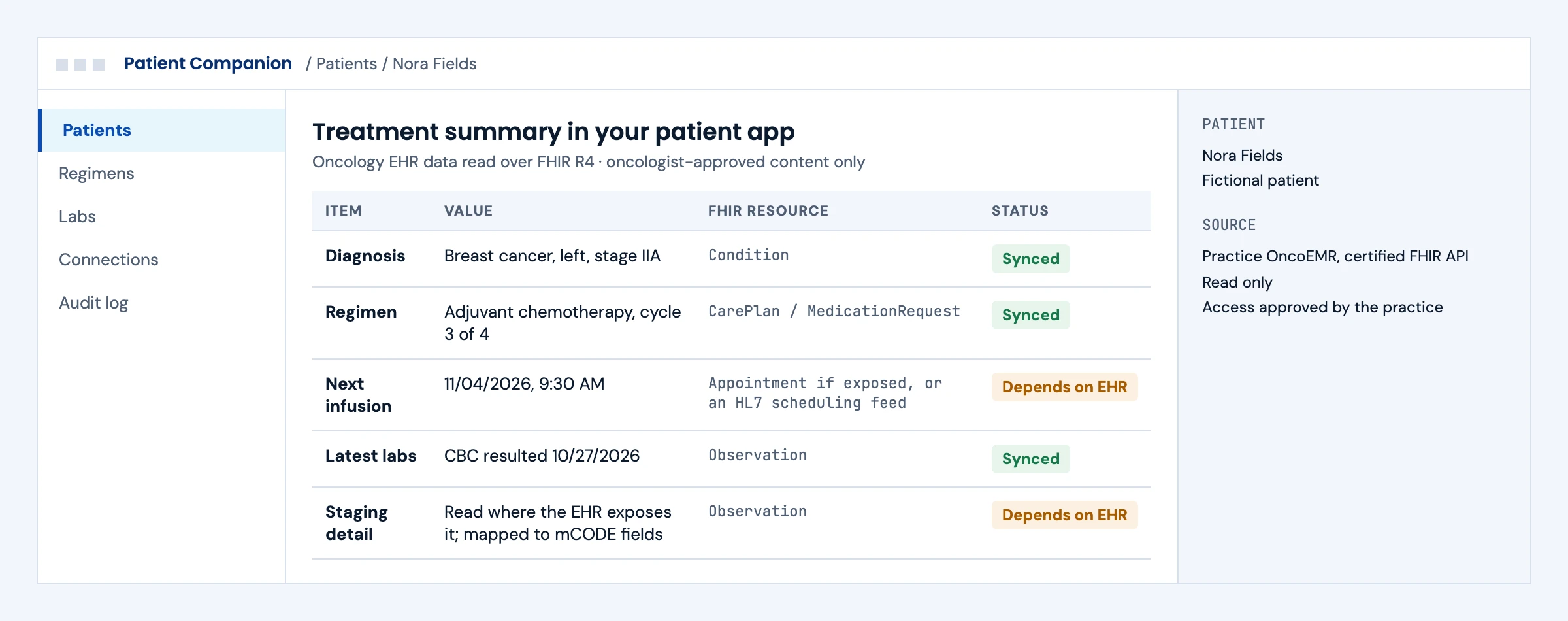
Treatment summary read over FHIR R4 from an oncology EHR: diagnosis, regimen cycle, labs, with scheduling and staging depending on the EHR
Illustrative screen with fictional patients: treatment summary read over FHIR R4 from an oncology EHR: diagnosis, regimen cycle, labs, with scheduling and staging depending on the EHR. Tap to open full size.

One Plan Across Oncology Systems

Today

Each new practice starts a fresh integration project on a different system.

With the integration

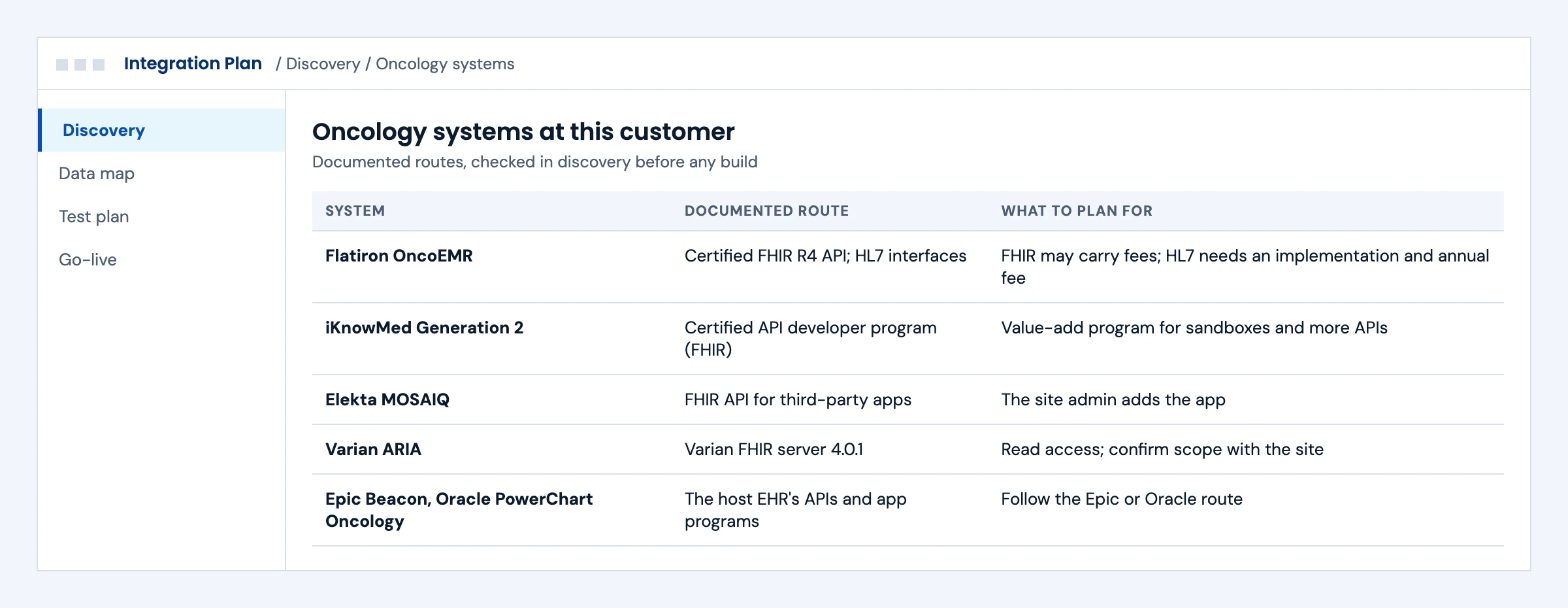
Discovery records which oncology systems each customer runs and the documented route and costs for each, so the second and third practice reuse the same model.

What we build
  • A route check per system: OncoEMR, iKnowMed, MOSAIQ, ARIA, Epic Beacon, Oracle PowerChart Oncology
  • One internal data model behind every connector
  • Vendor fees and approvals listed before build
Discovery table of oncology systems with each documented route and what to plan for, from OncoEMR to Epic Beacon
Illustrative screen with fictional patients: discovery table of oncology systems with each documented route and what to plan for, from OncoEMR to Epic Beacon. Tap to open full size.

Infusion Days Planned From the Chart

Today

Nurses check labs and dose changes for each patient by phone the morning of treatment.

With the integration

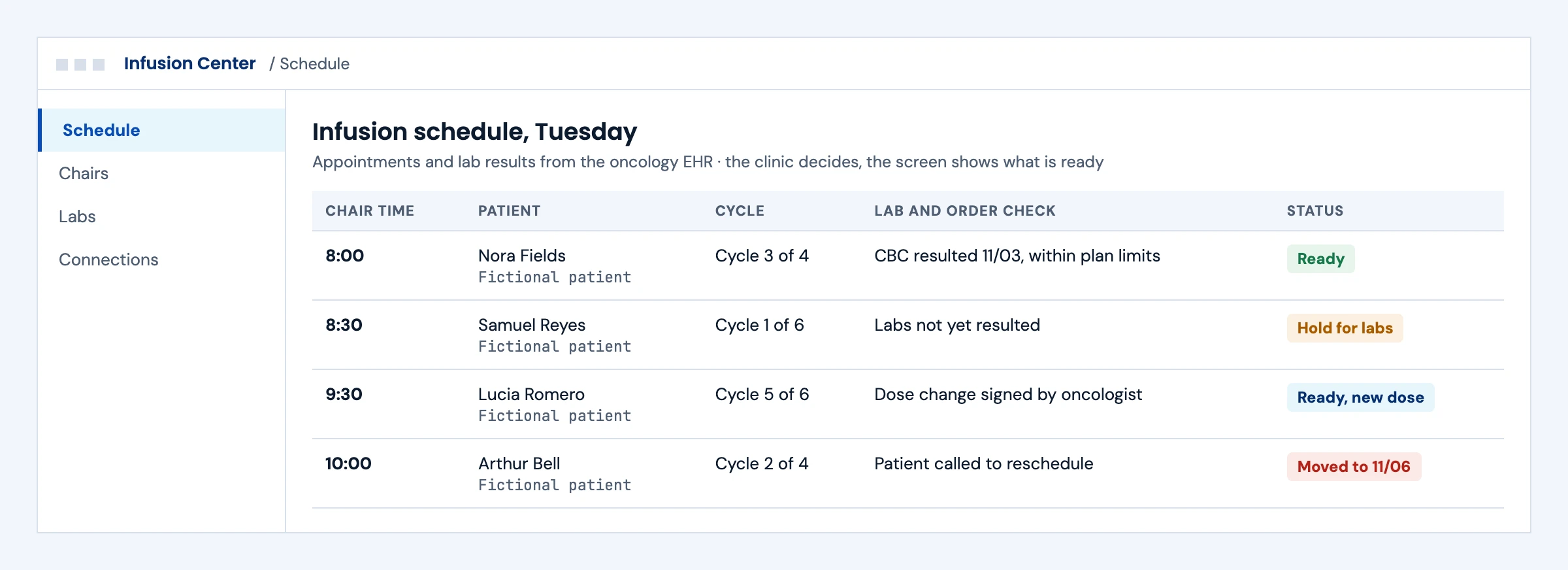
Chair times, cycles, lab results and signed dose changes appear together, so the team sees who is ready, who is waiting on labs and who moved.

What we build
  • Appointments and lab results from the EHR's interfaces
  • Signed order changes shown, never decided by the app
  • Holds the clinic defines, not the software
Infusion schedule with chair times, cycles, lab and order checks, and ready, hold and rescheduled statuses
Illustrative screen with fictional patients: infusion schedule with chair times, cycles, lab and order checks, and ready, hold and rescheduled statuses. Tap to open full size.

Symptoms Reported Between Visits Reach the Care Team

Today

Side effects reported in an app sit in a separate dashboard nobody checks.

With the integration

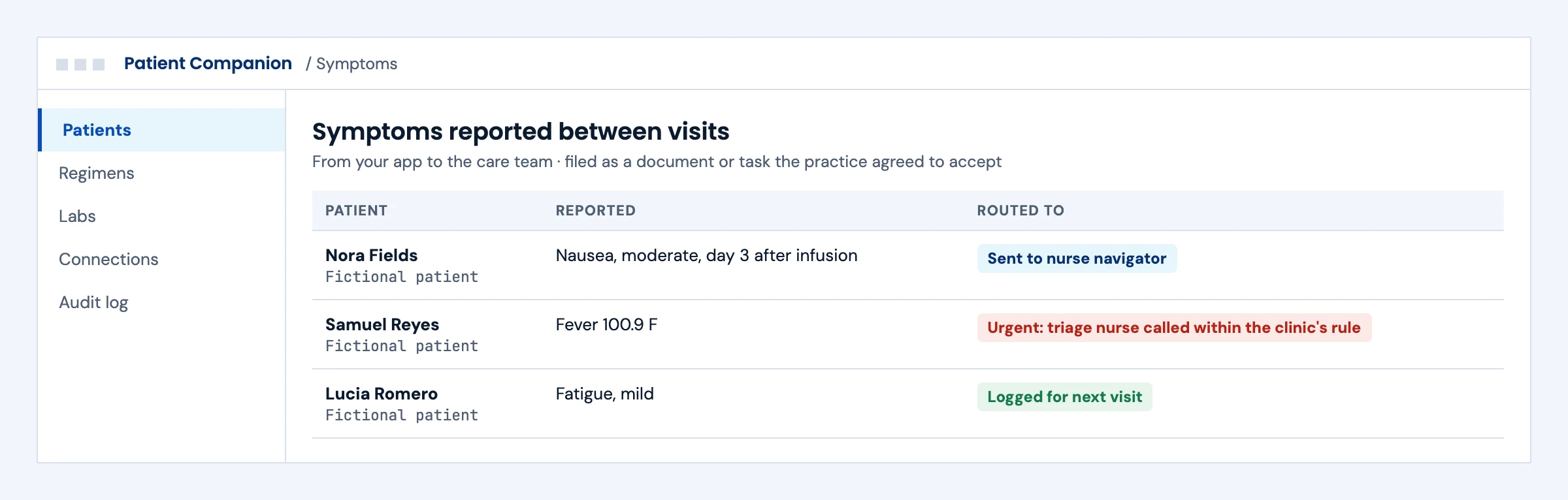
Reported symptoms are routed to the nurse navigator or triage nurse under the clinic's rules and filed in the EHR as a document or task the practice agreed to accept.

What we build
  • Routing rules the clinic writes and owns
  • Write-back only where the EHR and practice allow it
  • An audit trail of who saw each report and when
Patient-reported symptoms routed to the nurse navigator and triage nurse, with a mild report logged for the next visit
Illustrative screen with fictional patients: patient-reported symptoms routed to the nurse navigator and triage nurse, with a mild report logged for the next visit. Tap to open full size.

First call

Questions We Will Ask You on the First Call

The answers decide the route per system, the vendor fees and where your product can write back.

Which oncology EHRs do your customers run?

OncoEMR, iKnowMed, Epic Beacon, Oracle PowerChart Oncology, MOSAIQ and ARIA each have different routes.

Medical oncology, radiation oncology or both?

Radiation oncology systems such as ARIA and MOSAIQ usually sit next to the main EHR.

Which data do you need first?

Diagnosis and medications are standard; regimens, cycles and staging often need more.

Do you need to write back to the chart?

Most certified oncology APIs are read only, so write-back usually means a vendor interface or document.

Who approves the app at each practice?

Some vendors need the site administrator to add the app; others need a vendor program.

Has the practice been quoted fees for FHIR or HL7 interfaces?

Flatiron states FHIR APIs may require additional fees and HL7 interfaces carry implementation and maintenance fees.

Do you plan to use mCODE?

Mapping to mCODE early makes multi-system data comparable.

Who reviews AI or patient-facing content before it reaches patients?

In oncology, clinician review is part of the workflow, not an add-on.

The short answer

How Oncology EHR Integration Works

Oncology EHR integration connects oncology software to the systems cancer care runs on. The main community oncology EHRs publish certified FHIR APIs: Flatiron's OncoEMR is certified for the standardized API criterion on FHIR R4 with US Core 4.0.0, and Flatiron states FHIR APIs may require additional fees while HL7 interfaces carry implementation and maintenance fees. Ontada runs a certified API developer program for iKnowMed. In radiation oncology, Elekta offers a FHIR API for MOSAIQ that the site administrator approves, and Varian runs a FHIR server for ARIA. Certified APIs cover patients, problems, medications and labs well; regimens, cycles and staging often need vendor interfaces or mCODE mapping.

Who it is for
Oncology software companies, patient support and trial matching products, and community practices connecting oncology systems.
What we build
Route checks per system, FHIR connectors, HL7 interfaces where offered, mCODE mapping, patient-facing summaries with clinician review, and symptom reporting back to the care team.
The outcome we design for
One product working across the oncology systems your customers run, with vendor fees and approvals known before build. These are intended outcomes, not a promise about vendor decisions.

Routes by oncology system

Oncology EHR Routes and What They Cost to Plan

Read from each vendor's published pages on 26 October 2026. Fees and approvals are set by the vendor and the practice.

SystemDocumented routeWhat to plan forSource
Flatiron OncoEMRCertified FHIR R4 API (US Core 4.0.0); HL7 interfacesFHIR APIs may require additional fees; HL7 interfaces may need a one-time implementation fee and an annual maintenance feeFlatiron certification page
iKnowMed Generation 2 (Ontada)Certified API developer program on FHIR; a value-add program with sandboxes and more APIsConfirm current endpoints and certification edition with OntadaOntada developer program
Elekta MOSAIQFHIR API for third-party appsThe MOSAIQ site administrator adds the app; confirm data scope with ElektaElekta FHIR page
Varian ARIAVarian FHIR server (FHIR 4.0.1) with documentationRead access; confirm scope and approval with the site and VarianVarian FHIR portal
Epic BeaconEpic's APIs and app programsFollow the Epic route; oncology detail depends on the site's buildOur Epic integration page
Oracle PowerChart OncologyOracle Health's APIs and app programsFollow the Oracle Health routeOur Oracle Health integration page

NCCN chemotherapy order templates are integrated in several of these EHRs under NCCN licensing, which affects how regimens are represented. We read each site's build before mapping regimens.

What we build

What Our Oncology EHR Integration Builds

Pick the workstreams your product needs. Each one ships with a specification, test runs and an owner.

01

Route Check per System

The oncology and radiation oncology systems at each customer, the documented route, fees and approvals, written down before build.

OncoEMR · iKnowMed · MOSAIQ · ARIA · Epic Beacon

02

Certified FHIR Connectors

Patients, conditions, medications, labs and documents read through each system's certified FHIR API, approved by the practice.

FHIR R4 · US Core · SMART on FHIR

SMART on FHIR app development →
03

HL7 Interfaces Where Offered

Scheduling, results and orders over the vendor's HL7 interfaces where FHIR stops, with the vendor's fees listed up front.

HL7 v2 · SIU · ORU · ORM

HL7 integration services →
04

Oncology Data Model and mCODE

One internal model for diagnoses, regimens, cycles and staging, mapped to mCODE fields so data from different systems compares.

mCODE · CarePlan · MedicationRequest

FHIR integration services →
05

Patient-Facing Summaries With Review

Treatment summaries and education that reach patients only after clinician review, with the source of every item shown.

Review queue · source labels

06

Symptoms Back to the Care Team

Patient-reported symptoms routed under the clinic's rules and filed as a document or task the practice agreed to accept.

Routing rules · documents · tasks

Integration monitoring and support →

Buyer decisions

Oncology Integration Options Compared

Start with the certified API; add vendor interfaces where oncology detail needs them.

OptionBest fitStrengthsWhat to plan for
Certified FHIR APIPatient apps, trial matching, analytics on core clinical dataStandard resources, practice approvalRead only in most cases; oncology detail may be thin; possible fees
Vendor HL7 interfacesScheduling, results and ordersMature and widely usedImplementation and maintenance fees; vendor scheduling
Host EHR programs (Epic, Oracle Health)Health system oncology on Beacon or PowerChart OncologyThe host EHR's full app ecosystemThe host EHR's approval process
Exports and registriesResearch and quality reportingNo real-time buildDelay and manual steps
Login-based automationWorkflows no documented route coversWorks where routes stopVendor terms, written authorization and strict controls

We say so when an oncology system's documented routes cannot do what you need.

Integration boundaries

Oncology Integration Boundaries: Who Owns What

We write the split down before the build starts.

The practice

Approves the app, pays any vendor interface fees and decides what reaches patients.

The EHR vendor

Owns its APIs, interfaces, fees and approvals. We build to the published routes.

Clinicians

Review treatment content before patients see it and own every clinical decision.

The integration layer (ours)

Connectors, mapping, review queues, redacted operational logs and alerts. Defects in this layer are ours to fix.

Security and PHI

A BAA is available for agreed work involving PHI. We encrypt in transit and at rest and keep raw payloads out of operational logs.

Deliverables

Oncology EHR Integration Deliverables

Everything lands in your repository and your runbook.

01

Route check per system

Documented route, fees and approvals for each oncology system your customers run.

02

Integration code in your repository

FHIR and HL7 connectors and the oncology data model, with site configuration kept out of the code.

03

mCODE mapping

How each system's data maps to mCODE fields, with gaps listed.

04

Test evidence

Recorded runs against vendor sandboxes or test sites, covering missing data and permission errors.

05

Monitoring and runbook

Feed alerts, redacted operational logs and a support runbook.

Delivery phases

Oncology EHR Integration Timeline

Initial planning estimate: 8 to 12 weeks to a first live practice on one oncology system, subject to vendor access, any interface fees and validation. Discovery confirms the systems and routes before you commit to a release date.

  1. 01

    Discovery and access

    Weeks 1 to 2

    Systems mapped per customer, app registration and interface requests started

  2. 02

    Build

    Weeks 2 to 7

    Connectors, data model and review flows built and tested

  3. 03

    Practice validation

    Weeks 6 to 10

    First practice connected, data checked with clinicians

  4. 04

    Go-live and hypercare

    Weeks 9 to 12

    First practice live, monitoring on, next systems scheduled

Cost drivers

What Drives Oncology EHR Integration Cost

Use the scoping call to pin down the workflow, the access you need and what goes into a scoped proposal. These are the factors that move cost.

Systems covered

Each oncology or radiation oncology system adds its own connector and approvals.

Vendor fees

FHIR access and HL7 interfaces can carry vendor fees, paid by the practice or vendor.

Oncology detail

Regimens, cycles and staging need more mapping than core clinical data.

Write-back

Filing documents or tasks back to the chart adds vendor work and review.

Patient-facing content

Clinician review queues and source labels add design and testing.

Support level

Monitoring and on-call support are priced per connection.

Book a call ↗

Proof

Oncology and Multi-EHR Work You Can Check

Client names are withheld. The case study is published on our site; the guides show how we approach multi-EHR integration. None of them proves access to a specific oncology vendor.

Published case study

Oncology Treatment Platform Across Several EHRs

A platform for a US oncology company that reads patient data from several EHRs over FHIR R4 into one clinical record, with oncologists reviewing treatment plans before they reach patients.

Read the case study →

Published engineering guide

Multi-EHR API Comparison

How major EHRs expose their APIs, and what that means for a product that must serve several of them.

Read the guide →

Published engineering guide

HL7 Document Messages

How HL7 MDM messages carry documents into EHRs when FHIR write-back is not available.

Read the guide →

Security

ISO 27001:2022 Certified, BAAs Signed

We are ISO 27001:2022 certified and sign Business Associate Agreements for work that touches patient data.

FAQ

Oncology EHR Integration: Questions Buyers Ask

Does OncoEMR have an API?

Yes. Flatiron's OncoEMR is certified for the standardized API criterion on FHIR R4 with US Core 4.0.0, and Flatiron links its API documentation from its certification page. Flatiron states FHIR APIs may require additional fees, and HL7 interfaces can carry implementation and annual maintenance fees.

Does iKnowMed have an API?

Ontada describes a self-served certified API developer program for iKnowMed Generation 2 on FHIR, plus a value-add program with sandboxes and additional APIs. We confirm current endpoints and terms with Ontada during discovery.

Does MOSAIQ have a FHIR API?

Yes. Elekta offers a FHIR API for MOSAIQ that third-party developers can build on, and the MOSAIQ site administrator adds the application. We confirm the data scope with Elekta and the site.

Does ARIA have a FHIR API?

Varian runs a FHIR server for ARIA, on FHIR 4.0.1, with published documentation. We confirm the resources available and the approval steps with the site and Varian.

Can certified oncology APIs return regimens and staging?

Core clinical data such as conditions, medications and labs is standard. Regimens, cycles and staging depend on each system's build and may need vendor interfaces or mapping to mCODE.

What is mCODE and should we use it?

mCODE is a FHIR implementation guide for core oncology data such as cancer conditions, staging and treatments. Mapping to it early makes data from different oncology systems comparable.

Can we write back to the oncology EHR?

Most certified APIs are read only. Write-back usually means a vendor HL7 interface or a document the practice agrees to accept, with the vendor's fees and approval.

How do you handle Epic Beacon and Oracle PowerChart Oncology?

These are oncology modules of Epic and Oracle Health, so integration follows the host EHR's APIs and app programs. Our Epic and Oracle Health pages cover those routes.

How do you keep patient-facing content safe?

Treatment summaries and education reach patients only after clinician review, every item shows its source, and the clinic owns the rules for routing reported symptoms.

How long does an oncology EHR integration take?

Our initial planning estimate is 8 to 12 weeks to a first live practice on one oncology system, subject to vendor access, interface fees and validation.

How much does oncology EHR integration cost?

Cost depends on the systems covered, vendor fees, the oncology detail you need, any write-back, patient-facing review and the support level. A BAA is available under our ISO 27001:2022 certified management system. After a scoping call we send a scoped proposal with the access dependencies listed.

Next step

Plan Your Oncology EHR Integration

Tell us which oncology systems your customers run and the data your product needs. An engineer replies with the route per system, the likely vendor fees and the open access questions.

Start with your workflow

Tell Us About Your Oncology Integration

Share the oncology systems, the data you need and your target date. Use de-identified examples only. Read by an engineer, answered within one business day.

Please exclude patient data and credentials. We use these details to respond to your inquiry. Privacy policy

Thank you. Your inquiry has been received. Our team will review your requirements.