eFax Integration for Healthcare: Testing, Formats, HIPAA, Cost and Timeline (2026)

Nirmitee.io Engineering
Author
A healthcare fax integration lets your EHR or app send and receive faxes through an API, with no fax machine on your side. This guide answers the questions buyers and developers ask most, using the vendors' own documents and one peer-reviewed study, and says plainly where no reliable number exists.
Healthcare fax integration facts at a glance (2026)
| Question | Short answer |
|---|---|
| Fax machine or phone line needed? | No. You send a PDF to a fax API, and the provider makes the call. |
| HIPAA | Allowed with safeguards. A BAA with the provider is required. |
| Delivery guaranteed? | No. One study: 37.7% failed without retries, 9.9% with retries. |
| File format | PDF. Black and white, text at 10 point or larger. |
| Testing | Four layers: test mode, simulated failures, loopback, a real machine. |
| Status updates | Webhooks, with polling as a backup. |
| Go-live | New number: often the same day. Ported number: about 2 to 4 weeks (vendor estimates). |
| Cost | From $0.007 to about $0.05 per page on API plans; enterprise vendors quote. |
| Hardest part | Inbound: matching each fax to the right patient and filing it in the EHR. |
| Build or buy | Buy the transport, build the workflow. |
Our experience with fax integration
Nirmitee has built a production fax integration on the Documo API for a US healthcare client. These are the rules we now apply on every fax build:
- Store the provider's fax ID against the patient and the document before anything else, so every status update has a home.
- Treat webhooks as unreliable. Apply each event once, and run a nightly check for faxes stuck "in progress".
- Decide the retry rule per failure reason. Retry a busy line, never a wrong number.
- Sign the BAA before any test data contains real patient information.
- Test on a real fax machine before go-live, because test mode cannot show whether a page is readable.
The guidance below combines that build with each vendor's own documents and the published research, and says where no reliable number exists.
Do you need a fax machine or a phone line?
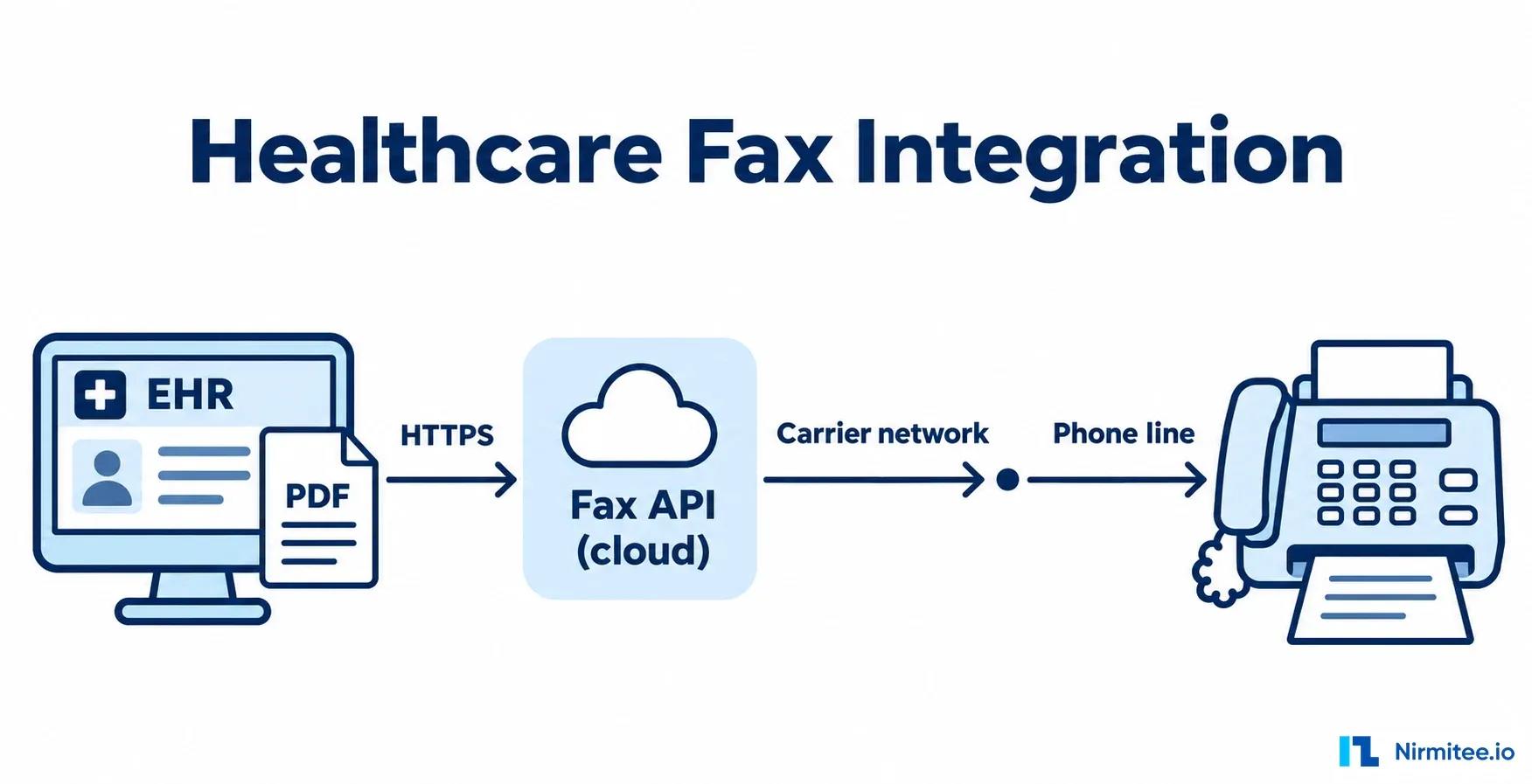
No. Your system sends a PDF over HTTPS to a cloud fax provider, and the provider turns it into fax pages and places the call over its carrier network. The person on the other side can still use an ordinary fax machine.
Between internet networks, a fax travels either as T.38 (a protocol built to carry fax over the internet) or as G.711 (plain voice audio). The last step to an office fax machine is the ordinary phone network. Telnyx, for example, documents both methods and lets you turn T.38 off for a single fax (Telnyx send fax docs).
This is also why faxes fail more often than emails. Compressed voice calls often damage fax tones (Cisco technote). T.38 must also work on every hop of the call. Most "how cloud fax works" pages leave this out.
You get a fax number in one of two ways. You buy a new number from the provider, or you port (move) the number you already have.
Is fax HIPAA compliant?
Fax is allowed under HIPAA, but no fax product is "HIPAA compliant" by itself. HHS lets providers fax patient information for treatment if they have reasonable administrative, technical and physical safeguards. Pre-programming the numbers you use often is one example (HHS FAQs 356 and 482).
Compliance belongs to your whole setup. Three gaps are often missed:
- The phone call itself is not encrypted. When a vendor says "encrypted", that covers its storage and your API connection. It does not cover the call to the receiving machine.
- Fax to email moves patient data into a mailbox. That mailbox may sit outside your fax provider's BAA.
- A cover sheet notice does not prevent a breach. It only asks the wrong recipient to destroy the fax.
Our HIPAA development checklist covers the rest of the setup.
Do you need a BAA with the fax provider?
Yes. A fax provider that sends or stores patient information for you is a business associate, so you need a signed BAA (HHS business associate guidance). Ask three questions before signing:
- Does the BAA cover the API product and stored inbound faxes, or only the web portal?
- Which plan includes the BAA? Fax.Plus requires its Enterprise plan (Fax.Plus).
- Can you turn off fax storage or set a retention period? Phaxio tells customers to turn off storage where it is not needed and to secure webhooks (Phaxio HIPAA page).
Sign the BAA before any test data contains real patient information.
Is fax delivery guaranteed?
No. A "delivered" status means the receiving fax machine finished the handshake and confirmed the pages. It does not prove that the right person saw them.
The only measured failure rate we found comes from a peer-reviewed study of one Canadian referral workflow (Tian et al., JMIR Medical Informatics, 2025):
| Setup | Faxes | Failed | Failure rate |
|---|---|---|---|
| Without automatic retries | 2,712 | 1,023 | 37.7% |
| With new retry logic (from March 2023) | 3,082 | 304 | 9.9% |
This is one workflow in one country, not an industry rate. Some vendor blogs quote the 37.7% as a general failure rate, but it is the rate without retries. Vendor delivery rates such as "99.8%" are marketing figures that do not say how "delivered" is defined. The carrier Bandwidth states that there is "no SLA or guarantee" on fax performance over the internet (Bandwidth T.38 guide).
Retries also carry a risk. If the first attempt printed but reported a failure, a retry can send a prescription or order twice. Your system should flag repeated sends of the same document.
Why do faxes fail?
Most failures come from the phone side, not your code. The common reasons are a busy line, no answer, ring timeout, a person answering instead of a machine, an incompatible receiver, and the line dropping during the call.
Providers report these as error codes. Sinch lists 17 busy, 30 no answer, 16 ring timeout, 15 congestion and 11 call dropped (Sinch error list). Sinch notes that this scheme applies to faxes created before 26 Oct 2026, so check the current list. Telnyx uses named reasons such as receiver_incompatible_destination (Telnyx error list).
Plan your retry rules per reason. Retry busy and no-answer calls. Do not retry a wrong number. For receivers that keep failing, Bandwidth suggests a lower speed and turning error correction mode off.
What file formats work, and what are the limits?
Send PDF. It is the one format every fax API we checked accepts. Telnyx accepts PDF only and rejects files over 50 MB or 350 pages. Inbound faxes usually arrive as PDF, and some providers also offer TIFF.
Fax pages are low resolution, so small text breaks first:
- Render text at 10 point or larger.
- Use black and white, not grey scans or color.
- Test scanned signatures and handwritten forms on a real machine before go-live.
Standard fax resolution is about 204 by 98 dots per inch, and "fine" mode is about 204 by 196 (ITU-T T.4).
How do you test a fax integration?
Test in four layers, because each layer catches different problems.
- Provider test mode. This proves your code calls the API correctly, at no cost. Phaxio (now Sinch) has test API keys and a parameter that simulates chosen failures. Documo has a separate sandbox that sends no real faxes.
- Simulated failures. This proves your retry and alert logic. Some providers publish test numbers that always return busy or no answer. For example, the InterFAX simulator number +999-9999-6017 returns busy (InterFAX simulator). RingCentral's sandbox cannot simulate busy or no answer.
- Loopback. This proves your inbound webhook and filing. Buy two numbers and fax from one to the other.
- A real fax machine. This proves the page is readable. Send your real documents to a physical machine: 20-plus page records, small fonts and signatures.
Also test the missed-webhook path. Turn your webhook endpoint off, send a fax, and check that a polling job still finds the result.
Webhooks or polling for fax status?
Use both. Webhooks give you the result within seconds, and polling catches the webhooks you miss. Telnyx sends a delivered or failed event with the page count (Telnyx callbacks). Concord's guide recommends polling as a backup to push notices.
Make your webhook handler safe to run twice, because providers retry callbacks. Run a nightly check for faxes stuck "in progress" and raise an alert for each one.
Code pattern: send a fax and handle the status webhook
The pattern is the same on every fax API: send, store the provider's fax ID, then update your record from the webhook. This sketch is vendor neutral; field names differ by provider, so map them from your provider's docs.
// Send: store the provider fax ID against the patient and document
async function sendFax(doc, toNumber) {
  const job = await db.faxJobs.insert({ docId: doc.id, patientId: doc.patientId,
    to: toNumber, status: "queued", attempts: 0 });
  const res = await faxProvider.send({ to: toNumber, file: doc.pdf,
    callbackUrl: WEBHOOK_URL, clientRef: job.id });
  await db.faxJobs.update(job.id, { providerId: res.id, status: "sending" });
}

// Webhook: verify the signature, then apply each event once
async function onFaxWebhook(req) {
  if (!verifySignature(req)) return 401;
  const e = req.body;
  if (await db.webhookEvents.exists(e.eventId)) return 200; // already applied
  await db.webhookEvents.insert(e.eventId);
  const job = await db.faxJobs.findByProviderId(e.faxId);
  if (e.status === "delivered") await db.faxJobs.update(job.id, { status: "delivered", pages: e.pages });
  else if (RETRYABLE.has(e.reason) && job.attempts < 3) await scheduleRetry(job, e.reason);
  else await openTask(job, e.reason); // a person decides
  return 200;
}

// Nightly: catch missed webhooks
async function reconcile() {
  for (const job of await db.faxJobs.stuck({ olderThanMinutes: 60 }))
    await db.faxJobs.update(job.id, await faxProvider.getStatus(job.providerId));
}
RETRYABLE holds busy, no answer and ring timeout. A wrong number or an incompatible receiver goes to a person, never to an automatic retry.
How do you connect fax to your EHR?
Outbound is simple. The EHR creates a PDF, such as a referral, an order or a records release. Your service sends it through the fax API and stores the fax ID against the patient and the visit.
Inbound is where the cost is. Each fax must be read, matched to the right patient, labelled by document type, and filed:
- The webhook delivers the PDF and the sender's number.
- OCR (text recognition) reads the pages, and a classifier labels each one: referral, lab result, records request or prior auth reply.
- Matching finds the patient by name, date of birth and other details. A fax with no confident match goes to a person, never to a best guess.
- Splitting separates a 50-page fax that covers several patients.
- Filing writes the document to the EHR, for example as a FHIR DocumentReference or an HL7 v2 MDM message.
Decide early who owns a fax that cannot be matched, and how fast it must be handled. Our EHR integration team builds this inbound flow.
How long does it take to go live?
No published source gives an end-to-end timeline, so treat these as estimates. On self-serve fax APIs, you can usually have a new number working the same day. Porting an existing number takes longer:
- Dropbox Fax says porting averages two weeks.
- mfax estimates 7 to 15 business days for local numbers and 10 to 20 for toll-free.
- Toll-free numbers go through a separate process (Telnyx).
With enterprise vendors, the BAA is usually the slowest step, but no source measures it. Keep the old number receiving until the port finishes. Afterwards, update your number with payers, pharmacies and referral partners.
What does a fax API cost?
Per-page prices are low and easy to compare. Prices were read on 28 Nov 2026; check the vendor's page before you buy.
| Provider | Listed price | Note |
|---|---|---|
| Telnyx | $0.007 per page | Number billed separately |
| Sinch (Phaxio) | $0.045 per page | One comparison site lists $0.07 |
| Documo Solo | $25 per month (billed yearly), 300 pages | $0.15 per extra page |
| eFax Corporate | Quote only | HIPAA on higher tiers |
The bigger cost is the staff time to sort inbound faxes, and no independent study measures it. Estimate it from your own volume before choosing a vendor.
Healthcare fax integration vendors (2026)
Nineteen vendors cover most healthcare fax integrations. They fall into four groups: pure fax APIs (Sinch, Telnyx, Notifyre, iFax), fax products with an API (Documo, WestFax, Fax.Plus, SRFax, eFax Corporate), interop platforms that include fax (Concord, Kno2, Consensus, Updox), and fax servers (RightFax).
Each cell comes from the vendor's own site, read on 28 Nov 2026, unless it says "third party". "Not found" means we did not find it on the vendor's site, not that the feature is missing.
| Vendor | Owner | Type | Public API | Webhooks | BAA | Listed price |
|---|---|---|---|---|---|---|
| eFax Corporate | Consensus Cloud Solutions | Cloud fax + enterprise API | REST, by quote | Not found | Yes | Quote only |
| Consensus (Clarity, Unite, Harmony) | Consensus Cloud Solutions | Interop platform | Harmony API, no public docs | Not found | Not found | Not found |
| Sfax | Scrypt | Cloud fax portal | Per third party, on higher plans | Not found | Per third party, higher plans | Third party: $37 to $125 per month |
| Documo (mFax) | Not found | Cloud fax API + portal | Yes, REST | Yes | Yes, every plan | From $25 per month |
| Concord Technologies | Not found | Cloud fax + interop and document AI | Yes, login required | Not found | Not found | Quote only |
| WestFax | Not found | Cloud fax portal + API | Enterprise only | Yes, Enterprise | Yes, every plan | From $14.99 per month |
| OpenText RightFax | OpenText | Fax server and cloud | Not found | Not found | Not found | Quote only |
| Sinch Fax (Phaxio) | Sinch | Cloud fax API | Yes | Yes | Yes, free to sign | $0.045 per page |
| Telnyx Programmable Fax | Telnyx | Cloud fax API | Yes | Yes, fax events | Only above commercial thresholds | $0.007 per page plus usage |
| Fax.Plus | Not found | Cloud fax portal + API | Enterprise only | Yes, signed | Enterprise only | Enterprise from $79.99 per month |
| SRFax | Not found | Cloud fax portal + API | Yes | No push found; you fetch | Yes, on request | From $12.60 per month |
| Upland InterFAX | Upland Software | Cloud fax API + portal | Yes, docs not found | Not found | Yes, on request | Not found |
| RingCentral Fax | RingCentral | Fax add-on to phone system | Not found | Not found | Yes, on request | From $22.99 per user per month |
| iFax | Not found | Cloud fax portal + API | Yes | Yes, 16 retries | Yes, free for API customers | From $12.49 per month |
| Dropbox Fax | Dropbox | Cloud fax portal + API | Yes, via support | Not found | Not found | $0.05 per page, $100 monthly minimum |
| Kno2 | Not found | Interop platform (fax, Direct, FHIR) | Yes, partners only | Not found | Not found | Quote only |
| Updox | EverCommerce | Practice communication portal | Partner program only | Not found | Not found | Quote only |
| Notifyre | Not found | Cloud fax API + portal | Yes | Yes, signed | Yes | $0.03 per page |
| Medsender | Not found | Healthcare fax API with OCR | Yes, docs not public | Yes, incl. OCR events | Yes | Quote only |
Which fax provider should you choose?
Choose on these five points, not on the per-page price:
- An inbound API with webhooks
- A BAA that covers the API
- Retention controls
- Clear failure reasons
- A real test mode
We asked ChatGPT, Perplexity and Gemini the same question on 28 Nov 2026. ChatGPT put Phaxio (Sinch) first, Perplexity put Documo first, and Gemini listed Phaxio, Telnyx, Fax.Plus, SRFax and Documo. None gave a measured failure rate. None covered inbound patient matching or porting time.
What users complain about, from review sites (small samples, not healthcare-only):
- eFax Corporate: 213 BBB complaints in 3 years. Reviewers mention slow enterprise support and faxes that recipients said never arrived.
- WestFax: rated 4.8 on G2 from 31 reviews. The complaints are hard setup and a dated interface.
- Documo: about 4.6 on G2 from about 190 reviews. Healthcare is its largest reviewer industry.
Avoid Twilio Fax tutorials. Twilio shut down Programmable Fax for all accounts on 17 Dec 2021 (Twilio support), but old guides still rank.
Should you build or buy your fax integration?
Buy the fax transport and build the workflow around it. Almost no healthcare team should run its own fax lines, but the part that saves staff time, inbound matching and EHR filing, is specific to your systems and is rarely solved off the shelf.
| Option | What you get | Fits when | Watch out for |
|---|---|---|---|
| Buy a fax portal with an EHR connector | A ready product. Staff still sort and file faxes by hand or in the vendor's screen. | Low volume, one EHR the vendor already supports, no developers. | Manual filing time grows with volume. The connector covers only what the vendor built. |
| Buy a fax API, build the workflow | The provider handles calls and carriers. You build sending, retries, matching, splitting and filing. | Your own app or product, several EHRs, or high inbound volume. | You own retry logic, missed webhooks and the queue for faxes that cannot be matched. |
| Build your own fax server | Your own fax software and phone (SIP) trunks. | Rarely. Usually only large systems that already run a fax server such as RightFax. | T.38 and carrier problems become yours. Most teams are moving away from this. |
| Buy a document AI add-on | OCR, classification and sometimes patient matching on inbound faxes. | High inbound volume where sorting is the main cost. | Check its accuracy on your own faxes, and keep a person on low-confidence matches. |
To decide, count three things from one normal month: faxes in, faxes out, and staff hours spent sorting and filing inbound faxes. If sorting hours are high, the workflow is where the money is, whichever transport you choose. This guide does not give a cost per option, because no independent source measures one. Your own counts are the honest basis.
Not sure which option fits? Talk to our team about a short review of your fax volume and sorting time, and we will recommend build, buy or a mix.
Is the government getting rid of fax?
Not on current evidence. The CMS Health Tech Ecosystem, launched on 30 July 2025, is voluntary (CMS interoperability framework). Nothing in it sets a date after which fax stops being accepted. Plan to keep fax as a fallback alongside FHIR and Direct messaging for years.
What should you do if a fax goes to the wrong number?
Treat it as a possible breach and assess it. The ADA notes that a misdirected fax may be a breach of unsecured patient information under the Breach Notification Rule, and state law may add duties (ADA guidance). The four-factor risk assessment in 45 CFR 164.402 decides whether you must notify. Prevent it with saved numbers, a check of the recipient before sending, and an alert when a new number is used.
Healthcare fax integration checklist
- BAA signed, covering the API and stored inbound faxes, before any real patient data.
- Fax storage turned off or a retention period set at the provider.
- Webhook signatures checked, and each event applied only once.
- Retry rules set per failure reason, with a duplicate-send flag.
- Nightly job for faxes stuck "in progress".
- All four test layers passed, including a real fax machine.
- Inbound: OCR, classification, patient matching, splitting and filing, with a queue for faxes that cannot be matched.
- An owner and a time limit for unmatched faxes.
- Saved numbers and a new-number alert to prevent misdirected faxes.
- Old number kept receiving until the port finishes, and directories updated.
Need fax built into your EHR or app, with inbound matching and filing done properly? See our healthcare interoperability services, or talk to our team.
Ready to scale?
Talk to our healthcare engineering team about building, integrating, and shipping faster.
Frequently Asked Questions
Do I need a fax machine to use a fax API?
Is cloud fax HIPAA compliant?
How do I test a fax API without sending real faxes?
How long does porting a fax number take?
What file format should I send?
Is Twilio Fax still available?