PointClickCare Marketplace: How to Become a Partner (2026)

CTO & Co-Founder
CTO & Co-Founder at Nirmitee.io. Architects healthcare integrations across FHIR, SMART on FHIR, ABDM and NHCX, writing from production experience taking hospital software from sandbox to go-live.
The PointClickCare Marketplace is where skilled nursing and senior living operators look for software that already works with their EHR. If you sell to those operators, a listing puts your product in that directory and gives you partner APIs that the public FHIR API does not have. This guide is for vendors. It covers what kinds of products get listed, the path from the first form to a live facility, and what PointClickCare does not publish.
Every PointClickCare fact here comes from PointClickCare's own pages or agreements, read on November 13, 2026, with the link beside it. For API detail (endpoints, auth, sandbox, the $65 USCDI Connector fee), see our PointClickCare API integration guide. If you want a team to build it, see our PointClickCare integration services.
What the PointClickCare Marketplace is
The PointClickCare Marketplace is PointClickCare's directory of third-party software and service partners whose products connect to its EHR for long-term and post-acute care and senior living. Operators use it to find integrated products. Vendors join through the Marketplace partner program.
A listing tells operators that your app passed PointClickCare's App Validation. It does not guarantee sales or enable any facility: each customer still chooses you and signs a Letter of Authorization.
PointClickCare launched the Marketplace on October 8, 2018 for long-term and post-acute care and senior living (press release). Its Developer Program had started that March. Today the product page reports 375+ connected partners, 20+ integration categories and 14,000+ facilities with integrations, and calls the connections "validated API-based" (product page). PointClickCare's 2024 solution sheet says Marketplace partners "have been reviewed by PointClickCare" (solution sheet).
The Marketplace site has three parts:
- Integrated Solutions: software listings by category, such as claims management, medical devices, and resident and family engagement. Each listing is filtered by markets served (United States, Canada) and target market (skilled nursing, assisted living, independent living, memory care) (claims page).
- Network Partners: HIEs, lab and imaging providers and pharmacies, each with a partner tier (Network Partners).
- Business Partners: firms that offer consulting, setup and support to PointClickCare customers.
Why vendors list on the Marketplace: use cases
Vendors list on the PointClickCare Marketplace to reach skilled nursing and senior living operators where they already look for connected software. A listing also brings partner APIs for writing data back, webhooks and sign-in with PointClickCare. Typical products are claims tools, device feeds, family engagement, clinical notes, lab and imaging, and pharmacy.
Business value below is the usual goal for each kind of product, not a measured result. Typical build estimate: build time only, after you have partner API access. It excludes PointClickCare's App Validation and each facility's enablement.
1. Claims and revenue cycle
| Business value | Cleaner claims and faster payment for the facility's business office, with less re-keying of census and billing data. |
|---|---|
| Domain | Billing and claims |
| Complexity | Medium |
| What works today | Claims management is a named Marketplace category. Its listings describe pulling census, therapy and billing data from PointClickCare. (source) |
| What is limited | Which billing and census fields the partner APIs expose is documented only behind the partner login. |
| Typical build estimate | 2 to 4 weeks |
2. Medical devices
| Business value | Readings reach the resident record without nurses typing them, so fewer transcription errors. |
|---|---|
| Domain | Vitals and device data |
| Complexity | Medium |
| What works today | Medical devices is a named Marketplace category, described as cutting manual data entry. (source) |
| What is limited | Write paths and data formats for device readings are not public. |
| Typical build estimate | 2 to 4 weeks |
3. Resident and family engagement
| Business value | Families get updates without phone calls to the nurses' station. |
|---|---|
| Domain | Communication |
| Complexity | Low |
| What works today | Resident and family engagement is a named Marketplace category. (source) |
| What is limited | Which resident and contact data you may read, and under which use case, is set in your agreement. |
| Typical build estimate | 1 to 2 weeks |
4. Clinical notes from outside providers
| Business value | Visiting physicians' notes land in the resident chart, so staff stop scanning paper. |
|---|---|
| Domain | Clinical documentation |
| Complexity | Medium |
| What works today | Writing into PointClickCare is a partner-program feature. eClinicalWorks announced in March 2025 a Marketplace integration that sends completed progress notes into PointClickCare. (source) |
| What is limited | Note types, size limits and error handling are in the partner documentation only. |
| Typical build estimate | 2 to 4 weeks |
5. Lab and imaging orders and results
| Business value | Orders go out and results come back into the chart without fax. |
|---|---|
| Domain | Diagnostics |
| Complexity | High |
| What works today | Lab and Imaging is a Network Partners category, with subcategories for lab orders, lab results, imaging orders and imaging results. Listings carry a partner tier: Exchange or Premier Exchange. (source) |
| What is limited | PointClickCare does not publish what each tier requires or costs, or the message formats. |
| Typical build estimate | 4 to 6 weeks, after PointClickCare confirms formats and onboarding |
6. Pharmacy
| Business value | Orders and dispensing data stay in step between the pharmacy and the facility. |
|---|---|
| Domain | Medication management |
| Complexity | High |
| What works today | Pharmacy is a Network Partners category with its own tier, Pharmacy Integrated. Pharmacies sign a separate Pharmacy Partner Agreement whose offerings each have their own certification and onboarding. (source) |
| What is limited | Pharmacy fees sit in order forms, not in the public agreement. |
| Typical build estimate | 4 to 6 weeks, after pharmacy partner onboarding |
The six use cases compared
| Use case | Domain | Complexity | Main limit | Typical build estimate |
|---|---|---|---|---|
| Claims and revenue cycle | Billing and claims | Medium | Which billing and census fields the partner APIs expose is documented only behind the partner login. | 2 to 4 weeks |
| Medical devices | Vitals and device data | Medium | Write paths and data formats for device readings are not public. | 2 to 4 weeks |
| Resident and family engagement | Communication | Low | Which resident and contact data you may read, and under which use case, is set in your agreement. | 1 to 2 weeks |
| Clinical notes from outside providers | Clinical documentation | Medium | Note types, size limits and error handling are in the partner documentation only. | 2 to 4 weeks |
| Lab and imaging orders and results | Diagnostics | High | PointClickCare does not publish what each tier requires or costs, or the message formats. | 4 to 6 weeks, after PointClickCare confirms formats and onboarding |
| Pharmacy | Medication management | High | Pharmacy fees sit in order forms, not in the public agreement. | 4 to 6 weeks, after pharmacy partner onboarding |
Marketplace partner or USCDI Connector
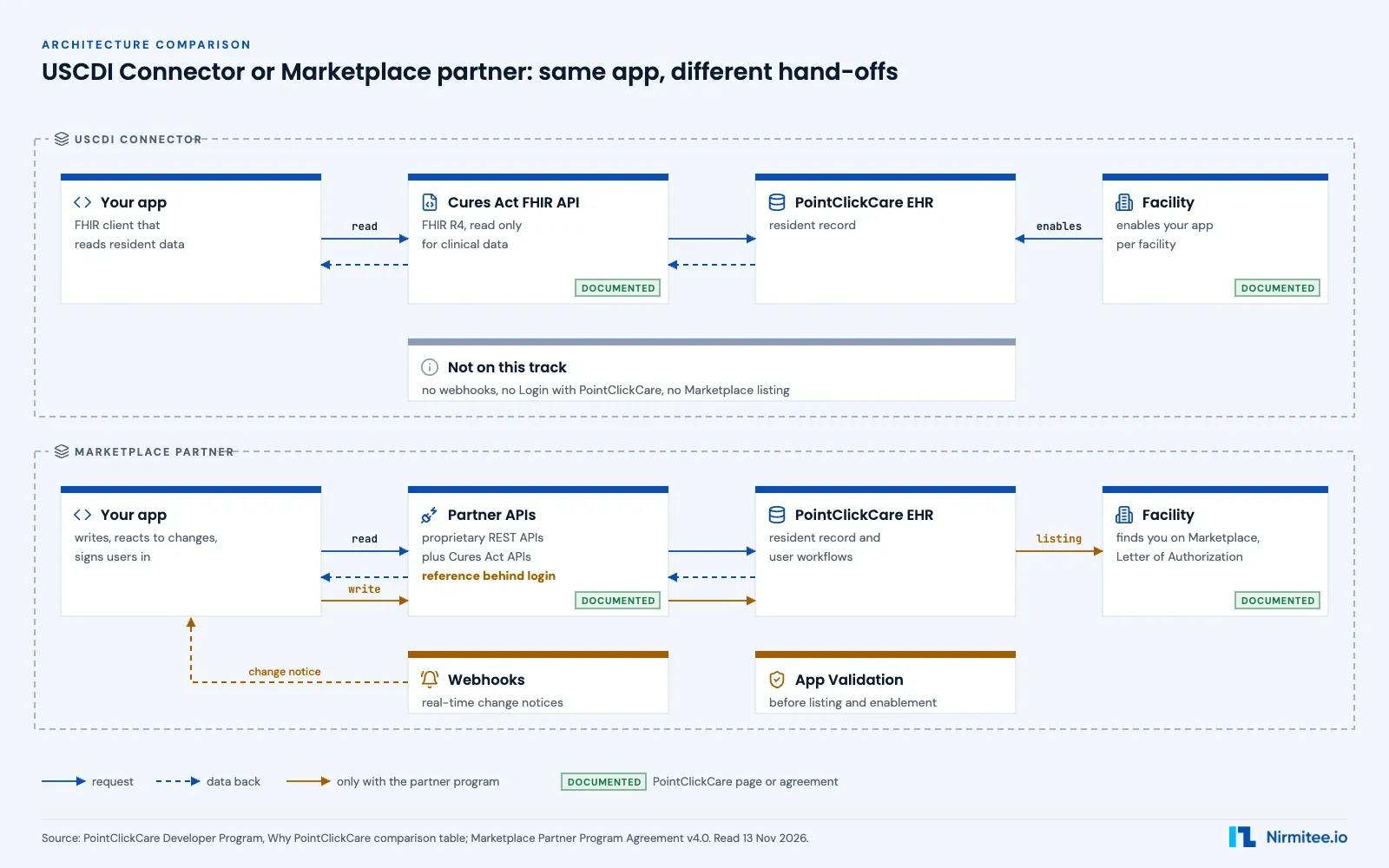
PointClickCare runs two developer programs under the Amplify name (Developer Program). The USCDI Connector gives developers "a limited number of Restful APIs" for Cures Act data. The Marketplace partner program is for companies that want to "design, test, market, deploy, maintain, and support a certified interface" with PointClickCare. PointClickCare's comparison table lists these features for Marketplace partners only (Why PointClickCare):
| Feature (PointClickCare's wording) | Marketplace partner | USCDI Connector |
|---|---|---|
| Proprietary APIs integrated with user workflows | Yes | No |
| Real-time notification of data changes (webhooks) | Yes | No |
| Login with PointClickCare and user management | Yes | No |
| Marketplace app listing | Yes | No |
| Dedicated partner manager | Yes | No |
| Technical validation for app readiness | Yes | No |
| Customer self-serve enablement | Yes | No |
| Co-marketing, sales referrals, Summit | Yes | No |
PointClickCare does not publish what the co-marketing, sales referral and Summit benefits include.
Our recommended design rule: if you only read clinical data for facilities that have agreed to use you, the USCDI Connector may be enough. If you write back, react to changes, sign users in with PointClickCare, or want to be found by operators, you need the partner program. The API guide covers the Connector's data set and calls.
How to become a PointClickCare partner, step by step
To become a PointClickCare partner, send the inquiry form on the Marketplace site and let PointClickCare match you to an access path. For a listing you then sign the partner agreement, build on the partner APIs, and pass App Validation. Each facility then signs a Letter of Authorization before PointClickCare enables your app.
- Send the inquiry. The "Become a partner" link now opens a form titled "Evaluate Authorized Data Access Paths and Partnership Programs". It asks for your company description, solution category and target market (acute care, skilled nursing, senior living). PointClickCare states that "Vendors are required to access PCC systems through an authorized set of secure, modern, and governed channels" (inquiry page).
- PointClickCare reviews your data needs and guides you to an access path. The form does not promise a reply time.
- Sign the Marketplace Partner Program Agreement. The public copy we read is version 4.0 from June 2020. It has an Appendix A that names your app, your authorized use cases and your fees (agreement v4.0). Your APIs are limited to those use cases.
- Build against the sandbox and partner APIs. Partners get a development sandbox, sandbox UI access and individual development support (Why PointClickCare).
- Pass App Validation. PointClickCare describes validation as "a set of activities" that checks your app gives clients a good experience and is secure and reliable (Why PointClickCare). The agreement ties it to the App Validation Guidelines and lets PointClickCare require it again after a material change.
- Get listed. After validation, the agreement grants a right to display and market the app to customers through the Marketplace.
- Each customer signs a Letter of Authorization. After validation and that letter, PointClickCare enables the interface for that customer (agreement section 2.2).
- Run support. You provide all customer support, show a support phone and email in the app, and give PointClickCare at least five business days' notice of planned downtime (section 3.3).
Fees, terms and timelines
PointClickCare publishes no Marketplace price list and no review or listing timeline. The only public agreement, a 2020 copy, charges the partner a confidential monthly fee for each active facility, with a yearly minimum, and sets a 14-month first term. Current terms may differ, so ask PointClickCare during your inquiry.
PointClickCare publishes no Marketplace price list. Its developer site says "no upfront integration fees and self-serve access" (Developer Program). The 2020 agreement adds detail (agreement v4.0):
- The partner pays a fee for each active facility, invoiced monthly in arrears. The amount is confidential and redacted in the public copy.
- There is a minimum number of integrated facilities per year. If you fall short, you pay the difference.
- The first term is 14 months, then one-year renewals. Either side can end it with 90 days' notice.
- You sell to the customer directly. Purchase fees pass between you and the customer, not through PointClickCare.
- PointClickCare may hold business reviews, and inactivity in enabling customers can be grounds to end the agreement.
PointClickCare publishes no timeline for review, validation or listing. The product page's "two days or less" refers to customers connecting a solution that is already integrated, not to a new partner's onboarding (product page).
Integration architecture for a partner app
A Marketplace partner app needs a token service that never stores credentials in plain text, an API client scoped per facility, a webhook receiver that stores events before processing them, and a registry of facilities with a signed Letter of Authorization. Run and support it from the US or Canada. This is our recommended design.
Three parts come from the agreement: credentials must never be stored in plain text, you answer customers' security assessments and audit requests yourself, and the app may not be accessed or supported from outside the US or Canada (sections 3.2 and 3.10). Keep a registry of which facilities have a Letter of Authorization and are enabled, and scope every API call to it. Treat webhooks as a trigger: store the event, acknowledge it, and process it from a queue.
Known issues and caveats
Most of what decides a Marketplace build is not public: the API reference, the validation checklist, the current agreement and the fees. Plan to get these from PointClickCare before you commit a date.
- The partner API reference, rate limits and validation checklist sit behind the partner login. We cannot list endpoints here, and you should not plan a build until you have read them.
- The only public agreement copy is version 4.0 from June 2020. PointClickCare's current terms may differ. Ask for the current version early.
- The agreement says neither party is a business associate of the other. Your HIPAA obligations run to the customer, so expect each operator to run its own security review.
- Offshore teams: the US and Canada rule covers access and support. A third-party integration developer is allowed but may not work from sanctioned countries, and you carry its liability (section 2.3).
- Pharmacies follow a separate Pharmacy Partner Agreement (May 2026) with its own certification, onboarding and order-form fees (pharmacy agreement).
- Network Partners tiers (Exchange, Premier Exchange, Pharmacy Integrated) are visible on listings, but PointClickCare does not publish what each requires.
If you want help choosing the path and planning facility rollout, see our PointClickCare integration services.
Sources
All read on November 13, 2026.
- PointClickCare Marketplace product page
- Marketplace data access and partnership inquiry page
- PointClickCare Developer Program home
- Developer Program, Why PointClickCare
- Marketplace Network Partners directory
- Marketplace claims solutions page
- PointClickCare Marketplace solution sheet (May 2024)
- Marketplace Partner Program Agreement, version 4.0, June 2020 (copy filed on SEDAR in 2021)
- PointClickCare Pharmacy Partner Agreement (May 2026)
- PointClickCare press release, Marketplace launch, October 8, 2018
- eClinicalWorks press release, March 2025
Ready to scale?
Talk to our healthcare engineering team about building, integrating, and shipping faster.
Frequently Asked Questions
What is the PointClickCare Marketplace?
What is the PointClickCare partner program?
How do I become a PointClickCare partner?
Is there a fee to join the PointClickCare Marketplace?
How long does it take to get listed?
What is App Validation?
What is the difference between the Marketplace and the USCDI Connector?
Can a facility turn on my app by itself after I am listed?
Can I run or support my Marketplace app from outside the US or Canada?
How do I check if a vendor is on the PointClickCare Marketplace?
Does PointClickCare take a revenue share?
What if my app fails App Validation?
Can I list on the PointClickCare Marketplace in Canada?
What are the partner tiers on the Marketplace?