
Founders and product leaders
Use field observations to challenge a product assumption before committing the roadmap or an implementation budget.
Free healthcare product discovery field guide
From the Floor to the Product
Before you build a healthcare product, understand the work it needs to fit. This free field guide takes your team from observing clinical workflows to mapping exceptions, defining software requirements and planning a pilot.
Start with the work
Clinical workflow analysis examines who does a task, in what order, with which information and systems, and what happens when the expected path breaks. For a product team, the useful result is a set of decisions about the problem to solve, the data needed and the people who must accept the change.
Start with one task and a question you can investigate. Observe the work, ask why a workaround exists, and compare what people describe with the records available to your team. Map the current process before proposing a new screen or automation. The guide then connects those observations to requirements, integration dependencies and a pilot decision.
If you need help investigating a specific product problem, explore our healthcare product discovery service. The PDF is a free resource you can also use with your own team.
Use field observations to challenge a product assumption before committing the roadmap or an implementation budget.
Identify systems, data access, handoffs and exception handling before estimating an EHR-connected feature.
Bring clinical, operational and technical owners into the same review of the current workflow and proposed change.
From observation to a build decision
Follow the sequence before a new build, an EHR-connected feature or a workflow redesign. Each part leaves your team with something it can review.
Steps 1–4
Frame a claim you can investigate, arrange site access, choose the settings and shifts, and identify the roles and systems involved.
Your working output: A discovery question, site plan and stakeholder list.
Steps 5–7
Observe tasks and handoffs, interview staff about their decisions, and use available logs to check what happens between the visible steps.
Your working output: Field notes that distinguish observations, explanations and open questions.
Step 8
Turn the notes into swimlanes, a data flow map, an exception catalog, a workaround register, role personas and requirement traceability.
Your working output: An implementation brief that links requirements to the work observed.
Steps 9–12
Prioritize what to build, configure or leave alone. Plan the workflow change, review dependencies and agree the pilot measurement and decision.
Your working output: A scoped product direction and a pilot plan with owners.
Take the method into the field
The PDF includes examples to adapt to your own site and project. Use them to make the observations, dependencies and unanswered questions explicit.
Record a task, interruption, handoff and the question to follow up.
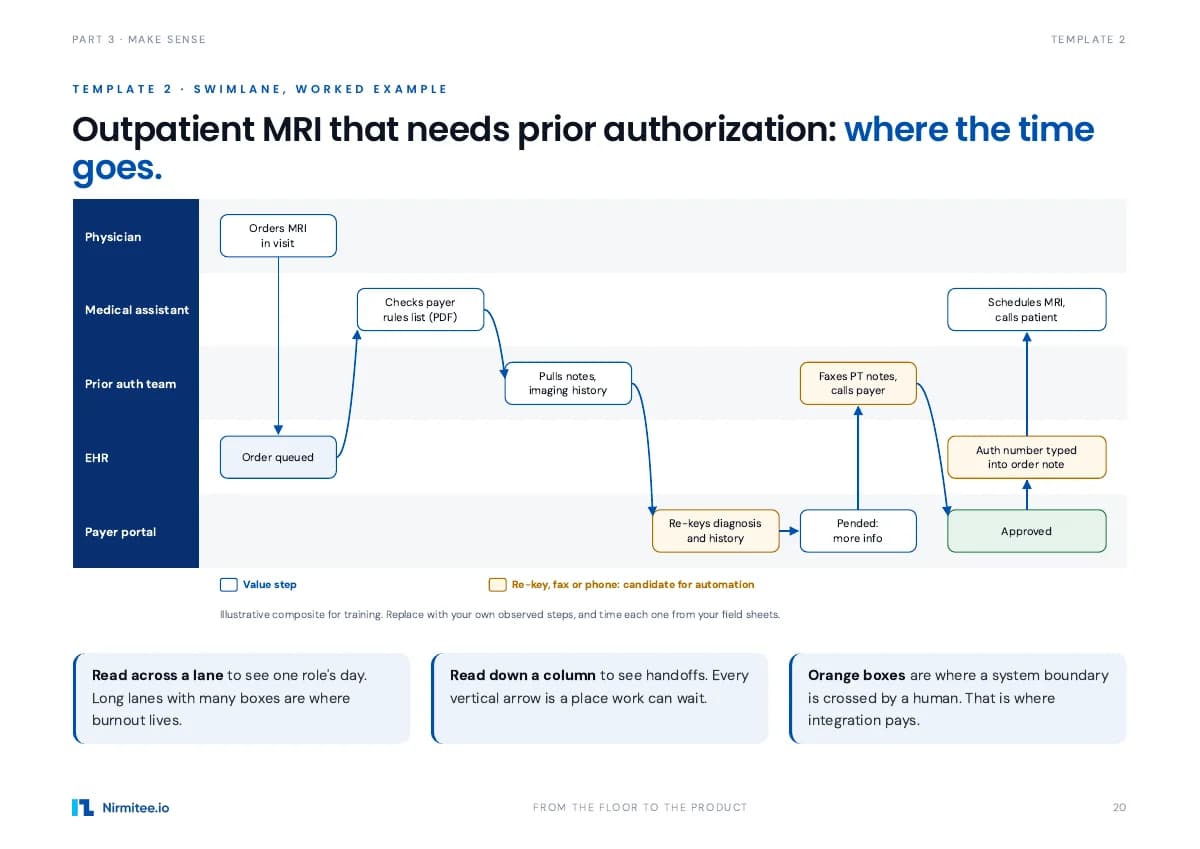
See how clinical, operational and system responsibilities cross during an MRI prior-authorization workflow.
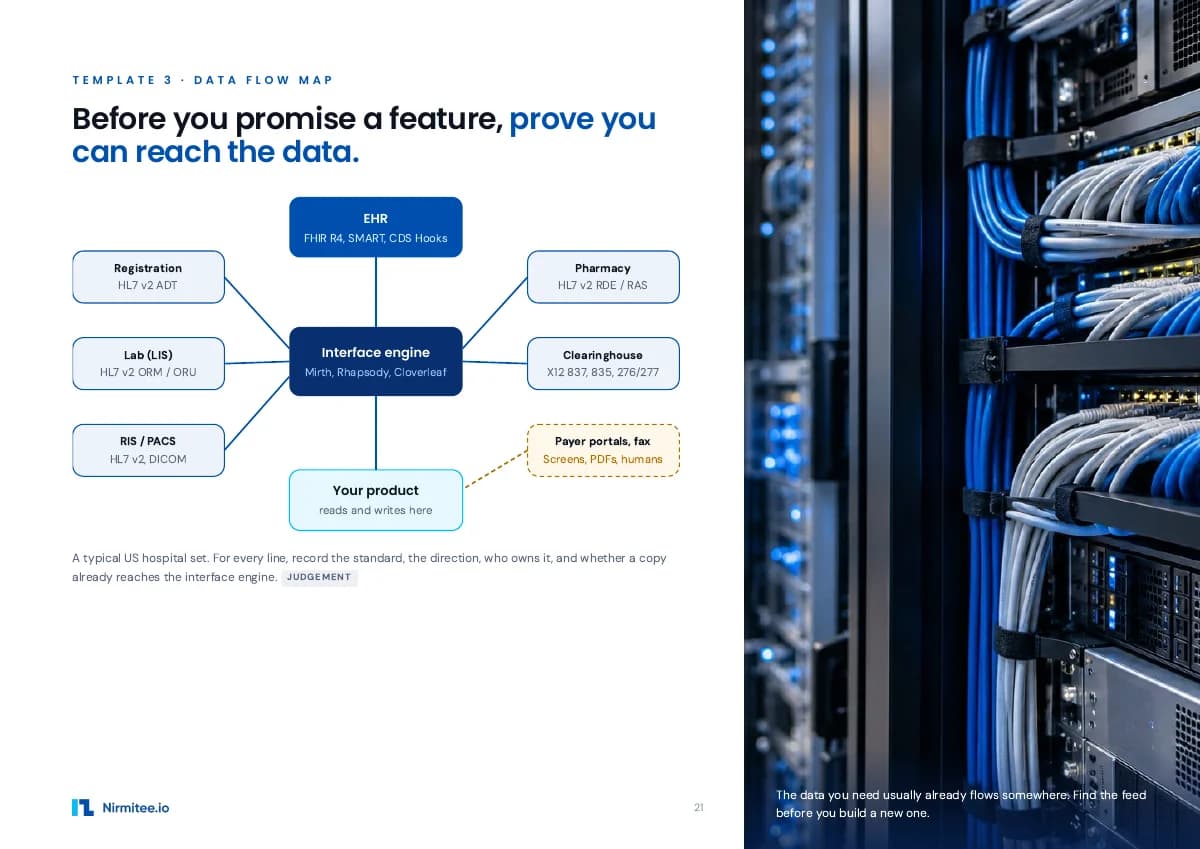
Identify which system holds the information, how it moves and which access still needs confirmation.
Capture the cases and unofficial workarounds that the standard process misses.
Connect a role and observed need to a requirement, design decision and acceptance check.
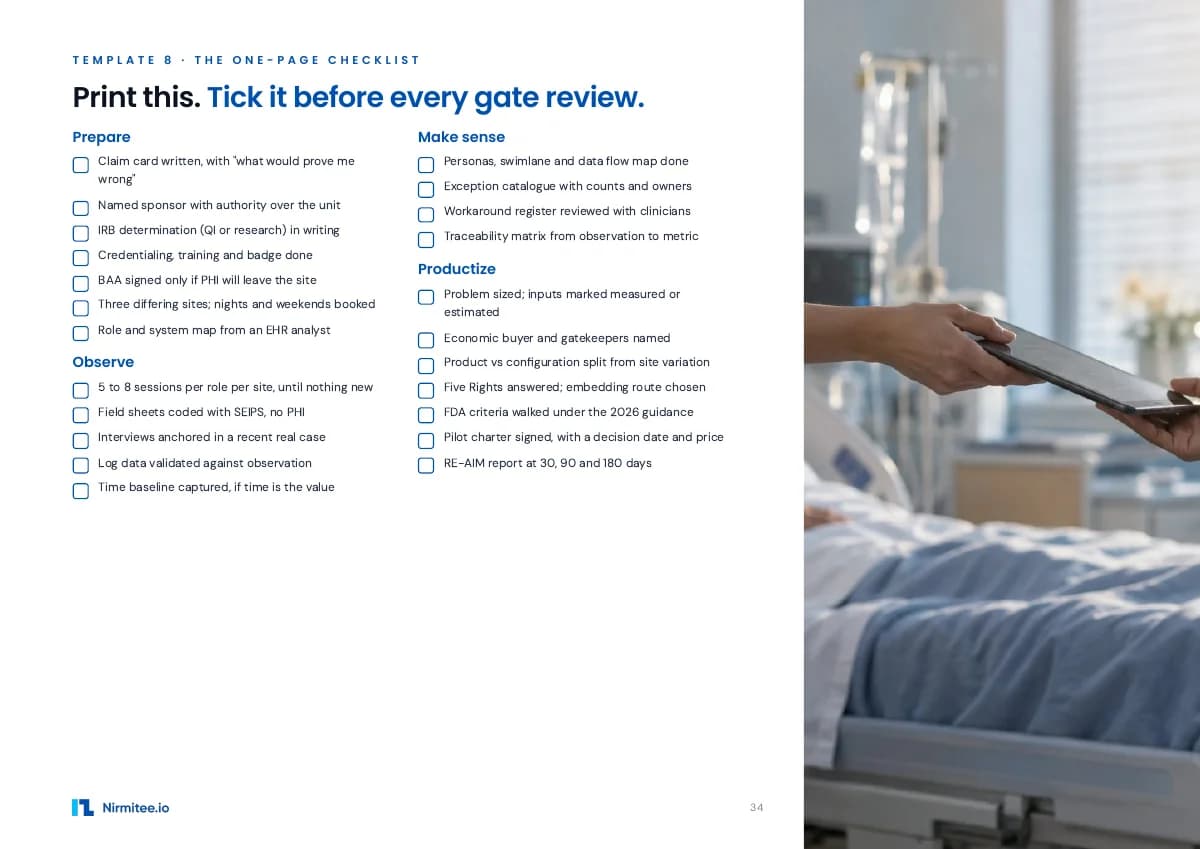
Review the preparation, observations, maps and product decisions before moving into a pilot.
Templates are presented in the PDF; no separate editable workbook is included.
Look inside the actual guide
These pages are taken from the PDF. Enter your email to get the complete guide.
Before you request it
Clinical workflow analysis examines the tasks, roles, handoffs, information and systems involved in delivering care. In healthcare product discovery, it helps a team understand the current process and its exceptions before deciding which software feature or integration to build.
The guide is written for healthcare founders, product leaders, CTOs, engineering leads and hospital innovation or informatics teams. Its focus is turning workflow discovery into healthcare software requirements and a practical pilot plan.
The email contains the complete 37-page From the Floor to the Product PDF. It contains a four-part, twelve-step method, worked workflow and data-flow examples, templates, case discussions and a source list. The pages shown above are previews from that same PDF.
The templates and worked examples are inside the PDF. You can use them to prepare your own project documents. The email does not include a separate editable spreadsheet, and the PDF is not a fillable form.
It asks the team to trace a requirement back to an observed task, constraint or exception. The workflow and data maps help identify users, system dependencies, access questions and acceptance checks before the implementation scope is agreed.
Enter your work email in the form on this page and we send the complete PDF to your inbox. Requesting the guide does not subscribe you to marketing emails.
Put the findings to work