Ultrahuman API Integration Guide 2026: Ring and CGM

CTO & Co-Founder
CTO & Co-Founder at Nirmitee.io. Architects healthcare integrations across FHIR, SMART on FHIR, ABDM and NHCX, writing from production experience taking hospital software from sandbox to go-live.
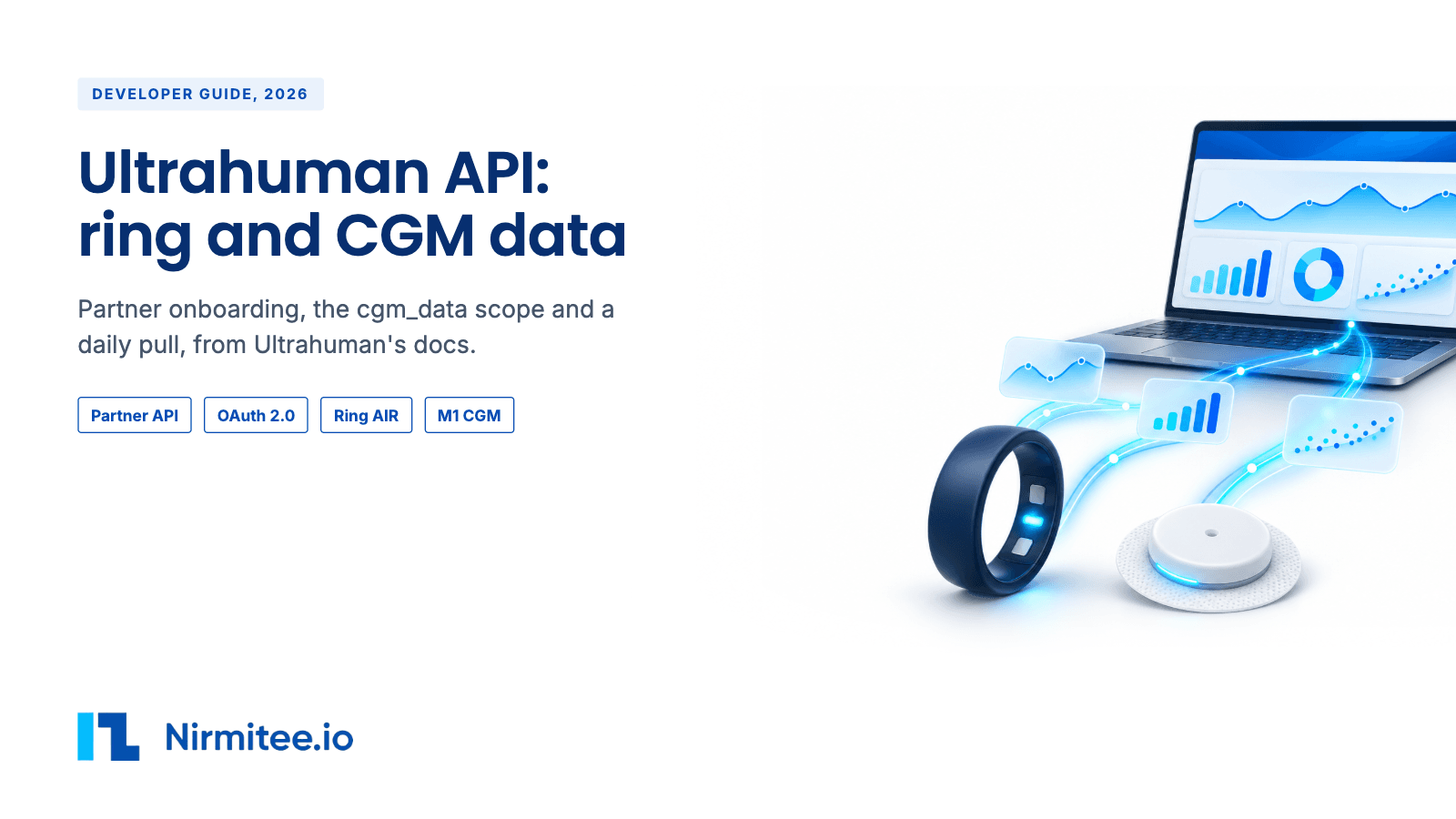
You can integrate Ultrahuman Ring AIR and Ultrahuman M1 CGM data through the Ultrahuman API for partners, the Ultrahuman Partner API. It uses OAuth 2.0, and one daily call returns heart rate, HRV, skin temperature, steps, sleep and, if granted, glucose. You get credentials through partner onboarding. Price, eligibility and waiting time are not published. One rule decides most projects. Glucose data needs a separate cgm_data scope that Ultrahuman grants on request, so a metabolic or diabetes program must ask for it first.
Want a team to build this for you? Our medical device integration services cover the vendor approval, the data pipeline and EHR delivery.
Ultrahuman integration at a glance
| Question | Short answer |
|---|---|
| Official API? | Yes. Partner API at partner.ultrahuman.com, versioned v1. |
| Cost to developer? | Not published. |
| Does the end user need a subscription or device? | An Ultrahuman Ring AIR, or an M1 CGM for glucose. User subscription needs are not published. |
| Same-day start? | The docs say you create an OAuth app after logging in to the developer area. The blog says credentials come through partner onboarding. Timing not published. |
| Who approves scale-up? | Ultrahuman. The CGM scope is granted on request. Reviewer and time not published. |
| HIPAA / BAA? | Not published. |
| Raw vs summary data? | Intraday series plus daily summaries. No raw sensor signals published. |
| First build | About 3 to 4 weeks after credentials. This is our estimate. |
Integration strategies
| Route | Own mobile app? | Own server? | Vendor approval or contract? | SDK? | Data latency | Supported data | Not supported | Best for |
|---|---|---|---|---|---|---|---|---|
| Partner API (cloud REST, pull) | No | Yes | Yes, partner onboarding and the API Agreement for Developers and Partners. CGM scope on request | No | Pull by date. CGM summaries stay null until the day ends | HR, HRV, skin temperature, steps, sleep stages and score, resting HR, VO2 Max, recovery and movement indexes, metabolic score, CGM glucose | Webhooks and raw accelerometer (not published). Raw PPG only through the separate PPG Recordings API | Both readers. The main route |
| Webhooks / push | Not published. Plan to poll. | |||||||
| Phone SDK | Not published. | |||||||
| Apple Health / HealthKit | Yes | Optional | No | HealthKit | After the user's phone syncs | HRV, skin temperature and energy burned, per an Ultrahuman blog post. Sleep and workouts per marketing pages | Full list not published | Apps already reading HealthKit |
| Health Connect | Yes | Optional | No | Health Connect | After sync | Not published by Ultrahuman for ring data. Only cycle data import is documented. Sahha says the Ring AIR writes there. | Not published | Test before you plan on it |
| Aggregators, checked 10 November 2026 | Terra lists Ultrahuman as a cloud source. Junction lists it as a cloud source that needs an Ultrahuman API partner application. Spike lists it with no route stated. ROOK does not list it. Thryve, Validic and Sahha coverage is not published here. Open Wearables also documents it. | |||||||
| File export | Not published. | |||||||
For a healthcare buyer in remote monitoring, chronic care or diabetes prevention: use the Partner API and ask for the cgm_data scope on day one. It is the only route that can deliver ring and glucose data together. For a consumer sleep, recovery or metabolic coaching app: the Partner API is still the best fit. If you already read Apple Health or Health Connect, test what the ring writes there before you add a second route.
Build it yourself, use an aggregator, or work with a partner
| Question | Build in-house | Wearable aggregator | Build with a partner (Nirmitee) |
|---|---|---|---|
| Whose Ultrahuman API app? | Yours | Depends on the aggregator. Junction asks for your own Ultrahuman partner application. | Yours. We build it in your account. |
| Agreement risk | Your counsel reads the API Agreement | Your counsel reads it, plus the aggregator's terms | Your counsel reads it. We design storage around the answer. |
| Daily pulls and token renewal | You build and run them. Refresh tokens rotate on each use. | The aggregator runs them | We build them, then hand them to you or run them |
| Glucose (cgm_data) | You ask Ultrahuman for the scope | Not published per aggregator | You ask Ultrahuman. We prepare the request with you. |
| Data model | Ultrahuman's own JSON | The aggregator's schema | FHIR Observations for your EHR or remote monitoring stack |
| Other devices later | One new build per device | Many devices through one API | Same pattern reused across devices |
| Time to first real user | Depends on your team | Depends on the aggregator's onboarding | About 3 to 4 weeks after credentials, our estimate, plus Ultrahuman onboarding |
| Cost shape | Engineering time | Aggregator fee. Pricing for Ultrahuman on these platforms is not published. | Project fee, scoped after a call |
What data you can get
All ring and CGM data comes from GET /api/partners/v1/user_data/metrics?date=YYYY-MM-DD. Intervals in the docs sample are illustrative.
| Data type | Granularity | History window | Push or pull |
|---|---|---|---|
| Heart rate | Intraday series (hourly in the sample) plus daily summary | Not published | Pull |
| Heart rate variability | Intraday series plus daily summary | Not published | Pull |
| Skin temperature | Intraday series plus daily summary | Not published | Pull |
| Steps | Intraday series (5-minute in the sample) plus daily total | Not published | Pull |
| Sleep | Stages, graphs and sleep score per night | Not published | Pull |
| Night resting heart rate | Per night | Not published | Pull |
| VO2 Max, Recovery Index, Movement Index, Metabolic Score | Daily score | Not published | Pull |
| CGM glucose (mg/dL) | Readings plus daily average, variability %, HbA1c estimate, time in target. Summaries null until the day ends | Not published | Pull, cgm_data scope only |
| Workouts | The workout scope adds the day's workouts to the metrics response. Fields are not shown in the docs sample | Not published | Pull |
| Profile | From /user_data/user_info | Current | Pull |
What is inside one Ultrahuman metrics response
One call returns a list called metric_data. Each entry has a type and, when there is data, an object. An entry appears only when the token has its scope. These details come from the sample response in the OAuth docs.
| Entry | What it holds |
|---|---|
| hr, temp, hrv, steps | A time series for the day, each point a Unix timestamp and a value, plus a summary (last reading, average or total). Units in the sample: BPM, °C for skin temperature, and ms for sleep HRV. |
| Sleep | The night that ended on the requested day: bedtime start and end, deep, light and REM time and percent, a stage graph with start and end times, movement and toss and turn counts, heart rate, HRV and skin temperature graphs, respiratory rate in breaths per minute, average SpO2 (beta) and sleep score contributors |
| night_rhr, sleep_rhr, avg_sleep_hrv | Resting heart rate for the last few nights, and single sleep values for the night |
| recovery_index, movement_index, vo2_max | One value per day |
| active_minutes, inactive_time, weekly_active_minutes, movements, morning_alertness | One value per day. Morning alertness is in minutes. |
| ring_extended_data scope | Active hours, cardio age, stress score, brain waste clearance, dynamic recovery, temperature deviation and calories burned, one value per day. Calories burned is total kcal, resting energy included. |
| cgm_data scope | Glucose readings in mg/dL, plus metabolic score, glucose variability, average glucose, HbA1c estimate and time in target |
The response also gives latest_time_zone, and day_start_timestamp marks the start of the day in that zone. Empty days are uneven: some entries come back null, some with an empty list, and ring_extended_data entries are left out. Parse each type on its own terms.
What you cannot get
- Raw accelerometer signals: not published. Raw PPG exists only for sessions a member records in the app's Developer Mode, through the separate PPG Recordings API.
- SpO2 as a day-long series: not published. The sleep record carries one average oxygen saturation value per night, flagged as beta.
- Webhooks or any push: not published.
- Glucose without the cgm_data scope, which is granted on request.
- New scopes for existing users without a reconnect. They must sign in again.
- A published history window or rate limit.
- A mobile SDK or file export: not published.
How to get access
- Contact Ultrahuman for partner onboarding. Eligibility rules are not published.
- Read and accept the API Agreement for Developers and Partners linked from the developer docs. We have not read its contents.
- Log in to the developer area at vision.ultrahuman.com and create your OAuth app. You receive a Client ID, Client Secret and set a redirect URI.
- Ask for the cgm_data scope if you need glucose. Who grants it and how long it takes is not published.
- Build the OAuth flow and test with your own ring.
- Go live. Any scale-up review is not published.
From zero to your first Ultrahuman data in four steps
- Create the app. Log in to the developer area at vision.ultrahuman.com and create an OAuth app. You can give it every scope except cgm_data when you create it, and change scopes later from the OAuth applications page.
- Send the user to consent. Redirect to auth.ultrahuman.com/authorise with response_type=code, your client_id, redirect_uri and a space-separated scope list, for example profile ring_data.
- Swap the code for tokens on your server. POST to partner.ultrahuman.com/api/partners/oauth/token with grant_type=authorization_code. Store the refresh token, and replace it every time you refresh.
- Pull a finished day. Ask for a date that has already ended in the member's time zone, so the summaries are final.
curl 'https://partner.ultrahuman.com/api/partners/v1/user_data/metrics?date=2024-10-14' \
  --header 'Authorization: Bearer <ACCESS_TOKEN>'
Terms you must know
The API Agreement exists but we did not read it. Treat each clause below as a question until you have read it.
- Medical use: not published. A healthcare product using CGM data for care decisions must confirm this in writing. A wellness product should confirm too, since glucose invites medical reading.
- PHI and HIPAA: not published. Glucose and HbA1c estimates in a patient record are PHI on your side.
- BAA: not published. Ask before you sign.
- Storage and retention: not published.
- AI training: not published.
- Display and branding: not published.
- Data selling: not published. Assume it is not allowed until the agreement says otherwise.
- Termination: not published.
- Competing products: not published. A metabolic coaching app may overlap with Ultrahuman's own products and should ask.
- FDA status of the ring: not published. Do not present ring metrics as diagnostic.
- HbA1c: the API value is an estimate from CGM. Label it as estimated, never as a lab result.
Cost and payment terms
- Developer fee: not published.
- End-user subscription for API access: not published.
- Enterprise contract: not published.
- Aggregator fees: not published.
Use cases
Remote monitoring of sleep and recovery
A patient connects the ring in your portal with OAuth. Each morning your scheduler calls the metrics endpoint for the previous day in the patient's time zone. You store resting HR, HRV, skin temperature and sleep, write FHIR Observations to the EHR, and flag trends for the care team. Data used: night resting HR, HRV, skin temperature, sleep stages.
- Pulling too early returns a partial day. Fix: pull after the user's local midnight plus a buffer, and re-pull the previous day once.
- Refresh token reused and rejected. Fix: store the new refresh token on every refresh, since tokens rotate.
- Skin temperature read as body temperature. Fix: label it skin temperature and code it LOINC 39106-0, Temperature of Skin.
Diabetes prevention or metabolic program
Participants wear the M1 CGM and the ring. With cgm_data granted, your daily job pulls glucose readings, average glucose, variability and time in target. Coaches see the day next to sleep and steps. Data used: CGM glucose and summaries, steps, sleep.
- CGM scope not granted. Fix: request it before enrollment starts.
- Summaries null mid-day. Fix: show daily summaries only after the day closes, and re-pull the day once it ends.
- HbA1c estimate mistaken for a lab value. Fix: label it estimated in the UI and in FHIR.
Clinical trial with sleep and HRV endpoints
Participants get rings. Your server pulls each day's metrics and stores the JSON as source data. Data used: sleep stages, HRV, HR, steps.
- History window unknown, so late enrollment may lose data. Fix: connect at enrollment.
- Scope added mid-study. Fix: every participant must reconnect, so lock scopes before first patient in.
Recovery coaching app
Users connect the ring in your app. You show a morning card with Recovery Index, sleep score and HRV, and adjust training advice. Data used: Recovery Index, sleep score, HRV, Movement Index.
- The docs conflict on token life (one day or one week). Fix: assume one day and refresh before each pull.
- User revokes access. Fix: catch auth errors and prompt a reconnect.
Employer wellness
Employees connect rings. You pull daily steps and sleep for a team challenge. Data used: steps, sleep duration.
- Time zone mistakes put steps on the wrong day. Fix: store the user's time zone and request by local date.
Ultrahuman data in an EHR or remote monitoring program
Most healthcare teams want ring and glucose readings next to clinical data, not in a separate app. The usual pattern is to turn each reading into a FHIR Observation, the standard record for a measurement, and send it to the EHR or the remote monitoring platform. Read the API Agreement first, because it decides what you may store.
| Ultrahuman value | FHIR Observation | Code |
|---|---|---|
| Heart rate series (hr) | Heart rate, beats per minute | LOINC 8867-4 |
| Resting heart rate (night_rhr, sleep_rhr) | Resting heart rate | LOINC 40443-4 |
| Skin temperature (temp) | Skin temperature, °C | LOINC 39106-0. Not body temperature. |
| Steps | Step count | LOINC 55423-8 |
| Total sleep (Sleep) | Sleep duration | LOINC 93832-4 |
| Respiratory rate (Sleep) | Respiratory rate, breaths per minute | LOINC 9279-1 |
| CGM glucose (glucose) | Glucose in interstitial fluid, mg/dL | LOINC 99504-3 |
| Average glucose | Average interstitial glucose for the period | LOINC 97507-8 |
| HRV, HbA1c estimate, VO2 max, recovery and metabolic scores | Device-specific Observation | Your own code system. Ultrahuman does not publish its HRV method or HbA1c formula, and the scores are its own, so no standard code fits exactly. |
Store the date and the member's time zone on each Observation, and overwrite a day when you re-pull it, since CGM summaries change until the day ends.
Known blockers and gotchas
- Token lifetime conflict. The blog and docs text say one week. The docs table and sample say 86400 seconds, one day. Build for one day.
- Rotating refresh tokens. Each refresh returns a new refresh token. Losing it means the user must reconnect.
- Reconnect for new scopes. Adding a scope later forces every existing user to sign in again.
- CGM gate. cgm_data is on request only.
- No push. Plan daily polling jobs and time-zone logic.
- Day-end nulls. CGM summaries are null until the day ends.
- Unknown rate limits. Not published. Ask before backfilling many users.
- Two auth hosts. Authorize at auth.ultrahuman.com. Token and revoke at partner.ultrahuman.com.
Delivery timeline
Our estimate. Steps marked "vendor" depend on Ultrahuman.
| Week | Work | Depends on vendor? |
|---|---|---|
| Before week 1 | Partner onboarding, API agreement, CGM scope request | Yes. Time not published |
| 1 | OAuth flow and rotating refresh token store | No |
| 2 to 3 | Daily pull jobs, time-zone handling, re-pull of late data | No |
| 4 | FHIR mapping and testing with real rings | No |
Questions to ask Ultrahuman before you sign
- Who qualifies for partner onboarding, and how long does it take?
- What does it take to get the cgm_data scope?
- Is the access token valid for one day or one week?
- What are the rate limits and history window?
- Are webhooks planned?
- Does the API agreement allow clinical use, and will you sign a BAA?
- Is there a fee, now or planned?
- Is SpO2 available in the API?
Other device integration guides
Ultrahuman is often one device among several. Each guide below uses the same layout, so you can compare access, data and terms side by side. For the full service, see medical device integration.
- Oura API integration guide
- WHOOP API integration guide
- Garmin API integration guide
- Eight Sleep API integration guide
- Fitbit and Google Health API integration guide
- Apple Health API integration guide
- Health Connect API integration guide
- Samsung Health API integration guide
- Withings API integration guide
- Dexcom API integration guide
- FreeStyle Libre API integration guide
- Polar API integration guide
- COROS API integration guide
- Suunto API integration guide
- Strava API integration guide
- Peloton API integration guide
- MyFitnessPal API integration guide
Ready to build with Ultrahuman data?
Tell us your device, your users and your target date, and we will send back the route, the vendor approvals you need and a build plan. We do not have an existing Ultrahuman partnership. Book a call about your device integration.
For whoever builds this
- Authorize: https://auth.ultrahuman.com/authorise (authorization code flow).
- Token and revoke: partner.ultrahuman.com/api/partners/oauth/.
- Scopes: profile, ring_data, cgm_data (on request), ring_extended_data, workout, sleep_info.
- Access token: 86400 seconds per docs table and sample. Text says one week. Refresh tokens rotate on each use.
- Endpoints: GET /api/partners/v1/user_data/metrics?date=YYYY-MM-DD and GET /api/partners/v1/user_data/user_info.
- Rate limits, webhook signing: not published.
- FHIR mapping (our mapping, LOINC checked 11 November 2026): heart rate 8867-4, resting HR 40443-4, HRV 80404-7 (an SDNN code; Ultrahuman does not publish its HRV method), skin temperature 39106-0, steps 55423-8, sleep duration 93832-4, CGM glucose 99504-3 (interstitial fluid), average glucose 97507-8, time in target 97510-2 once you confirm the target range, respiratory rate 9279-1, SpO2 59408-5. HbA1c estimate: no exact code. Do not use 4548-4, which is a lab blood test. 97506-0 (glucose management indicator) is the closest, but Ultrahuman does not say it uses that formula. VO2 max: no exact code. 60842-2 is plain oxygen consumption, so use your own code.
- Version: v1 in the path. Partner API blog dated 19 September 2025. Sunset dates not published.
Sources
All read 10 November 2026.
- Ultrahuman on HRV in Apple Health, https://www.ultrahuman.com/blog/how-to-access-your-hrv-data-on-apple-health/, read 10 November 2026.
- Terra supported integrations, https://docs.tryterra.co/reference/health-and-fitness-api/supported-integrations, read 10 November 2026.
- Junction providers list, https://docs.junction.com/wearables/providers/introduction, read 10 November 2026.
- Thryve data sources overview, https://docs.thryve.health/thryve-data-sources/overview, read 10 November 2026.
- ROOK data sources, https://docs.tryrook.io, read 10 November 2026.
- Sahha integrations, https://www.sahha.ai/docs/connect/integrations.md, read 10 November 2026.
- Spike integrations, https://www.spikeapi.com/integrations, read 10 November 2026.
- Validic supported devices and restricted vendor list, https://www.validic.com/features/supported-devices/, read 10 November 2026.
- https://vision.ultrahuman.com/developer-docs?type=oauth
- https://www.ultrahuman.com/blog/accessing-the-ultrahuman-partnership-api/ (19 September 2025)
- https://sahha.ai/integrations/ultrahuman/ (third party)
- https://tryterra.co/integrations/ultrahuman (third party)
- Ultrahuman developer docs, OAuth tab sample response and scopes, https://vision.ultrahuman.com/developer-docs?type=oauth, read 11 November 2026.
- Ultrahuman UltraSignal API docs (personal token, PPG Recordings), https://vision.ultrahuman.com/developer-docs?type=api, read 11 November 2026.
- LOINC codes, https://clinicaltables.nlm.nih.gov/api/loinc_items/v3/search, checked 11 November 2026.
Ready to scale?
Talk to our healthcare engineering team about building, integrating, and shipping faster.
Frequently Asked Questions
Does Ultrahuman have an API?
Can I get Ultrahuman M1 CGM glucose data through the API?
What data does the Ultrahuman Ring API return?
Does the Ultrahuman API have webhooks?
How long do Ultrahuman access tokens last?
How much does the Ultrahuman API cost?
Is Ultrahuman Ring data available in Apple Health?
Do users need to reconnect when I add scopes?
Is the Ultrahuman HbA1c value a lab result?
Will Ultrahuman sign a BAA?
Which OAuth scopes does the Ultrahuman API use?
How much history can I pull when a user first connects?
Why are some fields null in the Ultrahuman response?
Can I get raw PPG data from the Ultrahuman Ring?
Does the Ultrahuman API give SpO2 or respiratory rate?
What units does the Ultrahuman API use?