AI nurse voice charting on Oracle Health: every field shows the words it came from
We built Scribe, a nurse charting product for a Canadian health-tech startup. Scribe is our project name, not the client's brand. A nurse speaks the head-to-toe assessment at the bedside. The AI fills up to 322 flowsheet fields, links each one to the transcript and the audio, and the nurse signs before anything goes into Oracle Health (Cerner).
November 24, 2026 · 12 min read · Jitendra Choudhary, CTO & Co-Founder
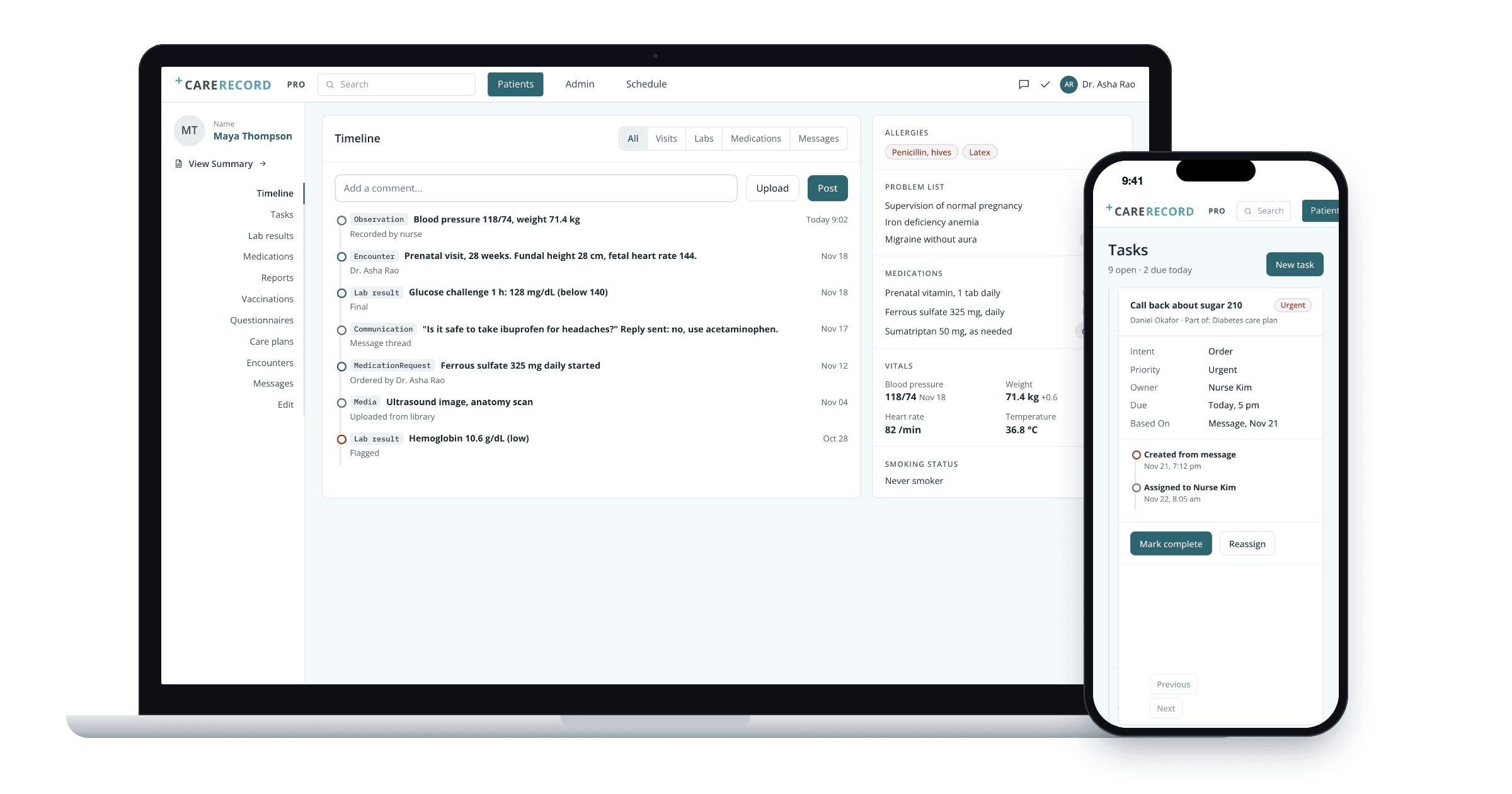
This was custom healthcare software development from the first proof to a live product: a nurse app, a review web app, an AI service and the EHR connection.
Why the client needed it
Nurses on Cerner wards filled in a head-to-toe assessment of more than 300 fields by hand, every shift. They already said everything out loud at the bedside. The founders wanted that spoken assessment to fill the chart, with the nurse still in charge of every value.
"Nursing charting takes up so much time that it decreases patient care significantly."
The journey, from proof to live
Scribe grew in four stages. Each one solved the problem the last one uncovered.
- 1
Oct to Nov 2024
Seven-week proof. No Cerner admin was free, so we built a test FHIR server that behaves like Cerner and sent nine vitals through it.
- 2
Dec 2024
Phase 2 starts with two full-stack developers and one mobile developer. Two roads: an app inside Cerner, or a standalone product.
- 3
Jan to Feb 2025
The founder reviewed every field the AI filled, recording by recording, and wrote rules for each group of fields.
- 4
Dec 2025 to Apr 2026
The chart grows from 68 to 322 fields. The app goes live on Oracle Health in stages, the mobile app ships on iOS and Android, and the client completes SOC 2 with us as its engineering partner.
The field review changed the product most. The founder found that one rule for all fields would never work. Some fields must only be filled when the nurse says them. Some can be marked normal only when a related field was called normal. The pain tool field may only choose between numeric and verbal scales. She also flagged fields the AI should have caught but missed. Those rules became the green and blue marking nurses see today, and the per-field rules admins can edit.
"They acted as a true extension of our team, delivering high-quality results on schedule. I would highly recommend Nirmitee to anyone looking for reliable, end-to-end software development partners."
Founder and CEO, the client
How it works at the bedside and on the web
The nurse records on the phone, which can be worn on the forearm, and reviews on the web. The AI only ever produces a draft.
- 1
Record
The app keeps recording when the screen locks, so a nurse can talk with gloved hands.
- 2
Transcribe
Audio is sped up, split and transcribed, then turned into a Nurse and Patient dialogue.
- 3
Fill the draft
Each field group is filled with a value, a reason and the exact words it came from.
- 4
Review
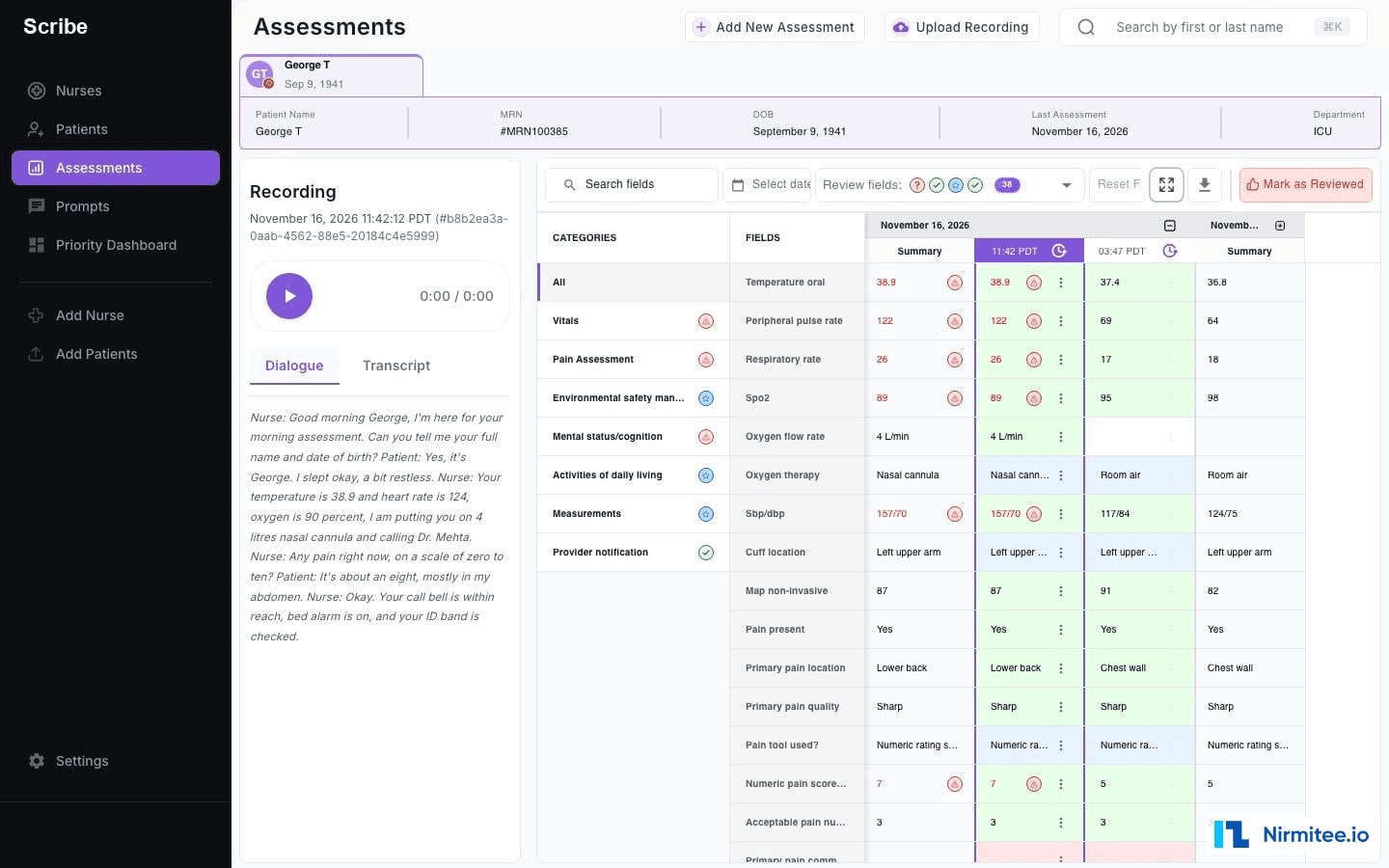
Green was said, blue was inferred, red is out of normal range. Tap a field to hear the audio.
- 5
Sign
The nurse edits and confirms. The chart saves with full edit history and goes to the EHR.
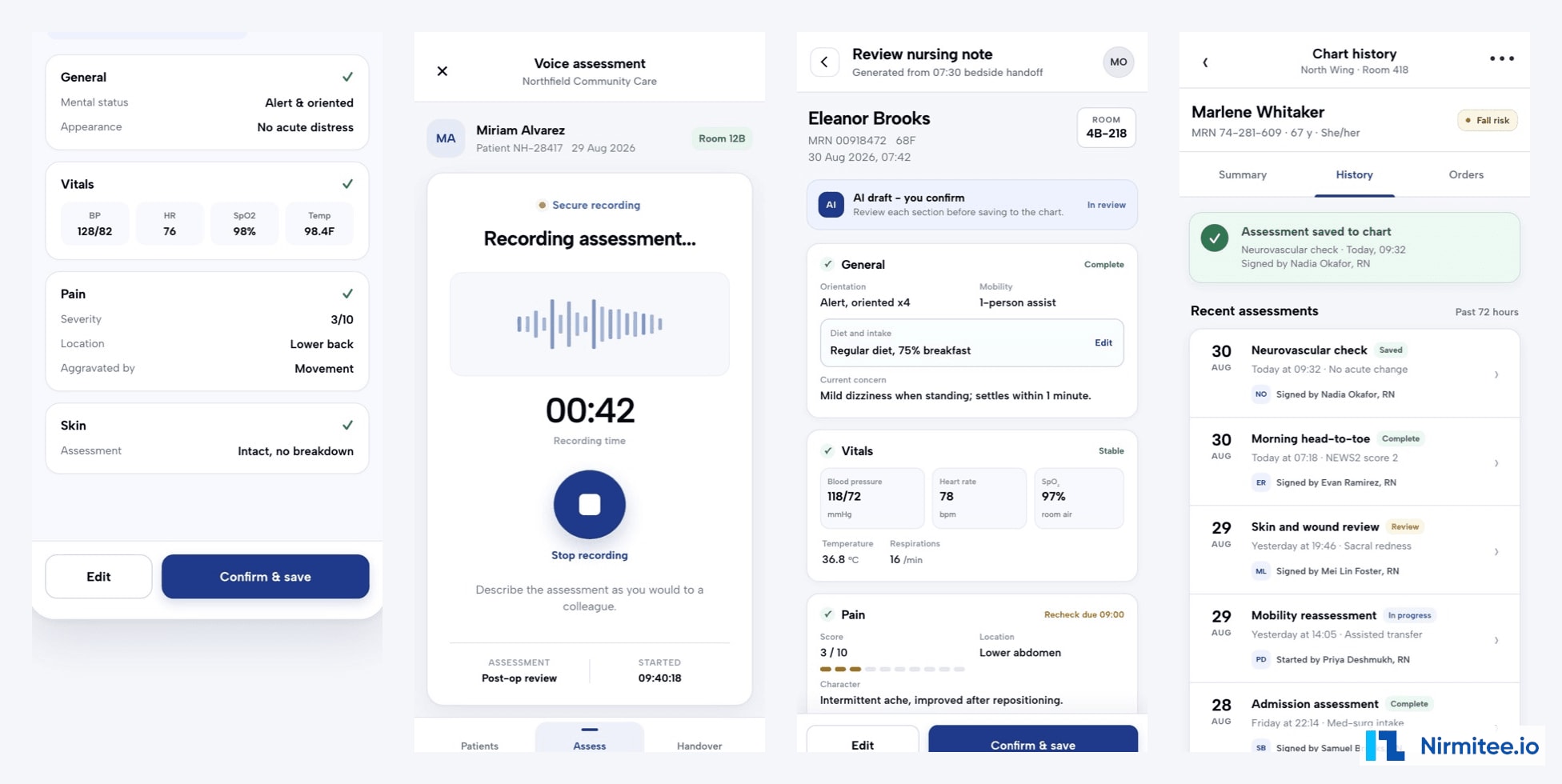
Nurse app: patient summary, recording, draft review and chart history.
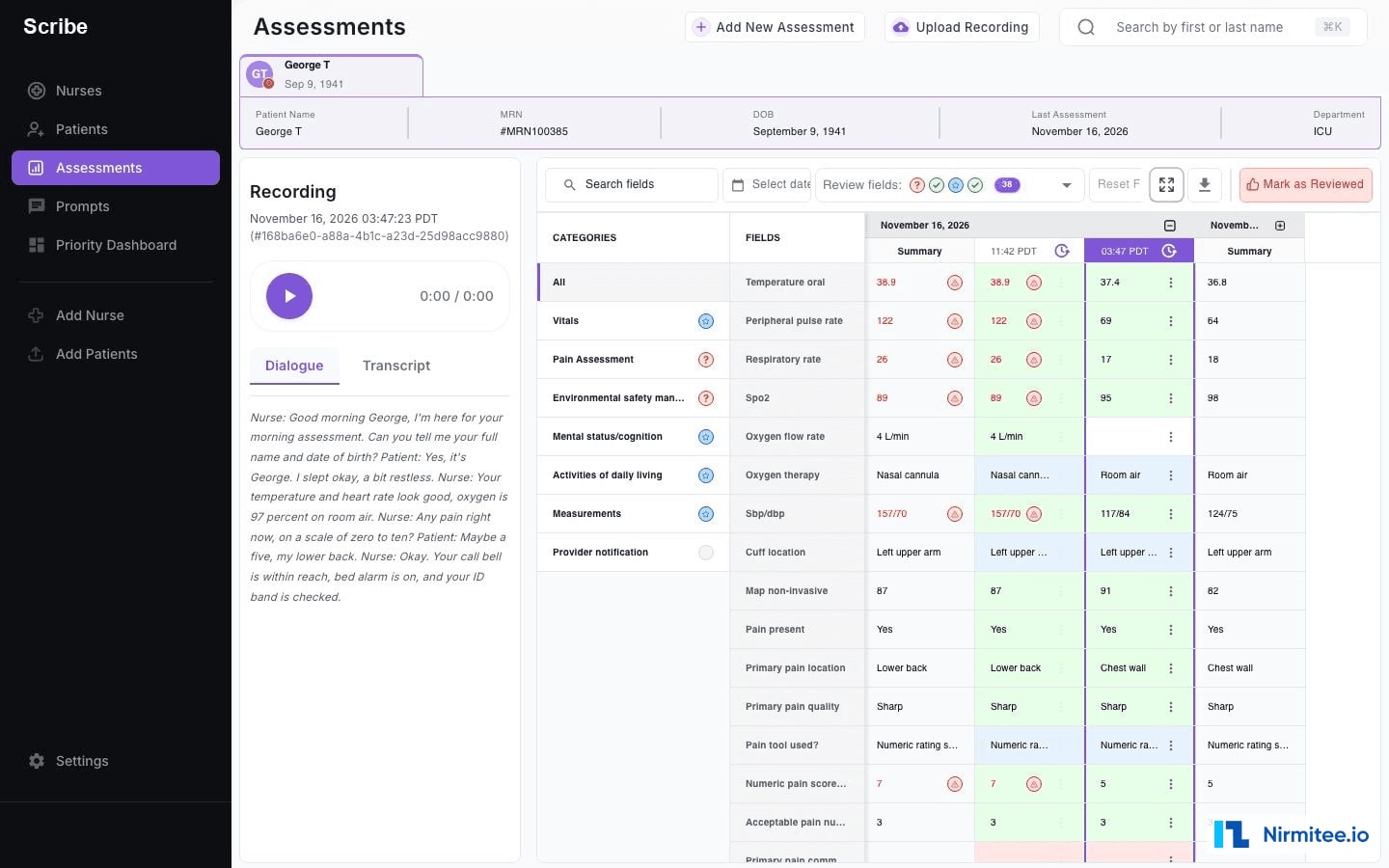
Recordings sit side by side, so the trend is visible without opening old charts. Demo patient.
The architecture
Two apps, a Node API for patients and charts, and a separate Python AI service with background workers. All of it runs in the client's own Azure account.
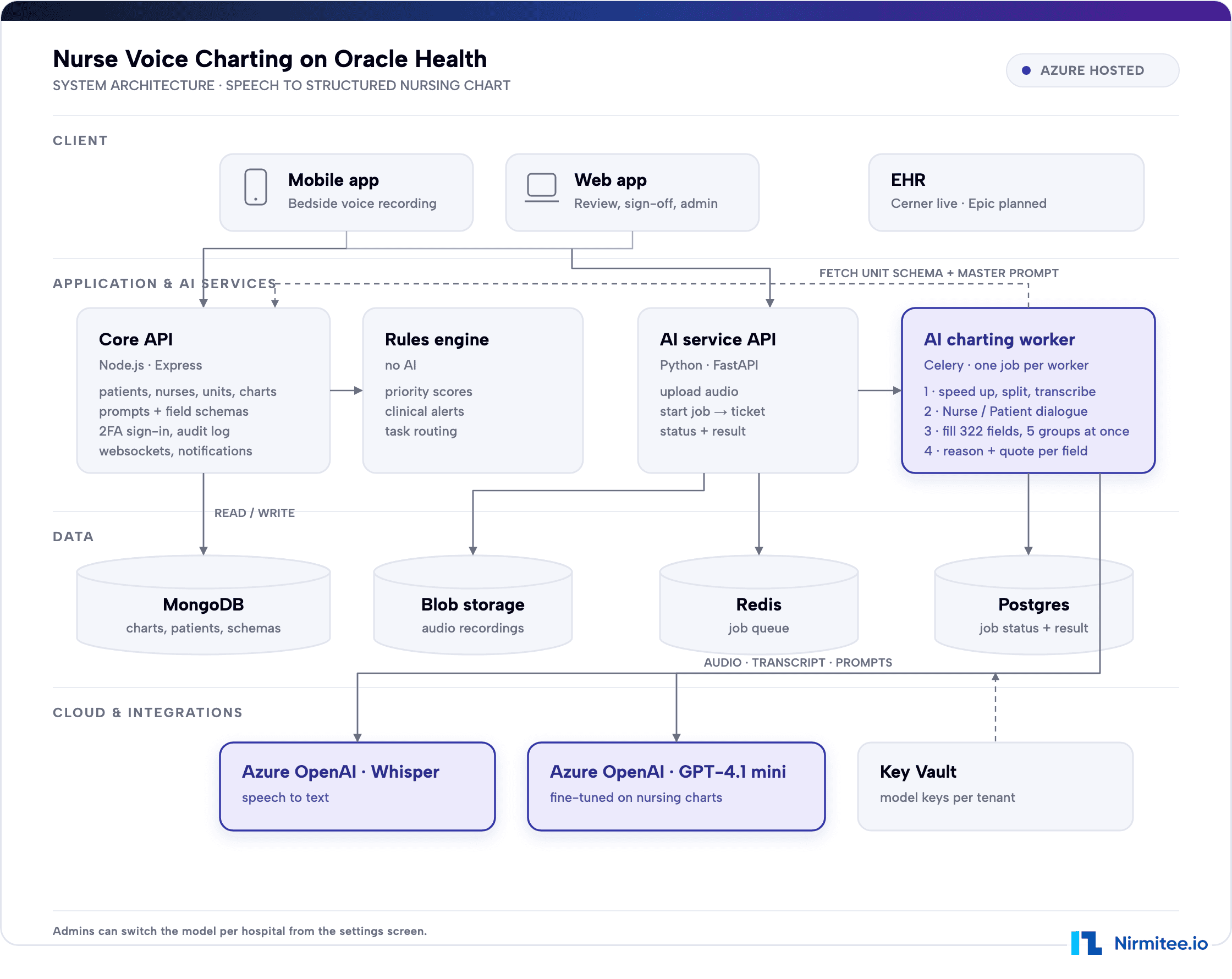
The AI service asks the core API for each unit's field list and rules, so clinical content lives in the database, not the code. Standard FHIR records are what make the EHR connection possible. See our healthcare interoperability work for how that data moves.
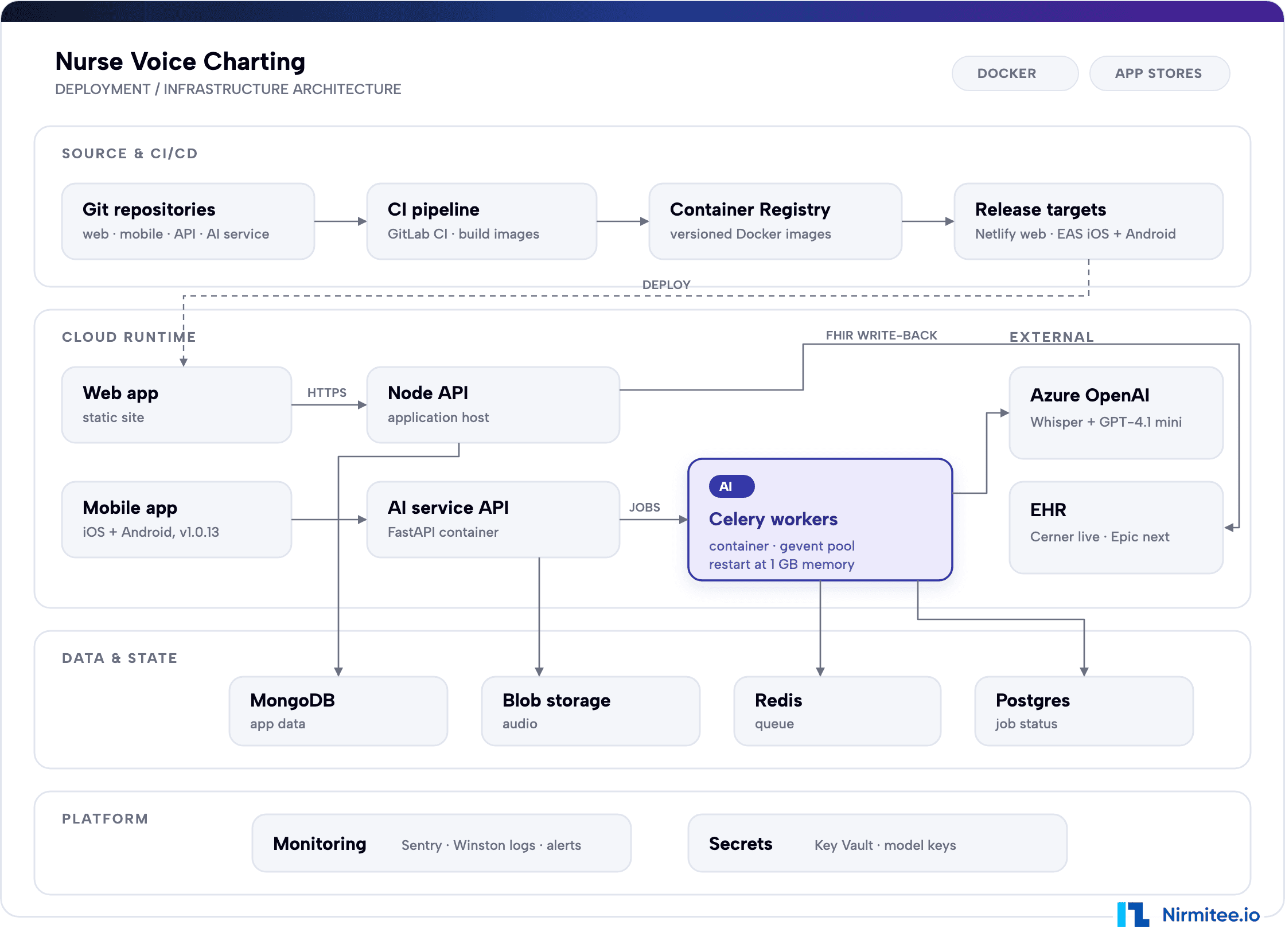
Safety built into the design
| Risk | What the system does |
|---|---|
| The AI invents a value | Dropdown answers must match the allowed list or stay empty. |
| A nurse cannot check a value | Every field carries a reason, a transcript quote and the audio. |
| A draft is saved as final | Only the nurse's confirmation saves a chart. |
| Abnormal vitals are missed | Values outside normal ranges turn red. |
| A worker crashes mid-job | A job is confirmed only when it finishes, so a crashed job runs again. |
Teaching the model to chart like a nurse
The extraction job is narrow: read one transcript and fill fixed fields from fixed options. That favoured a smaller model trained on real charting work over a large general one.
| Stage | Speech to text | Field filling | What we learned |
|---|---|---|---|
| Proof, 2024 | AWS Transcribe | Simple mapping to FHIR vitals | Launching inside the EHR worked. Mapping speech to fields was harder. |
| First product | Whisper on Azure | GPT-4, then GPT-4o, one prompt | Good results, but one prompt over 300+ fields drifted from the allowed options. |
| Split by group | Whisper, audio sped up, split in parallel | One call per field group, 5 at a time | Smaller calls are faster and easier to check. |
| Fine-tuning | Whisper | Fine-tuned GPT-4.1 mini in production | A small tuned model fits a narrow charting job. |
| Model as a setting | Whisper | Any approved model, chosen per hospital | Admins switch models in settings, with no release. |
This is the kind of human-in-the-loop design our healthcare AI agents follow: the AI drafts, a person decides.
How it compares
Other nurse documentation tools, in their own words, and what Scribe adds.
| Tool | What its public page says |
|---|---|
| Abridge for nursing | Ambient documentation for nurses, built with Epic, with draft notes traced back to the source conversation. |
| Microsoft Dragon Copilot | Ambient capture turned into structured flowsheet entries for nurse review and approval, inside Epic. |
| Oracle Health Clinical AI Agent | Voice-enabled discrete charting into the Oracle Health inpatient EHR. |
Scribe adds three things on every single field: the transcript quote, the audio clip, and a mark showing whether the nurse said it or the AI inferred it. It also lets each unit edit its own field rules without a release.
Vendor descriptions summarised from the linked pages, November 2026.
Oracle Health today, Epic next
Scribe runs as a SMART on FHIR app, the standard way to launch an app inside an EHR with the patient already open.
| Step | Oracle Health (Cerner) | Epic |
|---|---|---|
| Launch | Inside PowerChart, patient in context | Inside Hyperspace, patient in context |
| Read | Patient, encounter and allergies to pre-fill | Same, through Epic FHIR R4 |
| Write | Confirmed vitals and assessment values as FHIR Observations | Same code, flowsheet set-up per site |
| Status | Live | Next |
Read more about our Oracle Health integration and Epic integration work.
Security and privacy
For this engagement, patient audio and charts stay in the client's own Azure account, under the client's control and its Canadian privacy obligations.
What we learned
Four lessons we now bring to every clinical AI build.
Explore our healthcare AI solutions and AI medical scribe development services.
Building AI charting for nurses?
Tell us your EHR, your units and your assessment forms. We will show how voice charting fits, where the nurse stays in control, and what the first phase takes, with a fixed-scope quote after a scoping call.
Client details are kept private. Demo patients shown. Industry figures link to their sources.