E-prescribing for telehealth, EHR vendors and health systems

E-Prescribing Integration Services

We add e-prescribing to your product or connect it to the prescribing you already have. We pick the route that fits you: an eRx vendor API such as DoseSpot, DrFirst Rcopia, ScriptSure or Photon Health, a direct Surescripts connection, or the prescribing module inside Epic, Oracle Health or athenahealth. Then we build EPCS for controlled substances, benefit checks before signing, and refill and change requests that come back to the right prescriber.

  • Surescripts
  • NCPDP SCRIPT 2023011
  • EPCS
  • DoseSpot
  • DrFirst Rcopia
  • Photon Health
  • FHIR MedicationRequest

Pick the route, then build the workflow
  1. 01Choose the route

    eRx vendor API, direct Surescripts, or the EHR's own prescribing, set by your volume and buyers.

  2. 02Prescribe

    Patient, drug and pharmacy picked in your screen; NewRx sent over the network.

  3. 03Controlled substances

    EPCS identity proofing and two-factor signing where you prescribe Schedule II to V.

  4. 04Close the loop

    Renewals, changes, cancels and fill status tied back to the original order.

The short answer

E-Prescribing Integration Services, in Short

Almost every US retail pharmacy receives prescriptions as NCPDP SCRIPT messages over the Surescripts network. Your product reaches it in one of three ways: through a certified eRx vendor that already holds the connection, through your own Surescripts certification, or through the EHR your clinicians already prescribe in. Most telehealth and digital health products start with a vendor API. EHR vendors and high-volume platforms move to a direct connection. Hospitals prescribe inside Epic or Oracle Health and need integrations around that prescribing, not a second prescribing tool. We build all three, plus EPCS, benefit checks and a FHIR medication model in your product.

Who it is for
Telehealth and virtual care products, GLP-1 and weight loss clinics, behavioral health platforms, EHR and practice management vendors, health systems and digital pharmacies.
What we build
eRx vendor API or widget integration, direct NCPDP SCRIPT connectivity, EPCS workflows, formulary and real-time benefit checks, and integrations around EHR-native prescribing.
The outcome
Prescriptions that reach the pharmacy the patient chose, controlled substances signed the way the DEA requires, and every pharmacy response matched to the original order.

How it works

How E-Prescribing Integration Works

Three pictures of the same work: one prescription end to end, the three routes side by side, and what changes in a large hospital.

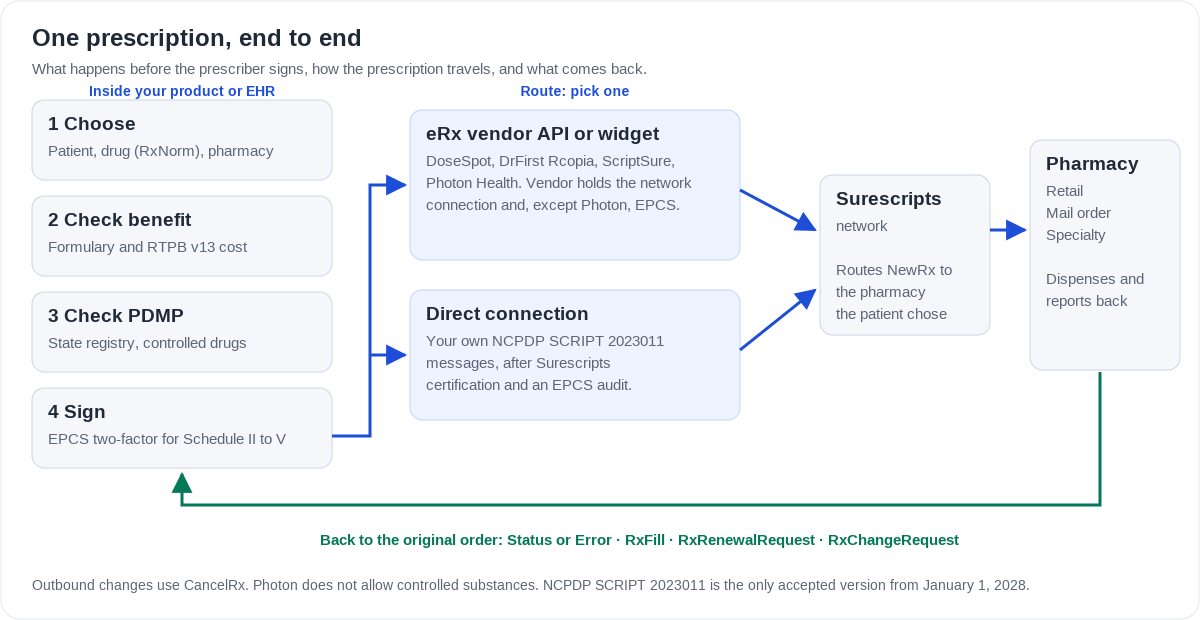
One e-prescription end to end: choose patient, drug and pharmacy, check formulary and real-time benefit, check the PDMP, sign with EPCS, send through an eRx vendor API or a direct NCPDP SCRIPT connection to the Surescripts network and the pharmacy, then receive Status, RxFill, RxRenewalRequest and RxChangeRequest back on the original order.
One prescription, end to end. The checks happen before signing; the pharmacy's answers come back to the original order.
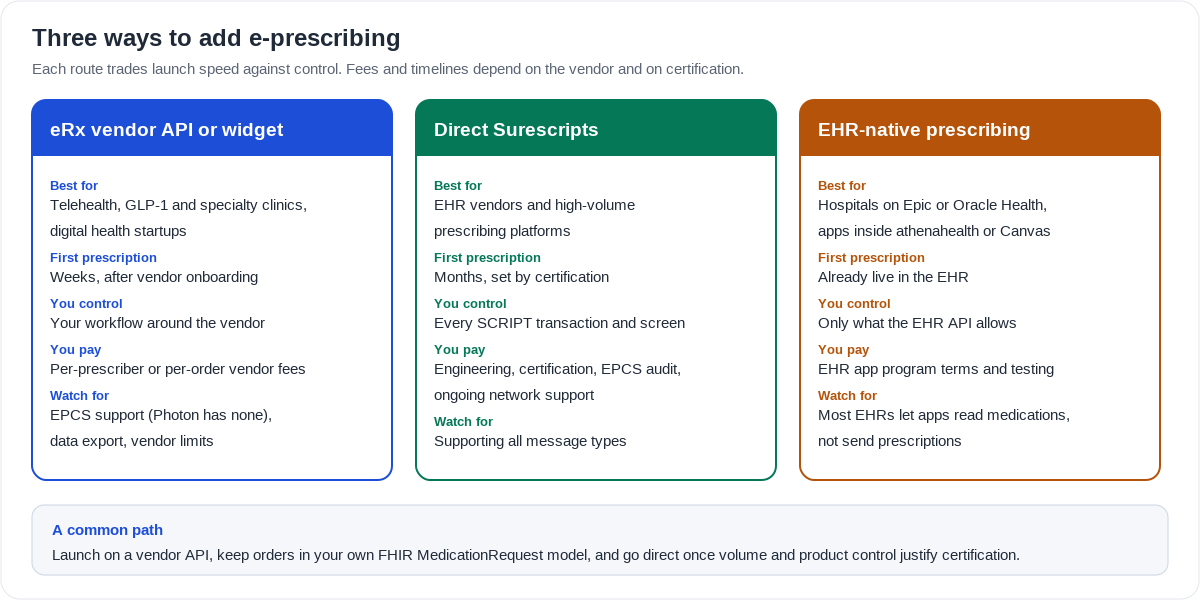
Three routes compared: an eRx vendor API launches in weeks for telehealth and clinics; direct Surescripts certification takes months and suits EHR vendors; EHR-native prescribing suits hospitals and apps inside an EHR, which usually let outside apps read medications but not send prescriptions.
Three routes to the pharmacy network, with who each one fits and what it costs you.
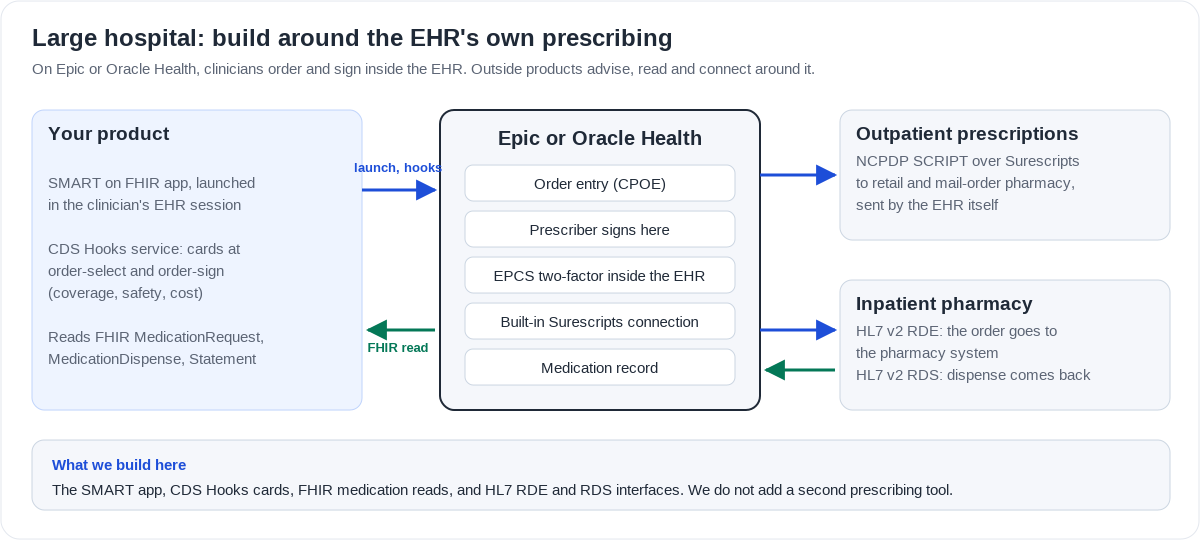
In a hospital on Epic or Oracle Health, prescribers order and sign in the EHR. An outside product launches as a SMART on FHIR app, returns CDS Hooks cards at order-select and order-sign and reads FHIR medication resources. Outpatient prescriptions go over Surescripts; inpatient orders go to pharmacy as HL7 RDE and dispenses return as RDS.
Large hospitals: we build around the EHR's own prescribing instead of adding a second prescribing tool.

Routes to the pharmacy

Every Way to Add E-Prescribing, by Buyer

The right route depends on who prescribes, how many prescriptions you send and whether you prescribe controlled substances. These are the routes we build on, as of November 2026.

Your situationRoute we usually recommendWhyWhat to plan for
Telehealth or digital health startupeRx vendor API or embedded widget (DoseSpot, DrFirst Rcopia, ScriptSure, Photon Health)The vendor already holds the Surescripts connection and EPCS, so you launch in weeksPer-prescriber fees, the vendor's onboarding and identity steps, and what data you can export
GLP-1, weight loss or med spa cliniceRx vendor API, plus compounding or mail-order pharmacy routing where usedPrescribing sits inside your intake and follow-up flowWhich pharmacies the vendor reaches, and state rules for the drugs you prescribe
Behavioral health with controlled substanceseRx vendor with EPCS, or direct certification at scaleEPCS identity proofing and two-factor signing are required for Schedule II to VDEA 21 CFR 1311 controls, PDMP checks and state EPCS mandates
EHR or practice management vendorDirect Surescripts certification, or a white-label eRx vendor while you certifyYou control the prescriber experience across every customerSurescripts certification testing, EPCS audit or certification, and support for every SCRIPT transaction
Large hospital or health system on Epic or Oracle HealthThe EHR's own prescribing, with integrations around itOrders, EPCS and pharmacy routing already run inside the EHRFHIR MedicationRequest reads, CDS Hooks at order sign, and HL7 RDE and RDS messages for inpatient pharmacy
Product used inside athenahealth, eCW, Cerbo or CanvasThe EHR's own prescribing, reached through its API where allowedIn our November 2026 checks most EHRs let outside apps read medications but not send prescriptions. Canvas Medical plugins can draft and send, and the prescriber still signs in CanvasWhat each EHR allows: read only, a queue the prescriber signs, or full drafting
Digital, specialty or mail-order pharmacyPharmacy-side network connection for inbound prescriptionsYou receive NewRx and send renewals, changes and fill statusPharmacy network certification and inbound routing rules

FHIR alone does not send a prescription to a US retail pharmacy. Use FHIR inside your product and convert to NCPDP SCRIPT at the network edge.

What we build

What Our E-Prescribing Integration Services Build

Each workstream ships with a specification, tests and an owner.

01

eRx Vendor API or Widget Integration

Prescriber and patient sync, the vendor's prescribing screen or API embedded in your product, pharmacy search, and status webhooks written back to your records.

DoseSpot · DrFirst Rcopia · ScriptSure · Photon Health

DoseSpot API integration guide →
02

Direct Surescripts Connection

NCPDP SCRIPT 2023011 messaging for NewRx, CancelRx, RxRenewal, RxChange and RxFill, the pharmacy directory, and the test scripts Surescripts certification asks for.

NCPDP SCRIPT 2023011 · NewRx · RxRenewal · RxChange · CancelRx · RxFill

Surescripts integration guide →
03

EPCS for Controlled Substances

Identity proofing through a credential service provider, two-factor signing at the moment of prescribing, two-person access control, audit logs, and PDMP checks before signing.

DEA 21 CFR 1311 · identity proofing · two-factor · PDMP

DrFirst and Rcopia integration guide →
04

Integrations Around EHR-Native Prescribing

For hospitals and EHR-embedded products: read medication orders through FHIR, add advice at order sign through CDS Hooks, and connect inpatient pharmacy with HL7 RDE and RDS.

FHIR MedicationRequest · CDS Hooks order-sign · HL7 RDE and RDS

NCPDP SCRIPT and FHIR MedicationRequest →
05

Benefit, Formulary and Prior Authorization

Pharmacy eligibility, formulary status and real-time prescription benefit shown before the prescriber signs, and electronic prior authorization when the plan asks for it.

X12 270/271 · NCPDP F&B · NCPDP RTPB 13 · NCPDP ePA

CoverMyMeds API integration →
06

FHIR Medication Model and Pharmacy Interfaces

MedicationRequest, MedicationDispense and MedicationStatement coded to RxNorm in your product, and Mirth Connect channels for SCRIPT and pharmacy system messages.

FHIR R4 · US Core · RxNorm · NDC · Mirth Connect

Mirth Connect for NCPDP and pharmacy →

Buyer decisions

eRx Vendor API vs Direct Surescripts vs EHR-Native Prescribing

The three routes trade launch speed against control. We build on each and help you move between them.

RouteTime to first prescriptionWhat you controlWhat it costs you
eRx vendor API or widgetWeeks, after the vendor's onboardingYour workflow around the vendor's prescribing screen or APIPer-prescriber or per-transaction vendor fees and the vendor's product limits
White-label eRx vendorWeeks to a few monthsYour branding and most of the prescriber experienceHigher vendor fees and a deeper vendor contract
Direct Surescripts certificationMonths, set largely by certification testingThe full SCRIPT workflow, prescriber experience and dataEngineering for every transaction, certification, the EPCS audit and ongoing network support
EHR-native prescribingDepends on the EHR's app programOnly what the EHR's API allows around its own prescribingEHR app program terms and testing in each customer's EHR
Pharmacy-side connectionMonths, set by network certificationInbound prescriptions and pharmacy responsesPharmacy certification and routing rules

A common path is to launch on a vendor API, keep orders in your own FHIR model, and move direct once volume and product control justify certification.

Integration boundaries

E-Prescribing Boundaries: Who Owns What

Prescribing crosses clinical, regulatory and network lines. We write ownership down before the build.

Prescribers and your clinical team

Drug choice, substitutions and signing. The software supports the prescriber; it never decides for them.

The network and the eRx vendor

Surescripts or your eRx vendor owns network participation, certification testing and the pharmacy directory.

DEA, CMS and state rules

EPCS comes from 21 CFR 1311 and state law. The application's third-party audit or certification is a gating step we plan for.

The integration layer (ours)

Vendor or SCRIPT connectivity, FHIR mapping, routing, identity and signing workflows, correlation, retries and alerts. Defects here are ours to fix.

Security and PHI

Prescription data is encrypted in transit and at rest, access is logged, and we sign a BAA and work inside our ISO 27001:2022 certified management system.

Deliverables

E-Prescribing Integration Deliverables

Everything below lands in your repository and your runbook.

01

Route decision record

Vendor, direct or EHR-native route, with the reasons, the fees you will carry and the exit path if you change later.

02

Integration specification

Transactions, FHIR resources, identifiers, pharmacy routing and annotated sample messages.

03

Connectors and code

Vendor API or SCRIPT connector, FHIR mapping and webhooks in your repository.

04

EPCS evidence pack

Identity proofing flow, two-factor signing, access control records and audit logs ready for the third-party review.

05

Test evidence

NewRx, renewal, change, cancel, fill and error scenarios, including pharmacy rejections.

06

Monitoring and runbook

Alerts on failed or unanswered prescriptions, escalation contacts and support procedures.

Delivery phases

E-Prescribing Integration Timeline

Prescribing through an eRx vendor API typically takes 6 to 10 weeks. Direct Surescripts certification and the EPCS audit add time, set largely by the certifying bodies.

  1. 01

    Route and requirements

    Weeks 1 to 2

    Route chosen, vendor or network onboarding started, EPCS scope and state rules confirmed

  2. 02

    Build

    Weeks 2 to 6

    Vendor API or SCRIPT integration, FHIR mapping, benefit checks and the prescriber workflow

  3. 03

    Certification and testing

    Weeks 5 to 9

    Vendor or network test scripts, EPCS identity and signing tested, pharmacy responses checked

  4. 04

    Go-live and hypercare

    Weeks 8 to 10

    Production prescribers enabled, monitoring live, runbook handed over

Cost drivers

What Drives E-Prescribing Integration Cost

You get a fixed scope after one scoping call. These are the factors that move it.

Route to the network

A vendor API is the smallest build. Direct certification is a larger, longer workstream.

Controlled substances

EPCS adds identity proofing, two-factor signing, PDMP checks and an application audit or certification.

Transactions in scope

NewRx alone is the smallest unit. Renewals, changes, cancels and fill status each add a workflow.

Benefit and prior authorization

Formulary, real-time benefit and ePA checks add payer and PBM connectivity.

EHR context

Working around Epic, Oracle Health or athenahealth prescribing adds that EHR's app program and testing.

Vendor fees

eRx vendor and network fees are paid to the vendor and sit outside our scope. We list them in the route decision.

Book a call ↗

Proof

E-Prescribing Work You Can Check

Client names are withheld. The code linked here is public.

Case study

Digital Pharmacy Marketplace with E-Prescribing

Built for a multi-store pharmacy chain: Surescripts e-prescribing, 270/271 insurance checks, PDMP checks before the pharmacist reviews a prescription, and delivery tracking in a patient app.

Read the case study →

Public GitHub repository

Open-source Headless EHR on FHIR R4

Our FHIR R4 EHR backend passed 47 of 47 ONC (g)(10) Inferno SMART App Launch STU2 standalone patient tests, the same foundation we use for MedicationRequest workflows.

View the repository on GitHub →

Public GitHub repository

Open-source Da Vinci CRD Server

Our CDS Hooks coverage requirements server returns coverage and documentation rules at order sign, the same moment a prescriber needs benefit information.

View the CRD server on GitHub →

Nirmitee platform

Interoply Integration Platform

Our platform runs X12, HL7 v2 and FHIR connectors behind one API, with per-partner configuration, replay and monitoring built in.

See Interoply →

Security

ISO 27001:2022 Certified, BAAs Signed

We are ISO 27001:2022 certified and sign Business Associate Agreements for work that touches patient data.

FAQ

E-Prescribing Integration: Questions Buyers Ask

What Is E-Prescribing Integration?

E-prescribing integration connects your product or EHR to the network that carries prescriptions to pharmacies. It covers choosing a route (an eRx vendor, a direct Surescripts connection or the EHR's own prescribing), the prescriber workflow, EPCS for controlled substances, benefit checks, and the pharmacy responses that come back.

What is the best e-prescribing API for EHR integration?

It depends on your buyers and volume. DoseSpot, DrFirst Rcopia, ScriptSure and Photon Health all reach pharmacies through certified network connections and differ in embedding style, EPCS support, pricing model and data access. We compare them against your workflow in the route decision before you sign a vendor contract.

Do I have to go through Surescripts to reach retail pharmacies?

Almost every US retail pharmacy receives e-prescriptions over the Surescripts network. You either connect directly, which means Surescripts certification, or use a certified eRx vendor that already holds the connection. Most products start with a vendor and move direct when volume justifies it.

Can I use FHIR for electronic prescribing?

Use FHIR inside your product and between apps and EHRs: MedicationRequest for the order, MedicationDispense and MedicationStatement for what happened next. To reach a US retail pharmacy, the network still expects NCPDP SCRIPT, so we convert FHIR to SCRIPT at the network edge or let the eRx vendor do it.

How do large hospitals handle e-prescribing integration?

Hospitals on Epic or Oracle Health prescribe inside the EHR, which already holds the Surescripts connection and EPCS. Outside products integrate around it: they read orders through FHIR MedicationRequest, add advice at order sign through CDS Hooks, and connect inpatient pharmacy systems with HL7 RDE and RDS messages.

Can an outside app send prescriptions into athenahealth or another EHR?

In our November 2026 checks of vendor documentation, most EHRs let outside apps read medications but not send prescriptions. Some offer a queue the prescriber reviews and signs. Canvas Medical plugins can draft and send a prescription, and the prescriber still signs it in Canvas. We confirm what your target EHR allows before we design the flow.

Do I need to be NCPDP certified to send electronic prescriptions?

You need network certification, which Surescripts runs, only if you connect directly. If you use a certified eRx vendor, the vendor holds it and you complete their onboarding. Controlled substances also need an EPCS audit or certification of the prescribing application, which vendors usually cover for their own software.

What does EPCS require?

Under DEA rule 21 CFR 1311, each prescriber's identity is proofed by an approved credential service provider, every controlled substance prescription is signed with two-factor authentication, access controls are set by two people, and the application needs a third-party audit or certification. Many states also mandate EPCS.

Can I white label a prescribing interface inside my own product?

Yes. Several eRx vendors offer an API or white-label option so the prescriber stays in your screens, while the vendor holds the network connection and EPCS. Options, fees and what you can restyle differ by vendor, so we check them against your design before you commit.

Which NCPDP SCRIPT version is required?

CMS adopted NCPDP SCRIPT version 2023011 for Medicare Part D in a final rule published June 17, 2024. Version 2017071 or 2023011 may be used during the transition, and from January 1, 2028 only 2023011 is accepted. Products still on 2017071 should plan the upgrade now.

How Long Does E-Prescribing Integration Take?

Prescribing through an eRx vendor API typically takes 6 to 10 weeks. Direct Surescripts certification and the EPCS audit add time, set largely by the certifying bodies. Work around EHR-native prescribing depends on the EHR's app program.

How Much Does E-Prescribing Integration Cost?

Cost depends on the route, whether you prescribe controlled substances, the SCRIPT transactions in scope, benefit and prior authorization checks, and the EHRs involved. Vendor and network fees are paid to the vendor. We give a fixed scope after one scoping call, before you commit.

Next step

Pick Your E-Prescribing Route in One Call

Tell us who prescribes, roughly how many prescriptions you send, which EHRs your customers use and whether you prescribe controlled substances. An integration engineer replies with the route we recommend and a fixed scope.

Send your details

Which Prescribing Workflow Do You Need?

Tell us about your product, your prescribers and the pharmacies you need to reach. Please do not send patient data.

  • The systems and partners involved
  • Available API, SFTP or interface access
  • Your workflow and target date

Please exclude patient data and credentials. We use these details to respond to your inquiry. Privacy policy

Thank you. Your inquiry has been received. Our team will review your requirements.