42 CFR Part 2 checklist for 2026, with a consent form template
42 CFR Part 2 protects substance use disorder treatment records, and compliance with the 2024 rule became mandatory on Feb 16, 2026 (89 FR 12472). This page lists 30 checks with their CFR citations, the 10 consent elements and a plain-language consent form template.
Dates, and what the Nov 19, 2026 HIPAA rule changed
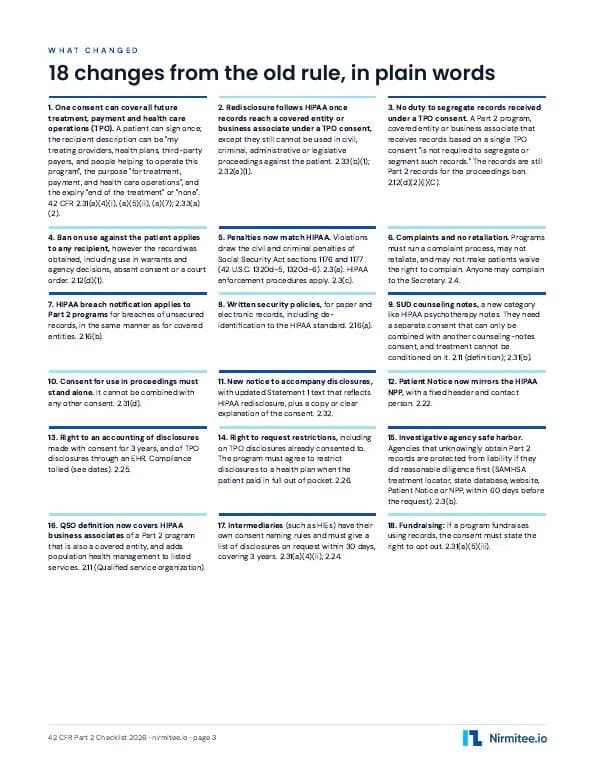
18 changes from the old rule in plain words
Checks grouped by team, each cited
Consent form template and notes for engineers
ISO 27001:2022 certified4.7 on Clutch (12 reviews)We sign BAAsSOC 2 in progressTrust center
The PDF holds everything on this page in a printable form, plus the engineering notes.
The short answers
The short answers
What is 42 CFR Part 2?
A federal rule that protects substance use disorder treatment records from federally assisted programs (42 CFR 2.11, 2.12). The 2024 update aligned it with HIPAA: one consent can cover treatment, payment and operations (2.31(a)(4)(i)), and HIPAA penalties and breach notification now apply (2.3(a), 2.16(b)).
When did compliance start?
Feb 16, 2026. The rule took effect Apr 16, 2024 (89 FR 12472). The compliance date for the accounting of disclosures section (2.25) is tolled until HHS revises 45 CFR 164.528 (89 FR 12472).
Did the November 2026 HIPAA rule remove Part 2 consent?
No. HHS states Part 2 programs must still get patient consent before sharing records for treatment, payment and operations (91 FR 74921).
At a glance
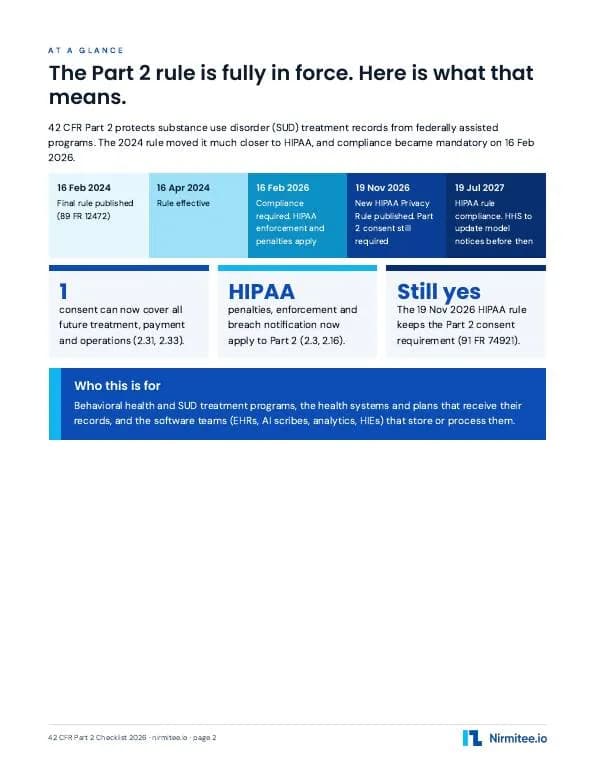
42 CFR Part 2 dates: the rule is fully in force
Compliance with the 2024 Part 2 rule has been required since Feb 16, 2026, and HIPAA penalties, enforcement and breach notification now apply to Part 2 (2.3, 2.16). The Nov 19, 2026 HIPAA rule keeps the Part 2 consent requirement (91 FR 74921).
Feb 16, 2024 Final rule published (89 FR 12472)
Apr 16, 2024 Rule effective (89 FR 12472)
Feb 16, 2026 Compliance required (89 FR 12472). HIPAA enforcement and penalties apply (42 CFR 2.3)
Nov 19, 2026 New HIPAA Privacy Rule published (91 FR 74848). Part 2 consent still required (91 FR 74921)
Jul 19, 2027 HIPAA rule compliance date. HHS says it will update the model notices before then (91 FR 74848)
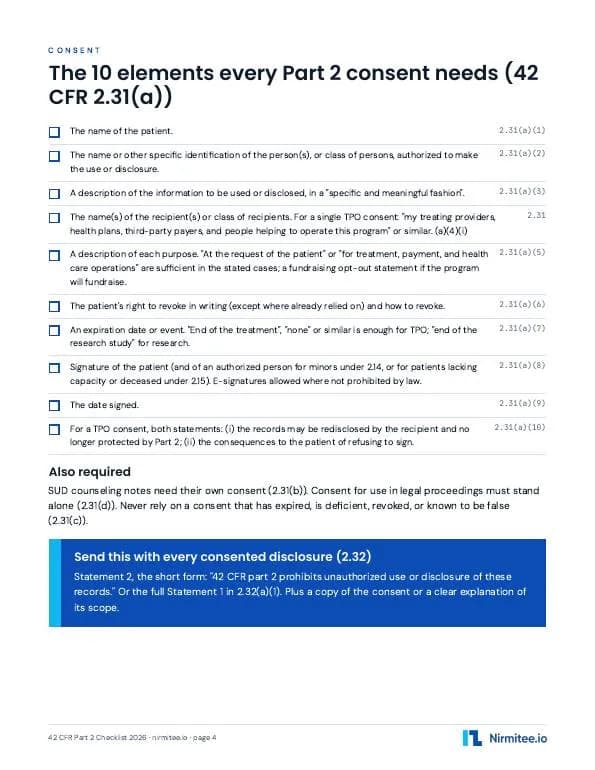
42 CFR Part 2 consent form: the 10 required elements
Every Part 2 consent needs these ten elements under 42 CFR 2.31(a). SUD counseling notes need their own consent (2.31(b)), and consent for use in legal proceedings must stand alone (2.31(d)).
#
Required element
Citation
1
The name of the patient.
2.31(a)(1)
2
The name or other specific identification of the person(s), or class of persons, authorized to make the use or disclosure.
2.31(a)(2)
3
A description of the information to be used or disclosed, in a "specific and meaningful fashion".
2.31(a)(3)
4
The name(s) of the recipient(s) or class of recipients. For a single TPO consent: "my treating providers, health plans, third-party payers, and people helping to operate this program" or similar.
2.31(a)(4)(i)
5
A description of each purpose. "At the request of the patient" or "for treatment, payment, and health care operations" are sufficient in the stated cases; a fundraising opt-out statement if the program will fundraise.
2.31(a)(5)
6
The patient's right to revoke in writing (except where already relied on) and how to revoke.
2.31(a)(6)
7
An expiration date or event. "End of the treatment", "none" or similar is enough for TPO; "end of the research study" for research.
2.31(a)(7)
8
Signature of the patient (and of an authorized person for minors under 2.14, or for patients lacking capacity or deceased under 2.15). E-signatures allowed where not prohibited by law.
2.31(a)(8)
9
The date signed.
2.31(a)(9)
10
For a TPO consent, both statements: (i) the records may be redisclosed by the recipient and no longer protected by Part 2; (ii) the consequences to the patient of refusing to sign.
2.31(a)(10)
Send this with every consented disclosure (2.32). Statement 2, the short form: "42 CFR part 2 prohibits unauthorized use or disclosure of these records." Or the full Statement 1 in 2.32(a)(1). Plus a copy of the consent or a clear explanation of its scope.
The PDF holds a plain-language consent form template that follows these elements. Review it with counsel before use.
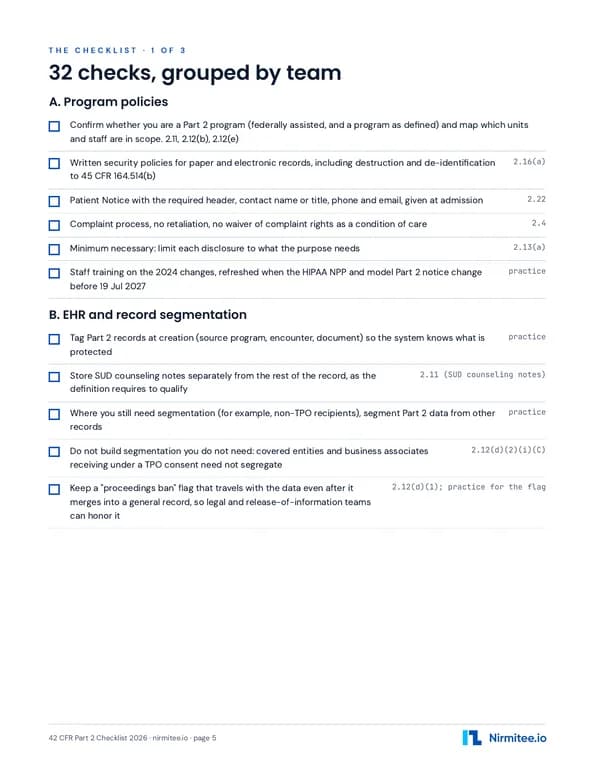
The 42 CFR Part 2 checklist: 30 checks, grouped by team
Each rule check carries its section of 42 CFR Part 2 or the Federal Register. Checks marked "Nirmitee recommendation, not a rule requirement" are our engineering advice.
A. Program policies
Confirm whether you are a Part 2 program (federally assisted, and a program as defined) and map which units and staff are in scope.2.11, 2.12(b), 2.12(e)
Written security policies for paper and electronic records, including destruction and de-identification to 45 CFR 164.514(b).2.16(a)
Patient Notice with the required header, contact name or title, phone and email, given at admission.2.22
Complaint process, no retaliation, no waiver of complaint rights as a condition of care.2.4
Minimum necessary: limit each disclosure to what the purpose needs.2.13(a)
We recommend training staff on the 2024 changes, and again when HHS updates the model notices (HHS says before Jul 19, 2027, 91 FR 74848).Nirmitee recommendation, not a rule requirement
B. EHR and record segmentation
We recommend tagging Part 2 records at creation (source program, encounter, document) so the system knows what is protected.Nirmitee recommendation, not a rule requirement
Store SUD counseling notes separately from the rest of the record, as the definition requires to qualify.2.11
Do not build segmentation you do not need: covered entities and business associates receiving under a TPO consent need not segregate.2.12(d)(2)(i)(C)
We recommend a flag that carries the ban on use in proceedings (42 CFR 2.12(d)(1)) with the data, even after it merges into a general record.Nirmitee recommendation, not a rule requirement
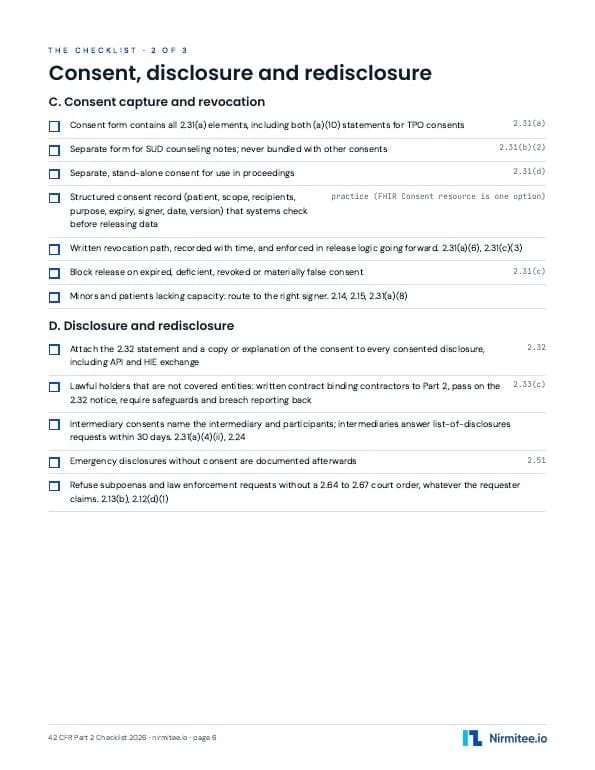
C. Consent capture and revocation
Consent form contains all 2.31(a) elements, including both (a)(10) statements for TPO consents.2.31(a)
Separate form for SUD counseling notes; never bundled with other consents.2.31(b)(2)
Separate, stand-alone consent for use in proceedings.2.31(d)
We recommend a structured consent record (patient, scope, recipients, purpose, expiry, signer, date, version) that systems check before releasing data.Nirmitee recommendation, not a rule requirement
Written revocation path, recorded with time, and enforced in release logic going forward.2.31(a)(6), 2.31(c)(3)
Block release on expired, deficient, revoked or materially false consent.2.31(c)
Minors and patients lacking capacity: route to the right signer.2.14, 2.15, 2.31(a)(8)
D. Disclosure and redisclosure
Attach the 2.32 statement and a copy or explanation of the consent to every consented disclosure, including API and HIE exchange.2.32
Lawful holders that are not covered entities: written contract binding contractors to Part 2, pass on the 2.32 notice, require safeguards and breach reporting back.2.33(c)
Intermediary consents name the intermediary and participants; intermediaries answer list-of-disclosures requests within 30 days.2.31(a)(4)(ii), 2.24
Emergency disclosures without consent are documented afterwards.2.51
Refuse subpoenas and law enforcement requests without a 2.64 to 2.67 court order, whatever the requester claims.2.13(b), 2.12(d)(1)
E. Breach notification
Run HIPAA breach risk assessment and notification (individuals, HHS, media where required) for unsecured Part 2 records.2.16(b), 45 CFR 164 subpart D
F. Patient rights
Accounting of disclosures made with consent for 3 years, and TPO disclosures through an EHR. The compliance date is tolled until HHS revises 45 CFR 164.528 (89 FR 12472).2.25
Accept requests to restrict TPO disclosures; must agree to restrict disclosure to a health plan for self-paid care.2.26
Patient access to their own records.2.23
G. AI scribes and analytics
We recommend treating an AI scribe or analytics vendor that receives Part 2 records as a qualified service organization under the 2.11 definition, or, where the program is also a covered entity, as a business associate under a BAA.Nirmitee recommendation, not a rule requirement
We recommend keeping scribe transcripts and draft notes of counseling sessions inside the program's security controls (42 CFR 2.16(a) requires written security policies for records).Nirmitee recommendation, not a rule requirement
Vendor contract requires breach reporting, deletion on termination, no redisclosure, and subprocessor flow-down.2.33(c)
H. Audit evidence
HIPAA enforcement procedures now apply to Part 2 (42 CFR 2.3(c)). We recommend keeping an evidence pack: signed consents and versions, revocations, 2.32 notices sent, disclosure logs, QSO agreements and BAAs, risk assessments, breach files, training records and Patient Notice versions.Nirmitee recommendation, not a rule requirement
When you want it done for you
Part 2 Gap Review
Our engineers review your EHR, apps, scribe and data flows against these 30 checks and return a fix list with effort estimates, ranked by risk. You keep the report.
Integrations we have delivered: athenahealth, eClinicalWorks, and an Epic SMART on FHIR patient-facing app.
You own the code: everything we build lives in your repositories.
Price: fixed-scope quote after a scoping call.
The call: a 30-minute technical review with a Nirmitee engineer, not a sales pitch. No patient data needed.
When did the new Part 2 rule take effect, and when did compliance start?
Effective Apr 16, 2024; compliance required by Feb 16, 2026. The compliance date for the accounting of disclosures section (2.25) is tolled until HHS revises 45 CFR 164.528. Source: 89 FR 12472.
Can one consent cover all treatment, payment and operations?
Yes. A single consent for all future TPO is allowed, with generic recipient wording and an expiry of "end of treatment" or "none". Source: 42 CFR 2.31(a)(4)(i), (a)(5)(ii), (a)(7); 2.33(a)(2).
What must a 42 CFR Part 2 consent form include?
Ten elements under 42 CFR 2.31(a): patient name, who may disclose, what is disclosed, recipients, purpose, the right to revoke, expiry, signature, date and, for a TPO consent, the redisclosure and refusal statements. Source: 42 CFR 2.31(a)(1) to (a)(10).
Does HIPAA breach notification apply to Part 2 records?
Yes, to breaches of unsecured records, in the same manner as for covered entities. Source: 42 CFR 2.16(b).
What are the penalties?
The HIPAA civil and criminal penalties under Social Security Act sections 1176 and 1177, with HIPAA enforcement procedures. Source: 42 CFR 2.3(a), (c).
Do we have to segment Part 2 data in our EHR?
Not for records a Part 2 program, covered entity or business associate receives under a single TPO consent. The records keep their protection against use in proceedings. Other recipients may still need to segregate. Source: 42 CFR 2.12(d)(1), (d)(2)(i)(C).
We value your privacy
We use cookies to enhance your browsing experience, serve personalized content, and analyze our traffic. By clicking "Accept All", you consent to our use of cookies. Read our Privacy Policy