Nirmitee.io

Behavioral health EHR integration · United States

Behavioral Health EHR Integration Services

We connect mental health products and provider groups to behavioral health EHRs such as Netsmart myAvatar, Qualifacts, SimplePractice, TherapyNotes and athenahealth. The work starts by confirming vendor access, matching clients and agreeing where records should appear. We build supported exchanges and review queues, applying the disclosure policy your privacy owner approves.

  • Netsmart CareConnect
  • myAvatar
  • Qualifacts
  • SimplePractice
  • TherapyNotes
  • FHIR R4
  • 42 CFR Part 2

Access first, then destination, then policy.
  1. 01Find the real door

    Each EHR offers something different: certified FHIR, a general FHIR API with writes, a partner program, HL7, or only exports. We confirm it before you build.

  2. 02Apply the approved policy

    Records your privacy owner identifies as subject to 42 CFR Part 2 move only with a recorded consent or another permitted basis.

  3. 03Write back where supported

    Note drafts, assessments and appointments go to the destination the organization agreed, on the right client and episode, with every attempt logged.

The problem

Sound Familiar?

Digital mental health companies and behavioral health groups tell us the same four things before an integration starts.

Every customer runs a different EHR

One customer is on Netsmart myAvatar, the next on Qualifacts, a third on SimplePractice. Each one allows something different, and sales promised all three.

Notes end up copied and pasted

Clinicians finish a note in your product, then paste it into the EHR. Nobody can tell which version is the record.

Scores never reach the treating team

PHQ-9 and GAD-7 results sit in your app. The clinician who needs them is looking at the EHR.

Privacy review stops the project

The customer's privacy officer asks how substance use records are protected when consent is missing or withdrawn, and there is no clear answer yet.

Use cases

What It Looks Like When It Works

Four use cases, each shown as the screen your team works in. The clients and customers are fictional; the vendor access rules behind each screen are the ones the vendors publish.

A Reviewed Note Draft Reaches the Agreed Chart Location

Today

A therapist finishes a note in your product and pastes it into the EHR by hand.

With the integration

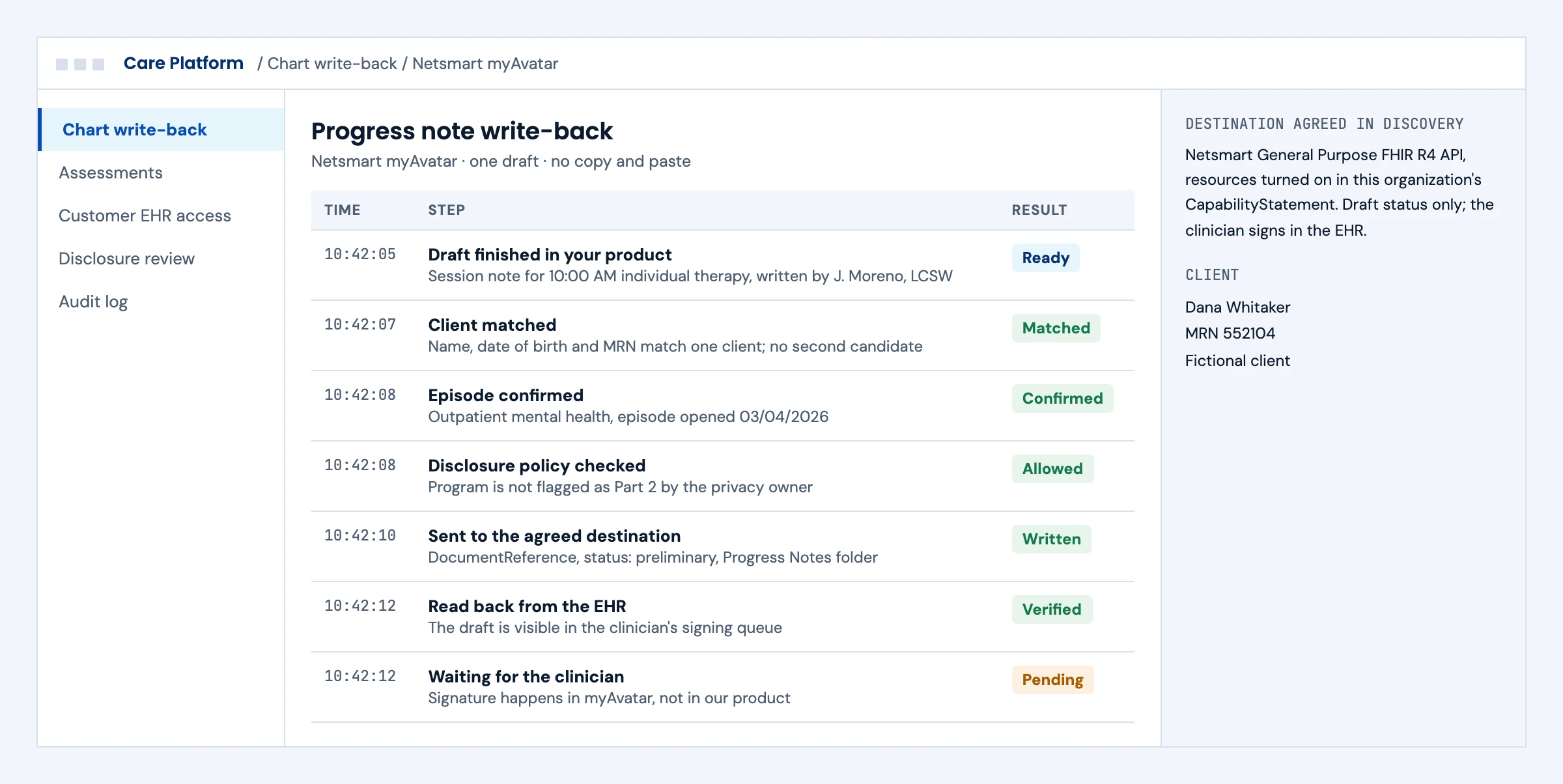
The integration matches the client and episode, writes a draft to the location agreed with the organization, reads it back, and leaves signing to the clinician in the EHR.

What we build
  • Client and episode matching, with a review queue for any uncertain match
  • Write-back only to the destination confirmed in the organization's CapabilityStatement and workflow
  • Draft status where the EHR supports it, with the clinician completing the signing step
Progress note draft written to Netsmart myAvatar as a preliminary document after client and episode checks, waiting for clinician signature
Illustrative screen with fictional clients: progress note draft written to Netsmart myAvatar as a preliminary document after client and episode checks, waiting for clinician signature. Tap to open full size.

Measurement-Based Care Scores Reach the Treating Team

Today

PHQ-9 and GAD-7 results stay inside your product, where the treating clinician rarely looks.

With the integration

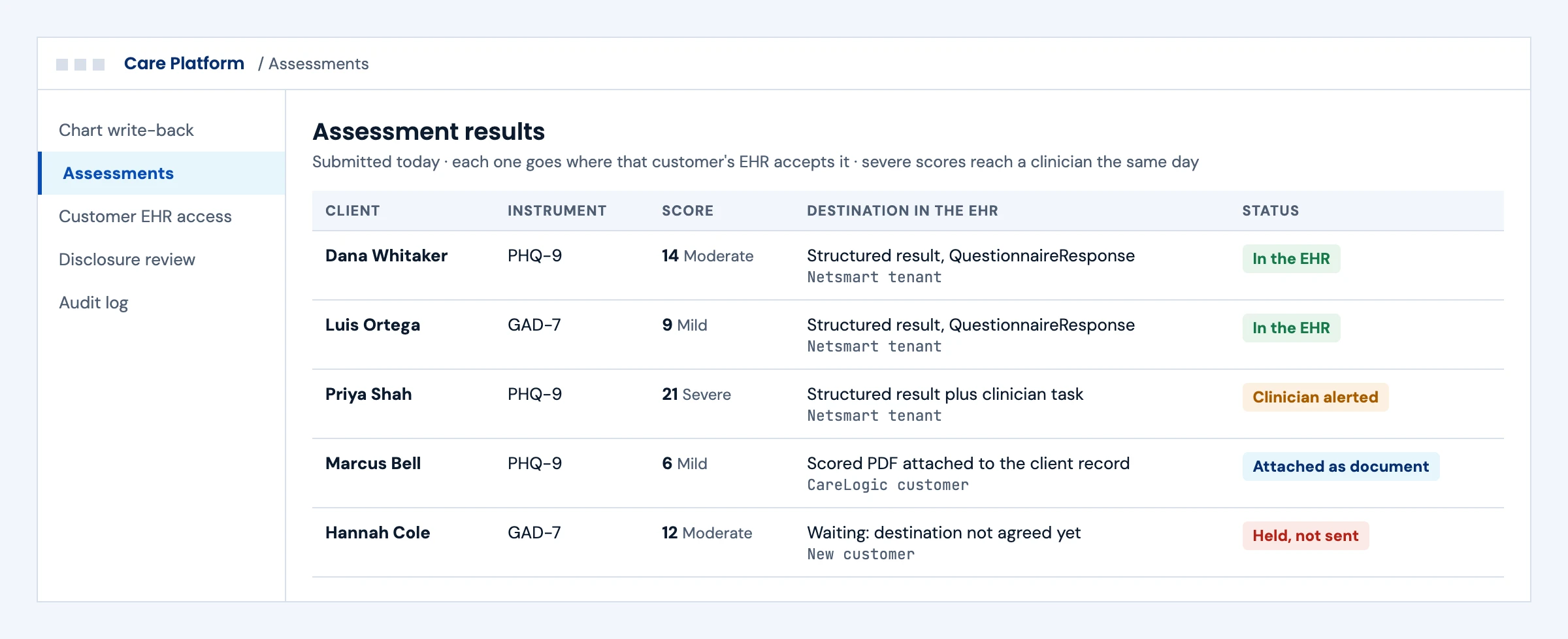
Each score goes to the destination that customer's EHR actually supports: a structured result where writes are allowed, a document where they are not. A severe score also reaches a clinician the same day.

What we build
  • Instrument mapping per EHR: structured QuestionnaireResponse where supported, document otherwise
  • Same-day routing rules for scores your clinical lead defines as urgent
  • A hold, not a guess, when a customer's destination has not been agreed
Assessment results with PHQ-9 and GAD-7 scores routed to each customer's supported EHR destination
Illustrative screen with fictional clients: assessment results with PHQ-9 and GAD-7 scores routed to each customer's supported EHR destination. Tap to open full size.

Knowing What Each Customer's EHR Allows Before You Build

Today

Your team finds out after the contract is signed that a customer's EHR has no public API.

With the integration

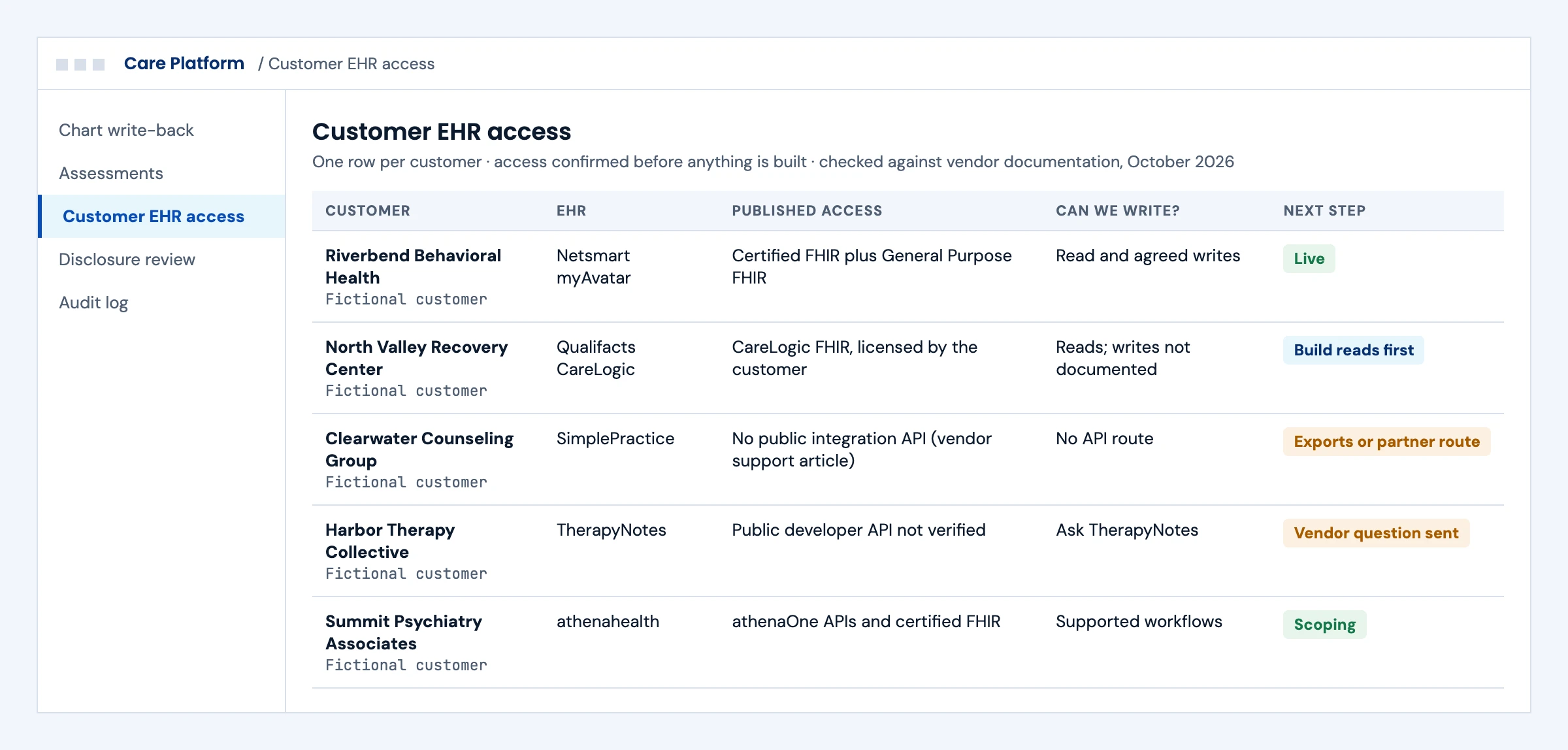
Each customer gets an access check against the vendor's published documentation: certified reads, documented writes, or no public integration API, with the next step named.

What we build
  • An access check per customer and EHR product, done in week one
  • Separate checks for CareLogic, Credible and InSync instead of one Qualifacts answer
  • A plain recommendation where no public API exists: exports, a vendor route, or a written question to the vendor
Customer EHR access check comparing Netsmart myAvatar, Qualifacts CareLogic, SimplePractice, TherapyNotes and athenahealth
Illustrative screen with fictional clients: customer EHR access check comparing Netsmart myAvatar, Qualifacts CareLogic, SimplePractice, TherapyNotes and athenahealth. Tap to open full size.

Records Held When Consent Is Missing or Withdrawn

Today

The same export sends every record to every recipient.

With the integration

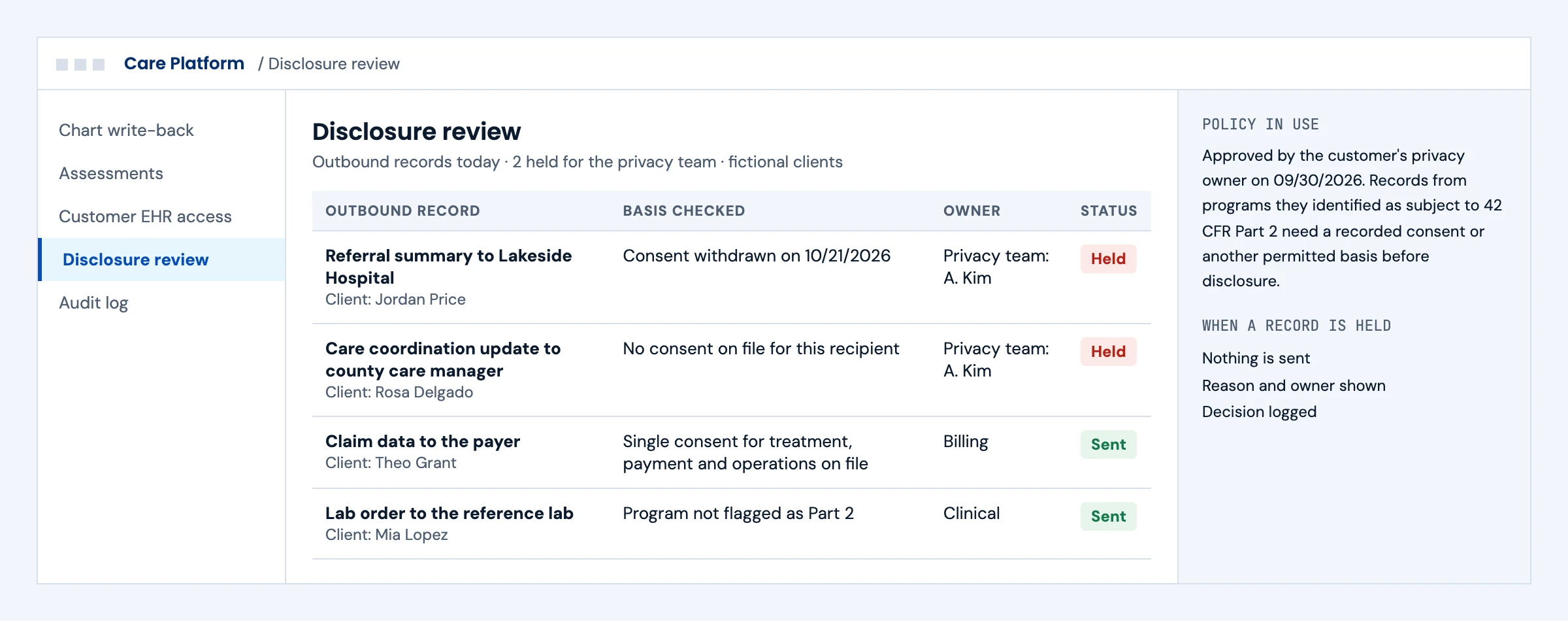
Records the privacy owner has identified as subject to 42 CFR Part 2 go out only with a recorded consent or another permitted basis. Anything else is held with the reason and an owner, and nothing is sent.

What we build
  • The disclosure policy your privacy owner approves, implemented as rules in the integration
  • Withdrawal and exceptions handled, with extra protection for separately kept counseling notes
  • A decision log showing what was held, why and who released it
Disclosure review queue holding outbound records where consent was withdrawn or missing, with the privacy team as owner
Illustrative screen with fictional clients: disclosure review queue holding outbound records where consent was withdrawn or missing, with the privacy team as owner. Tap to open full size.

First call

Questions We Will Ask You on the First Call

The answers decide the route per customer, the timeline and where behavioral health integrations usually stall. You do not need them all before we talk.

Which EHR products do your first three customers run, and which versions?

Netsmart myAvatar and myEvolv, Qualifacts CareLogic, Credible and InSync, SimplePractice and TherapyNotes each allow different things.

What must you read, and what must you write?

Reads are widely available. Writes depend on the vendor, the customer's license and the organization's configuration.

Where should a note or score appear for the clinician?

A document, a flowsheet and a signing queue are different destinations. We agree the exact screen before we build.

Who signs, and in which system?

We keep the signing step where the customer's clinical policy puts it, usually in the EHR.

Which programs hold records subject to 42 CFR Part 2?

Your privacy owner decides that, and the consent or other permitted basis each disclosure needs.

How should a withdrawn consent behave?

Hold, notify, or stop a recurring feed. The answer shapes the review queue.

How are clients matched across systems today?

Shared clients need matching rules and a review step for uncertain matches.

Do appointments also need eligibility checks?

Many behavioral health groups want coverage checked before the first session, which we connect to the same intake flow.

The short answer

Behavioral Health EHR Integration, in Short

Behavioral health EHR integration exchanges information between mental health EHRs and other care, billing or digital health products: demographics, appointments, progress notes, treatment plans, assessments, case management and medication management data, and the consent that governs them, plus the exchange with primary care in integrated care programs. Access and write capabilities differ by vendor and customer. Netsmart documents a General Purpose FHIR R4 API with create and update, subject to each organization's setup. Qualifacts documents CareLogic FHIR for registered developers and licensed customers. SimplePractice states it has no public integration API, and a public developer API for TherapyNotes is unverified. A useful integration confirms the receiving chart location, resolves uncertain client matches and applies the approved policy for records subject to 42 CFR Part 2, whose 2024 rule reached its compliance date on February 16, 2026.

Who it is for
Digital mental health and substance use treatment companies, measurement-based care and AI documentation products, payers and care management teams, and provider groups running more than one behavioral health EHR.
What we build
EHR access per vendor, client and episode matching, the approved disclosure policy as rules, supported note and assessment write-back, scheduling and referral flows, and the monitoring around them.
The outcome we design for
Records that reach the agreed chart location under the approved policy, with a record of what moved, when and why. These are intended outcomes, confirmed in your first rollout.

EHR access

What Each Behavioral Health EHR Allows Integrators to Do

Behavioral health vendors expose different combinations of certified reads, operational interfaces, exports and partner access. Checked against each vendor's published documentation in October 2026; access always depends on the customer's license and the vendor's approval, so we confirm it for each customer and product separately.

EHRPublished accessCan you write data?What to plan for
Netsmart myAvatar and myEvolv (CareConnect)Certified FHIR R4 for patient, practitioner and system access (US Core 6.1.0, Bulk Data 2.0.0) through a new developer portal with tenant-specific base URLsYes, through the General Purpose FHIR R4 API: create and update on resources including Patient, Encounter, EpisodeOfCare, CarePlan, Goal, DocumentReference, QuestionnaireResponse and ServiceRequest, per the organization's configurationRead the tenant's CapabilityStatement first, then confirm the myAvatar screen, episode and signing queue where each record should appear; a resource write is not the same as native note completion
Qualifacts CareLogicFHIR R4 with SMART on FHIR; patient, user and system (bulk) scopes; sandbox for registered developersNot documented publicly; the published API is for reading health dataProduction only for customers that licensed CareLogic FHIR; CareLogic documents 1,000 requests a minute and 100 a second per key by default
Qualifacts Credible and InSyncFHIR APIs documented per product (Credible Behavioral Health 11, InSync EMR/PM)Not documented publiclyRegistration, licensing, operations and terms must be checked separately for CareLogic, Credible and InSync
SimplePracticeNo public SimplePractice API: its own support article states it has no public integration APINo public write pathPractice exports or a vendor-supported route; login-based automation only with the practice's written authorization and within the terms
TherapyNotesPublic developer API access has not been verifiedNot verifiedWe confirm supported access and export routes with TherapyNotes before proposing a connection
athenahealth (behavioral health practices)athenaOne APIs and certified FHIR R4Yes, through athenaOne APIs for supported workflowsMarketplace onboarding and the practice's configuration; see our athenahealth integration page

Login-based automation is a last resort for EHRs with no API. It needs the practice's written authorization, must respect the vendor's terms, and is only safe with the controls in our EHR automation guide.

What we build

What Our Behavioral Health EHR Integration Builds

A behavioral health integration can exchange assessments, supported note drafts, referrals and care information. Each workflow needs a confirmed client, episode and receiving destination, an agreed clinical review step and the approved disclosure policy.

01

EHR Access and App Registration

Vendor registration, sandbox access and production approval for each EHR your customers use, with the access path written down per customer.

CareConnect · Qualifacts FHIR · athenaOne APIs

FHIR integration services →
02

Client, Episode and Program Matching

Clients matched across systems with a review queue before any uncertain match is associated with a chart, and every record tied to the right episode of care and program.

Matching rules · EpisodeOfCare · MRN rules

Patient identity and consent →
03

42 CFR Part 2 Disclosure Policy

We implement the disclosure policy your privacy owner approves for records subject to 42 CFR Part 2. The design records the applicable consent or other permitted basis, handles withdrawal and exceptions, and applies extra protection to separately maintained counseling notes. Tagging is an implementation option.

Consent · permitted basis · decision log

Patient identity and consent →
04

Notes, Assessments and Treatment Plans

Progress note drafts, PHQ-9 and GAD-7 results, and treatment plan goals written back where the EHR allows, to the destination the organization agreed, with signing left to the customer's clinical workflow.

DocumentReference · QuestionnaireResponse · CarePlan · Goal

AI scribe EHR integration →
05

Scheduling, Referrals and Care Coordination

Appointment and referral flows between your product and the EHR, plus care team updates for collaborative care and payer care management.

Appointment · ServiceRequest · CareTeam

06

Monitoring and Support

A record of every exchange, alerts when a feed or token fails, and a runbook your team and the provider's IT can both follow.

Audit log · alerts · runbook

Integration monitoring and support →

Buyer decisions

Behavioral Health EHR Integration Options Compared

Most products end up with more than one path, because behavioral health EHRs differ so much in what they expose.

OptionBest fitStrengthsWhat to plan for
Certified FHIR APIReading demographics, problems, medications and documentsStandard US Core resources and SMART on FHIRRead-focused; customer licensing and app review per vendor
Vendor FHIR or proprietary API with writesNetsmart organizations and EHRs with a published write APINotes, plans and encounters written directlyTenant configuration, resource approval and per-customer setup
HL7 v2 interfaceHospitals, HIEs and labs exchanging with the behavioral health EHRMature and widely supportedAn interface engine and each site's interface team
Partner or marketplace programProducts that want to be listed for a vendor's customersA vendor-run process with published criteriaApproval criteria, timelines and commercial terms set by the vendor; listing does not grant access for every customer
Login-based automationEHRs with no API at allWorks where nothing else doesWritten authorization, vendor terms, fragility on screen changes and strict controls

We start with the option the vendor and your customer will approve, and we say so when an EHR's access does not support your use case.

Integration boundaries

Behavioral Health Integration Boundaries: Who Owns What

Behavioral health integration crosses clinical, legal and vendor lines. We write the split down before the build starts.

The provider organization

Defines its clinical workflows, authorizes data access and approves every data flow. We implement the rules as signed off.

The EHR vendor

Owns its APIs, registration, licensing and app review. We build to the published interfaces and the access you are granted.

Your privacy owner

Decides how 42 CFR Part 2, HIPAA and state mental health confidentiality laws apply, including which records are in scope and the permitted basis for each disclosure. We build the records and checks that policy needs.

The clinician

Completes the signing step the customer's clinical policy requires. Which EHR operations create drafts, and where they land, is confirmed per EHR.

The integration layer (ours)

Access, matching, consent checks, write-back, retries, audit logging and alerts. Defects in this layer are ours to fix.

Security and PHI

We sign a BAA for agreed work involving PHI, encrypt in transit and at rest, keep operational logs to redacted metadata and work inside our ISO 27001:2022 certified management system.

Deliverables

Behavioral Health EHR Integration Deliverables

Everything lands in your repository and your runbook.

01

Access map per EHR and customer

Which path each customer's EHR supports, what it can read and write, and what the vendor needs from you.

02

Disclosure policy design

The consent or other permitted basis per flow, withdrawal handling, exceptions and the decision log, signed off by your privacy owner.

03

Integration code in your repository

Connectors, matching, consent checks and write-back, with customer configuration kept out of the code.

04

Sandbox test evidence

Recorded runs covering matches, consent denials, drafts, timeouts and duplicates.

05

Customer onboarding pack

The documents a provider's IT, privacy and clinical leads ask for, so each new customer starts from a checklist.

06

Monitoring and runbook

Exchange log, failure alerts and a support runbook per EHR.

Delivery phases

Behavioral Health EHR Integration Timeline

Initial planning estimate: 8 to 14 weeks to a first live customer on one EHR, subject to vendor access, customer licensing and privacy review. Discovery confirms the first workflow and access conditions before you commit to a release date.

  1. 01

    Discovery and access

    Weeks 1 to 2

    EHRs and customers listed, access path confirmed per vendor, registration and sandbox requested

  2. 02

    Policy design

    Weeks 2 to 4

    Records in Part 2 scope identified by the privacy owner, disclosure rules and decision log agreed

  3. 03

    Build and sandbox

    Weeks 3 to 9

    Connectors, matching, consent checks and write-back built and tested

  4. 04

    Go-live and hypercare

    Weeks 8 to 14

    First customer live, monitoring on, runbook handed over, next customer scheduled

Cost drivers

What Drives Behavioral Health EHR Integration Cost

Use the scoping call to pin down the workflow, the access you need and what goes into a scoped proposal. These are the factors that move cost.

Number of EHRs

Each vendor has its own access path, approval and testing.

Write-back depth

Reading data is quicker than writing notes, assessments and plans.

Part 2 scope

Programs that hold records subject to Part 2 need the approved disclosure rules, withdrawal handling and a decision log.

Matching quality

Shared clients across systems need matching rules and a review queue.

Customers per year

A repeatable onboarding pack matters most when you add many organizations.

Support level

Monitoring and on-call support are priced per connection.

Book a call ↗

Proof

Behavioral Health Work You Can Check

Client names are withheld. A behavioral health platform shows relevant application experience; it does not prove access to every named EHR. The guides show how we approach the work.

Anonymized delivered work

A Behavioral Health EHR We Build and Run

We engineer a behavioral health EHR used by practices: consent capture, treatment plans, supervision, claims and an AI documentation assistant with clinician sign-off. It is our own product work, not an integration with the EHRs named on this page.

See our behavioral health work →

Published engineering guide

AI Documentation Inside a Behavioral Health EHR

Consent before recording, grounded drafts, clinician sign-off and versioned prompts, written up as an engineering guide.

Read the build guide →

Published engineering guide

EHR Automation Without API Access

When an EHR has no API, this is how we decide between FHIR, RPA and computer-use agents, and the controls each needs.

Read the guide →

Security

ISO 27001:2022 Certified, BAAs Signed

We are ISO 27001:2022 certified and sign Business Associate Agreements for work that touches patient data.

FAQ

Behavioral Health EHR Integration: Questions Buyers Ask

What is behavioral health EHR integration?

Behavioral health EHR integration connects a mental health or substance use treatment EHR to other systems, such as digital therapy products, payers, labs, HIEs or billing, so client records, notes, assessments and appointments move without retyping. It also has to apply the customer's disclosure policy for records subject to 42 CFR Part 2.

Does Netsmart myAvatar have an API?

Yes. Netsmart CareConnect publishes certified FHIR R4 APIs for patient, practitioner and system access, plus a General Purpose FHIR R4 API that supports create and update on resources such as Encounter, CarePlan, Goal and DocumentReference. Which resources are available depends on each organization's configuration, so we read its CapabilityStatement first.

Can an AI scribe write a draft note into myAvatar?

Netsmart documents create and update for DocumentReference, Encounter and related resources through its General Purpose FHIR R4 API, subject to the organization's setup and approval. A resource write is not the same as a completed note, so we confirm the destination screen, the episode and the clinician's signing step with the organization before building.

Does Qualifacts have an API for CareLogic, Credible or InSync?

Qualifacts documents FHIR APIs for CareLogic, Credible and InSync. For CareLogic, access is for registered developers with a sandbox, production only for customers that licensed CareLogic FHIR, with a default of 1,000 requests a minute per key. Registration, licensing and terms are checked separately for Credible and InSync.

Does SimplePractice have a public API?

No. SimplePractice's own support article states that it has no public integration API. Options are practice exports, a vendor-supported route where one exists, or, with the practice's written authorization and within SimplePractice's terms, login-based automation. Confirm current options with SimplePractice before you plan a build.

Does TherapyNotes have an API?

A public developer API for TherapyNotes is unverified. We ask TherapyNotes which supported access and export routes apply to your customers' accounts before proposing a connection, and we only plan around a vendor program once TherapyNotes confirms one.

How does 42 CFR Part 2 affect EHR integration?

Part 2 protects records from federally assisted substance use disorder programs, with scope depending on the program, record and use. The 2024 final rule allows a single consent for future treatment, payment and health care operations, with exceptions, and its compliance date was February 16, 2026. HHS does not require data segmentation; we implement the policy your privacy owner approves, and tagging is one option. A related question is how you handle revoked consent: the integration holds the affected records and routes them to the privacy team.

Can you integrate a behavioral health EHR with Epic or a hospital?

Yes. Most hospital and HIE exchange with behavioral health EHRs runs through HL7 v2 interfaces, C-CDA documents or FHIR, often through the EHR vendor's integration engine, such as Netsmart CareConnect. Part 2 consent still applies to what is shared.

Can PHQ-9 and GAD-7 scores appear in the EHR flowsheet?

Where the EHR accepts structured results, yes. Netsmart's General Purpose FHIR API documents QuestionnaireResponse writes, subject to the organization's setup. Other EHRs may only take a scored document attached to the record. We confirm whether the score lands as structured data or as a document before building.

How long does behavioral health EHR integration take?

Our initial planning estimate is 8 to 14 weeks to a first live customer on one EHR, subject to vendor registration, customer licensing and privacy review. Later customers on the same EHR usually start from the access checklist we built for the first.

How much does behavioral health EHR integration cost?

Cost depends on the number of EHRs, how much you write back, whether Part 2 records are in scope, how shared clients are matched, how many customers you add each year and the support level. After a scoping call we send a scoped proposal with the access dependencies listed.

Do you sign a BAA?

Yes. A BAA is available for agreed work involving PHI. We encrypt data in transit and at rest, keep operational logs to redacted metadata and work inside our ISO 27001:2022 certified management system. For Part 2 records we follow the disclosure policy your privacy owner signs off.

Next step

Find Out What Your Customers' EHRs Allow

Tell us which behavioral health EHRs your customers use and what you need to read or write. An engineer replies with the likely access path per EHR, the open access questions and what is needed for a scoped proposal.

Start with your workflow

Tell Us About Your Integration

Share the EHRs, the data you need and your target date. Use de-identified examples only. Read by an engineer, answered within one business day.

Please exclude patient data and credentials. We use these details to respond to your enquiry. Privacy policy

Thank you. Your enquiry has been received. Our team will review your requirements.