Epic Cosmos Integration: Data Access Routes (2026)

CTO & Co-Founder
CTO & Co-Founder at Nirmitee.io. Architects healthcare integrations across FHIR, SMART on FHIR, ABDM and NHCX, writing from production experience taking hospital software from sandbox to go-live.
Last checked: Nov 27, 2026.
What is Epic Cosmos? It is a research dataset that Epic builds with the health systems that use its electronic health record (EHR), "a dataset created in collaboration with a community of health systems using Epic". Approved staff at those health systems query it, and Epic uses it to power tools clinicians see during a visit.
Can your product connect to Epic Cosmos? No. Epic's public developer sites describe no Cosmos API, FHIR endpoint or export. Access goes only to people "affiliated with and approved by a Cosmos participating organization", and Epic says "access to Cosmos and Cosmos data cannot be purchased".
Three routes do work, and this guide teaches each one step by step. You can partner with a researcher at a Cosmos member organization. You can suggest a study to Epic Research. Or, when a product needs patient-level data, you can get similar data from one health system's own Epic through Bulk FHIR, FHIR APIs or reporting extracts from Clarity.
What are the short answers about Epic Cosmos integration?
Epic Cosmos has no API, cannot be bought, and lets only reviewed aggregate results out, so integration means working through a member organization, Epic Research or one health system's own Epic.
| Question | Short answer |
|---|---|
| Who grants access? | A participating organization, under Epic's Cosmos rules. Direct access is only for people "affiliated with and approved by a Cosmos participating organization". |
| Who must sign? | Each organization agrees to the Cosmos Rules of the Road. Each user attests to their use and discloses funding. |
| Is there public documentation? | Yes for what Cosmos is and how it is governed. Epic's developer sites list no Cosmos API. |
| Which routes exist? | Into Cosmos itself, one: a person at a member organization works inside Epic's web portal. Around it, three: a member researcher, a study idea to Epic Research, or one health system's Epic data through Bulk FHIR, FHIR APIs or Clarity extracts. |
| What does it cost? | Epic publishes no price, and access cannot be bought. Member organizations report paid Epic training for line-level work, about $400 to $800 per person at Stanford. |
| How long does it take? | Epic publishes no approval time. Line-level training is 1 to 2 days of classes at Stanford. |
| What is the biggest limit? | Line-level data never leaves the portal, and only reviewed aggregate results can go out. |
What can you build around Epic Cosmos data?
No product can read Epic Cosmos, so what you build uses what Cosmos produces (counts, rates, published findings and Epic's point-of-care tools) or the data of one health system's own Epic. Each use case below names the row in "What is possible" that supports it. Build complexity is our own rating.
1. Check that a patient group is big enough before you build
low
- Who it is for: digital health startups, device makers and trial sponsors that work with a member health system.
- The value: you learn in days whether a condition, drug or care pattern is common enough to justify a product or pilot.
- Build complexity: low.
- How well it works: well for counts. Every Cosmos user gets SlicerDicer, which returns summary statistics and shows counts of 1 to 10 as "10 or fewer". The person running the query must be at a member organization. See row P1.
2. Fund a multi-site study run by a health system researcher
medium
- Who it is for: pharma, medtech and payer research teams, and nonprofits.
- The value: real-world evidence from hundreds of organizations, published under the researcher's name.
- Build complexity: medium.
- How well it works: possible with approval. Externally funded projects need approval from both Epic and the Cosmos Governing Council. Fees can apply. Approved funders so far include NIH, CDC, pharmaceutical manufacturers and nonprofits. Some member organizations do not take outside funding for Cosmos work yet. UC Davis Health, for example, limits it to internally funded projects. See rows P2 and P6.
3. Benchmark one health system against the Cosmos community
low to medium
- Who it is for: quality, analytics and population health teams inside a member health system.
- The value: a fair comparison of your own rates against a large peer group.
- Build complexity: low to medium.
- How well it works: well for internal teams. Portal users can see data quality metrics for the whole dataset and for their own organization, with the SQL behind each metric. Epic's rules ban using the data for market comparisons, so a benchmark for sales or marketing is out. See row P3.
4. Find trial sites and eligible patients across member organizations
medium
- Who it is for: clinical trial teams at member health systems and the sponsors they work with.
- The value: faster site selection and a head start on recruitment.
- Build complexity: medium.
- How well it works: described by Epic's authors. Users can find patients who meet trial criteria across Cosmos and send pointers to the local EHRs, which then handle site recruitment. The sponsor does not see patient-level data. See row P4.
5. Check a risk model built on one health system's data
medium
- Who it is for: AI and analytics vendors that already work with a member health system.
- The value: you see whether the outcome rates your model predicts match rates seen across many organizations.
- Build complexity: medium.
- How well it works: partly. Your model runs on the customer's own Epic data under your contract. A researcher at that customer pulls comparison rates from Cosmos and exports them as reviewed aggregates. Line-level Cosmos data cannot be joined to outside line-level data, so you cannot score your model on Cosmos patients. See rows P2 and P5.
6. Put published Cosmos findings into clinical content
low
- Who it is for: clinical content, patient education and decision support companies.
- The value: evidence from a very large population, with a citation your clinical reviewers can check.
- Build complexity: low.
- How well it works: well. Epic Research publishes findings free to the public, and most of its studies use Cosmos. Epic lists 270 peer-reviewed papers that used Cosmos. See row P7.
7. Propose a study to Epic Research
low
- Who it is for: anyone without a member organization partner, including vendors and patient groups.
- The value: Epic Research can pick your question, study it and publish the answer.
- Build complexity: low.
- How well it works: possible, with no promise of uptake. Epic points people who are not eligible to "submit ideas for study on Epic Research". Epic Research picks its own studies. See row P7.
8. Show Cosmos insights to clinicians inside Epic
low
- Who it is for: member health systems.
- The value: clinicians see how similar patients did, during the visit.
- Build complexity: low for the health system, because Epic builds the tools.
- How well it works: through Epic's own features only. Epic names Best Care Choices for My Patient, Look-Alikes and condition-specific growth charts. A vendor app cannot add its own Cosmos-powered feature. See row P8.
9. Build the product on the customer's own Epic data instead
medium to high
- Who it is for: any vendor that needs patient-level data in a product.
- The value: the product gets patient-level data, under that customer's approval.
- Build complexity: medium to high, depending on the route.
- How well it works: well, outside Cosmos. The product reads one health system's own Epic data through Bulk FHIR, FHIR APIs or a Clarity extract, with that health system's approval. See row P9.
Use case comparison
| Use case | Who it is for | Complexity |
|---|---|---|
| 1. Size check before you build | Startups, device makers, sponsors | Low |
| 2. Funded multi-site study | Pharma, medtech, payers, nonprofits | Medium |
| 3. Benchmark against the community | Health system quality teams | Low to medium |
| 4. Trial site and patient finding | Trial teams and sponsors | Medium |
| 5. Check a risk model | AI and analytics vendors | Medium |
| 6. Published findings in content | Content and decision support firms | Low |
| 7. Propose a study to Epic Research | Anyone | Low |
| 8. Cosmos insights in Epic | Member health systems | Low |
| 9. Product on one customer's Epic data | Any vendor | Medium to high |
How do you get Epic Cosmos access?
You get Epic Cosmos access only through a participating organization. Epic says "access to Cosmos and Cosmos data cannot be purchased".
Joining is a choice each Epic customer makes. The 2026 ACI Open paper calls participation "an opt-in service for Epic EHR customers". Access then goes to the staff of organizations that send data. A user "must be an employee of a submitting organization or affiliated institution". The user also needs analytics access in their own organization's EHR and must accept a responsible-use agreement. So the organization contributes data, and its people get to query the whole pool.
An organization's data become usable only after they pass Epic's data quality checks.
If you are not eligible, Epic names two paths. You can find a collaborator at a participating organization, or you can submit a study idea to Epic Research.
The steps inside a member organization are set by that organization. The public guides from Stanford, UC Davis Health, UT Southwestern and Dartmouth follow the same pattern.
| Step | What happens | Who decides |
|---|---|---|
| 1. Be eligible | Be staff or faculty of the member organization, or a student on an approved project. Stanford limits use to Stanford Medicine researchers. | Your organization |
| 2. Accounts | An Epic UserWeb account and a local Epic account, which Dartmouth and UT Southwestern require even for Cosmos-only use. UC Davis also requires Duo sign-in. | Your Epic team |
| 3. Request | An internal request form or ticket. | Your Cosmos or research IT team |
| 4. Attest | State your use and disclose your funding. | You, audited by Epic |
| 5. Train | Free badges for SlicerDicer. Paid Epic certification for line-level work. | Epic runs training |
| 6. Query | SlicerDicer, or a Data Science Virtual Machine after certification. | Audited by Epic |
| 7. Export | Aggregate results only, after a file review. | Epic |
| 8. Publish | Mask small counts, notify Epic, cite Cosmos. Stanford's checklist gives the steps. | Epic publications team |
Who signs what: each organization agrees to the Cosmos Rules of the Road, and a 15-member elected council oversees them. Each user attests to their use. Funded projects need approval from Epic and the council. Epic and the council do not require IRB approval for either dataset, but each member organization sets its own IRB policy. Epic does not publish the full Rules of the Road. Ask your organization's Cosmos team for the current copy.
What data do you get in Epic Cosmos?
Epic Cosmos data comes in two versions of the same records, each with its own tool and its own privacy treatment, drawn from more than 300 million patients.
How big is Epic Cosmos?
Epic's Cosmos pages, read on Nov 27, 2026, show these counts. The pages give no "as of" date, so treat them as a snapshot from that day.
| Measure | Value | Source |
|---|---|---|
| Patients | 310 million | cosmos.epic.com/about |
| Encounters | 22.6 billion | cosmos.epic.com/about |
| Face-to-face visits | 10.8 billion | cosmos.epic.com/about |
| Hospitals | 2,336 | cosmos.epic.com/about |
| Clinics | 52.2K | cosmos.epic.com/about |
| Physicians | 625K | cosmos.epic.com/about |
| Organizations | 389 in 4 countries | cosmos.epic.com/community |
| Critical access hospitals | 140 | cosmos.epic.com/community |
| Pediatric hospitals | 37 | cosmos.epic.com/community |
| Publications | 270 in 171 journals, from 75 organizations | cosmos.epic.com/publications |
A paper by Epic staff and members of the Cosmos Governing Council, published in ACI Open in 2026, gives dated numbers. As of April 2025, Cosmos held 300 million deduplicated patient records from 337 organizations. The first organization began sending data on Aug 1, 2018. In February 2026, data came from Canada, Lebanon, Saudi Arabia and the US. All of it was hosted in the US. For scale over time, a 2021 paper reported more than 60 million patients after the first two years.
The same 2026 paper shows how deep the records go. About 39% of patients (117 million) have 5 or more years of data. About 18% (53 million) have 10 or more. The longest records span 28 years. Most records (63%) come from a single organization.
Cosmos covers more than diagnoses and drugs. Epic says it includes patient-generated data, specialty data, birth records, vitals and social drivers such as transportation and financial security. Records join inpatient and outpatient care. They also follow a patient who moves between health systems.
What are the two versions of Epic Cosmos data?
The limited data set. Direct identifiers are removed inside each health system before the data leave. This version meets the HIPAA definition of a limited data set. That is a dataset with names and similar identifiers removed. It keeps exact dates and ZIP codes. Users see it only through summary views in SlicerDicer.
The de-identified dataset. Epic derives it from the limited data set and applies more changes to meet HIPAA's expert determination standard. Expert determination means a qualified expert judges that the risk of identifying anyone is very small. Three changes are described by Epic's authors. Each patient's dates move forward by a fixed random amount, so the order and gaps between events stay true. Location is cut to US state. Some values get random noise. An outside data advisory firm writes a re-identification risk report on this dataset every quarter. Certified users work with it at line level, inside the portal.
How data gets in: each health system sends data as encrypted HL7 C-CDA documents over Care Everywhere, Epic's network between Epic customers, to one Cosmos host at Epic. Data flow in near real time, and history is loaded back to the date the organization went live on Epic. Patients are matched across organizations with hashed IDs, so a patient seen at two systems becomes one record. Data are mapped to standard code sets such as ICD for diagnoses and LOINC for lab tests.
How fresh it is: both datasets are snapshots, typically refreshed every 2 weeks. Data from the last few days before a snapshot are held back so pending results can settle.
What are the routes to integrate with Epic Cosmos data?
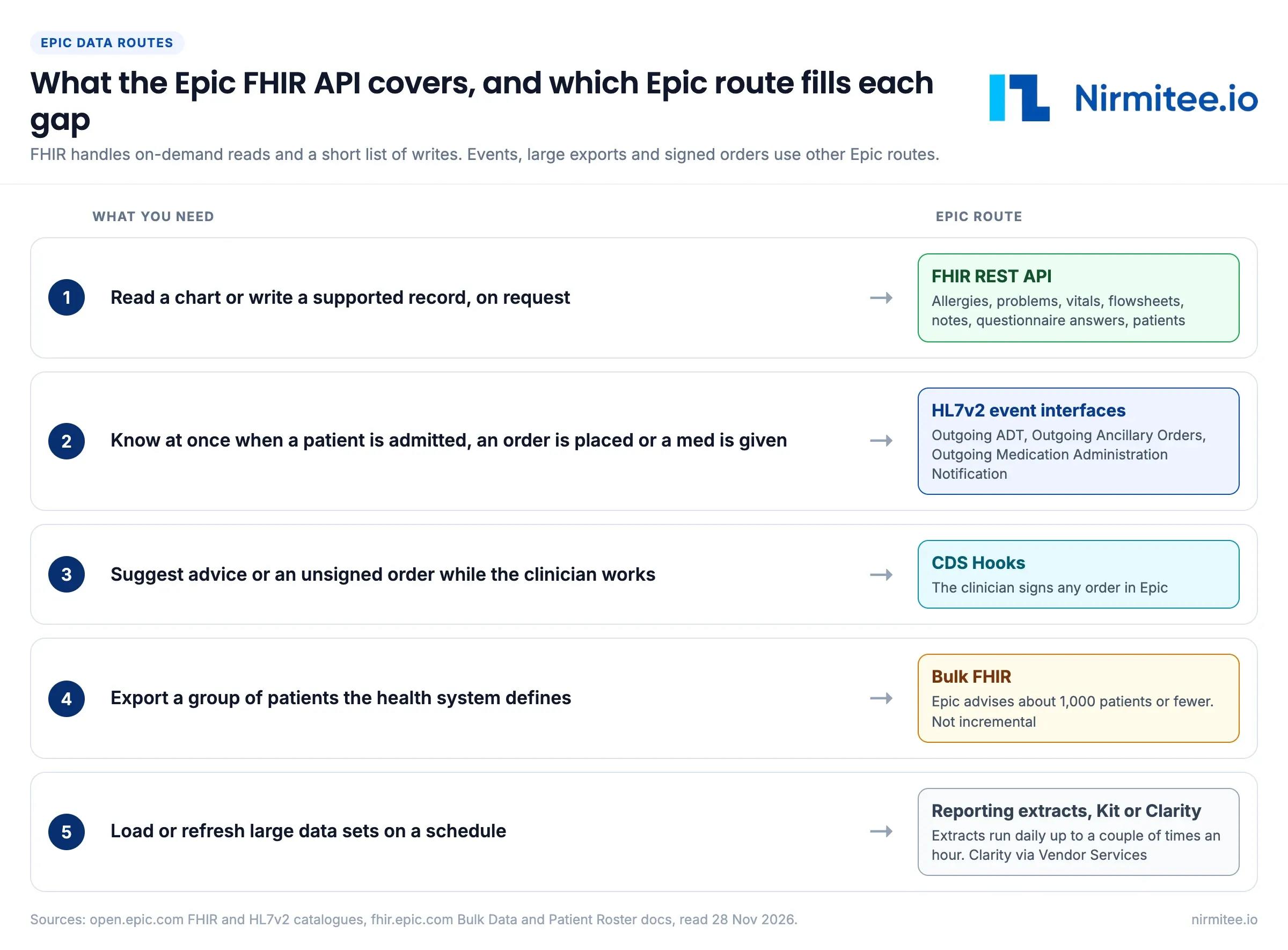
Outside software has no route into Epic Cosmos, so you pick one of three routes around it: a member partner, Epic Research, or one health system's own Epic.
If your product needs to sit inside the clinician's screen at one health system, our Epic Hyperspace guide covers SMART on FHIR launches and Hyperdrive.
We checked Epic's public developer sites on Nov 27, 2026. The word "Cosmos" does not appear on fhir.epic.com's home or specifications pages. On open.epic.com it appears only as a link to the Cosmos website.
Route A: partner with a Cosmos member organization
Epic tells people who are not eligible to "find a collaborator at a participating organization". The partner runs the work inside the portal and you get aggregate results.
- Shape the question as counts or rates. A question that must name a patient cannot be answered in Cosmos.
- Find a member partner. Epic's community page lists 389 organizations. A researcher you already work with is the fastest start.
- Check their local rules. Some members limit use. Stanford keeps Cosmos to Stanford-related research, and UC Davis Health takes only internally funded projects for now.
- Disclose funding. Each user attests to the use and discloses funding sources. If you pay for the work, Epic and the Cosmos Governing Council must approve it, and fees may apply.
- The partner runs the queries. SlicerDicer for counts, or a Data Science Virtual Machine if they hold the paid certification.
- Receive aggregates. Epic reviews each file before it leaves the portal. Line-level export is not allowed.
Route B: suggest a study to Epic Research
Epic points people without access to "submit ideas for study on Epic Research". Epic Research is a subsidiary funded by Epic, and most of its studies use Cosmos.
- Write one clear question that population counts can answer.
- Submit it through the "Submit an Idea" link on epicresearch.org.
- Wait for the decision. Epic Research picks its own studies and publishes no response time.
- Use the result. Findings are free to the public, so you can cite them in your product or content.
Route C: get similar data from one health system's Epic
When a product needs patient-level data, it gets it from one health system's own Epic, with that health system's approval. This is outside Cosmos. Epic documents three ways in.
C1. Bulk FHIR export. Bulk FHIR lets a health system "provide external clients with large amounts of data for a population of patients formatted as FHIR resources".
- Register an app on Epic on FHIR. You get production and non-production client IDs.
- Scope the Bulk Data Kick-off, Status, File and Delete APIs, plus the R4 Search API for each resource you need.
- Agree with the health system on a patient group. It authorizes your client for that group and gives you the Group FHIR ID.
- Call
Group/{id}/$export. Epic supports only the Group export, version 1.0.1 for R4, and no_since. Use_typeto limit resources. The default is ndjson across the USCDI data classes. - Poll the status every 10 minutes for groups under 100 patients, or every 30 minutes above that.
- Download the files within 14 days, then call Delete. The request is not incremental and runs on the live database.
Epic lists a one-time load before ongoing exchange as a good use, and syncing a data warehouse or incremental loads as poor uses.
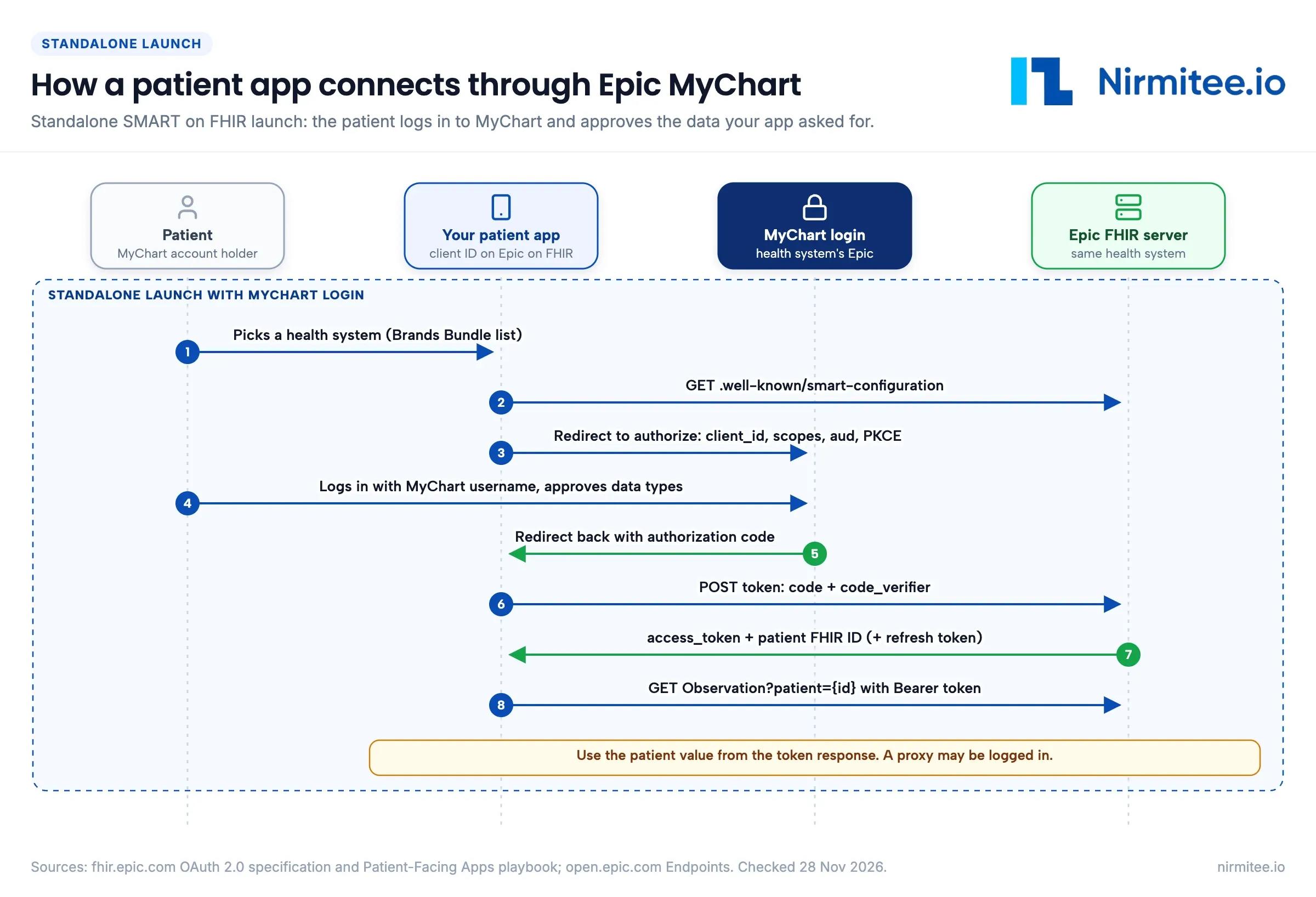
C2. FHIR APIs through open.epic. FHIR is "a lightweight REST-based access layer" for standard HL7 data models.
- Build against the open.epic sandbox, which holds synthetic data only.
- Scope only the APIs you need. Health systems review the scope for privacy and cost, and may ask for a narrower client ID.
- Test in the health system's non-production environment. Epic says this is required. Backend apps use OAuth 2.0 client credentials.
- The health system downloads your client record and signs the open.epic API Subscription Agreement.
C3. Reporting extracts from Clarity. Epic says its "reporting tools ... can often double as a way to extract information for third party integrations". Clarity is Epic's reporting database.
- Give the health system your patient criteria and the data fields you need.
- Its business intelligence developers write the report. Some can start soon, and others "may not be able to prioritize these needs for some time".
- Agree how often it runs. Epic says from daily up to a couple of times an hour, depending on the tool.
- Or take on the work yourself by licensing Kit or Clarity through Epic Vendor Services and writing the SQL.
How do the Epic Cosmos routes compare?
| Route | What data you get | Who approves | Effort |
|---|---|---|---|
| A. Member partner | Aggregate counts and rates across Cosmos, after Epic's file review | The member organization; Epic and the council if funded | Low for you, medium for the partner |
| B. Epic Research | A published study, if picked | Epic Research | Low, with no promise of uptake |
| C1. Bulk FHIR | Patient-level FHIR resources for an agreed group, one health system | The health system | Medium |
| C2. FHIR APIs | Patient-level FHIR resources on request, one health system | The health system, after security review | Medium |
| C3. Clarity extract | Report output the health system defines, one health system | The health system | Low to high, set by its report queue or your own SQL |
| API into Cosmos | Nothing. Not offered. | No one | Not possible |
What is possible with Epic Cosmos?
With approved access you can count, compare and model patterns across member organizations, then publish aggregate results.
| Row | What you can do | How | Source |
|---|---|---|---|
| P1 | Count patients and events across all members | SlicerDicer on the limited data set | |
| P2 | Line-level analysis and modeling | Data Science Virtual Machine, SQL, Python, R, 750+ packages | |
| P3 | See data quality for the community and your own organization | Portal metrics with their SQL | |
| P4 | Find trial-eligible patients and send pointers to local EHRs | Portal trial tools | |
| P5 | Export aggregate results | File review by Epic | |
| P6 | Run a funded study | Approval by Epic and the council | |
| P7 | Read and cite published findings | Epic Research and journal papers | |
| P8 | Show insights to clinicians in Epic | Best Care Choices, Look-Alikes, growth charts | |
| P9 | Build a product on one customer's Epic data | Bulk FHIR, FHIR APIs or a Clarity extract, outside Cosmos | |
| P10 | Bring a small file into the portal | Stanford says Epic has a process for importing .xls or .csv files, by request | |
| P11 | Try queries on a sample first | About 1% pseudorandom sample with each snapshot |
Epic also uses Cosmos itself for Epic Curiosity, its generative models trained on Cosmos data. An Epic-authored paper on arXiv first called them CoMET, the Cosmos Medical Event Transformer, in August 2025, and renamed them Curiosity in November 2025. The paper says they were pretrained on 118 million patients and 115 billion medical events. The largest has 1 billion parameters. The authors tested them on 78 tasks. Epic says researchers can query the model without being able to extract patient data.
What is not possible with Epic Cosmos?
You cannot buy access, take patient-level rows out, connect a product, or use the data commercially. Epic says breaking the rules can mean permanent loss of access.
| Not possible | Why | What to do instead |
|---|---|---|
| Buy access or data | Epic: access "cannot be purchased" | Partner with a researcher at a member organization |
| Export line-level data | Line-level data "never leaves the secure Cosmos portal" | Analyze inside, export reviewed aggregates |
| Query Cosmos from your app | No public interface | Build on one customer's own Epic data |
| Sell the data or products made from it | "Cosmos data cannot be sold" | Use the customer's data under your contract |
| Advertising or market comparisons | Banned by Epic | None |
| Join Cosmos rows to your own patient data | Not possible by design | Compare aggregate rates side by side |
| Re-identify a patient to check a finding | Not possible by design | Validate on one health system's identified data under its rules |
| Train your own model on Cosmos | No public route. Epic trains its own models. | Train on a customer's data under contract |
| Use Cosmos for a decision about one patient | Dartmouth and UT Southwestern forbid it for their users | Use Epic's own point-of-care tools |
| Present Cosmos results as your hospital's results | Dartmouth and UT Southwestern forbid it | Report your own data separately |
What are the limits of Epic Cosmos?
The main limits are who can get in, what can come out, and what the data can show.
- Structured data only. Notes, images and genomic sequences are not available.
- Single-vendor population. Only care documented in Epic at member organizations appears. Epic's authors name bias from a single-vendor population as a limit. Out-of-hospital deaths and whether patients took their drugs are often missing.
- Documentation varies. Workflows and coding differ between health systems, and the authors list documentation error as a limit.
- Growth skews counts. Because organizations keep joining, the authors advise reporting rates, not counts.
- Dates and places trade off. The de-identified dataset shifts dates and stops at state level. Work that needs exact dates or ZIP codes has to use SlicerDicer on the limited data set.
- Small counts are masked. SlicerDicer shows 1 to 10 as "10 or fewer". Stanford's publishing checklist says to mask counts under 11.
- Deduplication is not perfect. Matching across systems relies on recorded links, so some patients stay split.
- Records change. Chart corrections can update old encounters in later snapshots.
- Not real time. Snapshots come about every 2 weeks, with recent days held back.
- Seats lapse. Stanford blocks accounts after 180 days without a login.
- Route C has its own limits. Bulk FHIR is not incremental, runs on the live database, and keeps files only 14 days. Report extracts wait in the health system's queue.
How much does Epic Cosmos cost?
Epic publishes no price for Epic Cosmos, and access cannot be bought.
The costs people meet are training and, for some funded studies, a study fee.
- Using Cosmos. Stanford says "there is no cost to use Cosmos to follow hunches, ask questions, track trends, and more".
- Training. The Super User badge is free. Line-level access needs paid Epic certification. Stanford estimates about $800 for the SQL path (COS305 and COS500) and about $400 for the R or Python path (COS305 and COS550), paid by the researcher. UC Davis Health gives about $800 for the SQL path.
- Funded studies. Epic's authors say "fees may be charged when funding is received or additional resources are needed". Stanford says fees from sponsored projects fund Cosmos, and that small projects can have no fee. No amount is published.
What to ask your member organization's Cosmos team: whether your study counts as funded, what fee Epic quotes for it, and who pays for training.
For route C, Epic licenses its APIs to health systems, not to app developers, and fees follow production use. Epic recommends that the health system ask for a licensing estimate. A Clarity license through Vendor Services is an option for vendors. The public pages we read give no fee amounts.
How long does Epic Cosmos access take?
Epic publishes no approval time for Epic Cosmos access. Each member organization runs its own steps.
What the public guides do say:
- Training length. At Stanford, COS305 takes half a day, COS500 a day and a half, and COS550 half a day. Courses run in order and can all be done online. UC Davis says the classes run twice a month.
- Badge time. Stanford says the free badges take "a couple of hours". Dartmouth puts its Super User training at about 8 hours.
- Common delay. Dartmouth warns that choosing "Third-Party Contractor" when you register on Epic UserWeb "will delay access".
- New members. Stanford joined in early 2024 and UC Davis Health in late 2024. Epic does not say how long joining takes for a health system.
- Route C. App changes reach the sandbox within an hour. Epic publishes no time for a health system to approve an app or write a report, and says report priority varies a lot.
How do you run an Epic Cosmos integration project, step by step?
Pick the route first. For a question across many health systems, use these steps with an approved person. For a product, follow route C above.
- Write the question as counts, rates or comparisons. If the answer must name a patient, it is not a Cosmos question.
- Find the approved person. Your own staff at a member organization, or a collaborator at one.
- Check the rules. Confirm the use fits the Rules of the Road. Disclose any funding at attestation.
- Start on the sample. Test definitions on the 1% sample in SlicerDicer.
- Move to line level if needed. Certified users work in the Data Science Virtual Machine.
- Check data quality. Review the portal's metrics for the fields you use.
- Export aggregates. Mask small counts and request file transfer through your Cosmos representative.
- Publish and tell Epic. Stanford's checklist names CosmosPublications@epic.com.
What are the fine details and quirks of Epic Cosmos?
Most of these quirks come from the two datasets, the dates on Epic's counts and the stricter rules some members add.
Two datasets, two tools
SlicerDicer reads the limited data set with exact dates. The virtual machine reads the date-shifted, de-identified dataset. A number can differ between them.
The sample is not always the full picture
Epic's authors found the de-identified sample differed from the full dataset on some demographics. Run final analyses on the full data.
Counts on the site have no date
Epic's site showed 22.6 billion encounters on Nov 27, 2026. An Epic-authored preprint from 2025 gave 16.3 billion. Always cite the date you read a count.
Badges add seats
Stanford says the Super User badge "opens up 10 more Cosmos seats" for the organization.
Citations are tracked
Stanford's guide says users report their Cosmos citations to the Governing Council twice a year, under Section 2.3.1 of the Cosmos Terms.
The model name changed
Papers and news from 2025 say CoMET. Epic now says Curiosity. They are the same models.
Member rules are stricter than Epic's
Stanford limits Cosmos to Stanford-related research. UC Davis Health does not yet allow extramurally funded projects.
What should you take care of before an Epic Cosmos project?
Check that the question needs many health systems, that aggregate output is enough, and that a member organization will run it under its rules.
| Question | If yes | If no |
|---|---|---|
| Does the answer need many health systems? | Cosmos can fit | Use one system's Epic data |
| Is aggregate output enough? | Cosmos can fit | Use identified data at one site, under its rules |
| Do you have an approved person at a member organization? | Go ahead | Find a collaborator or propose to Epic Research |
| Is the work funded by an outside party? | Plan for Epic and council approval, and possible fees | Standard access rules |
| Does a product need to read the data? | Not Cosmos | Build on one customer's Epic data |
Questions to ask the member organization's Cosmos team:
- Do you accept externally funded Cosmos projects, and what approval path do you use?
- What study fee has Epic quoted for funded projects like ours?
- Who in your team can run the queries, and are they certified for line-level work?
- Does your IRB treat Cosmos work as non-human-subjects research?
- How will you share the exported aggregates with us, and who reviews them first?
For route C, ask the health system which patient group it will authorize, whether its team or yours writes the Clarity report, and how long its app review takes.
What should you do next with Epic Cosmos?
If your goal is research, find a researcher at a member organization or suggest a study to Epic Research. If your goal is a product that uses Epic data, your route is one health system's own Epic, through Bulk FHIR, FHIR APIs or a Clarity extract. That is the work our Epic integration services team does.
Ready to scale?
Talk to our healthcare engineering team about building, integrating, and shipping faster.
Frequently Asked Questions
What is Epic Cosmos?
How many patients are in Epic Cosmos?
Can I buy access to Epic Cosmos?
Who can use Epic Cosmos?
Does Epic Cosmos have an API?
Is Epic Cosmos data de-identified?
Can I export data from Epic Cosmos?
How often is Epic Cosmos updated?
What tools come with Epic Cosmos?
Does Epic Cosmos need IRB approval?
How can a vendor use Epic Cosmos?
What is Epic Curiosity?
Can Bulk FHIR replace Epic Cosmos?