CharmHealth integration · United States

CharmHealth API Integration for FHIR and the API Program

We build CharmHealth integrations for digital health products and practices on CharmHealth EHR. CharmHealth documents a certified FHIR R4 API for reading patient records and runs an API program for broader access by request. We handle the license and access steps with you, build the SMART or backend app, and set up each practice's authorization.

  • CharmHealth
  • FHIR R4
  • US Core 6.1.0
  • SMART App Launch
  • Backend services
  • Bulk export
  • API license

Access first, then the app.
  1. 01Request access

    Submit CharmHealth's API access request, sign the API License Agreement and receive a client ID and secret.

  2. 02Build in the sandbox

    The developer license includes a sandbox. We build the patient, provider or backend app against it.

  3. 03Authorize each practice

    A practice administrator authorizes the app with an API key before it can read that practice's data.

Evidence you can check

The problem

Sound Familiar?

Teams building on CharmHealth for small practices run into these four problems first.

Access takes longer than the build

The code is ready, but the access request and license agreement are still being worked out.

Practices that never finish authorizing

Each practice administrator has to authorize your app, and some never get to it.

A read API on a write roadmap

Your roadmap assumed you could write care plans or appointments, and the FHIR API is for reading.

Exports nobody automated

Population reports depend on someone exporting data by hand every month.

Use cases

What It Looks Like When It Works

Four use cases, each shown as the screen your team works in. The people and organizations are fictional; the behavior follows the vendor's published documentation.

Every Practice's Access in One View

Today

Nobody knows which practices have authorized the app and which are waiting.

With the integration

Each practice shows whether its administrator has authorized the app, when data was last read, and what to do when access is revoked.

What we build
  • Authorization tracking per practice
  • Token health checks
  • Paused sync and owner alerts on revoke
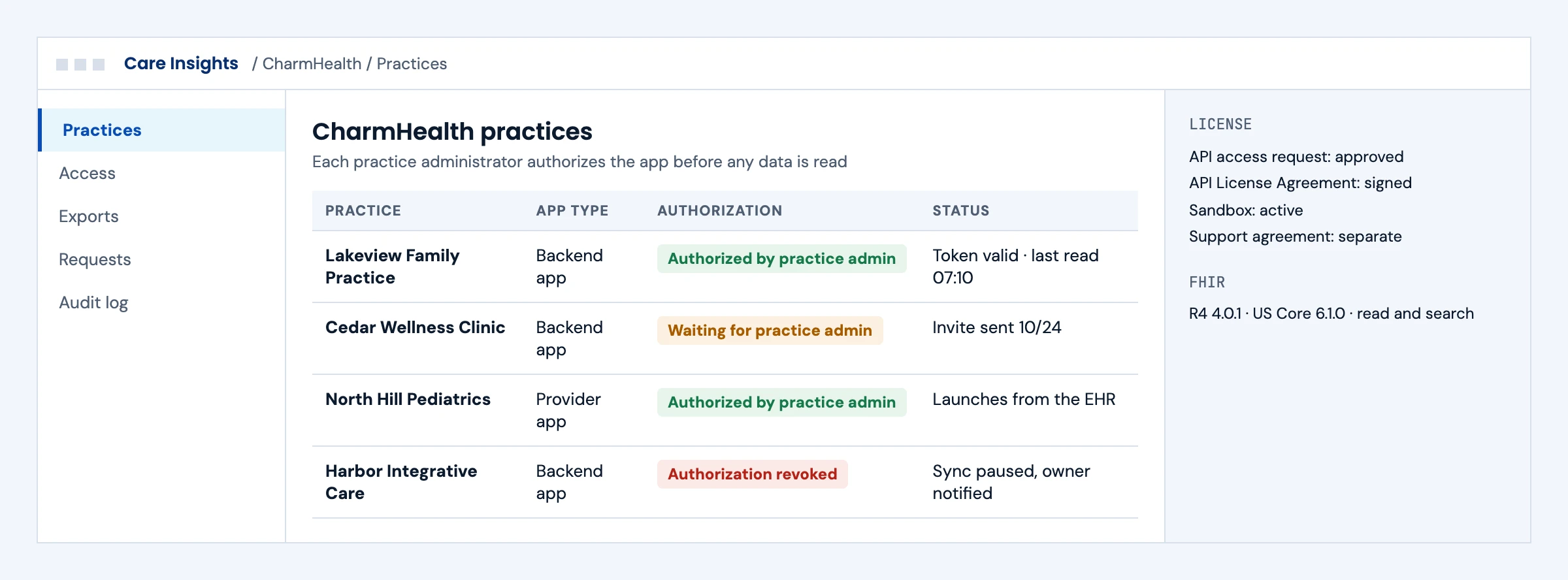
Practice list showing CharmHealth authorization status, token health and a revoked practice with sync paused
Illustrative screen with fictional patients: practice list showing CharmHealth authorization status, token health and a revoked practice with sync paused. Tap to open full size.

Patients Share Their Own Record

Today

Patients type their medications and allergies into your app from memory.

With the integration

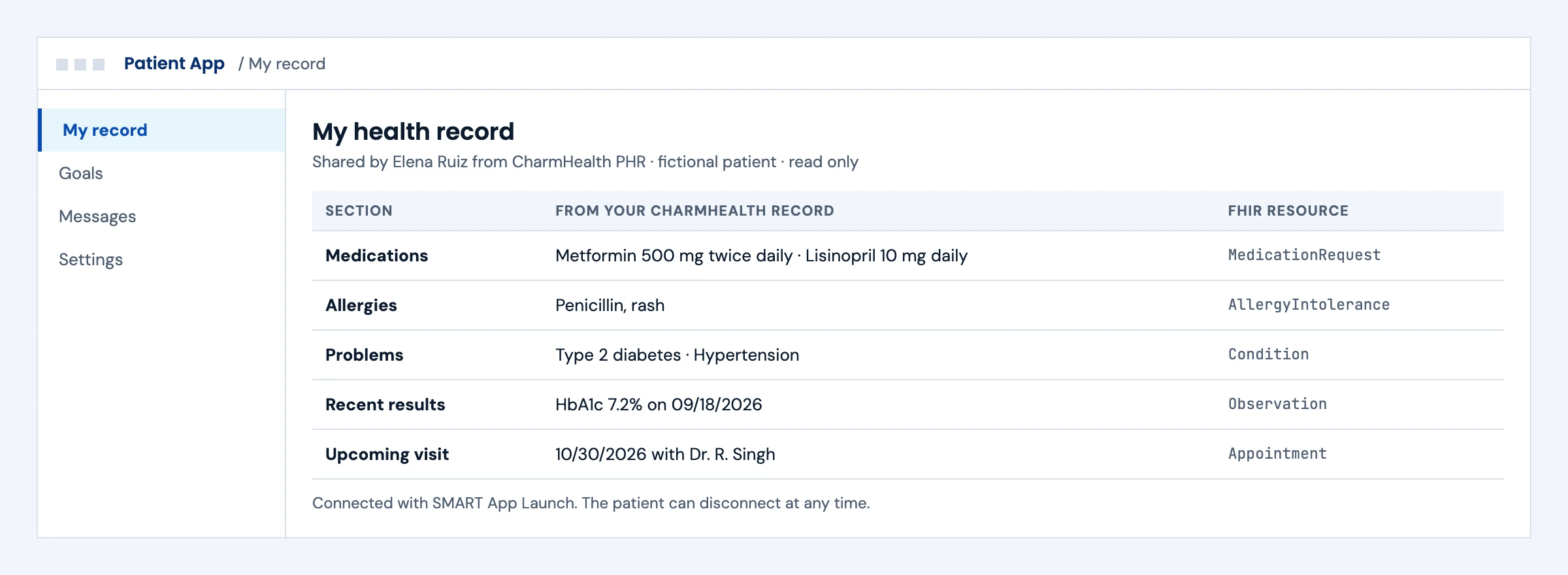
Patients connect with SMART App Launch and their CharmHealth PHR sign-in, and your app reads their medications, allergies, problems, results and visits.

What we build
  • SMART patient app connection
  • US Core reads for the sections your app shows
  • Disconnect handling
Patient app showing medications, allergies, problems, results and a visit read from CharmHealth through FHIR
Illustrative screen with fictional patients: patient app showing medications, allergies, problems, results and a visit read from CharmHealth through FHIR. Tap to open full size.

Population Data Without Manual Exports

Today

Staff export spreadsheets every month for population reports.

With the integration

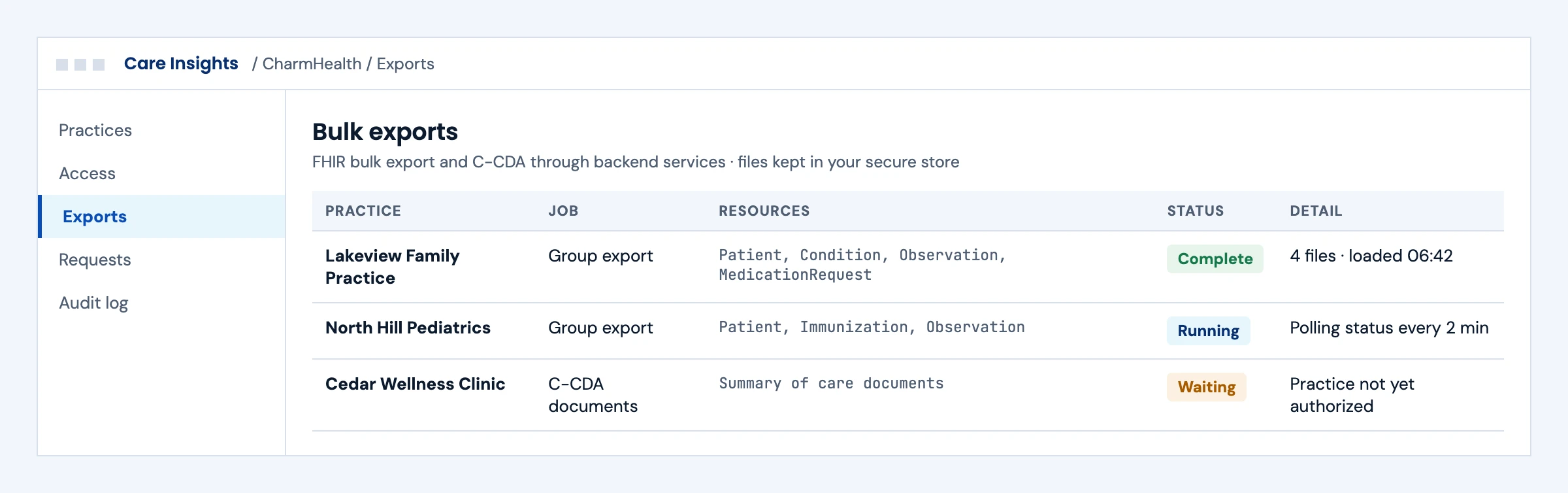
Backend services run FHIR bulk export and C-CDA jobs for each authorized practice, and files land in your secure store on a schedule.

What we build
  • Bulk export jobs per practice
  • Job status polling and retries
  • Secure file storage and loading
Bulk export jobs for three practices, with completed, running and waiting states
Illustrative screen with fictional patients: bulk export jobs for three practices, with completed, running and waiting states. Tap to open full size.

Every Need Mapped to a Route

Today

The team discovers in week six that a feature needs a write the API does not offer.

With the integration

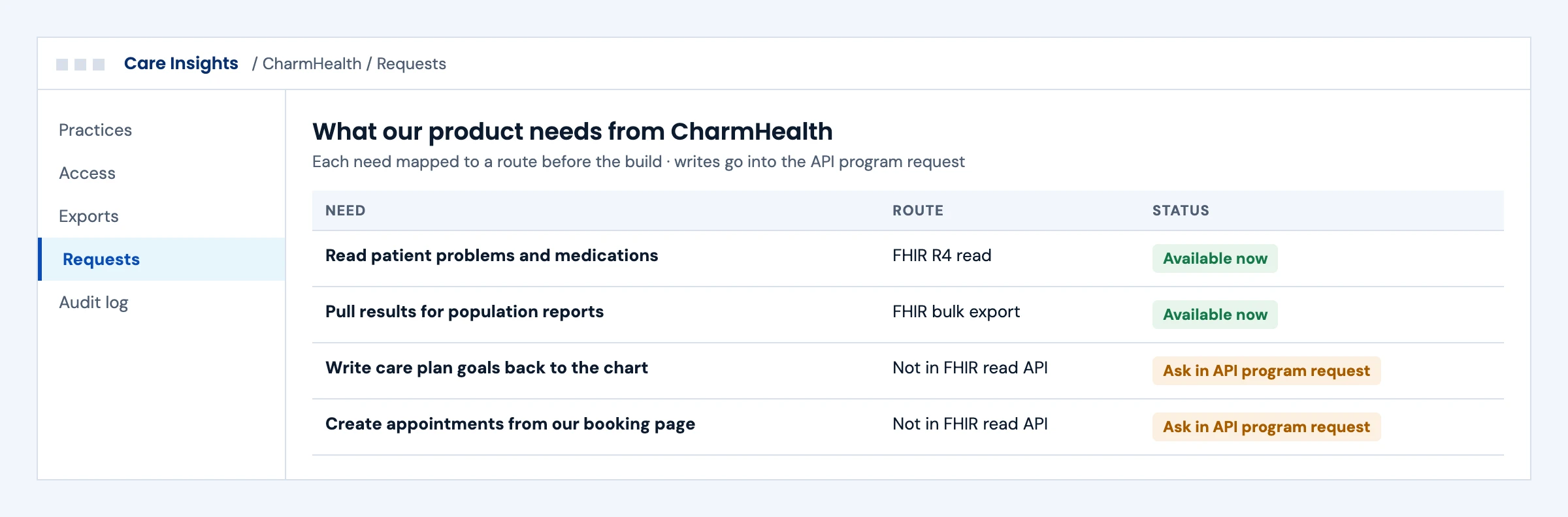
Each product need is mapped to FHIR reads, bulk export or the API program before the build, so writes go into the access request from day one.

What we build
  • Needs-to-route map
  • API program request for writes
  • License questions listed early
Product needs mapped to CharmHealth FHIR reads, bulk export or the API program request
Illustrative screen with fictional patients: product needs mapped to CharmHealth FHIR reads, bulk export or the API program request. Tap to open full size.

First call

Questions We Will Ask You on the First Call

The answers decide the route, the timeline and where these projects usually go wrong. You do not need them all before we talk.

What does your product need to read, and what does it need to write?

FHIR covers reads; writes need the API program.

Is this a patient app, a provider app or a backend service?

Each uses a different authorization flow.

How many practices will you onboard this year?

Practice authorization is the step most likely to slow rollout.

Have you submitted CharmHealth's API access request?

The license and sandbox follow from it.

Do you need bulk data?

Bulk export and C-CDA add storage and retention design.

Who supports the integration after launch?

CharmHealth's development license excludes support unless you add an agreement.

Do you need real-time events?

Webhooks are not in CharmHealth's own docs, so we confirm before designing around them.

What happens when a practice revokes access?

Your product should pause cleanly and tell someone.

The short answer

Does CharmHealth Have an API?

Yes. CharmHealth documents a FHIR R4 API built to version 4.0.1 and US Core 6.1.0 under the 2015 Edition Cures Update criteria, with SMART App Launch for patient and provider apps and SMART Backend Services for system access. Its FHIR resources are documented as list, get and search operations, plus C-CDA and bulk export, so the FHIR route is for reading data. CharmHealth also runs an API program described as a comprehensive set of REST APIs, reached through an access request. Access needs a signed API License Agreement with MedicalMine, CharmHealth's company, and each practice administrator must authorize the app.

Who it is for
Digital health products, patient apps, analytics and care management tools that serve small practices on CharmHealth.
What we build
SMART patient and provider apps, backend services, bulk export pipelines, and integrations through the API program where your use case needs more than FHIR reads.
The outcome we design for
CharmHealth data available in your product through the routes CharmHealth licenses, with a practice setup checklist. These are intended outcomes, not a promise about CharmHealth's decisions.

CharmHealth APIs

What CharmHealth's APIs Let You Do

From CharmHealth's FHIR API documentation, API program page and API terms of service, read in October 2026.

RouteWhat it coversAccessWhat to plan for
FHIR R4 patient-facing appsA patient's own record through SMART App LaunchThe patient signs in with CharmHealth PHR credentialsRead and search operations on US Core resources
FHIR R4 provider-facing appsClinician apps launched inside or outside the EHRThe provider signs in with CharmHealth EHR credentialsRead and search; launch context and scopes
FHIR backend servicesSystem-to-system access, including bulk exportSMART Backend Services with a signed JWT client assertionPractice administrator authorization with an API key
C-CDA and bulk exportDocuments and data for a group of patientsThrough the FHIR programExport jobs and file handling on your side
CharmHealth API programA broader set of REST APIs for medical applications and devicesAPI access request form, reviewed by CharmHealthScope, fees and terms agreed in your license

A consultancy guide describes CharmHealth webhooks, but CharmHealth's own documentation does not describe them, so we confirm event support with CharmHealth before designing around it.

What we build

What Our CharmHealth Integration Builds

Pick the workstreams you need. Each one ships with a specification, sandbox tests and an owner.

01

SMART Patient App

A patient-facing app that reads the patient's own CharmHealth record after the patient signs in.

SMART App Launch · OAuth 2.0 · US Core

SMART on FHIR app development →
02

Provider App in the EHR Workflow

A clinician-facing app launched from or alongside CharmHealth EHR with the right patient in context.

EHR launch · scopes · patient context

SMART on FHIR app development →
03

Backend Data Sync

A backend service that reads practice data on a schedule after the practice administrator authorizes it.

SMART Backend Services · JWT client assertion

FHIR integration services →
04

Bulk Export Pipeline

Bulk export jobs and C-CDA handling for analytics, population health or migration, with files stored and processed securely.

Bulk Data · C-CDA · job status

05

API Program Integration

Where your workflow needs more than FHIR reads, we prepare the API access request and build against the APIs CharmHealth grants.

API access request · license scope

Buyer decisions

CharmHealth Integration Options Compared

Most products start with FHIR reads and add the API program only where they need it.

OptionBest fitStrengthsWhat to plan for
FHIR R4 APIPatient apps, clinician read apps, analyticsCertified, standard US Core resourcesRead and search only; license and practice authorization
CharmHealth API programWorkflows that need more than FHIR readsBroader REST APIs by agreementAccess request, scope and fees set by CharmHealth
ExportsOne-time migrationsNo build on CharmHealth's sideManual steps and no ongoing sync
Login-based automationA gap no API coversWorks where APIs stopCharmHealth's terms, the practice's written authorization and strict controls

Integration boundaries

CharmHealth Integration Boundaries: Who Owns What

We write the split down before the build starts.

The practice

Authorizes your app with an API key and approves what data it reads.

CharmHealth (MedicalMine)

Owns the APIs, the license terms, access decisions and fees. The developer license includes a sandbox but not technical support unless you add a support agreement.

Your product team

Owns what your product does with CharmHealth data and how it appears to users.

The integration layer (ours)

Apps, connectors, token handling, export pipelines and alerts. Defects in this layer are ours to fix.

Security and PHI

A BAA is available for agreed work involving PHI. We work inside our ISO 27001:2022 certified management system, encrypt data in transit and at rest, keep credentials in a vault and keep raw payloads out of operational logs.

Deliverables

CharmHealth Integration Deliverables

Everything lands in your repository and your runbook.

01

Access pack

The completed access request, the use case description and the license questions to settle with CharmHealth.

02

Integration code in your repository

SMART or backend clients, export handling and data mapping.

03

Practice setup checklist

How a practice administrator authorizes your app.

04

Test evidence and runbook

Sandbox test runs, alerts and support steps.

Delivery phases

CharmHealth Integration Timeline

Initial planning estimate: 5 to 9 weeks to a first live practice, subject to CharmHealth's access review and license, and practice authorization. We confirm a release plan after discovery.

  1. 01

    Discovery and access

    Weeks 1 to 2

    Route chosen, access request and license questions sent

  2. 02

    Sandbox build

    Weeks 2 to 6

    App or backend service built and tested in the sandbox

  3. 03

    Practice validation

    Weeks 4 to 8

    First practice authorizes the app, data checked with the practice

  4. 04

    Go-live and hypercare

    Weeks 6 to 9

    First practice live, monitoring on, checklist handed over

Cost drivers

What Drives CharmHealth Integration Cost

Use the scoping call to pin down the workflow, the access you need and what goes into a scoped proposal. These are the factors that move cost.

Route

FHIR reads are the simplest; the API program adds scope and license work.

App type

Patient, provider and backend apps each have their own authorization flow.

Bulk data

Export pipelines add storage, processing and retention design.

Practices per year

A repeatable authorization checklist matters most at scale.

Support level

Monitoring and on-call support are priced per connection.

Book a call ↗

Proof

FHIR Work You Can Check

Client names are withheld. These published guides show how we approach FHIR and SMART work; they do not prove CharmHealth approval or a live CharmHealth integration.

Published engineering guide

Multi-EHR API Comparison

How certified EHR APIs differ in scopes, launch and write support, and what that means for a product serving several EHRs.

Read the guide →

Published engineering guide

EHR Automation Without API Access

What to do when a certified API is read only and your workflow needs more.

Read the guide →

Published engineering guide

HL7 MDM Document Messages

How documents move between systems when an API does not cover them.

Read the guide →

Security

ISO 27001:2022 Certified, BAAs Signed

We are ISO 27001:2022 certified and sign Business Associate Agreements for work that touches patient data.

FAQ

CharmHealth Integration: Questions Buyers Ask

Does CharmHealth have an API?

Yes. CharmHealth documents a FHIR R4 API to US Core 6.1.0 with SMART App Launch and backend services, and runs an API program with a broader set of REST APIs available by access request.

Is the CharmHealth FHIR API read only?

The FHIR resources are documented as list, get and search operations, plus C-CDA and bulk export, so plan on FHIR for reading. For writes, ask CharmHealth what its API program grants for your use case.

How do we get CharmHealth API access?

Submit CharmHealth's API access request with your contact details and planned application, sign the API License Agreement, and receive a client ID and, for confidential clients, a client secret.

Does each practice have to approve our app?

Yes. CharmHealth's documentation says the practice administrator must authorize third-party applications to access their data through an API key.

Is there a CharmHealth sandbox?

Yes. CharmHealth's API terms say a sandbox environment is provided for development under the developer license.

Does CharmHealth support webhooks?

A consultancy guide describes them, but CharmHealth's own documentation does not describe webhooks. We confirm event support with CharmHealth before relying on it and poll where needed.

Does the CharmHealth license include support?

CharmHealth's API terms say the development license does not include technical support or bug fixes. Support needs a separate agreement, and license pricing is set in your terms.

Can we build a patient app on CharmHealth?

Yes. Patient-facing apps use SMART App Launch, and the patient signs in with CharmHealth PHR credentials to share their own record.

Can we export data for many patients?

Yes, through the FHIR bulk export and C-CDA options, once the practice has authorized your backend app.

How long does a CharmHealth integration take?

Our initial planning estimate is 5 to 9 weeks to a first live practice, mostly set by CharmHealth's access review and the first practice's authorization.

How much does a CharmHealth integration cost?

Cost depends on the route, the app type, bulk data needs, how many practices you add and the support level. CharmHealth's own license fees are separate. After a scoping call we send a scoped proposal with the access dependencies listed.

Next step

Plan Your CharmHealth Integration

Tell us what your product needs from CharmHealth. An engineer replies with the route, the access steps and the open license questions.

Start with your workflow

Tell Us About Your CharmHealth Integration

Share the use case, the number of practices and your target date. Use de-identified examples only. Read by an engineer, answered within one business day.

Please exclude patient data and credentials. We use these details to respond to your inquiry. Privacy policy

Thank you. Your inquiry has been received. Our team will review your requirements.