
Biomedical engineering heads
Split downtime into reporting, vendor response, spares and handover, and enforce contract terms with evidence.
Free guide for biomedical heads, MS and nursing superintendents
We Own It. Why Can't We Use It? · India edition
Indian audits keep finding equipment that is present but not usable: not installed, waiting for a spare or the AMC engineer, without trained staff or consumables, or in the wrong ward. This free guide shows how to keep one master register, record status as well as location, meet NABH FMS.5, hold maintenance providers to uptime, and decide when to repair, move, condemn or buy.

Start with availability
Biomedical equipment management is the hospital programme for planning, registering, maintaining, calibrating and retiring medical equipment. NABH FMS.5 expects an inventory with logs, a documented preventive and breakdown maintenance plan, calibration, trained users, recall action and downtime monitoring for critical equipment.
Start with a census of one equipment class: compare the register with what is found, and record each device as in use, idle, faulty, in store or not installed. Then set ownership and ward pars, put AMC or CMC terms and downtime on the record, and give the Hospital Equipment Management Committee one page of numbers each month.
To see how one equipment record supports this method, explore Assetly hospital asset management software. The PDF is free to use with your own team.
Split downtime into reporting, vendor response, spares and handover, and enforce contract terms with evidence.
Bring NABH evidence, condemnation and purchase decisions to one committee review.
Stop duplicate purchases and paying for cover on equipment that is not in use.
From diagnosis to decision
Work through the parts in order. Each one leaves your team with something it can review.
Chapters 1–2
The national baseline from the government equipment programme, why equipment sits idle, the availability funnel and a two-week census.
Your working output: A funnel and six agreed measures for one equipment class.
Chapters 3–4
Ward pars and pools, the clean and dirty loop, the asset record with AMC/CMC and licences, transfers, reconciliation and moving off Excel, SAP or Tally.
Your working output: A trusted register and exceptions with owners.
Chapters 5–7
GS1 barcode and QR first, RFID audits, BLE where it pays; equipment statuses; breakdowns, calibration, recalls; NABH FMS.5, AERB, MvPI and BMMP uptime.
Your working output: An NABH evidence map and enforceable contract terms.
Chapters 8–9
Repair, move, condemn or buy; the beyond-economic-repair test; a one-page business case; a 90-day rollout and the committee review.
Your working output: A purchase case template and a monthly review rhythm.
Use it on Monday
The PDF includes worksheets and procedures to adapt to your own hospital.
Record each device found and whether it is in use, idle, faulty or not installed.
Set pars from peak use instead of the busiest day anyone remembers.
Decide where barcode, QR, RFID or BLE is worth it, device class by device class.
Response time, 72-hour critical downtime, penalties and evidence per visit.
BER test, committee approval, AERB decommissioning where needed and register update.
Six numbers, three decisions and a one-page programme checklist.
Templates are presented in the PDF; no separate editable workbook is included.
Look inside the actual guide
These pages are taken from the PDF. Enter your email to get the complete guide.
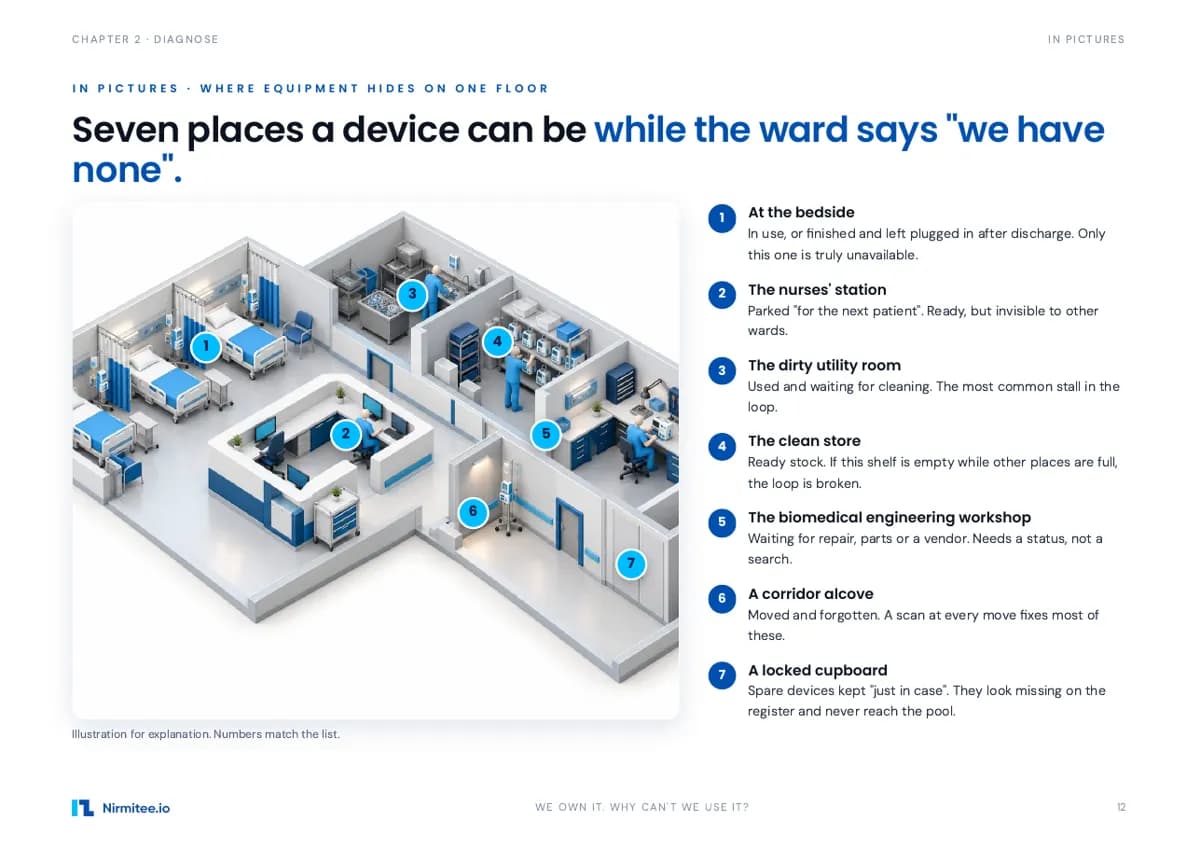
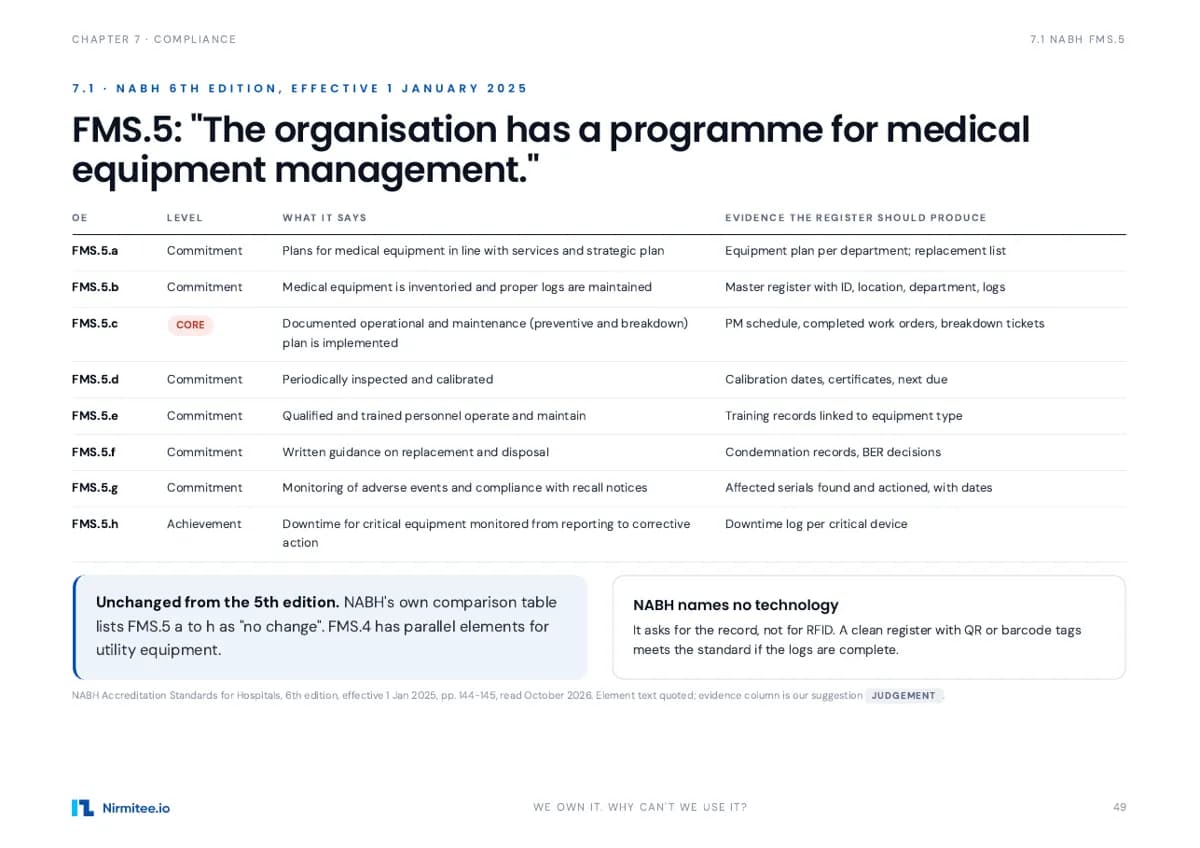
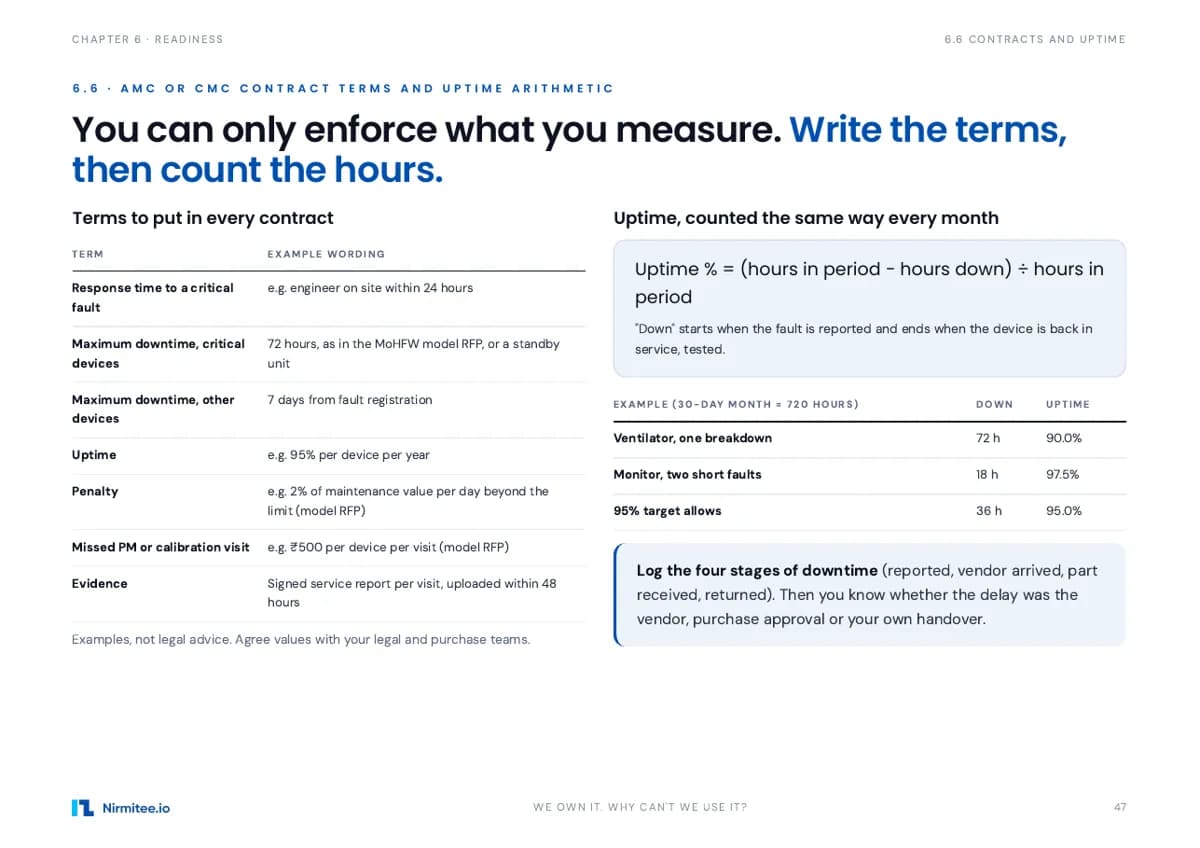
Before you request it
NABH 6th edition FMS.5 has eight objective elements: equipment planning, an inventory with logs, a documented preventive and breakdown maintenance plan (a Core element), periodic inspection and calibration, trained operators, written guidance on replacement and disposal, adverse event and recall monitoring, and downtime monitoring for critical equipment.
The Biomedical Equipment Management and Maintenance Program sets 95% uptime for district hospitals, 90% for CHCs and 80% for PHCs. The revised model contract limits downtime for listed critical and life-saving equipment to 72 hours and other equipment to 7 days.
Government audits most often cite missing trained staff or consumables, equipment not installed or commissioned, units not operating, and pending repairs, rather than lost equipment. The guide treats status and location as one record for this reason.
No. NABH asks for the records, not a technology. The government programme itself tags equipment with GS1 barcodes and QR codes. The guide recommends barcode or QR first, RFID for audits and battery tags only where searches are frequent and costly.
It is free, and we send it by email. Enter your work email in the form on this page. It does not subscribe you to marketing emails.
Yes. The US edition covers CMS equipment maintenance rules, the January 2026 Joint Commission changes and US hospital case studies.
Keep going