AMC Management Software for Hospitals: AMC vs CMC Renewal Checklist

CTO & Co-Founder
CTO & Co-Founder at Nirmitee.io. Architects healthcare integrations across FHIR, SMART on FHIR, ABDM and NHCX, writing from production experience taking hospital software from sandbox to go-live.
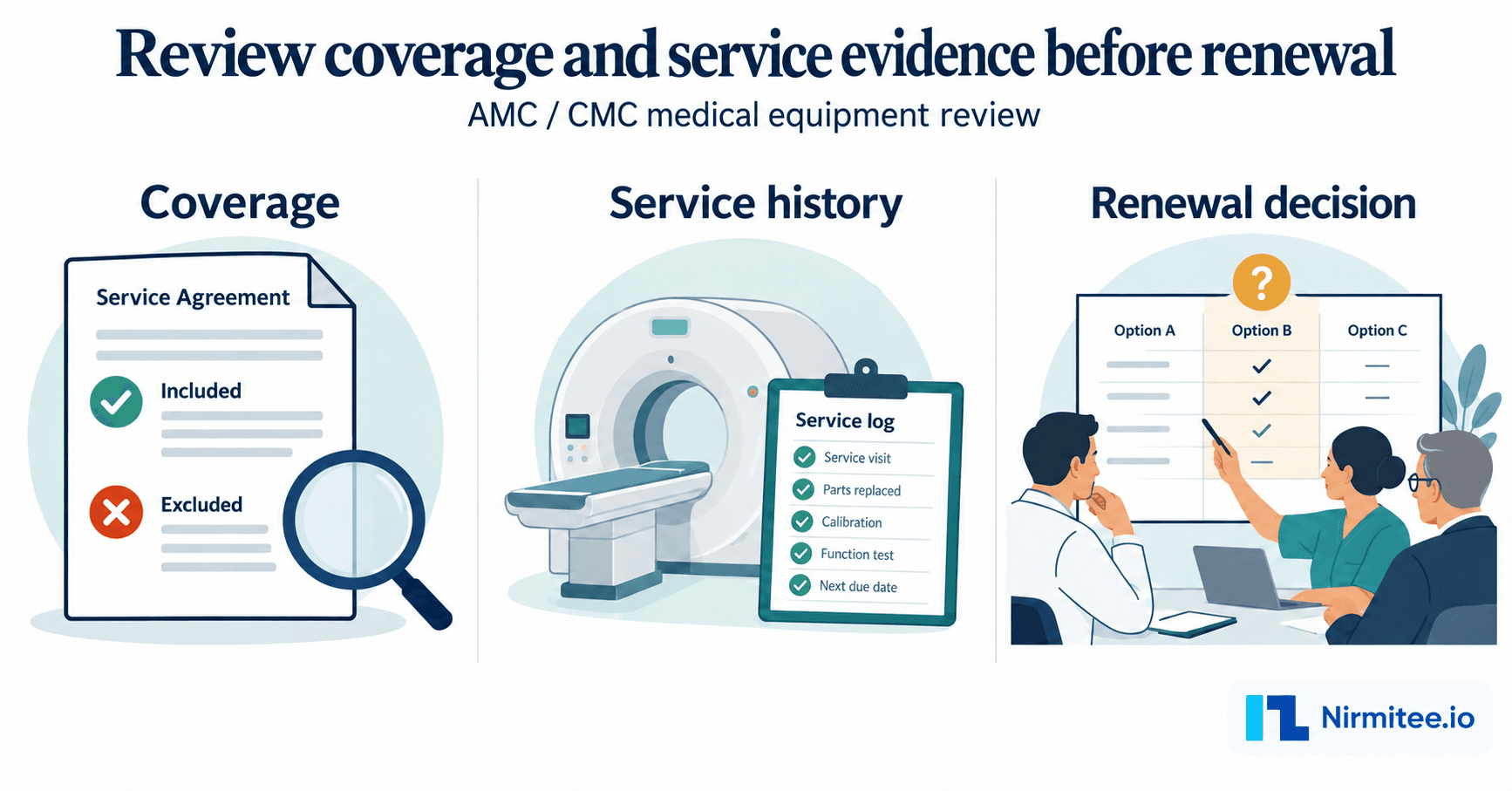
AMC vs CMC for medical equipment is a decision about the written maintenance scope, the hospital's exposure to additional costs and the evidence available at renewal. AMC commonly means annual maintenance contract. CMC commonly means comprehensive maintenance contract. The contract label alone does not settle which parts, visits, accessories or service commitments are included.
Tracking AMC and CMC renewals in spreadsheets? Book an Assetly demo and bring one contract due for renewal; we show coverage, service history and the renewal decision on one screen.
This guide is for Indian hospital procurement, biomedical engineering and finance teams comparing equipment-service proposals. It provides a coverage worksheet, a service-history review and a practical renewal process. The software discussion concerns managing contract records and equipment history; Assetly is not being offered here as the company performing physical maintenance.
Before comparing annual totals, identify the equipment covered, the actual inclusions and exclusions, the service commitments and the work the hospital must arrange separately.
What is the practical difference between AMC and CMC?
In many equipment-service proposals, AMC describes an annual service arrangement with specified visits, labour and other agreed work. CMC describes a broader coverage arrangement that may include specified replacement parts. Vendors and procurement documents can define these scopes differently. Read the schedule and exclusions before relying on either description.
If your problem is finding which agreement covers a device, review Assetly's equipment and vendor-record workflows against your current process. The software evaluation should show how the device, agreement and service history connect, while procurement separately qualifies the maintenance provider.
For example, an AIIMS equipment bid document sets out detailed coverage for its own warranty and comprehensive maintenance requirements, including named items and work. That is evidence of an equipment-specific procurement scope, not a rule that the same inclusions apply to another hospital's contract.
An ESIC procurement document also distinguishes AMC and CMC quotations. Use such documents as examples of the need to state scope. The hospital's actual agreement and applicable procurement process govern its purchase.
Compare coverage line by line
Give each shortlisted supplier the same equipment list and coverage worksheet. Ask for a written answer to each line. The following is a proposed evaluation table, not a statement that every AMC excludes parts or every CMC includes them.
| Coverage item | Ask the AMC supplier | Ask the CMC supplier |
|---|---|---|
| Equipment scope | Which serialised devices and accessories are covered? | Does the same equipment list apply? |
| Planned visits | What work, visit schedule and evidence are included? | Are those same obligations included and specified? |
| Breakdown labour | Which visits, labour and diagnostic work are included? | Are there limits, exclusions or additional charges? |
| Replacement parts | Which parts are included or charged separately? | Which parts are included, excluded or capped? |
| Consumables and accessories | What must the hospital buy separately? | Which items remain outside comprehensive coverage? |
| Calibration or testing | Is the required work included, and what evidence is supplied? | Does the scope include the same work and documents? |
| Travel and logistics | Are travel, freight or off-site work additional? | Are the same costs included or excluded? |
| Software and connected components | Which updates, licences and dependencies are covered? | What remains outside the equipment-service scope? |
| End of support | What happens if a required part is unavailable? | What remedy or limitation is written into the agreement? |
Mark “unconfirmed” where a proposal is silent. A blank cell is a clarification request. It should not be converted into an assumed inclusion during a price comparison.
Define service commitments in terms people can verify
A service-level agreement, or SLA, describes agreed service commitments and how they are assessed. A promise to “respond quickly” leaves room for disagreement. Define what starts the clock, what counts as acknowledgement, what counts as attendance and what counts as restoration under the actual contract.
Clarify working hours, holiday coverage, remote versus on-site activity, part-order dependencies and any agreed exclusions. Identify the communication channel that establishes a reported incident. Keep the hospital's record as well as the supplier's ticket reference.
Response and resolution are different events. An engineer acknowledging a call does not establish that the equipment has been repaired. Repair completion may also differ from an authorised return-to-service decision. Preserve the evidence for each event your agreement and operating process require.
Build the renewal decision from equipment service history
A renewal comparison is stronger when procurement can see the equipment covered, completed work, unresolved breakdowns, separately charged parts and outstanding documents. Keep those references connected to the relevant asset and contract rather than scattered across vendor email threads.
Assetly's hospital asset-management product includes equipment records, vendor history and contract-related workflows alongside maintenance, calibration, transfers and audits. Ask the team to demonstrate how your equipment and service records connect. Confirm any proposed SLA calculations, renewal reminders, report formats or integrations in the scope rather than assuming they are included.
Use de-identified examples for the first demonstration. The team can understand a missing service document or a coverage ambiguity without receiving patient information or confidential pricing from another supplier.
A service-history worksheet for procurement
| Record | Evidence to collect | How it affects renewal |
|---|---|---|
| Covered equipment | Internal asset IDs, serials, site and contract schedule | Confirms that quotes describe the same scope |
| Planned work | Required visits, completed records and unresolved evidence | Shows what can be substantiated about delivery |
| Breakdowns | Reported, acknowledged, attended and completed events where defined | Supports review against the actual service commitments |
| Parts and extra charges | Item, reason, equipment reference and invoice support | Explains cost outside the fixed fee |
| Outstanding obligations | Open repairs, documents, disputes and named owners | Prevents unresolved work from disappearing at renewal |
| Scope changes | Retired, replaced, transferred or newly covered equipment | Updates the proposed coverage without losing history |
Missing evidence does not automatically prove the supplier failed to perform the work. It establishes a record gap requiring clarification. Conversely, a signed attendance sheet may not establish that every contracted task was completed. State what each record actually supports.
Compare costs without inventing a repair forecast
Start with the fixed fee and the known work outside it. Include the same devices, period, currency and tax treatment in both proposals. Keep parts, consumables, travel, third-party work and any other exclusions visible.
If finance wants to estimate additional repair exposure, use an explicitly labelled scenario with documented assumptions. Equipment history can inform that scenario, but past repair cost does not guarantee next year's cost. Do not present a generic percentage of purchase price as a universal maintenance-contract benchmark.
A useful comparison has three layers: contracted fixed costs, separately priced known work and uncertain costs under stated scenarios. Keep operational consequences, such as an unavailable device, visible alongside the financial comparison without inventing a revenue-loss figure.
Ask finance to validate any proposed avoided cost against the actual decision and evidence. A negotiating opportunity is different from a saving already achieved. Keep staff effort, budget reallocation and cash savings separate.
Questions to ask before accepting a renewal
Does the equipment list match the hospital's current records?
Check serialised items, accessories, site assignments and any devices on loan or under repair. Make additions and removals explicit. A contract schedule copied from last year may cover equipment that has since been retired while missing a replacement.
Are important exclusions understandable?
Ask the technical owner to review exclusions against the equipment involved. A broad description such as “all parts” should be read with its detailed schedule, limits and exceptions. Record unresolved points before commercial approval.
Can the supplier perform the proposed scope?
Procurement should request the evidence required by its process for the supplier's authority, technical capability, access to parts and support arrangements. A similar company name or a supplier's general healthcare marketing does not establish that it can support the particular equipment and agreement.
What happens to unresolved work at the contract boundary?
List open incidents, outstanding documents and pending parts. Identify the owner and the applicable contract reference for each item. Clarify how records will remain available if the supplier changes. Do not close an exception merely because a new agreement begins.
Who approves the operational and commercial decisions?
Biomedical engineering, procurement, finance and the relevant legal or governance owners may assess different parts of the proposal. Record their decisions and unresolved conditions separately. A technical recommendation is not the same as an approved purchase order.
A practical renewal process
- Freeze the review scope. Record the contract, equipment list and review period. Preserve source documents and their versions.
- Reconcile equipment coverage. Resolve obvious list differences with authorised owners and retain the explanation.
- Collect delivery evidence. Bring together work records, breakdown events, documents and additional charges.
- Request comparable proposals. Use the same coverage worksheet and ask suppliers to identify every exclusion and dependency.
- Review uncertain cases. Assign technical, commercial and contractual questions to the appropriate owners.
- Record the decision. State what was approved, which conditions remain and how the new scope enters the equipment record.
Set the preparation period according to the hospital's procurement timetable and the work needed. This guide does not prescribe a universal renewal deadline, approval path or contract term.
When software helps with contract management
Evaluate software when the difficulty is connecting equipment, coverage, work evidence and unresolved actions across teams. A folder of contracts may preserve the agreement while leaving staff unable to identify which device it covers or which vendor should receive a breakdown request.
Use the following demonstration cases before purchasing a contract-record workflow. They are proposed tests, not claims that every product already provides the behaviour.
| Test case | Ask the software team to show | Evidence to inspect |
|---|---|---|
| A device has changed departments | Coverage remains connected to the same equipment identity | Contract reference and movement history |
| A contract has a named exclusion | The user can find the relevant source document and coverage note | Document version and clear responsibility |
| A vendor visit lacks its final report | The unresolved document request remains visible | Work reference, owner and next action |
| Renewal scope removes a retired device | The new scope changes without erasing the previous agreement | Historical and proposed equipment lists |
| A supplier changes | Old records remain accessible under the agreed retention policy | Usable history and export |
Keep maintenance delivery and software evaluation clear
If you need an engineer to repair equipment or a supplier to provide an AMC or CMC, qualify the appropriate maintenance provider through your procurement process. This article's Assetly enquiry is for equipment and contract-record software.
Bring your approximate equipment scope, sites, source-file format and the record problem driving the software evaluation. Ask the Assetly team to trace one device from the register to its contract and vendor service history, identify unresolved work and show the export required by your reviewers.
The India software vendor-evaluation guide can help scope that discussion. Use the software demonstration checklist for access and export tests, and the hospital asset-management guide for the wider equipment lifecycle.
A useful renewal decision explains the coverage being purchased, the evidence reviewed and the unresolved risks accepted by the appropriate owners. The contract label and annual total are only the beginning of that assessment.
Related Assetly buyer guides
- Medical equipment calibration tracking guide
- CMMS vs RTLS in hospitals: what to buy
- NABH asset management compliance guide
- How real-time location tracking cuts equipment loss
- Medical equipment utilisation rate formulas
- Hospital equipment downtime and patient safety
See how Assetly hospital asset tracking software connects equipment records, service work and location data.
See equipment and service-contract records together in Assetly
Bring a de-identified equipment list, a sample contract and the renewal problem your team needs to resolve. Ask how coverage and vendor service history connect to the equipment record.
Frequently Asked Questions
What is the difference between AMC and CMC for medical equipment?
Does CMC always include every spare part and consumable?
Which is cheaper, AMC or CMC?
Does Assetly provide equipment maintenance contracts?
What should we bring to an Assetly contract-workflow demo?
Check the product against your buying brief
Review Assetly equipment records, maintenance, vendors, transfers and audits before you request a scoped demonstration.