
CMMS for Hospitals vs RTLS: Which Should You Buy?

CTO & Co-Founder
CTO & Co-Founder at Nirmitee.io. Architects healthcare integrations across FHIR, SMART on FHIR, ABDM and NHCX, writing from production experience taking hospital software from sandbox to go-live.
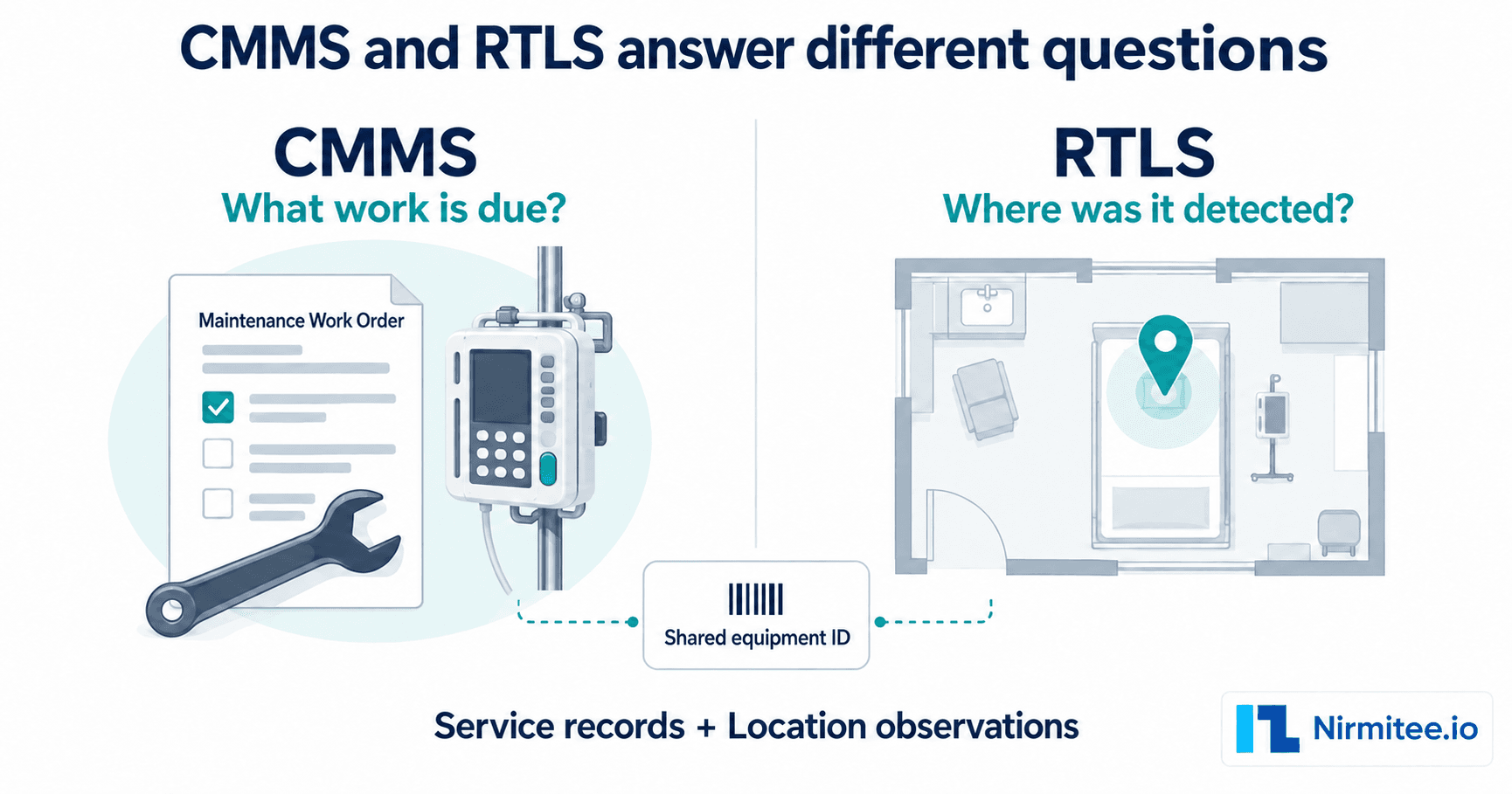
CMMS vs RTLS in hospitals is a buying decision about different kinds of evidence. A computerised maintenance management system, or CMMS, organises equipment work and service history. A real-time location system, or RTLS, provides location observations through a designed locating infrastructure. A hospital may need one, both or a simpler equipment-control workflow first.
Shortlisting a healthcare CMMS? Book an Assetly demo and bring your open work orders; we show which parts Assetly covers and what needs location hardware.
This guide is for hospital operations, healthcare technology management, clinical engineering and IT teams comparing proposals. It explains which problem each system can address, where their responsibilities meet and how to test a proposed integration before paying for a wider rollout.
Start with the question your team cannot answer today. “What work is due on this pump?” is different from “Where was this pump last detected?” A location observation also differs from an authorised decision that the equipment can return to service.
CMMS and RTLS: the practical difference
| Buying question | CMMS or maintenance workflow | RTLS or locating workflow |
|---|---|---|
| What does it primarily organise? | Planned work, breakdowns, service evidence and equipment history | Observations of tagged equipment within the locating design |
| What event makes information current? | A recorded work, review or approved equipment update | A tag detection and the system's location-processing behaviour |
| What physical infrastructure may be needed? | Depends on the workflow; equipment labels and mobile devices may support it | Tags and a specified reader, gateway, network or locating arrangement |
| What does it leave to confirm? | Whether equipment is physically where its assignment says | Whether equipment is serviceable, clean or clinically available |
| What should a pilot prove? | Required work and evidence can be recorded, reviewed and exported | Required locations and update behaviour are supported in the actual environment |
Product boundaries vary. Some suppliers combine modules or integrate with other systems. Compare the proposed scope and demonstrated behaviour rather than assuming every product with the same category name includes the same capabilities.
When maintenance management should lead the evaluation
Begin with the maintenance workflow when the immediate problem is work that cannot be assigned, tracked or explained. Examples include incomplete service history, unresolved calibration evidence, breakdown tickets without ownership or conflicting maintenance lists across departments.
If equipment records and service work are your immediate buying problem, compare Assetly's equipment and maintenance workflows with the evidence your team needs. Keep any locating infrastructure or external-system connection separately specified.
Ask suppliers to demonstrate a device's work history, an upcoming task, a missed action and the supporting evidence for completed work. Have the responsible team inspect permissions and approval steps. A calendar reminder shows that a date exists; it does not establish that the work was performed.
As one source example, Accruent's TMS documentation describes its healthcare CMMS in terms of equipment and work-order management. This is an example of maintenance-system positioning, not a comparative product test or a recommendation for every hospital.
If inaccurate equipment identity is causing the work records to disagree, address the register and ownership process alongside the software evaluation. Installing tags without resolving duplicate device records will not establish a dependable maintenance history.
When locating requirements should lead the evaluation
Begin with a locating brief when staff need an equipment observation between deliberate scans. Specify the equipment classes, physical areas, required room or zone detail and the update behaviour needed for the task. “Real time” needs an operational definition in the proposal.
Ask what infrastructure is required, how gaps and stale information are displayed, and who maintains the tags and other components. Test equipment in realistic rooms, routes and storage conditions. A map in a demonstration does not establish coverage at your site.
CenTrak's equipment-location offering, for example, describes purpose-built tags, map and list views and CMMS integrations. Those published capabilities illustrate the locating-system role. The design, infrastructure and performance for a particular hospital still require a scoped proposal and on-site evidence.
For barcode, passive RFID and locating-technology choices, use the existing hospital tracking-method comparison. This article focuses on the software-system buying decision.
When equipment control should come before either expansion
A hospital can have a maintenance system and still lack agreement about which device a record describes. It can have a location feed and still lack a reliable process for transfers, loans or retirement. In those cases, establish stable equipment identity and responsibility before treating an integration as the solution.
Use an internal asset ID consistently across systems. Keep manufacturer serial numbers and source-system IDs as separate references. Decide which team can create, merge or retire equipment records and how those changes reach other systems.
Assetly connects equipment records with maintenance and calibration, vendor history, transfers and audits. If those workflows are driving the purchase, ask the team to demonstrate them first. Confirm locating hardware, external-system connections and any additional integration work separately. Do not infer that continuous location infrastructure is included in the software scope.
A buying matrix for three common situations
| Situation | Start by testing | Evidence required before expanding |
|---|---|---|
| Staff know the equipment location, but service work is hard to control | Maintenance workflow and equipment history | Assigned work, supporting documents, exception ownership and usable export |
| Service records are dependable, but mobile equipment is hard to locate | Site-specific locating design | Coverage, update behaviour, stale-state handling and operating responsibilities |
| Device records, assigned locations and department lists disagree | Identity and register reconciliation | Stable IDs, controlled corrections, transfer history and named owners |
These are proposed evaluation starting points. Your hospital may have more than one problem. Agree which one determines the first purchase and which work can follow after its assumptions have been tested.
If you integrate CMMS and RTLS, define the handoff
An integration should explain which event is shared, where it is stored and how people use it. “The systems have APIs” is insufficient evidence of a working process. Ask for the fields, update rules, failure behaviour and acceptance test in writing.
Use a shared identity without assuming a shared meaning
A location feed may identify a tag, while the maintenance system identifies an asset. Document how the tag is assigned, replaced and removed. Test a tag replacement without losing equipment history, and test a detection whose identity cannot be resolved.
Name the source of each state
The locating system may provide an observation. The maintenance workflow may provide a work status. A separate hospital process may establish readiness or availability. Store the source and time with each state so one system does not silently overwrite another kind of evidence.
Handle missing, late and repeated events
Ask what users see when the feed is unavailable. Test an observation that arrives late, an event received twice and a tag that stops reporting. Confirm how the integration recovers and who owns investigation. The aim is understandable behaviour when the connection is imperfect.
Define permission and audit responsibilities
Identify who can change the mapping, trigger a manual correction or export the event history. Have IT and security review the actual deployment and access arrangements. A connector being present does not prove that it meets the hospital's requirements.
An example integration acceptance worksheet
This worksheet is a proposed procurement aid. It does not describe an already-built Assetly connector or a guaranteed feature of another product.
| Item | Decision to record | Test to request |
|---|---|---|
| Equipment identity | Asset ID, tag ID and mapping owner | Replace a tag and preserve the same asset history |
| Location observation | Source time, receipt time, location granularity | Compare a known route with the recorded observations |
| Work status | Authoritative system and allowed state changes | Ensure a location event does not complete a service task |
| Outage | User-visible stale state and investigation owner | Interrupt the feed under an agreed test procedure |
| Recovery | Late or repeated event handling | Restore the feed and inspect history for gaps or duplicates |
| Export | Records and identifiers retained on exit | Export a complete sample with source and timestamps |
Measure the pilot against the problem being purchased
For a maintenance workflow, measure evidence such as unresolved work, completeness of required service records and time spent completing the agreed task. Define the equipment scope and observation period. Keep issues caused by source-data quality visible.
For a locating workflow, compare the required observation with independently known device positions and times. Record gaps and incorrect observations separately. Review performance on the device classes and physical areas driving the purchase, rather than relying only on one aggregate figure.
If the business case includes less search time, define the task, participants and start and end points of the observation. Time released is different from cash savings. An avoided equipment purchase needs an actual purchasing decision and supporting value. Neither result should be assumed from a new dashboard.
Compare the complete cost of each proposal
Separate software subscription or licence fees from equipment data preparation, configuration, document migration and user training. For locating proposals, include site assessment, tags, readers or gateways, installation and ongoing component maintenance. For integrations, name the build, testing and support work.
Compare the same equipment scope, sites, users and period. Ask about attachment storage, exports, renewal terms, service coverage and exit work. The cheapest subscription can still leave substantial implementation responsibilities with the hospital.
This guide does not assign a universal price or implementation duration. The missing inputs are the hospital's operating requirements and the supplier's written scope. Use the pilot to resolve the uncertainties that would materially change that scope.
What US, UK and Indian buyers should settle locally
US teams should involve healthcare technology management, operations and the organisation's privacy, security and procurement owners. UK teams should include clinical engineering or EBME, information governance and the appropriate procurement function. Indian teams should involve biomedical engineering, IT, finance and quality.
Have those owners specify the applicable deployment, contractual and evidence requirements. Do not infer approval from a product being marketed for healthcare or used in another country. Software, infrastructure, clinical process and commercial acceptance remain separate questions.
Bring one buying question to the Assetly demonstration
Choose the question driving your evaluation: “Can we account for our equipment?”, “Can we control service work?” or “What location evidence do we need?” Bring your country, sites, approximate equipment scope, existing systems and decision deadline.
Ask the team to show Assetly's relevant equipment, maintenance, vendor, transfer and audit workflow. If you need a connection to a locating system or another application, request a named integration scope and acceptance test. Use the software feature checklist for demonstration evidence and the hospital asset-management guide for the wider operating process.
The purchase decision should state what has been demonstrated, what still needs configuration or integration and which requirement remains unconfirmed. That record makes competing proposals easier to assess.
Related Assetly buyer guides
- Medical equipment calibration tracking guide
- AMC vs CMC renewal checklist for medical equipment
- NABH asset management compliance guide
- How real-time location tracking cuts equipment loss
- Medical equipment utilisation rate formulas
- Hospital equipment downtime and patient safety
See how Assetly hospital asset tracking software connects equipment records, service work and location data.
Compare your maintenance and tracking requirements with Assetly
Bring the workflow driving your purchase: unresolved service work, unreliable equipment records or a locating requirement. Ask which parts Assetly covers and what needs a separate scope.
Frequently Asked Questions
What is the difference between CMMS and RTLS in hospitals?
Can RTLS replace maintenance management software?
Does a CMMS provide real-time location?
Does equipment location prove availability?
How should we evaluate Assetly alongside an RTLS?
Check the product against your buying brief
Review Assetly equipment records, maintenance, vendors, transfers and audits before you request a scoped demonstration.

