
Clinical engineering and HTM directors
Separate location, readiness and staffing problems before asking for headcount or tracking hardware.
Free guide for clinical engineering and nursing leaders
We Own It. Why Can't We Find It? · US edition
Hospitals often own enough infusion pumps and still run short on the ward. This free guide shows how to find where availability leaks, fix ownership and records first, choose tracking per device class, keep devices ready for use, satisfy surveyors and decide when to share, repair, replace or buy.

Start with availability
Hospital equipment management covers the whole life of a medical device: the register, where it is and who holds it, whether it is clean, maintained and safe to use, and when to retire or replace it. For clinical engineering and nursing, the useful measure is availability: a ready device at the point of care when a patient needs it.
Start with one device class and a two-week baseline: count the register, sweep every room, record what is in use, idle, dirty or faulty, and log every search. The guide then shows how to set par levels, run the clean and dirty loop, keep one trusted register, pick QR, RFID or location tracking where each pays, and present the evidence a capital committee will accept.
To see how one equipment record supports this method, explore Assetly hospital asset management software. The PDF is free to use with your own team.
Separate location, readiness and staffing problems before asking for headcount or tracking hardware.
Set par levels from counts, reduce search time and stop hoarding without blame.
Review every equipment request with utilization, readiness and service history on one page.
From diagnosis to decision
Work through the parts in order. Each one leaves your team with something it can review.
Chapters 1–2
The hidden cost of unavailable equipment, what hospitals have measured, the availability funnel and a two-week baseline.
Your working output: Six agreed measures and a funnel for one device class.
Chapters 3–4
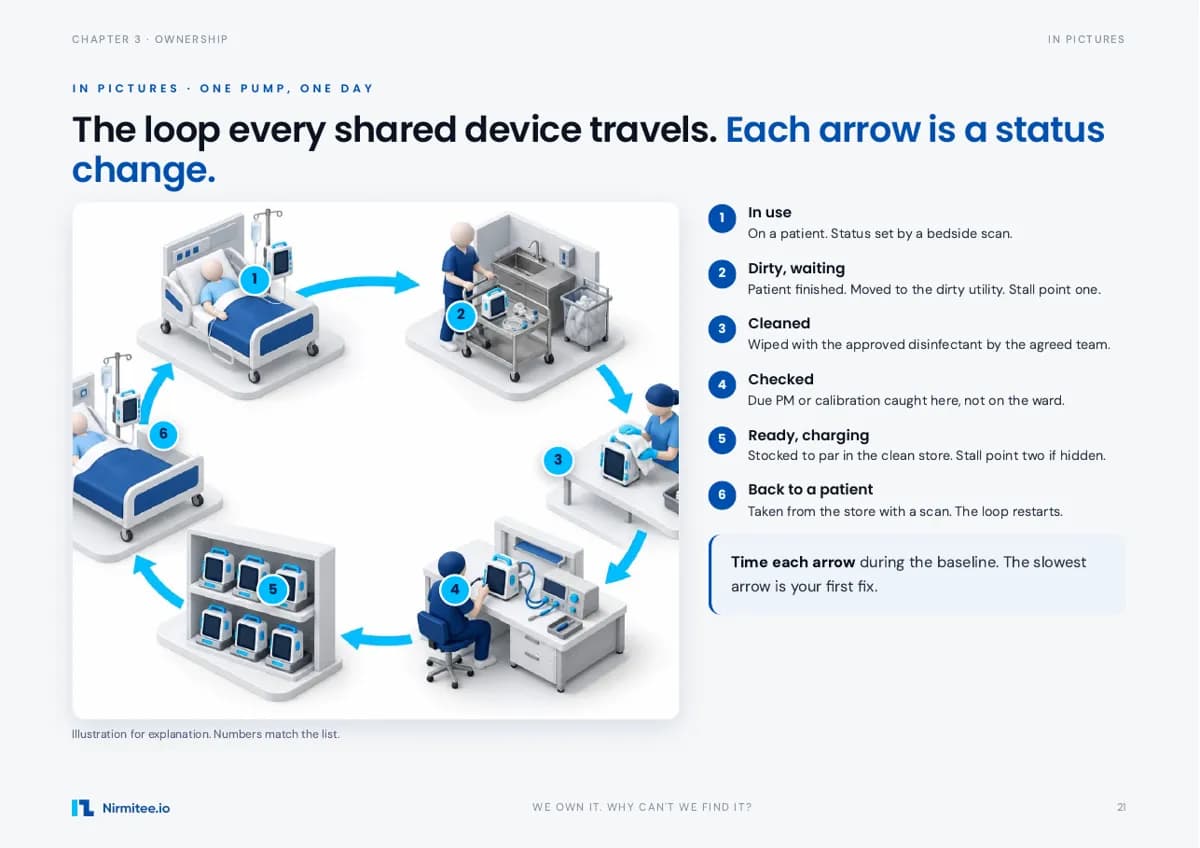
Departmental, pooled and hybrid models, the clean and dirty loop, par levels, the asset record, lifecycle, transfers and reconciliation.
Your working output: Pars, a trusted register and an exception list with owners.
Chapters 5–7
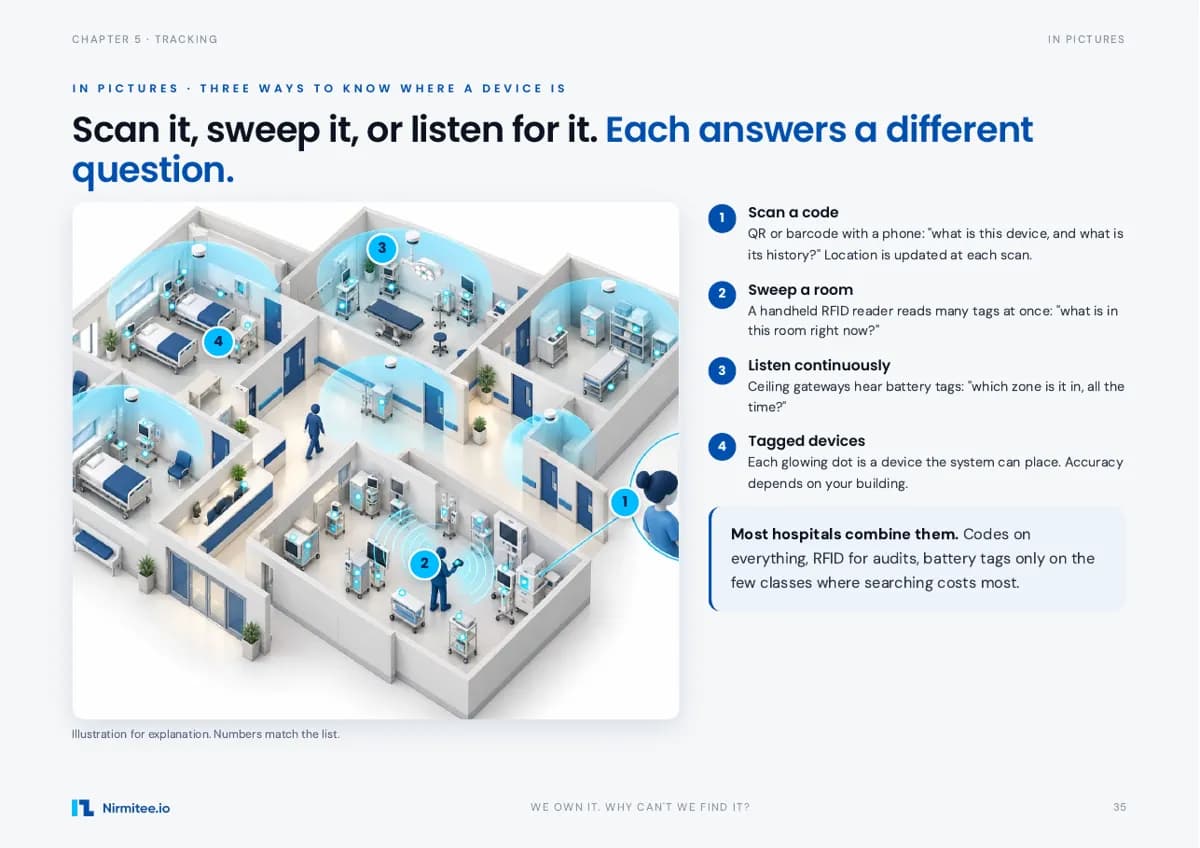
QR, barcode, RFID, BLE and RTLS by device class; eight equipment statuses; maintenance, recalls, contracts; CMS and Joint Commission evidence.
Your working output: A tracking choice per class and a survey-ready evidence map.
Chapters 8–9
Share, repair, replace or buy; total cost of ownership; replacement scoring; a 90-day rollout, daily huddle and monthly review.
Your working output: A one-page business case and a review rhythm.
Use it on Monday
The PDF includes worksheets and procedures to adapt to your own hospital.
Record every device found, where, and in what state, in one day.
Set unit pars from peak use, new starts and a safety margin.
Score each device class before choosing QR, RFID or location hardware.
Ten questions to ask any asset tracking or CMMS vendor.
Request, evidence of shortage, what was tried, options and a conditional approval.
Six numbers, three decisions, and a one-page programme checklist.
Templates are presented in the PDF; no separate editable workbook is included.
Look inside the actual guide
These pages are taken from the PDF. Enter your email to get the complete guide.
Before you request it
It is the programme that keeps medical devices registered, located, clean, maintained and safe to use across their life, from purchase to disposal. This guide focuses on availability: getting a ready device to the point of care when it is needed.
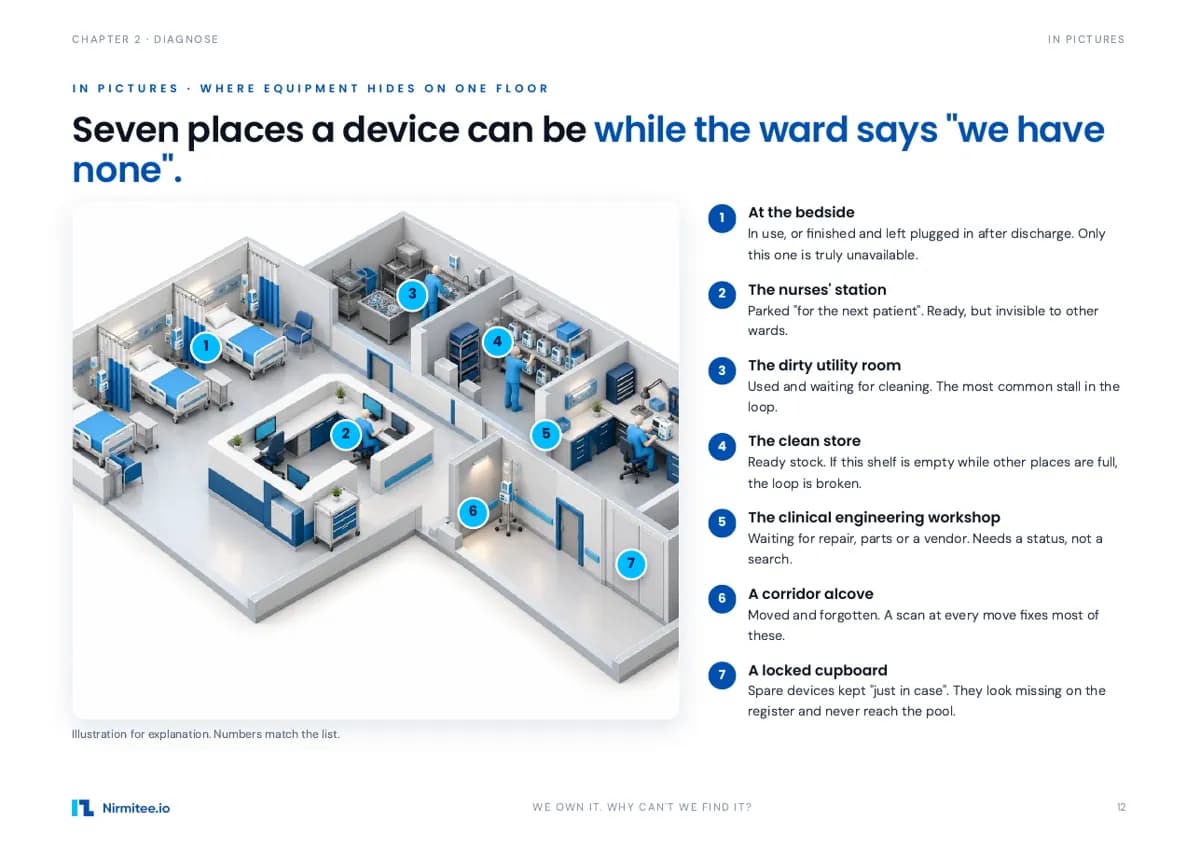
In published hospital cases the cause is usually the loop rather than the fleet size: devices waiting dirty, kept in unit closets, out for repair, or still listed after retirement. The guide shows how to measure which one you have before buying more.
Not always. One published hospital removed its nurse search time for IV pumps with process changes and no tracking system. The guide recommends owner and process first, then QR or RFID, and battery-tag location tracking only for the device classes where searches are frequent and costly.
CMS expects an inventory of owned and leased equipment with maintenance records, and allows a documented alternate maintenance programme with exceptions. From January 2026 the Joint Commission moved medical equipment requirements into its Physical Environment chapter. The guide maps the evidence and notes what to confirm in current manuals.
It is free, and we send it by email. Enter your work email in the form on this page. It does not subscribe you to marketing emails.
Yes. The India edition covers NABH FMS.5, AERB, the government Biomedical Equipment Management and Maintenance Program and uptime-based maintenance contracts.
Keep going