
Ambient Listening in Healthcare: What It Is, How It Works and What to Ask Before You Buy (2026)

CTO & Co-Founder
CTO & Co-Founder at Nirmitee.io. Architects healthcare integrations across FHIR, SMART on FHIR, ABDM and NHCX, writing from production experience taking hospital software from sandbox to go-live.
Updated October 2026
Ambient listening in healthcare is AI that records a conversation between a clinician and a patient, with the patient's agreement, and turns it into a draft clinical note for the clinician to review and sign. It is also called ambient clinical intelligence, ambient AI or an AI scribe, and it is now built into Epic, Oracle Health and athenahealth as well as sold by dozens of specialist vendors.
This guide explains ambient listening for the people who decide whether to use it: physician and nursing leaders, practice owners, CIOs and the product teams at digital health companies. It covers how the technology works step by step, where it is used, what the evidence shows, the risks, how notes reach the EHR, the main vendors, and the questions to ask before you sign. If you are adding ambient listening to your own product, see our healthcare AI solutions.
Key takeaways
- Ambient listening captures the visit, separates who said what, pulls out the clinical facts and drafts a note in your template. The clinician stays responsible for the note.
- Use is growing fast but unevenly. In a May 2024 MGMA poll, 28% of medical groups used ambient AI for notes. By August 2025, 71% of practice leaders reported some AI in patient visits, though nearly half used it in a quarter of visits or fewer.
- Clinicians report less burnout. Measured time savings are smaller: a UCLA randomized trial found 9.5% less time-in-note for one scribe and no significant change for another.
- Patient consent is required in practice, and in all-party consent states everyone in the room must agree before recording.
- The main buying questions are specialty fit, how the note gets into your EHR, how long audio is kept, and whether your data trains anyone's model.
What is ambient listening in healthcare?
Ambient listening is software that listens in the background of a clinical visit and writes the first draft of the documentation. The clinician talks with the patient normally, without dictating, and afterwards reviews a structured note, such as a SOAP note, plus any suggested orders or codes.
"Ambient" means the tool works in the background. The clinician does not give commands or narrate the exam. That is the difference from the speech recognition many clinicians already use, which types what the clinician says word for word.
| Ambient listening (AI scribe) | Dictation (speech recognition) | Human scribe (in person or remote) | |
|---|---|---|---|
| What it captures | The whole conversation, with who said what | Only what the clinician speaks into it | The visit, as a person hears it |
| What the clinician does | Talks with the patient, then reviews the draft | Narrates the note, then corrects the text | Talks with the patient, then reviews the scribe's note |
| Output | Structured draft note, often with suggested orders and codes | Text in the place the cursor is | Note written by the scribe |
| Consent | Recording consent needed | Usually no patient recording | Patient told a scribe is present |
| Main risk | Omissions, invented details, wrong speaker | Transcription errors | Cost, turnover, availability |
You will see several names for the same idea. Ambient clinical intelligence is the term Nuance (now Microsoft) used for its DAX product. Ambient clinical documentation and ambient AI scribe are the most common general terms. Epic calls its version Chart with Art.
How ambient listening works, step by step
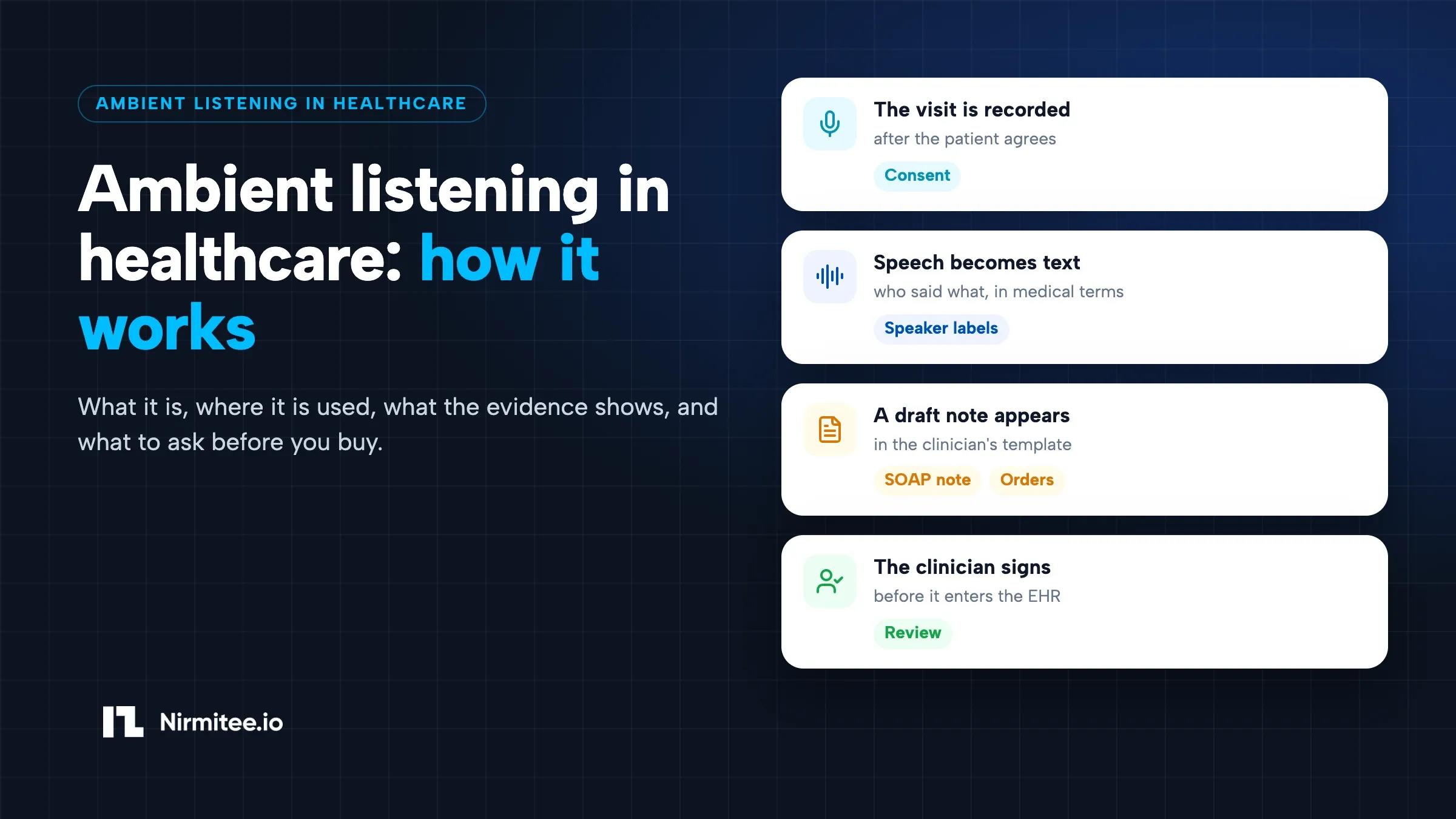
An ambient listening system runs six steps: consent, capture, transcription with speaker separation, clinical understanding, drafting in the clinician's template, and clinician review before the note enters the EHR. Each step has its own failure modes, which is why clinician review never goes away.
- Consent. The clinician tells the patient the visit will be recorded and asks for agreement. The VA, for example, uses the Veteran's verbal consent and says the tool is always optional.
- Capture. A phone, tablet or room microphone records the visit. Telehealth tools capture both sides of the call.
- Transcription and speaker separation. Speech recognition tuned for medical terms turns audio into text, and the system labels who is speaking: clinician, patient, family member or interpreter.
- Clinical understanding. A language model picks out symptoms, history, exam findings, medications, the assessment and the plan, and ignores small talk.
- Drafting. The system writes the note in the clinician's template and style, and may suggest orders, diagnosis codes and patient instructions.
- Review and filing. The clinician edits and signs. The note is filed in the EHR, either natively or through an integration.
Where ambient listening is used today
Ambient listening started in outpatient clinic visits and has spread to emergency departments, hospital wards, nursing, home health, therapy and telehealth. EHR vendors now list ambient drafting for several of these settings, and large public systems such as the VA are rolling it out.
| Setting | Example | Source |
|---|---|---|
| Outpatient clinic visits | Epic's Chart with Art drafts outpatient notes, orders and diagnoses; Stanford Health Care piloted DAX Copilot across five specialties | Epic Art page; Stanford Medicine, March 2024 |
| Emergency and inpatient | Epic lists drafting notes and queuing orders in inpatient and ED settings | Epic Art page |
| Nursing | Oracle Health reported extending its Clinical AI Agent to inpatient nursing documentation in September 2026 | HIT Consultant, September 2026 |
| Home health | Epic lists hands-free OASIS assessment drafting; home health vendors such as Homecare Homebase offer ambient scribes | Epic Art page; HCHB |
| Therapy | Epic lists drafting therapy progress notes | Epic Art page |
| Veterans' care | VA facilities use an ambient AI scribe with verbal consent, always optional | VA Southern Nevada news release |
| Behavioral health | Specialty EHRs and scribes add therapy-note formats and stricter privacy settings | Our own build work (see below) |
How widely is ambient listening used?
Ambient listening is one of the fastest-adopted technologies in healthcare, but most organizations still use it in a minority of visits. MGMA polls show 28% of medical groups using ambient AI for notes in May 2024, and 71% of practice leaders reporting some AI in patient visits by August 2025.
- May 2024: an MGMA Stat poll of 424 respondents found 28% of medical groups used ambient AI to transcribe speech or draft notes; 69% did not. Many non-users were waiting for their EHR to add it.
- August 2025: a later MGMA poll of 244 respondents found 71% reported some AI use in patient visits, but 47% used it in 25% of visits or fewer. Among AI users, 39% said it reduced workload and 44% said it had not.
- Vendors: the Peterson Health Technology Institute counted about 60 AI scribe tools in the market in its March 2025 report.
Since then, Epic, Oracle Health and athenahealth have all added their own ambient tools, which is likely to push adoption up further among groups that were waiting for their EHR.
Does ambient listening work? What the evidence shows
The evidence is consistent on burnout and mixed on time. Surveys and trials show clinicians feel less burdened, while measured time savings are modest, vary by product and specialty, and depend heavily on how often clinicians actually use the tool.
| Source | What was studied | What it found | How strong |
|---|---|---|---|
| UCLA randomized trial, NEJM AI | DAX Copilot and Nabla vs usual care; 238 physicians, 14 specialties, Nov 2024 to Jan 2025 | Nabla: 9.5% less time-in-note. DAX: no significant change. Burnout scores improved with both. Used in about a third of visits. | Strongest design so far; one site, eight weeks |
| Stanford Health Care pilot | DAX Copilot in primary care, cardiology, orthopedics, rheumatology, neurology | 96% found it easy to use; 78% said it sped up note taking; about two-thirds said it saved time | Survey of pilot users |
| VA initial testing | Ambient AI scribe in VA care | Used in 55% of encounters; about two minutes of note taking saved per appointment | Reported by VA; no study design given |
| Epic, September 2026 (OLVG, Amsterdam) | Chart with Art, pediatricians | 31% less note-writing time per appointment | Vendor-published, one hospital |
| Peterson Health Technology Institute, March 2025 | Review of early deployments | Burnout and cognitive load reduced; no significant financial improvement reported yet | Independent review; evidence base still thin |
Two lessons follow. Measure your own baseline before you start, because published results vary widely. And treat adoption as a result in its own right: a tool used in a third of visits saves a third as much as one used in every visit.
Accuracy and safety risks of ambient listening
The main risks are notes that leave out something important, add a finding that was never said, attribute words to the wrong person, or flip a negative into a positive. Clinician review catches most of them, so the design goal is a draft that is quick to check.
| Risk | Example | Control |
|---|---|---|
| Omission | A symptom mentioned at the door is missing from the note | Clinician review; checklists for required elements |
| Invented detail | An exam finding that was never performed appears in the note | Every sentence linked to the transcript; flag anything without a source |
| Wrong speaker | A parent's history is written as the patient's | Speaker labels shown in review; extra checks for visits with several speakers |
| Negation | "No chest pain" becomes "chest pain" | Highlight negated findings in the draft |
| Medication details | Wrong dose, route or frequency | Compare against the medication list; highlight changes |
| Sensitive content | Something the patient asked to keep private reaches the note | Pause button, clinician removal, behavioral health privacy settings |
| Suggested orders | An order discussed but not agreed is queued | Orders stay suggestions until the clinician places them |
In the UCLA trial, clinicians reported clinically significant inaccuracies "occasionally" with both scribes. That is why no responsible deployment lets an ambient draft reach the chart without a clinician's signature.
Consent and privacy for ambient listening
Ambient listening records protected health information, so it needs patient consent, a business associate agreement with the vendor, and clear rules on how long audio is kept and whether it trains AI models. State recording laws in places like California, Florida and Pennsylvania require every party in the room to agree.
- Ask every patient. Even where the law allows one-party consent, asking builds trust. Record the answer in the chart and make declining easy.
- Telehealth counts. Phone and video visits follow electronic recording rules, which are stricter in some states.
- Retention and training. Get the audio retention period and the model-training terms in writing. Epic's first AI Charting customer states that recordings are kept for a limited time and are not used to train AI models.
- Disclosure laws. Texas now requires practitioners to disclose some uses of AI in care. Check your state.
Our ambient AI scribe implementation guide has a patient consent form template you can copy and a state-by-state recording-consent table. For the engineering controls, see what a HIPAA compliant AI medical scribe needs.
How ambient listening notes get into the EHR
Ambient notes reach the EHR in one of three ways: the EHR vendor's own built-in tool, a partner scribe connected through the vendor's program, or a custom integration using FHIR or HL7 v2 interfaces. The route decides whether the note lands in your template, as a draft, on the right visit.
- Built in. Epic Chart with Art, Oracle Health's Clinical AI Agent and athenahealth's own scribe draft notes inside the EHR. See our guide to the Epic AI scribe.
- Partner programs. Abridge, Microsoft Dragon Copilot, Nabla and others connect through Epic's partner programs; athenahealth's Ambient Notes program lets practices pick an engine such as Suki.
- Custom integration. A scribe in your own product writes the note with a FHIR DocumentReference or an HL7 v2 document message. Formats and draft rules differ by EHR, as our DocumentReference guide shows. Our EHR integration services team builds these connections for Epic, Oracle Health and athenahealth.
Ambient listening vendors in 2026
The market splits into four groups: EHR vendors' own tools, enterprise scribes sold to health systems, specialty and self-serve scribes for practices, and platforms that software companies use to build their own. Most prices are not public outside the self-serve group.
| Group | Examples | Typical buyer | What to check |
|---|---|---|---|
| EHR-native | Epic Chart with Art, Oracle Health Clinical AI Agent, athenahealth athenaAmbient | Organizations on that EHR | Specialty fit; sites on other EHRs |
| Enterprise scribes | Abridge (Best in KLAS 2026 for ambient speech, per Becker's), Microsoft Dragon Copilot, Ambience | Health systems | Depth of EHR integration in your build; contract terms |
| Specialty and practice scribes | Suki, Nabla, DeepScribe, Commure, Freed, Heidi | Medical groups and independent practices | EHR push, templates, BAA on your plan |
| Platforms to build on | AWS HealthScribe | Software vendors adding a scribe to their product | You own consent, safety review and EHR integration |
For a side-by-side view of cost, EHR support and specialty fit, see our AI medical scribe comparison.
Questions to ask before you buy ambient listening
Ask about specialty fit, EHR write-back, audio retention, model training, consent support, accuracy reporting and total first-year cost. Get the answers in writing, and test the hard cases in your own pilot rather than relying on a demo.
| Question | Why it matters |
|---|---|
| Which of our specialties and visit types do you support well today? | Accuracy varies by specialty and visit type |
| How does the note reach our EHR, and does it land in our template as a draft? | Copy and paste kills adoption |
| How long are audio and transcripts kept, where, and who can listen? | Retention is a privacy and legal risk |
| Does our data train any model, yours or a subcontractor's? | Should be off unless you opt in |
| Will you sign a BAA, and who are your subprocessors? | HIPAA requires it for every party handling PHI |
| How do you support consent: scripts, chart fields, pause? | Consent is your obligation, but the tool can make it easy |
| How do you measure and report accuracy? | You need a way to track errors after go-live |
| Does it handle interpreters, several speakers and noisy rooms? | Common in real clinics, rare in demos |
| What is the full first-year cost, including setup and training? | License price is only part of it |
| What happens to our data if we leave? | Exit terms are easier to set before you sign |
What does ambient listening cost?
Enterprise ambient listening is sold on negotiated contracts without public prices, and EHR vendors have not published prices for their own tools. Self-serve scribes publish monthly plans: Freed, for example, lists plans from $39 to $119 per clinician per month as of October 2026.
Count the full cost: licenses, EHR build work, devices, training and support. Set it against your own pilot results. The Peterson Health Technology Institute found that early adopters saw burnout benefits but no significant financial gains yet, and warned that higher coding levels could raise costs for payers and patients. Treat time saved as capacity, not cash, unless it becomes more visits or less overtime.
Where ambient listening is heading
Ambient tools are moving from notes to the work around the note: suggested orders, diagnosis and visit-level codes, patient instructions, nursing documentation and home health assessments. Each new output needs its own review step and its own accuracy checks.
Epic's Art page already lists order queuing, code suggestions and patient instruction drafting. Oracle Health added order creation to its agent in the US in February 2026. The practical effect for buyers is that a scribe decision is becoming a decision about which AI helps with the whole visit, so EHR fit matters more each year.
How to get started with ambient listening
Start with a small pilot: two or three specialties, clinicians who want to try it, a baseline from your EHR data, and a consent process your counsel has approved. Judge it on eight weeks of use, then decide whether to scale, switch tools or stop.
- Pick the visits. Conversational outpatient visits are the easiest place to start. Procedures, crowded rooms and visits with interpreters are harder; add them once the basics work.
- Check your EHR first. If your EHR vendor now offers its own tool, include it in the pilot alongside one other product, so you compare fit rather than features on a slide.
- Set up consent. Write the script, add a chart field for the answer, and tell patients ahead of the visit. Make declining quick for both patient and clinician.
- Measure before and after. Track time-in-note, after-hours charting, how often clinicians use the tool, edit effort and errors. Clinician surveys are useful, but pair them with EHR data.
- Review errors every week. Name a clinical owner, collect every reported error, and feed patterns back to the vendor.
Our ambient AI scribe implementation guide covers each of these steps in detail, including security controls and EHR write-back for Epic, Oracle Health and athenahealth.
How Nirmitee helps with ambient listening
We build ambient documentation for digital health companies and provider groups, and connect it to Epic, Oracle Health and athenahealth. We have built an AI documentation assistant inside a behavioral health EHR, with consent capture, drafts tied to the transcript, clinician sign-off and prompt version control. We are ISO 27001:2022 certified and sign BAAs. We do not resell scribe products, so if an off-the-shelf tool fits your needs, we will tell you.
Ambient listening readiness review
For health systems, medical groups and digital health vendors deciding how to add ambient listening. In two weeks we return the route that fits your EHRs and specialties, a consent and security checklist, the EHR write-back design, and a fixed quote for any build. Book a scoping call.
Related: healthcare AI solutions, our voice to clinical notes case study, and what it takes to build an AI clinical scribe beyond the prototype.
Ready to scale?
Talk to our healthcare engineering team about building, integrating, and shipping faster.
Frequently Asked Questions
What is ambient listening in healthcare?
How does ambient listening technology work?
Is ambient listening the same as dictation?
How many practices use ambient listening?
Does ambient listening save clinicians time?
Is ambient listening HIPAA compliant?
Do patients have to consent to ambient listening?
Which companies offer ambient listening for healthcare?


