Clearinghouse Integration for EHR Teams: X12 Claims in Production

CTO & Co-Founder
CTO & Co-Founder at Nirmitee.io. Architects healthcare integrations across FHIR, SMART on FHIR, ABDM and NHCX, writing from production experience taking hospital software from sandbox to go-live.
Every US healthcare product that bills insurance eventually hits the same wall. The clinical side works. Notes are signed, codes are assigned, the charge is calculated. Then someone asks the question that stalls the roadmap for a quarter: how do we actually get paid?
📌 Updated guides: see the current step-by-step clearinghouse integration guide and the realistic enrollment timeline.
The answer is a clearinghouse. And integrating with one is not the two-week connector task it looks like on a slide. It is a distributed system with asynchronous responses, no delivery guarantees, correlation keys you must design for up front, and a money model that is easy to get subtly, expensively wrong.
This guide covers what actually matters in production: the transaction choreography, the traps that produce silent data corruption, and an architecture that survives contact with a real clearinghouse. Waystar is used as the worked example because it is one of the largest, but the patterns apply to Availity, Office Ally, Change/Optum and the rest.
What a clearinghouse actually does
There are thousands of payers in the United States. Each has its own enrolment process, connectivity, quirks and rejection behaviour. Connecting to them individually is not a project; it is a company.
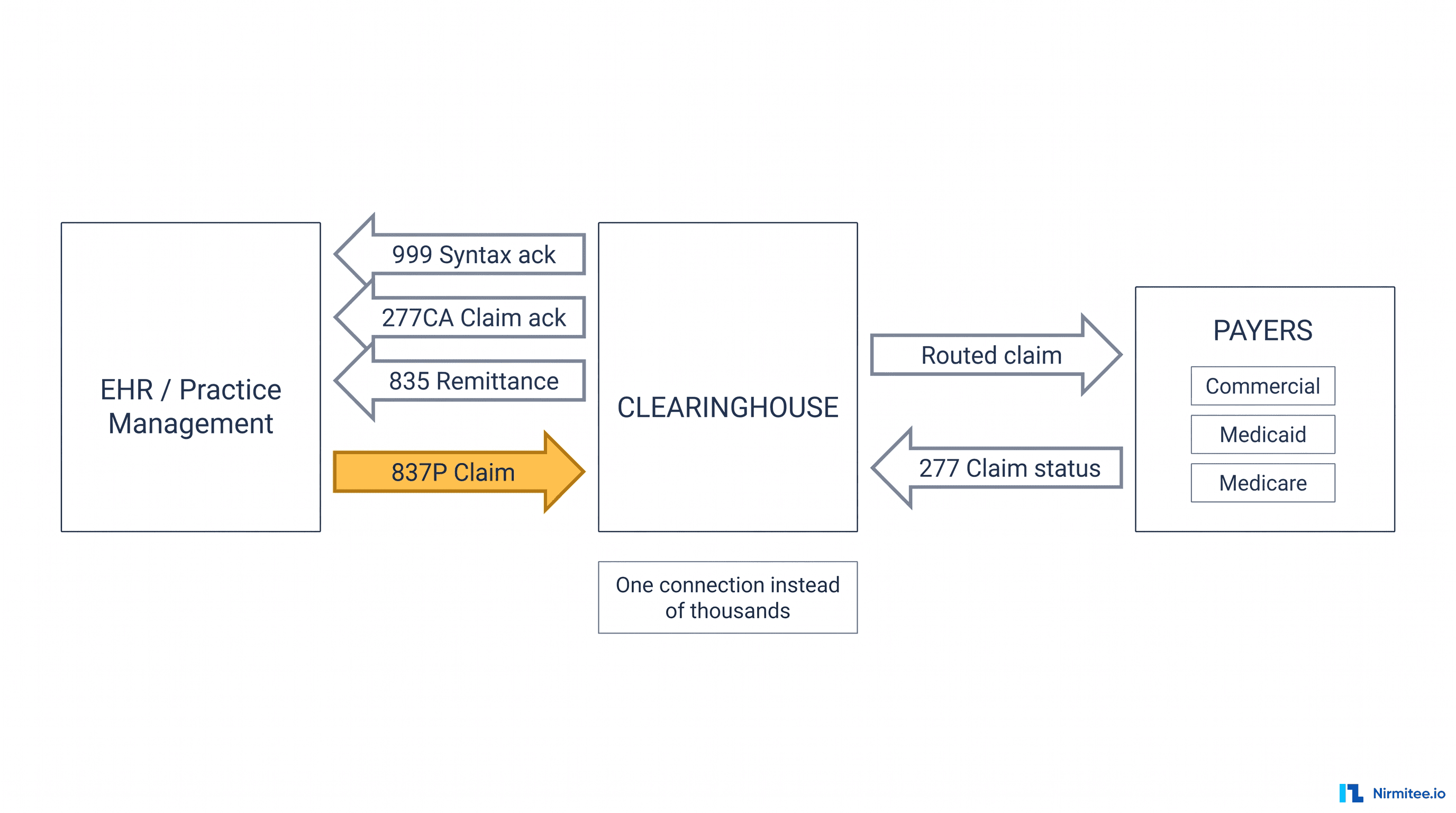
A clearinghouse collapses that into one connection. You send claims to them, they normalise, scrub, route to the correct payer, and return responses in a standard format. Waystar processes claims for a large share of the US population and connects to thousands of payer endpoints. That reach is the product.
What you get in exchange for the integration effort:
- One connection instead of thousands of payer relationships
- Pre-submission scrubbing that catches format errors before a payer sees them
- Normalised responses so you write one parser, not one per payer
- Enrolment support for the paperwork side of payer onboarding
What you do not get: a REST API that makes claims feel like a modern integration. Which brings us to the first thing to settle before any code is written.
Four contract questions to answer before you write code
These are commercial questions with hard architectural consequences. Getting them wrong late is expensive.
1. Is the account per-platform or per-clinic?
Clearinghouse contracts are typically negotiated per EHR platform, not per practice. One account submits on behalf of many organisations, each with its own tax ID — and the tax ID that identifies the billing entity travels inside the claim payload, not at the transport layer.
This matters enormously. The instinct on a multi-tenant platform is to build per-tenant credential storage, tenant-scoped connection pools and a secrets model to match. If the contract is per-platform, all of that is wasted work — you have one credential set, and tenancy is a payload concern. Unwinding that later is painful.
2. Is the API in your contract, or just SFTP?
"Does the clearinghouse have an API?" is the wrong question. The right question is "is the API entitled on our contract?" Real-time API access is frequently a separate product line that not every customer subscribes to. The default EHR agreement is very often SFTP batch only.
Teams routinely scope real-time claim status features, then discover the entitlement does not exist. If there is any chance the contract changes later, build the API adapter behind a feature flag and ship it dormant — turning it on becomes a config change rather than a project.
3. Are the provider and payer enrolled?
Every payer must be enrolled for every provider, and separately for each transaction type — claims, remittance, eligibility. Enrolment is paperwork, it takes weeks, and it is entirely outside engineering's control. A technically flawless integration cannot bill a payer the provider is not enrolled with.
Never commit to a go-live date without checking enrolment status first.
4. Is your infrastructure allowlisted?
Clearinghouses restrict connections to registered IP addresses. Your servers — and your developers, if they need to test — must be added. This has multi-day lead time and is the single most common cause of a stalled first sprint. Request it in week one, before you need it.
The transaction choreography
Claims submission is a conversation, not a request/response call. Each message is a numbered X12 transaction set, and they arrive asynchronously over hours or days.
Outbound: 837P
The claim itself. P is professional (the CMS-1500 form, used by outpatient and behavioural health). 837I is institutional (UB-04), 837D is dental. Most digital health products need 837P.
Inbound: 999 — was the file readable?
A functional acknowledgement. It tells you whether your file was syntactically valid. It arrives within minutes and says nothing about whether the claim is any good. A 999 acceptance means "we could parse it", not "we will pay it".
Inbound: 277CA — did the clearinghouse accept the claim?
A claim acknowledgement. The clearinghouse has looked at the claim and either accepted it for forwarding or rejected it. This is where most format and data-quality rejections surface. Still not the payer.
Inbound: 277 — where does it stand with the payer?
A claim status response. This is the payer's view. It is the transaction that tells you a claim was accepted, pended, denied or finalised at the organisation that actually pays.
Outbound: 276 — the one everyone forgets
A claim status inquiry. This is the critical asymmetry in the whole design: 999, 277CA and 835 arrive unsolicited. Current payer status generally does not.
If you never send a 276, you only ever know what the payer volunteered. Claims sit in whatever state your last inbound file left them in — indefinitely. Support tickets that read "our system says rejected but the clearinghouse portal says it is fine" almost always trace back to a missing 276 loop.
Build the 276 poll from day one, on an aging cadence: claims with no movement in N days get an inquiry. Reactive-only integrations always drift.
Inbound: 835 — the money
The remittance advice, or ERA. Payment, adjustments, patient responsibility. Days to weeks after submission. This is the transaction that closes the loop financially, and the one most commonly mis-implemented.
The 277 vs 277CA trap
This one is worth its own section, because it produces exactly the symptom teams find hardest to diagnose.
277 and 277CA are different transactions that share the same transaction set code. Both carry ST01 = 277. They are distinguished by the BHT06 element:
BHT06 = TH— a 277CA, the clearinghouse acknowledgementBHT06 = DG— a 277, the payer claim status response
A router that identifies inbound files by ST01 alone will feed payer status responses into the acknowledgement parser. Nothing crashes. Files are consumed, rows are written, logs look healthy. But the richest source of "the payer moved this claim forward" data is being misread — and claims silently hold stale statuses.
# Correct: sniff BHT06, not just ST01
def route(segments):
    st01 = first_segment(segments, "ST")[1]
    if st01 != "277":
        return HANDLERS[st01]

    bht = first_segment(segments, "BHT")
    purpose = bht[6] if len(bht) > 6 else ""

    if purpose == "DG":
        return handle_payer_claim_status   # 277
    return handle_claim_acknowledgement    # 277CA (TH)
If you take one implementation detail from this guide, take this one.
Correlation: how a response finds its claim
Responses arrive hours or days later, out of order, sometimes batched with other claims. Matching them back is the hardest part of the integration, and it must be designed before the first claim goes out.
| Response | Correlates by |
|---|---|
| 999 | ISA13 — the interchange control number of the file you sent |
| 277CA | Trace number to your patient control number |
| 835 | Payee tax ID to your organisation, then control number per claim |
| 271 | The trace number echoed back from your 270 |
The patient control number is the workhorse. It is your identifier, echoed back by everyone downstream. A predictable convention — a stable prefix plus your internal claim id — makes matching trivial for your own claims while letting foreign control numbers from a prior system fall out for manual triage.
Three rules learned the hard way:
- Reuse control numbers across retransmission attempts. If a send fails and you regenerate control numbers on retry, correlation breaks and you can no longer distinguish a retry from a duplicate claim.
- Never rewrite the payer's control number to force a match. The remittance is payer truth and must stay immutable. Record manual matches as a separate join record.
- Unmatched remittances must persist, never be dropped. Route them to a triage queue. A remit you cannot match is money you cannot post.
The money model — where most implementations go wrong
An 835 does not simply say "we paid you X". It decomposes the charge, and the decomposition is where the errors live.
Take a $200 session where the contracted allowed amount is $150:
- Billed charge: $200 — what you asked for
- Allowed amount: $150 — what your contract permits
- Insurance paid: $120
- Patient responsibility: $30 — copay, coinsurance, deductible
- Contractual adjustment: $50 — the difference you agreed to write off
The collectible balance is $30, not $80. The contractual adjustment is not money owed to you. You contracted it away when you joined the network.
The naive formula — billed − paid = remaining — is the single most common defect in home-grown revenue cycle systems. It overstates receivables on every in-network claim, and because the number looks plausible, it can survive for years before anyone reconciles.
Reading CAS segments correctly
Adjustments arrive in CAS segments. Group codes: CO contractual, PR patient responsibility, PI payer initiated, OA other.
There is a parsing trap here that silently corrupts the numbers. A CAS segment repeats as (reason, amount, quantity) triplets — but the group code appears only once, at the first position:
CAS*CO*45*50*1*253*2.5
    |  |  |  |  |   |
    |  |  |  |  |   +-- quantity  (2nd adjustment)
    |  |  |  |  +------ amount    (2nd adjustment)
    |  |  |  +--------- reason    (2nd adjustment)
    |  |  +------------ amount    (1st adjustment)
    |  +--------------- reason    (1st adjustment)
    +------------------ GROUP CODE - appears ONCE, applies to all
A loop that reads every third element as a group code picks up the quantity from the second adjustment onward. Reason codes and amounts stay correct, so totals look sane and nothing throws — but the CO versus PR distinction becomes noise. And that distinction is precisely what your collectible-balance calculation depends on.
# Correct: group code is read once, outside the triplet loop
group = elements[1]
i = 2
while i + 1 < len(elements):
    reason, amount = elements[i], elements[i + 1]
    adjustments.append((group, reason, amount))
    i += 3   # skip the quantity
Provider roles: the credentialing rule
A claim carries several distinct provider identities, and collapsing them is a reliable way to get rejected. The main ones:
- Billing provider — the organisation, with its tax ID and NPI
- Rendering provider — who is billed as having delivered the service
- Supervising provider — the credentialed supervisor, where applicable
- Referring provider — who referred the patient
Two rules that cause real-world rejections:
The name and the NPI must describe the same person. Mismatches produce a "rendering provider name matching required" rejection. If you store names and identifiers in different tables and join them at claim-build time, verify they resolve to one coherent identity.
Where a pre-licensed clinician delivers the service, the credentialed supervisor is the rendering provider. This matters enormously in behavioural health, where supervised trainees carry real caseloads. The trainee is not credentialed with the payer, so naming them as rendering gets the claim rejected. The supervisor is reported instead; the trainee is retained internally for attribution and reporting but is not transmitted.
Teams often model this backwards — showing the supervisor internally and sending the trainee — and then spend weeks debugging payer rejections that have nothing to do with their code.
Operational realities nobody documents
These are behaviours of real clearinghouse SFTP endpoints. They are not defects; they are the contract, and your integration must accommodate them.
- Uploads overwrite silently. Re-uploading the same filename replaces the content and can race with their ingest. Always generate unique filenames with a timestamp or batch id.
- The outbound directory is often write-only. You cannot list it to check for collisions, so filename uniqueness cannot depend on a lookup.
- Archiving is upload-then-delete, not atomic. A failure between the two steps leaves a duplicate in the archive and the original in place. Treat "already exists at destination" as recoverable, not as an error.
- Cancelling mid-transfer leaves undefined remote state. Reconcile by listing the directory before retrying.
- File extensions drive routing. The extension tells the clearinghouse which processing pipeline ingests the file — professional claims, institutional, dental, eligibility, remittance. Use the wrong one and the file is rejected or processed by the wrong engine. Many also forbid periods in the base filename.
- Non-EDI files appear in your inbox. Clearinghouses drop portal reports and audit digests alongside the X12. Your router must recognise and handle them, or they accumulate forever as "unrecognised".
Route inbound files by content, not filename. Naming conventions are rarely contractually stable; the X12 envelope structure is. Read the interchange header to find the delimiters, then the first transaction set code.
Retry without creating duplicate claims
A duplicate claim is worse than a failed one. It creates payer confusion, duplicate denials, and in the worst case duplicate payment followed by recoupment. Yet transmission failures are routine — networks fail, sessions drop, processes restart mid-send.
A submission design that survives this:
- Two-phase submit. Persist the submission record first with a pending state, then transmit. If the process dies between the two, the record exists and is recoverable.
- Separate delivery state from claim state. A claim can be "submitted" in your workflow while its file has not yet reached the clearinghouse. Conflating the two makes an undelivered claim indistinguishable from a filed one.
- Idempotency guard on submit. Refuse to create a second submission while a live one exists for the same claim.
- Exponential backoff with a cap, and a bounded attempt count.
- Reuse control numbers across attempts so correlation holds.
- Abandon explicitly. When the retry budget is exhausted, move the claim to a state a human will see. Silent abandonment is how claims disappear.
- Stale-pending detection. A record pending beyond a threshold was orphaned by a crash and should be picked up — but only after long enough that you are not racing a live send.
A reference architecture
The design that holds up separates two concerns that teams naturally entangle.
The EDI content lane knows X12. It builds claims and parses responses. It never opens a socket, never handles a credential.
The transport lane knows connections. Authentication, file transfer, retry, redaction. It never parses EDI content.
They meet at two narrow interfaces: something that moves bytes, and something that routes an inbound file to the right parser.
Why this separation earns its keep:
- Swapping clearinghouses touches one lane. The X12 content is standardised; the transport is vendor-specific.
- You can test the parsers without credentials. Feed sample files straight into the router. Most of the integration becomes testable on day one — a significant scheduling advantage when allowlisting has not come through.
- Credentials stay in one place, with startup validation that fails loudly rather than at 2am on the first live claim.
Two supporting pieces worth building early:
- Log redaction. Credentials, tokens and identifiers must never reach your log sink. Build the redactor before the first connection, not after the first audit.
- An immutable event ledger. Every state change — generated, transmitted, acknowledged, rejected, paid — as an append-only event with a source and a timestamp. Corrections create new events rather than editing history. When a payer disputes a claim eighteen months later, this is the only thing that saves you.
Where this fits in your interoperability roadmap
Claims integration sits on the financial side of healthcare interoperability (see our AI-driven interoperability solutions), distinct from the clinical data exchange most teams start with. Clinical data increasingly moves over FHIR APIs. Claims move over X12 EDI (see our X12 EDI healthcare integration), and will continue to for years — regulatory pressure is pushing payers toward FHIR APIs for member and clinical data, but the claims and remittance rails are not going anywhere.
Teams building serious revenue cycle capability need both. If you are earlier in the journey, our developer guide to 835, 837 and 277 covers the transaction formats in more depth, and our X12 EDI guide for developers walks through eligibility alongside claims.
A realistic sequence
If you are starting from nothing, this order front-loads everything that does not depend on the clearinghouse:
- Settle the contract questions. Per-platform or per-clinic. API entitled or SFTP only. Enrolment status. Start the allowlisting request.
- Build the content lane against sample files. Claim generation, response parsing, the money model. No credentials required.
- Build the transport lane behind interfaces. Retry, idempotency, redaction.
- Connect and verify. Prove connectivity standalone before involving the application.
- Submit one claim end to end and follow it through every response.
- Add the 276 loop before you have volume, not after.
- Add monitoring — awaiting transmission, failures, no response, unreconciled, aging. Essential before any automation.
Steps 2 and 3 are the bulk of the engineering and neither is blocked on the clearinghouse. Teams that sequence this way are usually testing real claims while teams that waited for credentials are still waiting.
The takeaway
Clearinghouse integration is not hard because X12 is complicated. It is hard because it is an asynchronous distributed system with financial consequences, wrapped in a commercial agreement that constrains your architecture, gated by paperwork you do not control.
The teams that do it well settle the contract questions first, separate content from transport, design correlation before the first claim goes out, model the money correctly from day one, and build the polling loop before they need it.
Building claims or revenue cycle capability into your platform? Our healthcare interoperability solutions team has delivered clearinghouse and EDI integrations end to end, and our healthcare product engineering practice builds the surrounding platform. Talk to our team about what your integration needs.
Ready to scale?
Talk to our healthcare engineering team about building, integrating, and shipping faster.
Frequently Asked Questions
What is the difference between a 277 and a 277CA?
Why do claims stay in a stale status even after the clearinghouse shows them resolved?
How do you calculate the remaining balance on a claim from an 835?
Do you need an API, or is SFTP enough for clearinghouse integration?
How do you prevent duplicate claim submissions when a transmission fails?