E-Prescribing Integration: The Complete A-to-Z Guide (2026)

CTO & Co-Founder
CTO & Co-Founder at Nirmitee.io. Architects healthcare integrations across FHIR, SMART on FHIR, ABDM and NHCX, writing from production experience taking hospital software from sandbox to go-live.
Reviewed by Jitendra Choudhary, CTO and Co-Founder, Nirmitee.io
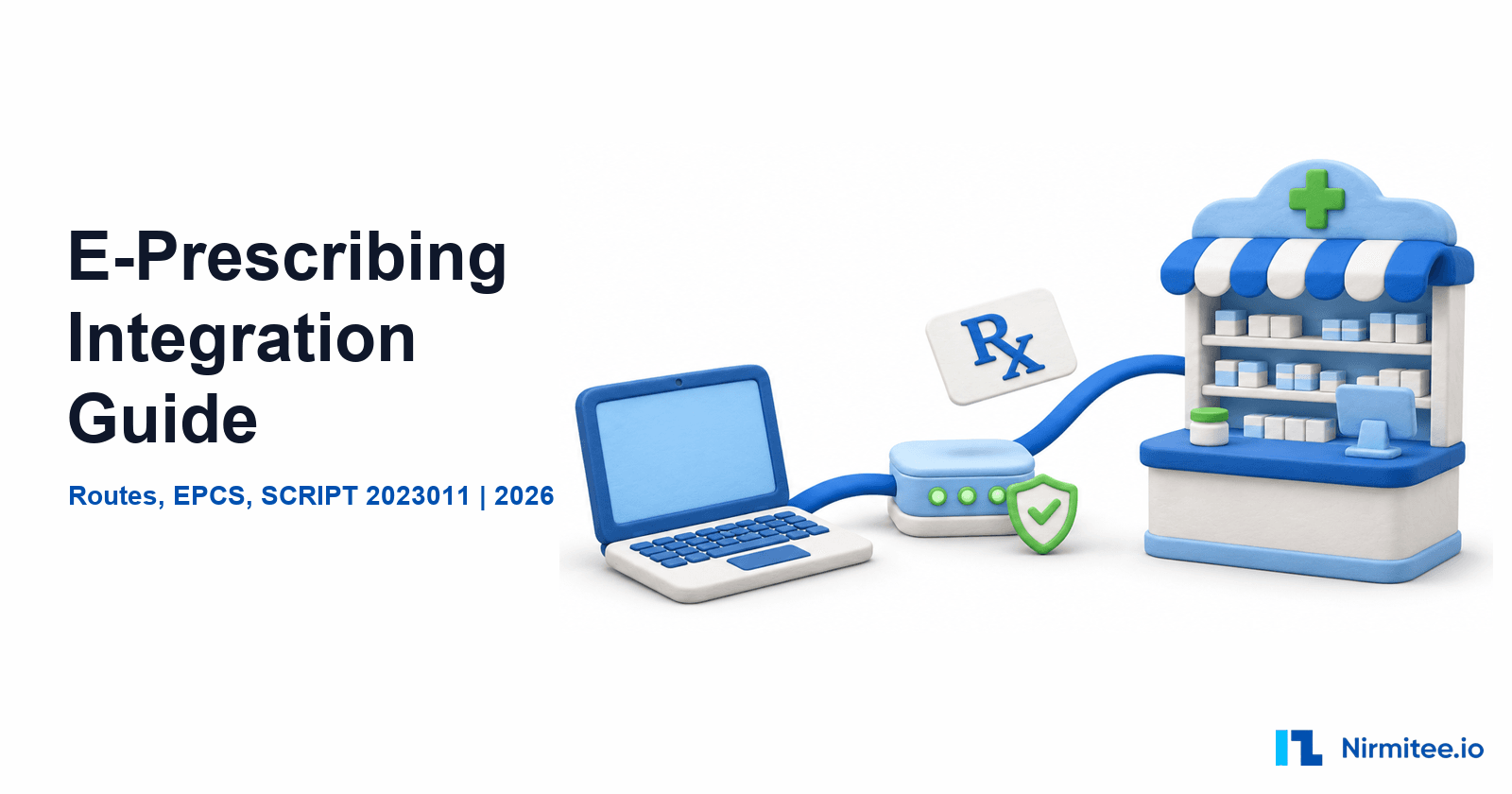
E-prescribing is sending a prescription from the prescriber's software to the pharmacy as a structured electronic message. In the US, that message is an NCPDP SCRIPT transaction, and nearly all retail pharmacies receive it over the Surescripts network. This guide covers every route a product can take to get there, who each route suits, the rules for controlled substances, the data model, the build steps and the problems that show up after go-live. It is written for US buyers. India, the UK and other countries use different rules and networks and are out of scope here.
Last checked November 25, 2026. Regulatory dates were read on cms.gov, ecfr.gov and the Federal Register on that day.
E-prescribing at a glance: the seven short answers
Most products reach pharmacies through a certified eRx vendor. A smaller group certifies directly with Surescripts, and products that live inside a large EHR use the EHR's own prescribing.
| Question | Short answer |
|---|---|
| What carries the prescription? | NCPDP SCRIPT. Versions 2017071 and 2023011 are both allowed now. From January 1, 2028, only 2023011 is accepted. |
| Which network? | Surescripts for nearly all retail pharmacies. Weno Exchange runs a separate network that prescribers can choose instead. |
| Fastest route for a new product | A certified eRx vendor API or embedded widget, such as DoseSpot, DrFirst Rcopia, ScriptSure or Photon Health. Photon does not allow controlled substances. |
| Who signs? | Always the prescriber, in a certified prescribing screen. Controlled substances need two-factor signing under DEA rule 21 CFR 1311. |
| Can FHIR do it alone? | No. FHIR MedicationRequest works inside your product and between apps and EHRs. Retail pharmacies expect NCPDP SCRIPT over a network. |
| Typical time | 6 to 10 weeks through a vendor API, by our estimate. Direct certification takes longer and is paced by the certifying bodies. |
| Biggest limit | In our November 2026 checks, most EHRs let outside apps read medications but not send prescriptions. Canvas Medical plugins can draft and send a prescription, and the prescriber still signs it in Canvas. |
How does an electronic prescription travel from prescriber to pharmacy?
An electronic prescription leaves the prescriber's software as an NCPDP SCRIPT NewRx message, crosses a network (almost always Surescripts), and lands in the pharmacy's system. The pharmacy then sends messages back about the same prescription: fills, renewal requests, change requests and errors.
Four parties take part. The prescribing application is where the clinician picks the drug and signs. The eRx engine is the certified software that builds the SCRIPT message; it is either a vendor you connect to or software you certify yourself. The network checks, routes and queues the message. The pharmacy system receives it and replies. Surescripts reports 2.64 billion e-prescriptions filled across its network in 2025.
Which NCPDP SCRIPT messages does a prescribing product need?
A prescribing product needs NewRx to send, CancelRx to stop, and the renewal and change pairs to answer pharmacy requests. Surescripts lists NewRx, RxFill, RxChange, RxTransfer, RxRenewal, NewRxRequest and CancelRx as the transactions its e-prescribing service carries. Read our NCPDP SCRIPT standard guide for the message structure.
| Message | Direction | What it does | What breaks if you skip it |
|---|---|---|---|
| NewRx | Prescriber to pharmacy | A new prescription | Nothing goes out |
| CancelRx | Prescriber to pharmacy | Stops a prescription the pharmacy holds | Stopped drugs can still be filled |
| RxRenewalRequest and Response | Pharmacy asks, prescriber answers | Refill authorization when refills run out | Renewal requests arrive by fax or phone instead |
| RxChangeRequest and Response | Pharmacy asks, prescriber answers | Substitution, prior authorization or clarification | Pharmacy calls the clinic to change the drug |
| RxFill | Pharmacy to prescriber | Dispensed, partly dispensed or not dispensed | You never learn whether the patient picked it up |
| Status and Error | Network or pharmacy to prescriber | Receipt or rejection of a message | Failed prescriptions go unnoticed |
| NewRxRequest, RxTransfer | Pharmacy initiated | Pharmacy asks for a new prescription, or moves one between pharmacies | Less common; scope them with your vendor |
Which SCRIPT version applies, and when?
Medicare Part D allows both version 2017071 and version 2023011 now. From January 1, 2028, only 2023011 is accepted. CMS states that from that date it requires version 2023011 and retires 2017071 for Part D e-prescribing, including medication history and electronic prior authorization transactions. If you build on a vendor, ask which version their API emits today and when they switch. If you certify directly, the upgrade is your work.
What are all the routes to e-prescribing?
There are five routes, and the right one depends on whether you own the prescriber's screen, how many prescriptions you send, and whether you sit inside someone else's EHR. The table compares them; each route has its own section below.
| Route | Who it suits | What you get | What to plan for |
|---|---|---|---|
| Certified eRx vendor (API or widget) | Telehealth, digital health, clinic software, most startups | Network connectivity, EPCS, pharmacy directory and drug database through one contract | Vendor fees, the vendor's screens or API limits, and how much data you can get back |
| Direct Surescripts certification | EHR vendors and high-volume prescribing platforms | Full control of the SCRIPT workflow and the prescriber experience | Certification testing, your own drug database, your own EPCS audit, a longer runway |
| EHR-native prescribing | Products used inside Epic, Oracle Health, athenahealth or eClinicalWorks | The EHR's existing eRx, EPCS and pharmacy routing | You integrate around prescribing; you do not send prescriptions yourself |
| Pharmacy-side receiving | Digital, mail-order and specialty pharmacies | Inbound prescriptions and renewal or change requests in your pharmacy system | Network certification as a pharmacy and inbound routing rules |
| FHIR only | Medication lists, reconciliation, care coordination | MedicationRequest and MedicationStatement shared across apps and EHRs | A retail pharmacy will not receive a FHIR prescription on its own |
Route 1: a certified eRx vendor API or embedded widget
A certified eRx vendor already holds the network certification, the drug database and the EPCS audit, so your product connects to the vendor instead of to Surescripts. This is how most telehealth and digital health products start. The vendors differ in three ways: whether you embed their screens or build your own, how you learn about pharmacy responses, and which network they use.
| Vendor | What the vendor publishes about integration | Network | Our guide |
|---|---|---|---|
| DoseSpot | Three options: Full Integration (your screens over the API), Jumpstart (embedded as an iFrame, object or web control) and TreatRx (standalone). Push notifications for many events. API-only users complete separate Surescripts certifications for some services. | Surescripts | DoseSpot API integration guide |
| DrFirst Rcopia | Integration through APIs or groups of APIs. Documents sit in a Partner Integration Portal; a sandbox comes after the contract, followed by a seven-step process to go-live. | Surescripts for some services, per DrFirst's terms | DrFirst API integration guide |
| ScriptSure (Daw Systems) | Three models: Core (full embedded), Advanced (hybrid) and Headless (API only). Embedded screens can carry your colors, fonts and branding. Daw states platforms do not need their own Surescripts certification. | Surescripts | ScriptSure eRx API guide |
| Photon Health | Elements: prebuilt prescribing UI components built as web components, no iFrames. Order webhooks such as order created, placed, rerouted and completed. A staging service for development. Does not allow controlled substance prescriptions. | Not named on the pages we read | Photon Health API guide |
| Weno Exchange | States that it runs its own e-prescribing network instead of Surescripts, that pharmacies get a free WENO Online account, and that integration options are open to all EHRs and prescriber software. | Weno's own network | None yet |
| MDToolbox | Standalone e-prescribing with EPCS for Schedules II to V and an HL7 interface. The home page describes no API program for software vendors. | Not stated on the home page | None yet |
Two points decide most vendor choices. First, ask whether you get pharmacy responses (RxFill, renewal and change requests) pushed to you or must poll for them. Second, ask what you can export if you leave: prescriptions, pharmacy choices and identity-proofing status. Vendors that publish no price, no rate limits and no webhook format should answer those in writing before you sign.
Route 2: direct Surescripts certification
Direct certification means your own software builds and sends NCPDP SCRIPT messages and Surescripts certifies it. Surescripts states that all participants must complete a certification process before joining the network, must use the most recent NCPDP standards, and that software sending controlled substance prescriptions must first prove a successful third-party audit under DEA rules. Surescripts does not publish the steps; it routes interested companies to its sales contact.
Direct suits EHR vendors whose customers expect native prescribing, and platforms whose per-prescriber vendor fees exceed the cost of owning the stack. You also take on a licensed drug database, the pharmacy directory, the EPCS audit every two years or whenever controlled substance functions change, and the move to SCRIPT 2023011. Our Surescripts integration guide walks through it.
Route 3: EHR-native prescribing in Epic, Oracle Health, athenahealth and eClinicalWorks
In large hospitals and in practices on a major EHR, prescribing already runs inside the EHR, and third-party products integrate around it. Epic and Oracle Health clinicians sign in the EHR, and athenahealth states that it partners with Surescripts to provide e-prescribing in athenaClinicals, with EPCS signed using the athenaOne password and a two-factor code.
Your product fits around that prescribing in three standard ways:
- Read the orders. FHIR MedicationRequest returns what was ordered, so your app can show it, track adherence or reconcile it.
- Advise at the moment of ordering. CDS Hooks
order-selectfires after the clinician selects an order and before signing;order-signfires when the clinician is ready to sign, and carries the unsigned orders as a bundle of draft FHIR resources. Your service returns cards with advice or suggestions. - Launch inside the chart. A SMART on FHIR launch opens your app in the EHR with the patient in context.
Hospital inpatient orders follow a different path. Orders for inpatients go to the hospital's own pharmacy system, usually as HL7 v2 pharmacy messages such as RDE (encoded order) and RDS (dispense), and never cross Surescripts. Discharge prescriptions to a retail pharmacy do.
Can an outside app write a prescription into the EHR and have it sent? In our November 2026 checks, most EHRs let outside apps read medications but not send prescriptions. Canvas Medical plugins can draft and send a prescription, and the prescriber still signs it in Canvas, which Canvas ties to Surescripts certification rules. Cerbo's API places a proposed prescription in a portal queue for clinic review. CharmHealth's FHIR API is read-only for prescriptions. Jane's API can create and update medication records but has no endpoint that sends a prescription to a pharmacy. See our CharmHealth FHIR API guide for one worked example.
Route 4: pharmacy-side receiving
Digital, mail-order and specialty pharmacies sit at the other end of the network and need inbound prescriptions to land in their pharmacy system. The work is receiving NewRx, sending RxFill, raising RxRenewalRequest and RxChangeRequest, and matching each message to the right patient and order. Prescribers find the pharmacy through the network's directory, so the pharmacy's directory entry has to be right. Amazon Pharmacy, for example, tells prescribers to select "Amazon.com - Amazon Pharmacy Nationwide Home Delivery" in their EHR and states that its directory listing comes from the Surescripts directory. Our Mirth Connect and NCPDP guide covers the interface engine side.
Route 5: FHIR only, inside your product
FHIR is the right model for medication data inside your product and between apps, and it cannot deliver a prescription to a US retail pharmacy on its own. Keep orders as MedicationRequest, dispenses as MedicationDispense and patient-reported use as MedicationStatement, and convert to NCPDP SCRIPT at the network edge through a vendor or your certified engine. HL7 publishes a Specialty Medication Enrollment implementation guide for FHIR exchange around specialty prescriptions, which supports enrollment work but does not replace the SCRIPT prescription. Our SCRIPT and FHIR MedicationRequest gap guide lists the fields that do not map cleanly.
Which e-prescribing route fits your type of company?
The buyer type predicts the route better than any feature list. This table is our recommendation for each, based on the routes above.
| Buyer | Recommended route | Why | Watch for |
|---|---|---|---|
| Telehealth startup | Certified eRx vendor, embedded widget first | Fastest to first prescription; the vendor carries certification and EPCS | Per-prescriber fees and whether renewals reach your queue |
| GLP-1 clinic or med spa | Vendor API, or the prescribing built into your clinic EHR | Compounded and branded drugs both need pharmacy choice and patient pricing | Compound support in the vendor's drug list; see our GLP-1 prescribing guide |
| EHR or practice software vendor | Vendor API now; direct Surescripts when prescriber count is high | Customers expect native prescribing in your screens | ONC (b)(3) certification if you sell certified EHR technology, and the 2028 SCRIPT upgrade |
| Large hospital or health system | EHR-native prescribing | Epic or Oracle Health already sends prescriptions and EPCS | Your work is CDS Hooks, SMART apps and FHIR reads around the order |
| Digital or specialty pharmacy | Pharmacy-side receiving | You need inbound prescriptions, not outbound | Directory listing, patient matching and renewal handling |
| Behavioral health with controlled substances | Vendor with EPCS, or EHR-native | EPCS audit and identity proofing are already in place at the vendor | The DEA telemedicine rule status and state PDMP checks |
What does EPCS require for controlled substance prescriptions?
Electronic prescribing of controlled substances (EPCS) is governed by DEA rule 21 CFR Part 1311, which sets requirements for the prescriber, the clinic and the software. The software side is usually covered by your eRx vendor's audit; the prescriber and clinic duties stay with your customer and your product's workflow.
| Requirement | Section | What it means in practice |
|---|---|---|
| Identity proofing | 1311.105 | Each prescriber gets a two-factor credential from an approved credential service provider or certification authority, issued over two channels. Vendors run this through services such as Experian (DoseSpot) or ID.me (ScriptSure). |
| Two-factor signing | 1311.115 | Signing a controlled substance prescription needs two of: something the prescriber knows, is, or has. A hard token must be separate from the computer. |
| Logical access control | 1311.125 | At least two people manage access at each registered location. At least one is a DEA registrant with a credential. One enters a permission and a second approves it. |
| Application requirements | 1311.120 | The application links each registrant to a DEA number and limits who can mark a prescription ready and who can sign. |
| Third-party audit or certification | 1311.300 | Before first use, and again when controlled substance functions change or every two years, whichever comes first. |
CMS EPCS program. For Medicare Part D, a prescriber is compliant when at least 70 percent of their Part D Schedule II to V prescriptions are electronic. CMS grants exceptions to prescribers with 100 or fewer qualifying prescriptions in the year, to those in a declared disaster area, and by approved waiver. Prescriptions for patients in long-term care facilities count no earlier than January 1, 2028.
State mandates. Some states require controlled substance prescriptions to be sent electronically, and their exceptions differ. Check each state you prescribe into.
PDMP checks. State prescription drug monitoring programs hold controlled substance dispensing history. Several eRx vendors expose PDMP checks in the prescribing flow; DoseSpot has a clinician PDMP endpoint and ScriptSure lists state PMP access. Whether a check is required before prescribing, and for which drugs, is set by each state.
Can you prescribe controlled substances over telehealth in 2026?
Yes, until December 31, 2026, under a temporary federal rule. The DEA and HHS published a fourth extension of the telemedicine flexibilities on December 31, 2025, effective January 1, 2026 through December 31, 2026. It lets practitioners prescribe controlled medications by telemedicine without first seeing the patient in person, subject to the rule's conditions. As of November 26, 2026, we found no later extension or final special registration rule from the DEA. If you prescribe controlled substances over telehealth, check dea.gov and the Federal Register again before January 1, 2027 and plan for an in-person or registration requirement.
What else runs alongside the prescription: benefit checks, medication history and ePA?
Three services sit around the prescription and decide whether the patient can afford and receive the drug. CMS has set dates for two of them.
| Service | What it answers | Standard and date |
|---|---|---|
| Real-time prescription benefit (RTPB) | What will this patient pay, and which covered alternatives exist, before signing | NCPDP RTPB version 13, required for Part D sponsors' real-time benefit tools from January 1, 2027 |
| Formulary and Benefit | Is the drug on the plan's formulary, with what limits | NCPDP F&B version 60 from January 1, 2027, retiring version 3.0 |
| Medication history | What has been filled or claimed for this patient | Part of the SCRIPT standard; vendors show it with patient consent rules |
| Electronic prior authorization (ePA) | Does the drug need approval, and can it be requested from the prescribing screen | NCPDP SCRIPT ePA transactions, inside the SCRIPT standard CMS adopted |
Most products get these from their eRx vendor rather than building them. DoseSpot documents ePA through CoverMyMeds and Surescripts, and ScriptSure lists RTPB and ePA in its workflow. Our CoverMyMeds API guide covers ePA in depth.
CMS proposed on April 14, 2026 (91 FR 19890) that Medicare Advantage, Medicaid, CHIP and marketplace plans support electronic prior authorization for drugs from October 1, 2027, using NCPDP SCRIPT, Formulary and Benefit and RTPB. This is a proposal, not a final rule, as of November 26, 2026.
What data model does e-prescribing need?
An e-prescribing product needs a clean medication model inside, a set of identifiers for every party, and a mapping to SCRIPT at the edge. Getting the identifiers right prevents most routing failures.
| Item | What it is | Where it comes from |
|---|---|---|
| FHIR MedicationRequest | The order: drug, dose, sig, quantity, refills, prescriber | HL7 FHIR R4 and US Core |
| FHIR MedicationDispense | What the pharmacy gave out | Built from RxFill |
| FHIR MedicationStatement | What the patient reports taking | Intake, reconciliation, medication history |
| RxNorm RxCUI | Normalized clinical drug name, linked to the major drug databases | National Library of Medicine |
| NDC | The specific package a pharmacy dispenses | FDA National Drug Code Directory |
| NPI | Prescriber and pharmacy identity | CMS NPPES registry |
| DEA number | Controlled substance registration, linked to each registrant under 1311.120 | DEA registration |
| NCPDP Provider ID | The pharmacy's network identity, used to address the NewRx | Pharmacy directory |
| Prescriber network ID | The prescriber's identity on the network (Canvas calls it the SPI, Surescripts Prescriber Identifier) | Issued during network registration |
The SCRIPT-to-FHIR gap. FHIR and SCRIPT describe the same prescription differently. SCRIPT carries pharmacy-specific fields, such as the pharmacy's network ID and structured responses for renewals and changes, that MedicationRequest has no single place for. RxRenewalRequest and RxChangeRequest have no direct FHIR resource; most products model them as tasks linked to the original MedicationRequest. Plan one mapping table, reviewed by a pharmacist, and a queue for drugs that fail to map.
How do you build an e-prescribing integration, step by step?
Build in this order: choose the route, settle identity, model medications, then send, then handle everything that comes back. The steps below assume a vendor API, which is where most products start.
- Choose the route and vendor. Use the buyer table above. Get the vendor's API guide, sandbox and contract terms, including data export.
- Register clinics and prescribers. Create clinic and clinician records with NPI, DEA number and state licenses. Start identity proofing early; it depends on the prescriber.
- Set up EPCS if needed. Identity proofing, two-factor enrollment, and the two-person access control approval for each location.
- Model medications in FHIR. MedicationRequest, MedicationDispense and MedicationStatement, coded to RxNorm, with NDC where you dispense.
- Patient and pharmacy. Send demographics that match the pharmacy's records, and let the patient pick a pharmacy from the directory search.
- Prescribe and sign. Drug search, structured sig, quantity, refills, interaction checks, then prescriber signing in the certified screen.
- Handle responses. Status and errors, RxFill, renewal and change requests routed to the right prescriber's queue, and CancelRx.
- Add benefit and ePA. RTPB, formulary and ePA in the prescribing screen.
- Certify and test. Run the vendor's test scripts, including rejected and misrouted prescriptions.
- Go live and monitor. Alerts on unacknowledged and failed prescriptions, a runbook and a named owner.
How long does an e-prescribing integration take?
Prescribing through an eRx vendor API typically takes 6 to 10 weeks, by our estimate. Vendors publish their own figures: DoseSpot states Jumpstart can be live in as little as 30 days including development and certification, and Full Integration in 3 to 6 months. Direct Surescripts certification and an EPCS audit add time that the certifying bodies control. Prescriber identity proofing runs per prescriber; DoseSpot notes a mailed-letter fallback that takes 3 to 5 business days.
| Phase | Weeks (our estimate) | Done when |
|---|---|---|
| Route and requirements | 1 to 2 | Vendor chosen, onboarding started, EPCS scope and states confirmed |
| Build | 2 to 6 | Prescribe, sign, responses and FHIR model working in the sandbox |
| Certification and testing | 5 to 9 | Vendor test scripts passed, EPCS signing tested |
| Go-live and hypercare | 8 to 10 | First prescribers live, monitoring on, runbook handed over |
What does e-prescribing integration cost?
Cost comes from two places: the vendor's fees and the build. Most eRx vendors do not publish prices, so get a written quote that covers per-prescriber fees, EPCS, ePA, RTPB and any per-transaction charges.
| Vendor | Published price, as read on November 25, 2026 |
|---|---|
| DoseSpot | Not published; sales quote. ONC disclosure says certified capabilities carry no cost over the standard license fee. |
| DrFirst Rcopia | Not published on the pages we read. DrFirst's certification disclosure lists its own fees; check the current listing on chpl.healthit.gov |
| ScriptSure | Not published on the pages we read |
| Photon Health | Published: API access from $300 a month with 350 orders included, then $1 per extra order (photon.health/pricing, checked November 26, 2026) |
| Weno Exchange | Shown as an image on weno.com; the page text gives no figure |
| MDToolbox | Monthly plans with no long-term contract; no figure in the page text |
For the build, these factors move the scope most: the route (vendor or direct), whether you prescribe controlled substances, which SCRIPT messages you handle beyond NewRx, benefit and ePA checks, the FHIR and EHR side, and any pharmacy-side systems. We give a fixed scope after a scoping call.
What goes wrong after an e-prescribing integration goes live?
Most failures after go-live are routing and matching problems. These are the ones to design for from the first sprint.
| Problem | What happens | How to prevent it |
|---|---|---|
| Wrong or stale pharmacy | The NewRx goes to a closed store or the wrong location | Search by NCPDP ID and address, show the address before sending, and refresh saved pharmacies |
| Patient does not match | The pharmacy cannot find the patient and calls the clinic | Send legal name, date of birth, sex and address exactly as the patient's insurance holds them |
| Free-text sig | Pharmacist re-types the directions or calls to clarify | Use structured sig fields where the vendor supports them, with a free-text fallback |
| Unmatched drugs and compounds | The drug cannot be coded, so it cannot be sent as coded | An RxNorm and NDC mapping table with a review queue; check compound support with your vendor |
| EPCS token and proofing failures | Prescriber cannot sign a controlled substance | Start proofing at onboarding; DoseSpot, for example, states it cannot help with proofing failures directly, so the platform opens the case |
| Renewals in the wrong place | RxRenewalRequests never reach the prescriber | Cerbo's help notes a prescriber can receive Surescripts refill requests in only one system at a time; decide which system owns renewals |
| Silent failures | A rejected NewRx is never noticed | Alert on every Error and on any NewRx without a Status within a set time |
| Sent is treated as filled | Dashboards count transmissions as pickups | Only RxFill tells you the pharmacy dispensed |
What should you ask an eRx vendor before signing?
Ask these in writing, because most of the answers are not on public pages.
- Which SCRIPT version does your API send today, and when do you move to 2023011?
- Which pharmacy responses are pushed to us, in what format, and with what retry rules?
- What are the rate limits, and what happens when we exceed them?
- Can we build our own prescribing screens, or must the prescriber sign in yours?
- Who handles identity proofing support, and what happens when a prescriber fails it?
- Which data can we export if we leave, including prescriptions and pharmacy choices?
- Do you support compounds, controlled substances in every state we serve, ePA and RTPB?
- What are the fees per prescriber, per transaction and for EPCS, and do they change with volume?
How has Nirmitee worked on e-prescribing?
We built e-prescribing and insurance automation for a 12-store pharmacy chain, including Surescripts e-prescribing, 270/271 eligibility checks and PDMP checks. The pharmacy marketplace case study describes the build. Our pharmacy integration services cover the pharmacy and claims side. Separately from prescribing, we have built general EHR integrations with athenahealth and eClinicalWorks.
If you are choosing a route, scoping EPCS or moving to SCRIPT 2023011, our e-prescribing integration services page explains how we scope the work, and you can talk to our team directly.
Pick the right e-prescribing route before you sign a vendor.
Tell us what your product does and whether you prescribe controlled substances. An integration engineer replies with the route we would choose and a fixed scope after a scoping call.
Frequently Asked Questions
What is the best e-prescribing API for EHR integration?
What is the cheapest e-prescribing API for an early-stage digital health company?
Do I need Redox to connect prescribing to an EHR?
Do I have to go through Surescripts to reach retail pharmacies?
Can I use FHIR for electronic prescribing?
Do I need to be NCPDP certified to send electronic prescriptions?
Can I route prescriptions to Amazon Pharmacy programmatically?
Can I white label a prescribing interface inside my own product?
Does athenahealth support third-party prescribing integrations?
What are the e-prescribing integration options for Canvas Medical or Healthie?
What does EPCS require?
When does NCPDP SCRIPT 2023011 become mandatory?
Can I prescribe controlled substances over telehealth in 2026?
How long does an e-prescribing integration take?