Epic Integration for Skilled Nursing Facilities: EpicCare Link, PointClickCare, ADT and FHIR

CTO & Co-Founder
CTO & Co-Founder at Nirmitee.io. Architects healthcare integrations across FHIR, SMART on FHIR, ABDM and NHCX, writing from production experience taking hospital software from sandbox to go-live.
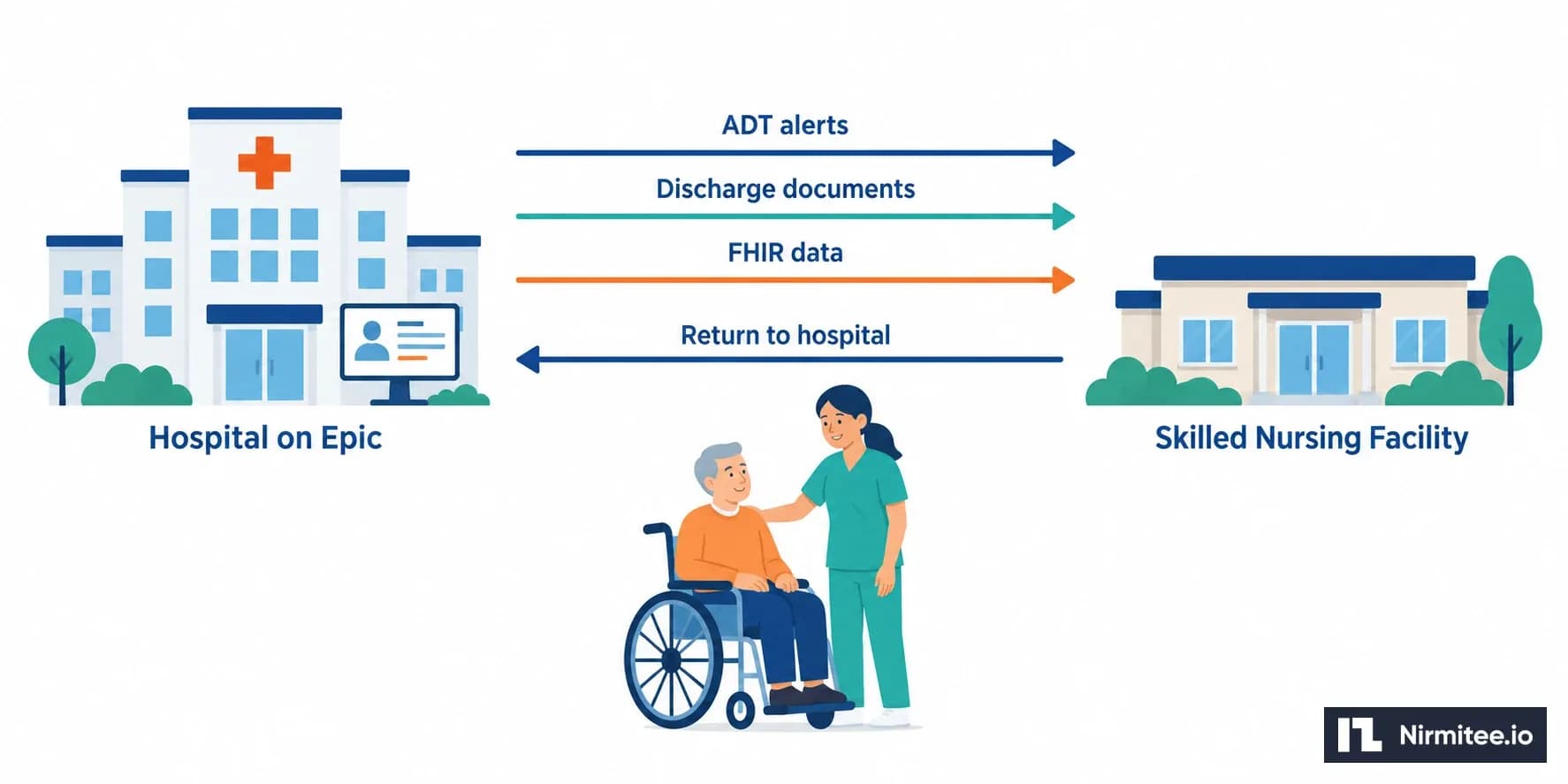
Epic integration for a skilled nursing facility (SNF) almost always means connecting a hospital that runs Epic to a nursing facility that runs a different EHR, most often PointClickCare. There is no single Epic connector for this: the working setups combine ADT event alerts, discharge documents, a referral channel and, where both sides allow it, FHIR APIs.
Updated October 2026. Written by Jitendra Choudhary, CTO at Nirmitee.io. Every rule, date and number below links to its primary source and was checked on 7 October 2026. Data collected before 2022 is marked as older.
This guide is for hospital integration and case management leaders, SNF operators and the health tech teams that sit between them. It covers the four ways an Epic hospital connects to a nursing facility, what EpicCare Link does and does not do, how Epic and PointClickCare integration works in practice, the referral to admission to return workflow and the exact points where it fails, the data that has to move, the CMS rules that now apply, and a step-by-step project plan with owners. If you are new to Epic itself, start with our main guide on how to integrate with Epic, then come back here for the post-acute detail. If you want a team to scope it, our Epic integration services page explains how we work.
Key takeaways
- Most SNFs are not on Epic. PointClickCare is the largest SNF EHR vendor by most accounts, and it bought American HealthTech in January 2024 (MedCity News, 2024). "Epic SNF integration" is a cross-vendor project.
- Four connection models cover nearly every case: Epic to the SNF's own EHR, EpicCare Link portal access, a referral network such as WellSky CarePort, and a SNF that runs on the hospital's Epic through Community Connect.
- Hospitals must already send ADT notices to post-acute providers. The CMS Conditions of Participation rule has applied since 30 April 2021 (CMS FAQ).
- Prior authorization is the new pressure point. In June 2024, Medicare Advantage plans denied 12% of SNF admission requests and overturned 95% of the denials that were appealed (HHS OIG, June 2026). CMS-0057-F requires payer Prior Authorization APIs by 1 January 2027.
- The hand-off still loses information. In the newest national survey, only 13.5% of 471 hospital-SNF pairs rated information sharing excellent (Adler-Milstein et al., JAMA Network Open 2021, older data from 2019 to 2020).
- PointClickCare's FHIR connector costs $65 per app, per facility, per month under its current model (PointClickCare, checked October 2026), so cost scales with the number of facilities.
What is Epic integration for skilled nursing facilities?
Epic integration for skilled nursing facilities is the set of connections that move a patient's information between a hospital's Epic system and the nursing facility that takes the patient after discharge, and back again if the patient returns. It spans four moments: the referral, the admission packet, alerts during the stay, and the return trip to the emergency department.
The scale is large. In 2024, about 14,400 freestanding SNFs furnished about 1.5 million Medicare-covered stays to 1.1 million fee-for-service beneficiaries, and Medicare and its beneficiaries spent $31 billion on SNF care (MedPAC, March 2026). Each of those stays starts with a hospital discharge, and in most US health systems that hospital runs Epic.
The nursing facility usually does not. PointClickCare described itself in 2021 as "the system of record for 70% of the skilled nursing facilities in the country" (a vendor claim, older data, from a Healthcare IT Today interview). MatrixCare, Netsmart and a long tail of smaller vendors cover most of the rest. So the real question for an Epic nursing home project is how to connect two different EHRs owned by two different organizations, under rules that bind only one of them.
The four connection models between Epic and a SNF
An Epic hospital connects to a SNF in one of four ways, and most hospitals run two or three at once. The choice depends on what the SNF runs, who pays, and whether data has to land inside the SNF's own chart.
| Model | How it works | Data lands in the SNF EHR? | Who usually pays | Best for |
|---|---|---|---|---|
| 1. Epic to the SNF's own EHR | ADT feeds, C-CDA documents, Care Everywhere or TEFCA query, FHIR APIs on both sides | Yes, if the SNF EHR accepts it | Shared; often the hospital or a network | High-volume preferred SNF partners |
| 2. EpicCare Link | The SNF logs in to the hospital's Epic through a web portal to view the chart and accept referrals | No. Staff read, print or retype | The hospital licenses it | Many SNFs with low volume each |
| 3. Referral or notification network | Case manager sends referrals from inside Epic to a network (WellSky CarePort, AIDA, PointClickCare's acute-side network); ADT alerts go out through the same network | Partly. Documents arrive; discrete data depends on the SNF EHR link | Hospital, ACO or payer | Placement speed across a wide market |
| 4. SNF on the hospital's Epic (Community Connect) | The health system extends its Epic instance to an owned or affiliated SNF | Yes. One shared chart | The SNF pays the host under its agreement | Health-system-owned post-acute units |
Model 1: Epic to the SNF's own EHR
Model 1 connects the hospital's Epic directly to PointClickCare, MatrixCare or another SNF EHR, so data arrives in the SNF chart without retyping. It is the most useful model and the hardest to set up, because it needs work on both vendors' platforms. The building blocks are an HL7 v2 ADT feed from Epic's interface engine (Bridges, see our Epic Bridges integration guide), discharge documents in C-CDA form, document query through Care Everywhere or TEFCA, and FHIR APIs where both sides expose them.
Model 2: EpicCare Link for SNFs
EpicCare Link is a web portal that a hospital on Epic gives to outside organizations, including SNFs, so their staff can see the hospital's chart for shared patients. It is covered in its own section below because it is the most searched part of this topic, and because people often expect more from it than it does.
Model 3: Referral and notification networks
A referral network sits between the hospital and many SNFs, so the hospital builds one integration instead of hundreds. WellSky joined the Epic Toolbox in the Community Resource Network category in December 2025, and says Epic users can send referrals from inside Epic to its network of more than 130,000 post-acute and community providers (WellSky, December 2025). AIDA Healthcare announced an Epic Toolbox designation for post-acute referrals in May 2025 (AIDA Healthcare, 2025). PointClickCare runs its own hospital-facing network, built from its 2021 purchase of Collective Medical.
Networks solve the sending side well. The receiving side is weaker: in a CarePort intake walkthrough recorded by a SNF operator, admissions staff accept a referral in the portal and then upload the accepted patient's documents by hand into PointClickCare's miscellaneous tab (Southern Healthcare Management, 2023). That re-keying step is where an integration still pays for itself.
Model 4: SNF on the hospital's Epic through Community Connect
Community Connect is Epic's program for a health system to extend its own Epic instance to affiliated organizations, which then share one chart. For a health-system-owned SNF, this removes the cross-vendor problem entirely. We found no public example of an independent SNF chain using Epic as its primary EHR, and Epic does not market a dedicated SNF product, so treat this model as one for owned or closely affiliated units. MDS assessment submission and PDPM billing, which every Medicare-certified SNF needs, should be confirmed with the host before signing.
EpicCare Link for SNFs: what it does and what it does not
EpicCare Link gives SNF staff a login to the discharging hospital's Epic so they can review records, receive placement requests and message the hospital team. It is free to the SNF user in most setups because the hospital licenses it, and each hospital decides what its outside users can see.
Baylor Scott & White's page for post-acute facilities shows a typical setup: nurses, managers and physicians at post-acute facilities can electronically accept discharge placement requests sent from the health system's case management and access patients' medical records (Baylor Scott & White, checked October 2026). A physician-office walkthrough from Arnot Health shows the other common features: In Basket messaging, a patient list, referral tracking, the Care Everywhere button for data from other Epic systems, and lab and imaging order entry (Arnot Health, 2025).
What EpicCare Link does not do is put data into the SNF's own EHR. Every medication, allergy and diagnosis the SNF needs still has to be read on screen and entered again in PointClickCare or MatrixCare. Each hospital also runs its own Link instance, so a SNF that takes patients from five health systems manages five logins. EpicCare Link is the right first step for low-volume partners and the wrong end state for a preferred SNF that takes hundreds of patients a year.
If you came here looking for the EpicCare Link login page, it belongs to the hospital that invited you. Search for that hospital's name with "EpicCare Link", or ask its referral or IT team for access.
Epic and PointClickCare integration: how it works in practice
Epic and PointClickCare integrate through standard exchange methods: Care Everywhere and Carequality style document query, HL7 v2 ADT messages, C-CDA documents and FHIR APIs on each side. The clearest public footage of the two working together comes from Ontario.
The Ontario example: Project Amplify
Project Amplify connects Ontario hospitals, including Epic sites, with long-term care homes on PointClickCare. In a January 2024 training session, the project team said Ontario sees more than 37,000 hospital to long-term care transfers a year, that 73 hospitals and 477 homes were in scope, and that PointClickCare holds "upwards of 90%" of the province's long-term care market (Great River OHT, January 2024). Long-term care in Ontario is not the same setting as a US Medicare SNF, but the technical hand-off is the same.
What worked, as described in the session:
- When a nurse records a transfer out in PointClickCare's Quick ADT screen and picks the destination hospital, PointClickCare pushes the resident's data to that hospital.
- When the patient is registered in the Epic emergency department, Epic queries PointClickCare and pulls the data into the chart through Care Everywhere, where clinicians review and reconcile problems, medications, allergies and immunizations.
- When a resident is admitted to the home, PointClickCare queries the hospital in the background for emergency and inpatient encounters.
What failed or stayed manual:
- Unknown destination. In an emergency transfer, staff often do not know which hospital the ambulance will choose. They select "to be determined", nothing is sent, and paper still travels with the resident.
- Identity mismatches. A difference in demographics, such as a nickname against a legal name, sends the record to an "External Pending" tab, where staff must confirm the match by hand.
- Uneven features. What each home sees depends on which PointClickCare add-ons it has bought.
- Training. A physician on the call said train-the-trainer did not reach visiting physicians.
- Funding. Ministry funding covered implementation and per-transfer licence fees until 31 March 2024; after that it was described as "unsecured".
The team listed the benefits it planned to measure (transfers, records exchanged, readmissions, hospital days, staff time) but reported no results in the session. Treat Project Amplify as a working pattern with known gaps. It is evidence of feasibility; it reports no outcome yet.
PointClickCare developer access and the $65 fee
PointClickCare offers two developer routes, and the choice decides what you can do. Its USCDI Connector is a set of FHIR APIs built for ONC certification, covering USCDI data with patient-facing, provider-facing and bulk app types. Under the current model, PointClickCare says customers "will be charged a flat fee of $65 per App per Facility per Month", subject to annual revision (fhir.pointclickcare.com, checked 7 October 2026). Each facility must also enable the app before data flows.
The USCDI Connector is read-oriented. Writing admissions, orders or assessments into PointClickCare goes through its separate Marketplace partner program, which uses proprietary APIs and fees set by agreement. A hospital network that reads data from 40 SNFs pays the connector fee 40 times per app, so price the per-facility model before choosing it over a network that already holds those connections.
Epic nursing home referrals: the workflow and where it breaks
The post-acute care integration workflow has six steps: referral, prior authorization, discharge packet, medication reconciliation, the SNF stay, and the return to hospital. Each step has a known failure point, and most of them come from build decisions that the hospital and SNF control.
Step 1. Referral
The hospital case manager selects SNFs in Epic and sends referrals through a Toolbox network, EpicCare Link or fax. SNF admissions teams work to tight targets; the SNF operator in the CarePort walkthrough aims for a decision within 20 minutes of a referral arriving. Where it breaks: the accepted referral's documents are re-keyed into the SNF EHR.
Step 2. Prior authorization for Medicare Advantage patients
For a Medicare Advantage patient, the plan must approve the SNF stay before admission. HHS OIG found that in June 2024 the 19 MA organizations it reviewed denied 12% of SNF admission requests, with plan rates from 0.4% to 23%. Only 18% of denials were appealed, and plans overturned 95% of those. Requests for SNF-level care from people already living in nursing homes were denied 40% of the time, against 11% for other enrollees (HHS OIG, OEI-09-24-00331, June 2026). KFF reports the same 12% SNF figure against an overall MA denial rate of under 8% for all services (KFF, July 2026). Where it breaks: the clinical documentation the plan needs sits in Epic, the request is often made by fax or payer portal, and each day of delay is a day in an acute bed. Our CMS-0057-F explainer covers the payer side.
Step 3. Discharge and admission packet
The SNF admits from whatever the hospital sends at discharge. In the newest national survey of hospital-SNF information sharing (Adler-Milstein et al., JAMA Network Open 2021, survey January 2019 to March 2020, older data):
- only 13.5% of 471 hospital-SNF pairs rated sharing excellent on completeness, timeliness and usability;
- 49.6% did not typically receive at least 19 of 23 information types, and only 11.0% received all 23;
- behavioral status was typically missing in 67.7% of pairs, social status in 65.7%, mental status in 44.1%, immunizations in 40.7% and functional status in 35.8%;
- information arrived after the patient often or always in 16.4% of pairs and sometimes in 33.8%;
- 47.1% said discharge documents always or often contained duplicative information.
No newer national survey has replaced it. Where it breaks: the packet is late, long, and missing exactly the functional and cognitive data a SNF needs to plan care.
Step 4. Medication reconciliation at SNF admission
Medication lists are where a bad integration does direct harm. A hospital medicine team reviewed 7,892 discharges from December 2021 to December 2022 and found 8.9% had an unreconciled medication list; for patients discharged to SNFs, unreconciled lists were significantly associated with 7-day and 30-day readmissions (SHM Converge abstract, one service, conference abstract). The cause was a build choice: the discharge summary template auto-populated the medication list before final reconciliation. Where it breaks: an interface that sends the discharge summary when the note is created carries the pre-reconciliation list. Send it once reconciliation is signed.
Step 5. The SNF stay
During the stay, the SNF completes MDS assessments and the hospital or ACO wants to know how the patient is doing. MedPAC reports the median SNF risk-adjusted rate of discharge to the community at 51.3% for fiscal years 2023 to 2024 (MedPAC, March 2026). Where it breaks: structured function and cognition data from the SNF rarely flows back to the hospital in a form Epic can file.
Step 6. Return to hospital
When a resident goes back to the emergency department, the ED needs the SNF's current medication list, code status and baseline function. MedPAC reports a median risk-adjusted potentially preventable readmission rate of 10.7% for SNFs in fiscal years 2023 to 2024, and SNF value-based purchasing is moving to a within-stay readmission measure. Where it breaks: the Ontario "to be determined" problem. If the SNF does not know the destination hospital, a push sends nothing, so the receiving ED needs a query path as a fallback.
What data has to move between Epic and the SNF
Four kinds of data move in a hospital to SNF integration: event alerts (HL7 v2 ADT), documents (C-CDA), discrete clinical data (FHIR), and post-acute assessments such as function and cognition (PACIO FHIR profiles). Each answers a different question, and a complete setup uses all four.
ADT events
ADT messages tell the SNF and the hospital that something happened: A04 for emergency registration, A01 for inpatient admission, A03 for discharge, A08 for updates, and A11 and A13 for cancellations. The discharge disposition travels in PV1-36. On the UB-04 patient discharge status code set (NUBC FL17), code 03 means "Discharged/transferred to Skilled Nursing Facility (SNF) with Medicare Certification in Anticipation of Skilled Care", 04 means a facility that provides custodial or supportive care, and 06 means home health (C-CDA value set for NUBC FL17, 2013). HL7 defines PV1-36 as a user-defined table, so each Epic site may load its own values. Ask the hospital for its mapping table in the first week. Our guide to ADT event processing covers the consumer side in depth.
C-CDA documents
Three C-CDA document types reach a SNF, and they are not interchangeable. The LOINC codes below are the required document codes in HL7's C-CDA templates (HL7 C-CDA, checked October 2026).
| Document | LOINC code | What it is for |
|---|---|---|
| Discharge Summary | 18842-5 | The inpatient stay: hospital course, discharge diagnoses, discharge medications and instructions |
| Transfer Summary | 18761-7 (Transfer summary note) | A hand-off to another care setting: reason for transfer, current medications, allergies, problems, functional and mental status, advance directives |
| Continuity of Care Document (CCD) | 34133-9 (Summary of episode note) | A general summary of the record, often returned by Care Everywhere and TEFCA queries |
The Transfer Summary is the closest match to what SNFs report missing, yet many hospitals send a Discharge Summary or a CCD. Which template the hospital's Epic build sends, and when, is a decision to make in the first two weeks.
FHIR resources
FHIR APIs carry the discrete data that can be filed straight into the SNF chart. Epic's FHIR catalog lists the US Core resources a post-acute app needs, including Patient, Encounter, Condition (encounter diagnosis and problem list), AllergyIntolerance, MedicationRequest, Observation, CarePlan, Coverage and DocumentReference (Epic on FHIR). The discharge summary is a DocumentReference with LOINC type 18842-5 in US Core, and Epic returns clinical notes as HTML and RTF, as we found when testing DocumentReference across Epic, Oracle and athenahealth. Which resources and scopes a given hospital enables for your app is set per site.
PACIO functional and cognitive status
The PACIO Project publishes free HL7 FHIR guides for the data SNFs need most: functional status, cognitive status, advance directives and a transitions of care Bundle. Both the Cognitive Status and Functional Status guides open with the same 2021 finding: SNFs received complete mental status information at transition only 6% of the time, and mobility and self-care information 60% of the time (older data, from the Adler-Milstein survey above). The profiles are built on Observation resources and map naturally to MDS Section GG (function) and Section C (cognition). In a January 2025 HL7 Connectathon session, the PACIO team sent hospital to SNF transfers as a FHIR document Bundle with a Composition first, and asked openly which resources Epic, Oracle Health and Meditech should file and which should stay inside the document (PACIO Project, 2025). We found no public report of Epic filing PACIO profiles in production, so plan for PACIO on the SNF side first.
Regulations that shape Epic post-acute care integration in 2026
Six federal rules and programs now drive hospital to SNF integration: the CMS e-notification Condition of Participation, CMS-0057-F prior authorization, the SNF Quality Reporting Program's Transfer of Health measures, TEFCA, information blocking, and SNF value-based purchasing. Only some of them apply to the SNF directly, which is why hospitals usually lead these projects.
CMS e-notification Condition of Participation
Hospitals whose EHR conforms to the HL7 2.5.1 ADT standard at 45 CFR 170.205(d)(2) must send notifications at emergency registration, inpatient admission, and discharge or transfer, and must make a reasonable effort to reach all applicable post-acute care providers, along with the patient's primary care practitioner and other named entities (42 CFR 482.24(d)). The rule has applied since 30 April 2021. CMS's FAQ says notices may be HL7 v2 messages, C-CDA summary records or a FHIR API, sent directly or through an intermediary (CMS FAQ). A SNF that is not getting these notices can ask the hospital which intermediary it uses.
CMS-0057-F and Medicare Advantage SNF prior authorization
CMS-0057-F requires Medicare Advantage, Medicaid, CHIP and other impacted payers to decide expedited prior authorization requests within 72 hours and standard requests within seven calendar days, from 1 January 2026, and to give a specific reason for denials. By 1 January 2027, they must run a FHIR Prior Authorization API that can report documentation requirements and support request and response (CMS fact sheet). For SNF admissions, this is the first time a federal rule pushes the authorization step toward an API that the hospital's Epic can call. See our prior authorization automation work for the build side.
Transfer of Health measures on Care Compare
The SNF Quality Reporting Program includes two measures on this exact hand-off: Transfer of Health Information to the Provider, Post-Acute Care (CMIT 00728) and to the Patient (CMIT 00727) (CMS SNF QRP). LeadingAge reported that both were first publicly reported in the October 2025 Care Compare refresh (LeadingAge, 2025). These measures cover what the SNF sends when a resident leaves, so the return trip to the hospital now shows up in public quality data.
TEFCA and Epic Nexus
TEFCA is the voluntary national framework for health data exchange, and Epic Nexus is Epic's network for it. On 2 June 2025, Epic said more than 1,000 hospitals and 22,000 clinics using Epic were live on TEFCA (Epic, June 2025). For a SNF, TEFCA matters only if its own EHR vendor participates through a network, so check that before you design a query-based fallback. Our TEFCA guide explains the moving parts.
Information blocking and Real Time Medical Systems v. PointClickCare
The 21st Century Cures Act bars health IT developers and providers from practices likely to interfere with access to electronic health information, unless an exception applies (ASTP/ONC). The SNF market has the leading court case. Real Time Medical Systems, an analytics company serving nursing facilities, sued PointClickCare after PointClickCare restricted its automated access to SNF customers' data with CAPTCHA images and account deactivations. The federal district court in Maryland granted a preliminary injunction on 29 July 2024; the Fourth Circuit affirmed it (131 F.4th 205, 2025) and denied en banc review on 23 April 2025 (Sequoia Project case summary; McDermott Will & Emery, May 2025). The underlying claim was unfair competition under Maryland law, with the Cures Act shaping whether PointClickCare's conduct was justified. The ruling is a preliminary one, so the case does not settle every access question, but it does tell builders that a SNF customer's own data access carries real weight.
HIPAA and sensitive records
HIPAA permits a hospital to share information with a SNF for treatment without patient authorization (45 CFR 164.506). Substance use disorder records under 42 CFR Part 2 and state-protected data may be filtered out of feeds, so the receiving SNF should not assume that absence of a record means absence of a condition. Build with a HIPAA audit trail from the first interface.
Engineering detail: messages, field map and failure modes
An Epic to SNF integration is built from a discharge ADT message, a field map between the two EHRs, and handling for eight common failure modes. The examples below use synthetic data only.
Sample ADT A03 discharge to a SNF (synthetic)
MSH|^~\&|EPIC|EXAMPLEHOSP|ADTRCV|EXAMPLE_SNF|20261007143000||ADT^A03^ADT_A03|MSG000231|P|2.5.1
EVN|A03|20261007142955
PID|1||TEST1234567^^^EXAMPLEHOSP^MR||TESTPATIENT^JANE^A||19410312|F|||100 EXAMPLE ST^^ANYTOWN^OH^00000||5555550100
PV1|1|I|4W^412^A^EXAMPLEHOSP||||DR1001^HOSPITALIST^ALEX^^^MD|||MED||||1|||DR1001^HOSPITALIST^ALEX^^^MD|IN||MCARE|||||||||||||||||03|EXAMPLE_SNF^Example Skilled Nursing|||||20261002091500|20261007142900
DG1|1||I50.23^Acute on chronic systolic heart failure^I10||20261002|A
IN1|1|MCRA|00001|MEDICARE PART A||||||||||||TESTPATIENT^JANE^A|SEL|19410312
PV1-36 carries 03 (discharged to a Medicare-certified SNF on the NUBC code set), PV1-37 the discharged-to location, PV1-44 the admit time and PV1-45 the discharge time. The A04 at ED registration and the A01 at admission are the other two events the CoP names. A consumer that handles HL7 v2 for a SNF must also process A08 updates and the A11 and A13 cancels, which is where duplicate admissions come from.
Example field map: Epic FHIR to PointClickCare
The table below is an example to start from. Confirm every row against the hospital's Epic build and PointClickCare's current API specification for your partner program before you code it.
| What the SNF needs | Epic FHIR R4 source | PointClickCare target (example) | Watch for |
|---|---|---|---|
| Demographics | Patient: name, birthDate, gender, identifier (MRN) | Resident record (Marketplace API) | The USCDI Connector reads; writes need Marketplace access |
| Admission source and dates | Encounter.period, Encounter.hospitalization.dischargeDisposition | Admission record, admitted-from | Map site-specific disposition codes |
| Diagnoses | Condition (encounter diagnosis, problem list), ICD-10-CM | Diagnosis list | Primary diagnosis drives the PDPM category |
| Allergies | AllergyIntolerance | Allergy list | Free-text allergies need a human review |
| Discharge medications | MedicationRequest (active orders at discharge) | Pending medication orders | Never auto-activate; a licensed nurse or pharmacist reconciles |
| Functional status | Observation (PACIO profiles if available; otherwise flowsheet observations) | MDS Section GG pre-fill | Epic support for PACIO not confirmed |
| Discharge summary | DocumentReference type 18842-5, Binary | Document attachment | HTML or RTF content |
| Code status, advance directives | Observation or DocumentReference (varies by site) | Code status field | Often missing in the packet |
| Payer | Coverage | Payer setup | An MA plan triggers the prior authorization step |
| Return to hospital | PointClickCare FHIR (USCDI): Encounter, Observation, MedicationRequest | Epic via Care Everywhere or an inbound interface | Readmission context for the ED |
Eight failure modes and how to design for them
- Patient matching. The hospital MRN and SNF resident ID differ, and SSN is often absent. Score name, date of birth, sex, address and phone, and send low scores to a review queue. A match score produces a candidate; a person confirms it.
- Duplicate and out-of-order ADT. A08, A11 and A13 arrive after the event they correct. Make the consumer idempotent on MSH-10 and the visit number, and apply cancels.
- Wrong medication list. Trigger the document send when medication reconciliation is signed (the SHM finding above).
- Late documents. Send the A03 and a Transfer Summary at the discharge order, then the signed summary as an update.
- Unknown destination. When the SNF cannot name the receiving hospital, a push sends nothing. Add a query path, so the ED pulls on registration.
- Network gaps. Document query only works if the SNF's vendor participates in the same network. Check before you design around it.
- Filtered sensitive data. Part 2 and state-protected records may be withheld. Show the clinician that a filter may apply.
- Code drift and per-facility cost. Each Epic site builds its own PV1-36 and location values, and per-facility API fees multiply across a network. Keep a mapping table per hospital and a cost line per facility.
Step-by-step plan for a hospital to SNF integration project
A hospital to SNF integration project runs in ten steps, from choosing one measurable goal to extending across the network. The owners below are roles, so the plan works whether the hospital, the SNF group or a vendor leads.
| Step | Work | Owner | Done when |
|---|---|---|---|
| 1 | Pick one goal: placement speed, readmissions, CoP compliance or MDS accuracy | Hospital care management lead and SNF administrator | One goal and one measure agreed |
| 2 | Inventory partner SNFs by EHR, network membership (CarePort, PointClickCare network), Care Everywhere and TEFCA status | Integration architect | A table of SNFs by EHR and network |
| 3 | Legal: BAA, data use terms, Part 2 handling, PointClickCare facility enablement | Privacy officer and SNF compliance lead | Signed |
| 4 | Event feed: A04, A01, A03 with the PV1-36 mapping table | Hospital Epic Bridges analyst and integration engineer | Test messages pass on 20 real discharges |
| 5 | Documents: choose Transfer Summary or Discharge Summary, and set the send after medication reconciliation | Epic clinical documentation analyst and pharmacy | Template and trigger agreed |
| 6 | Discrete data: FHIR read from Epic, write to the SNF EHR through its partner API | Integration engineers | Field map tested in both sandboxes |
| 7 | Matching and review queue | Integration engineer and SNF admissions nurse | Low-score matches go to a person |
| 8 | Go live with two or three SNFs | All | Two weeks without lost or duplicate messages |
| 9 | Measure: Transfer of Health, readmissions, time to acceptance, MA authorization turnaround | Quality lead | Baseline and 90-day numbers from a saved query |
| 10 | Extend to the network | Program owner | Per-facility cost reviewed against the measured gain |
Timelines depend on the hospital's interface queue and app review, so we do not quote a fixed number here. Our Epic integration timeline guide breaks down where time goes on the Epic side.
How Nirmitee helps with Epic SNF integration
Nirmitee builds the integration layer between Epic and the systems around it: HL7 v2 ADT consumers, C-CDA handling, FHIR apps registered on Epic's developer platform, and engines such as Mirth Connect. For post-acute work, that means the pieces this guide describes: ADT routing with PV1-36 mapping, a matching and review queue, discrete data writes into the SNF EHR through its partner program, and a query fallback for the return trip. Every SNF engagement starts with a fixed-scope assessment of your partner SNFs, networks and per-facility costs before any build.
Related reading: Epic Resolute integration for the billing side, Epic FHIR integration guide, and Epic vendor security review.
Planning a hospital to SNF connection? Explore our healthcare interoperability solutions and custom healthcare software development. Talk to our team to book a scoping call; we will map your SNF partners by EHR and network and return a field map and cost model for your first three facilities.
Ready to scale?
Talk to our healthcare engineering team about building, integrating, and shipping faster.
Frequently Asked Questions
What is EpicCare Link?
Does PointClickCare integrate with Epic?
Can a skilled nursing facility use Epic as its EHR?
Do hospitals have to notify SNFs when a patient is admitted or discharged?
How does a SNF get EpicCare Link access?
What is the discharge disposition code for a skilled nursing facility?
Which C-CDA document should a hospital send to a SNF?
How fast must Medicare Advantage plans decide on a SNF admission?
What is Epic Aura, and is it used for SNF referrals?
What does PointClickCare charge for API access?
What did the Real Time Medical Systems v. PointClickCare case decide?