Epic Beacon Integration for Oncology Workflows & Treatment Plans

Digital Growth Lead
Writes about healthcare technology, interoperability, and AI-driven transformation across modern care systems.

Part of our complete guide to Epic FHIR integration step-by-step.
Oncology is one of the highest-stakes workflows in any health system, and it is also one of the most structured. A cancer treatment plan is not a single order; it is a regimen that unfolds over cycles, with chemotherapy, supportive medications, lab checks, and monitoring all timed against each other. Epic Beacon is the module that holds that, and any product touching oncology, a patient app, a registry feed, a decision-support tool, has to understand how Beacon models care.
All Epic modules in one place: see our Epic modules list for what each module does and where apps integrate.
This guide explains Epic Beacon for the people building or scoping oncology integrations: what Beacon is, what a treatment plan contains, how it connects across Epic, and where third-party apps add value. For the full module-by-module view, our Epic integration services is the hub this guide links back to.
What Epic Beacon is
Beacon is Epic's medical oncology module. Oncologists use it to document cancer staging and to build and personalize treatment plans based on standard, evidence-based protocols such as NCCN guidelines. The plan then follows the patient through outpatient visits and inpatient stays, with a treatment summary that lets the care team see where the patient is in their course of therapy.
What makes Beacon distinct from ordinary order entry is its model of time and safety. A regimen has cycles and phases, doses calculated against body surface area, and built-in checks designed to catch the prescribing errors that are especially dangerous in chemotherapy. Computerized order entry through Beacon has been shown to reduce those errors, which is the whole reason the structure exists.
What a Beacon treatment plan holds
A treatment plan is a rich object, and it helps to see its parts.
Protocols are the evidence-based backbone: NCCN-aligned regimens with the cycle and phase logic that sequences therapy, customizable to the individual patient.
Medications cover the anticancer infusions, immunotherapy, and the supportive care drugs that go with them, with dose and body-surface-area checks built in.
Labs and monitoring include the required lab orders before and during treatment, response tracking, and the treatment summary that ties it together. An integration that touches oncology has to respect this structure rather than flattening a plan into a list of orders.
How Beacon connects across Epic
Oncology is inherently multidisciplinary, so Beacon does not stand alone.
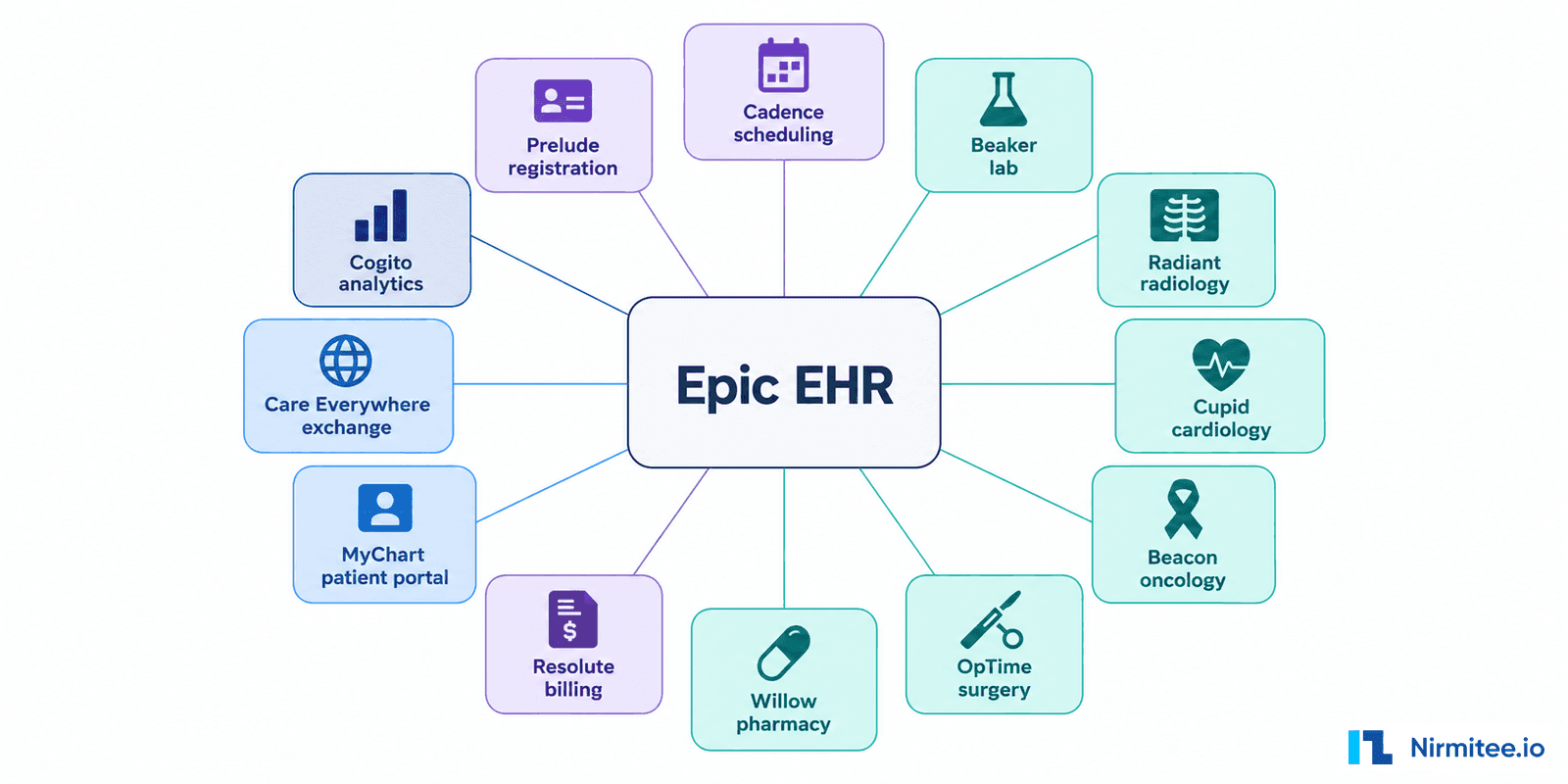
Beacon works closely with Willow, Epic's pharmacy module, because chemotherapy preparation and verification run through the pharmacy. It connects to Beaker, Epic's lab module, for the lab orders and results that gate each cycle. It ties to Radiant for the imaging that tracks the response to treatment,
which we cover in our Epic Radiant integration guide. And it exposes data to external applications through FHIR. For a vendor, the practical point is that oncology data rarely lives in one place, so an integration usually reads across several modules. The access path that comes before that work, from sandbox to a live customer, is covered in our guide to integrating with Epic step by step.
Where oncology apps add value
Beacon runs the clinical workflow inside Epic, but a lot of valuable oncology software lives around it.
Patient apps extend care beyond the clinic: symptom tracking between infusions, treatment diaries, and AI-driven insights that help patients understand their plan. We built exactly this kind of cancer-care app, with a treatment diary and AI health insights, for one client. Data exchange covers FHIR-based oncology data, registry reporting, and clinical-trial matching, where pulling structured treatment data out of Epic is the hard part. Decision support sits at the point of care with protocol suggestions, safety alerts, and outcome analytics. Each pattern reads from or writes to Beacon and the modules around it.
The data behind oncology integrations
Getting oncology data out of Epic cleanly is its own challenge. A treatment plan's structure, cycles, phases, doses, and the relationships between medications and labs, do not always map neatly onto a simple FHIR resource. Some of it comes through FHIR resources like MedicationRequest and Observation, some through reporting layers like Clarity and Caboodle, covered in our Clarity and Caboodle guides, and some requires careful mapping. A registry or trial-matching integration that needs the full regimen has to reconstruct it from several sources, and doing that accurately is where domain knowledge matters.
The gotchas worth knowing
Oncology integrations carry specific risks:
- Safety is paramount. Anything touching dosing or administration has to be designed with patient-safety review, not treated as ordinary data plumbing.
- Plans are structured, not flat. Cycles, phases, and dependencies have to be preserved; flattening a regimen loses clinical meaning.
- Multi-module reads. Oncology data spans Beacon, Willow, Beaker, and Radiant, so a complete picture means reading across modules.
- PHI and sensitivity. Cancer data is especially sensitive; access control, consent, and audit logging deserve extra care.
- Protocol updates. Regimens change as guidelines evolve, so an integration tied to specific protocols needs a maintenance plan.
Continuity across outpatient and inpatient care
One of Beacon's defining strengths is that a treatment plan follows the patient wherever they receive care. A regimen started in the infusion center continues to make sense if the patient is admitted, and the treatment summary gives any clinician a quick read on where the patient is in their course. For an integration, this continuity is a requirement, not a nicety: a symptom-tracking app or a care-coordination tool has to understand that the same plan spans settings, and that an event in one setting is relevant in the other. Building as though oncology care happens only in the clinic, or only in the hospital, produces a tool that loses the thread exactly when patients are most vulnerable.
Clinical trials and oncology data exchange
Oncology is where clinical research and routine care overlap more than in almost any other specialty. Trial matching, eligibility screening, and registry reporting all depend on getting structured treatment data out of Epic accurately. The challenge is that a regimen's meaning lives in its structure, the sequence of cycles, the specific agents and doses, the response assessments, and a flattened export loses the very details a trial-matching engine or a registry needs. A serious oncology data integration reconstructs the regimen faithfully, often combining FHIR resources with reporting-layer data, so that downstream systems see the plan the way a clinician would.
Designing oncology software around safety
Patient safety is not a feature of oncology software; it is the constraint everything else is designed around. Any integration that influences dosing, scheduling, or administration has to be reviewed through that lens, with clear handling of edge cases and a bias toward surfacing uncertainty rather than hiding it.
Even a read-only app that summarizes a plan for a patient has to be careful not to imply changes that a clinician has not made. The teams that do this well treat clinical review as part of the build, involve oncology pharmacists and nurses early, and design the integration so that the system of record, Beacon, stays authoritative.
How we approach Epic Beacon work
Healthcare is the only industry we work in, and we have built AI-enabled healthcare products, including a cancer-care app with AI-driven health insights and a treatment diary. We have built EHR integrations for healthtech startups, so reading structured clinical data out of Epic across modules is familiar work for our team.
We build to HIPAA requirements, sign BAAs and are ISO 27001:2022 certified, which matters doubly with data as sensitive as oncology. The pattern we see is that oncology integrations succeed when the plan's structure and patient safety are designed in from the first sprint, not added at the end.
Reading a treatment plan without breaking it
The recurring theme in oncology integration is fidelity. A treatment plan carries meaning in the relationships between its parts: a chemotherapy agent is tied to a cycle, a cycle to a set of pre-treatment labs, a dose to the patient's body surface area, and current counts.
When a product reads that plan, the temptation is to pull a flat list of medications and call it done, but a flat list cannot tell a patient which cycle they are in or a registry which regimen was actually delivered.
The integrations that hold up over time preserve those relationships, model the plan close to how Beacon represents it, and present it back to patients or downstream systems in a way that stays true to the clinical intent. That fidelity is harder than a simple data pull, and it is exactly what separates an oncology product clinicians trust from one they quietly stop using.
Where to start
Define exactly what oncology data or workflow you need: are you reading a treatment plan, tracking symptoms between visits, feeding a registry, or offering decision support?
That scope tells you which modules you read from and how much of the regimen's structure you have to preserve. Getting that decision right early keeps the build focused and keeps the clinical meaning of the plan intact all the way through to whatever surfaces it.
If you want help scoping or building an oncology integration, see our Epic integration services, or reach out to talk through your oncology product.
Related guides
- Epic Radiant Integration for Radiology Workflows
- Epic FHIR Integration Guide for Healthcare Apps
- Epic Integration Services (pillar guide)
Ready to scale?
Talk to our healthcare engineering team about building, integrating, and shipping faster.
Frequently Asked Questions
What is Epic Beacon?
What does an Epic Beacon treatment plan include?
How does Beacon integrate with other Epic modules?
Can you build a patient app on top of Epic Beacon?
Why are oncology integrations considered high-risk?