Healthcare Revenue Cycle Management: The Complete Guide To Automation In 2026

Digital Growth Lead
Writes about healthcare technology, interoperability, and AI-driven transformation across modern care systems.
Revenue cycle is where US healthcare loses money it already earned. Hospitals write off billions to denials that were preventable, spend forty dollars of labor on prior authorizations that resolve to yes, and post payments by hand from remittances that arrive as structured data. Every CFO knows the numbers; the open question in 2026 is which parts of the cycle automation can actually take over, and what the technology stack underneath looks like.
This guide is the map. It covers the full revenue cycle — eligibility, prior authorization, claims, denials, payment posting, and the payer integrations underneath them — with the honest state of automation in each, and links to the deep technical guides where we've documented the build details. It's written for the people who have to make this work: RCM leaders, healthtech CTOs building billing products, and the engineers wiring EDI in the middle of the night.
The Shape Of The Problem
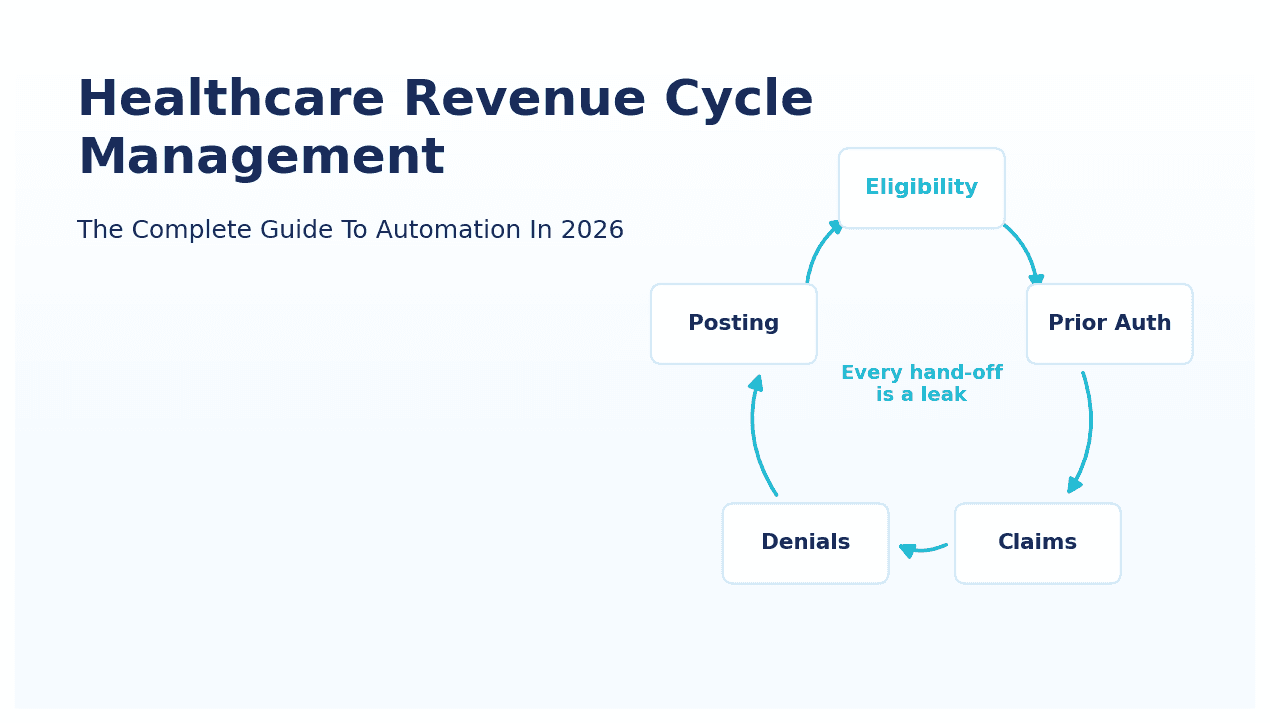
Follow one claim and the cycle explains itself: verify the patient's coverage, obtain authorization if the payer demands it, capture and code the encounter, submit the claim, track its status, work the denial if it comes back, post the payment when it does. Each step is a hand-off, and each hand-off leaks. Our analysis of the $262 billion revenue leak traces where the money actually goes — and why most of it is an integration problem wearing a billing costume.
The industry's answer has a name now: the McKinsey touchless revenue cycle framework — claims that flow from encounter to payment without a human touching them. No health system is fully there. The leaders are automating workflow by workflow, and the sections below follow that order.
The Revenue Cycle, Step By Step
Before the automation conversation, the standard map. RCM teams organize the cycle into three zones. The front office owns everything before care: scheduling and registration, eligibility verification, prior authorization, and increasingly the patient cost estimate that price-transparency rules and high-deductible plans demand. The mid cycle is where clinical work becomes billable data: documentation, charge capture, coding, and claim scrubbing. The back office takes it home: submission, status tracking, denial management, payment posting, patient billing, and accounts receivable follow-up.
The reason the zones matter: a mistake in zone one surfaces as a denial in zone three, weeks later, owned by a different team. That lag is why denial data has to flow backwards — the back office's root-cause reports are the front office's fix list. It's also why patient responsibility deserves front-office attention it rarely gets: with high-deductible plans pushing patients toward nearly a third of provider revenue at many organizations, the payment conversation now starts at scheduling, not at the statement.
The Numbers That Tell You If It's Working
Five metrics carry most of the signal. Clean claim rate — the share of claims accepted on first pass; below the mid-nineties, you're funding rework. Initial denial rate — industry averages have crept above ten percent, which is exactly why the denial sections above exist. Days in A/R — how long revenue sits between service and payment; the spread between your commercial and government payers tells its own story. Net collection rate — what you collected against what contracts entitled you to; the gap is your leak, and underpayment analysis lives inside it. Cost to collect — total RCM spend per dollar collected, the metric automation ultimately answers to. Baseline all five before any automation project; they're the before/after that justifies the next one.
Eligibility Verification: The First Leak
Somewhere between a fifth and a quarter of denials trace back to eligibility — coverage that lapsed, plans that changed, benefits misread at the front desk. It's also the most automatable step in the entire cycle, because the 270/271 EDI transaction pair was built for exactly this. The build pattern is covered in automating eligibility verification with 270/271, and the agent version — card scan to verified benefits — now runs in about thirty seconds. Pair it with intake automation with insurance card OCR and the front desk stops being the place where denials are born. The downstream effect is direct: most preventable denials die here, as the data in why claims get denied shows.
Prior Authorization: Where The Rules Are Changing
Prior auth is the revenue cycle's most hated workflow for good reason — the true cost per authorization, counted in staff time and delayed care, is indefensible for requests that overwhelmingly get approved. Two forces are breaking the logjam at once.
The first is regulatory. The CMS prior authorization API mandate forces impacted payers onto FHIR-based electronic prior auth by January 2027, built on the Da Vinci standards — the implementation path runs through Da Vinci PAS and DTR with CQL questionnaires.
The second is agentic. Authorization is document-heavy, criteria-driven work — exactly what language models handle well under supervision. The architecture for building a prior auth agent on FHIR and LLMs is proven, and the results at the aggressive end — approvals in around 90 seconds — explain why every RCM vendor now claims an agent story. For the fuller technical picture, the complete prior authorization automation guide ties the regulation, the standards, and the AI layer together.
Claims, Clean And Otherwise
A claim that's right the first time is the cheapest claim you'll ever process. Getting there is mostly validation discipline — the clean claim blueprint codifies the 25 rules that catch most rejections before submission. Coding sits upstream of that, and it's one of the areas where AI claims deserve scrutiny: medical coding AI is genuinely useful and genuinely error-prone, and knowing which is which protects both revenue and compliance.
Once submitted, status tracking is pure toil — polling portals, parsing 277s, chasing silence. It's also fully automatable: 277 claim status automation parses, routes, and resolves without a worklist, and the end-to-end effect on throughput shows up in how agents reduced claim processing time.
Denials: The $262 Billion Fight
Denial management is where automation pays fastest, because the work is pattern recognition at scale. The 2026 denial trends data shows rates still climbing, which makes the two-part play urgent: predict and prevent what you can, appeal what you can't. The prevention side runs on root cause analysis decision trees; the recovery side on automated appeals agents that draft payer-specific appeal letters from the denial code, the chart, and the policy. The full architecture and the return math live in the denial management architecture guide.
Payment Posting And Reconciliation
The 835 remittance is structured data, yet posting teams still key it by hand wherever the ERA doesn't match the claim cleanly. Payment posting automation closes that gap, and charge reconciliation catches the quieter leak — services delivered but never billed. Further up the food chain, payer contract management agents compare what contracts promise against what remittances actually pay, and the discrepancies routinely run into millions.
The Integration Layer Underneath All Of It
None of the automation above works without the plumbing: X12 EDI in and out, clearinghouse connections, and EHR billing modules. Engineers new to healthcare EDI should start with the X12 EDI developer guide covering 837, 835, 270/271 and their friends, then the clearinghouse integration production guide for the parts the companion guides don't tell you. On the EHR side, billing lives in specific modules with specific interfaces — Epic Resolute and Epic Bridges for Epic shops — and payer connectivity has its own map in the US payer integration guide. Skimp on this layer and every workflow above it inherits the fragility; the cost of claims integration done badly is measured in leaked revenue, not developer hours.
In-House, Outsourced, Or Automated
The traditional RCM decision was binary — build a billing department or hand the cycle to an outsourcing partner for a percentage of collections. Automation added a third axis, and it changes the math on both sides. In-house teams with strong automation keep control and compress cost-to-collect; outsourcers themselves now compete on how much of their pipeline is automated rather than how many billers they staff. The honest evaluation questions: where do your denials actually originate (outsourcing back-office work doesn't fix front-office errors), what does each model cost per dollar collected at your volume, and who owns the technology and the data when the contract ends. Value-based contracts complicate all three — quality-linked payment requires clinical and financial data in one place, which is an integration property, not a staffing one.
Where The Fraud And Compliance Risk Sits
Automation changes the compliance conversation in both directions. It reduces the innocent errors that trigger payer scrutiny, but it also scales mistakes if the rules are wrong — an agent misapplying a billing rule misapplies it ten thousand times. Two disciplines keep the risk bounded. On the detection side, ML-based billing fraud detection uses graph analysis to surface the patterns human auditors miss — useful whether you're a payer looking outward or a health system auditing itself. On the government side, Medicare has its own rails: Medicare claims processing with MAC integration carries appeals timelines and compliance requirements that commercial-payer automation doesn't prepare you for.
The rule of thumb we hold builds to: any automation that determines what gets billed needs a versioned rule set, a full decision log, and a human owner. Any automation that merely moves data faster — status checks, posting, reconciliation — can run at higher autonomy. Blur that line and an efficiency project becomes an audit finding.
Payments Beyond The Payer
Patient responsibility keeps growing as a share of revenue, which makes the patient payment experience part of the cycle rather than an afterthought. For digital health platforms this is architectural: money flows in from patients, out to providers, with the platform in the middle carrying compliance weight. The design patterns are in healthcare platform money flow, and the implementation most teams land on — Stripe Connect for healthcare platforms — has healthcare-specific gotchas around payouts and refunds worth knowing before the first transaction, not after.
Payment posting tooling itself is a crowded corner of the vendor market; the payment posting software comparison ranks the platforms by what they actually automate versus what they demo.
Buying Vs Building
The vendor market is mature and crowded. If you're evaluating platforms, start with the RCM software comparison and the practitioner review of RCM companies — both written from implementation experience rather than analyst decks. The build case gets stronger the more your revenue model deviates from standard fee-for-service billing: platforms, marketplaces, and RPM businesses (where the CPT code stack is its own guide) usually end up building the layer the vendors don't cover.
A realistic middle path is targeted automation on top of your existing stack: the 12-workflow automation architecture shows how the pieces above compose without a rip-and-replace, and the agentic RCM overview frames the sequencing. For the CFO's version of this conversation — margins, not architectures — there's a CFO operational guide to billing margins.
How To Start
- Measure your denial rate by root cause first. The data decides your sequence — an eligibility problem and a coding problem have different fixes.
- Automate eligibility before anything else. Highest volume, lowest risk, cleanest EDI transaction, and it prevents denials rather than working them.
- Put agents on the toil, not the judgment. Status checks, posting, appeal drafting — supervised. Coding and clinical documentation decisions — human-owned, agent-assisted.
- Fix the integration layer before scaling the automation. Agents on top of flaky clearinghouse connections just fail faster.
- Track the 2027 CMS deadline now. If prior auth touches your product or your payers, the FHIR API work has a hard date.
Healthcare is the only industry we work in, and revenue cycle automation is where our 70+ engineers spend a growing share of their time — EDI integration, prior auth agents, denial management systems, the whole stack above. Our revenue cycle management development services cover it end to end. The useful next step is specific: send us your top three denial root causes, and we'll come back with a feasibility read on which one automation kills first.
Deep Dives: The Claims & EDI Series
Each stage of the revenue cycle above has a dedicated deep-dive:
- Insurance eligibility verification — stop denials before the visit
- What is an 835 file? Explained with a real example
- How to read an ERA — paid, write-offs, patient responsibility
- Denial codes explained: CO-45, PR-27, CO-29
- The most common claim denial reasons (with data)
- Payment posting automation — the seven hard parts of the 835
- Waystar clearinghouse integration, step by step
- Seven traps that break claims integrations
- How long EDI enrollment really takes
- Build vs buy: adding billing to your EHR
- What billing capability really costs to build
Ready to scale?
Talk to our healthcare engineering team about building, integrating, and shipping faster.
Frequently Asked Questions
Our denial rate keeps climbing. Where do we actually start — better appeals or prevention?
We're a healthtech platform, not a hospital. Do we really need to build RCM capability?
Every RCM vendor now claims 'AI-powered automation.' How do we tell what's real?
The CMS 2027 prior authorization deadline — does it actually affect us, and what should we do this year?
Should we outsource our revenue cycle or automate it in-house?
What ROI should we realistically expect from RCM automation, and how fast?